
Developer productivity faces constant challenges from inefficient version control processes. CI/CD failures and code review delays often slow down projects and drain time. This article explores self-healing continuous integration as a practical solution. With autonomous AI tools like Gitar, teams can recover lost time, speed up merging code, and cut costs by automatically fixing issues and streamlining feedback.
Why CI/CD Failures and Code Review Delays Hurt Productivity
CI Failures Disrupt Developer Focus
CI failures can break a developer’s momentum. You push a pull request, expecting a smooth process, only to face errors like a missing dependency, a flaky test, or a linting issue. Fixing these requires digging through logs, switching contexts, making small changes, and waiting for the pipeline to rerun.
Such interruptions sap productivity. Developers may spend up to 30% of their time resolving CI and code review problems. Additionally, test flakiness and automated testing issues rank among the top CI pipeline challenges.
Submitting a pull request rarely means you’re done. Often, you move to another task, only to be pulled back by a failure or feedback. This context switching disrupts deep focus. A quick 30-minute fix can cost an hour of productive time due to mental overhead.
AI coding tools like GitHub Copilot add to this. While they speed up code creation, they also increase the volume of pull requests, tests, and potential failures. The real challenge now lies in validating and merging code efficiently.
Code Review Delays Stall Distributed Teams
Distributed teams face unique delays during code reviews. A developer in the US might need feedback from a teammate in India. Due to time zone differences, a simple exchange can stretch from hours to days.
Many AI review tools add to this delay by offering suggestions that still need manual fixes. Developers must apply changes themselves and hope they pass CI checks, adding more friction.
Modularizing large projects can speed up feedback cycles, but even well-organized projects struggle with the need for manual intervention on every issue or comment.
Business Costs of Delays and Inefficiencies
CI/CD failures impact more than just developers; they affect entire organizations. About 60% of companies experience project delays due to pipeline issues. These delays slow down market delivery and customer satisfaction.
For a 20-developer team, spending even one hour daily on CI and review issues adds up. That’s 5,000 hours yearly, costing around $1 million at $200 per hour. This excludes indirect losses from delayed releases, missed opportunities, and developer burnout.
Constant debugging and context switching wear developers down. When engineers spend more time fixing CI issues than building features, morale drops, and retention suffers.
Ready to streamline your process? Install Gitar to fix builds automatically and ship software faster.
How Self-Healing CI with Gitar Solves These Issues
Self-healing continuous integration offers a new approach. AI agents detect, diagnose, and fix CI failures and review feedback on their own. This shifts CI management from a reactive struggle to a proactive, automated system.
Meet Gitar: AI for Automated Code Management
Gitar acts as an autonomous AI agent, fixing failing CI pipelines and handling code review feedback. It saves developers hours daily by addressing CI and review hurdles directly, unlike tools that only suggest fixes.

Here are key ways Gitar stands out:
- Full Automation: Applies, validates, and commits fixes, ensuring they fit your CI setup.
- Complex Environment Support: Works with enterprise CI systems, handling specific SDKs, JDK versions, and tools like SonarQube or Snyk.
- Review Feedback Handling: Implements reviewer comments directly, reducing manual work.
- Flexible Trust Options: Offers modes from suggestion-based to auto-commit with rollback, so teams can adjust based on comfort level.
- Platform Versatility: Integrates with GitHub Actions, GitLab CI, CircleCI, BuildKite, and more.
How Gitar Improves Developer Workflows
Gitar changes the game by fixing CI issues like lint errors or test failures before developers notice them. This cuts out the tedious debugging loop and constant context switching.
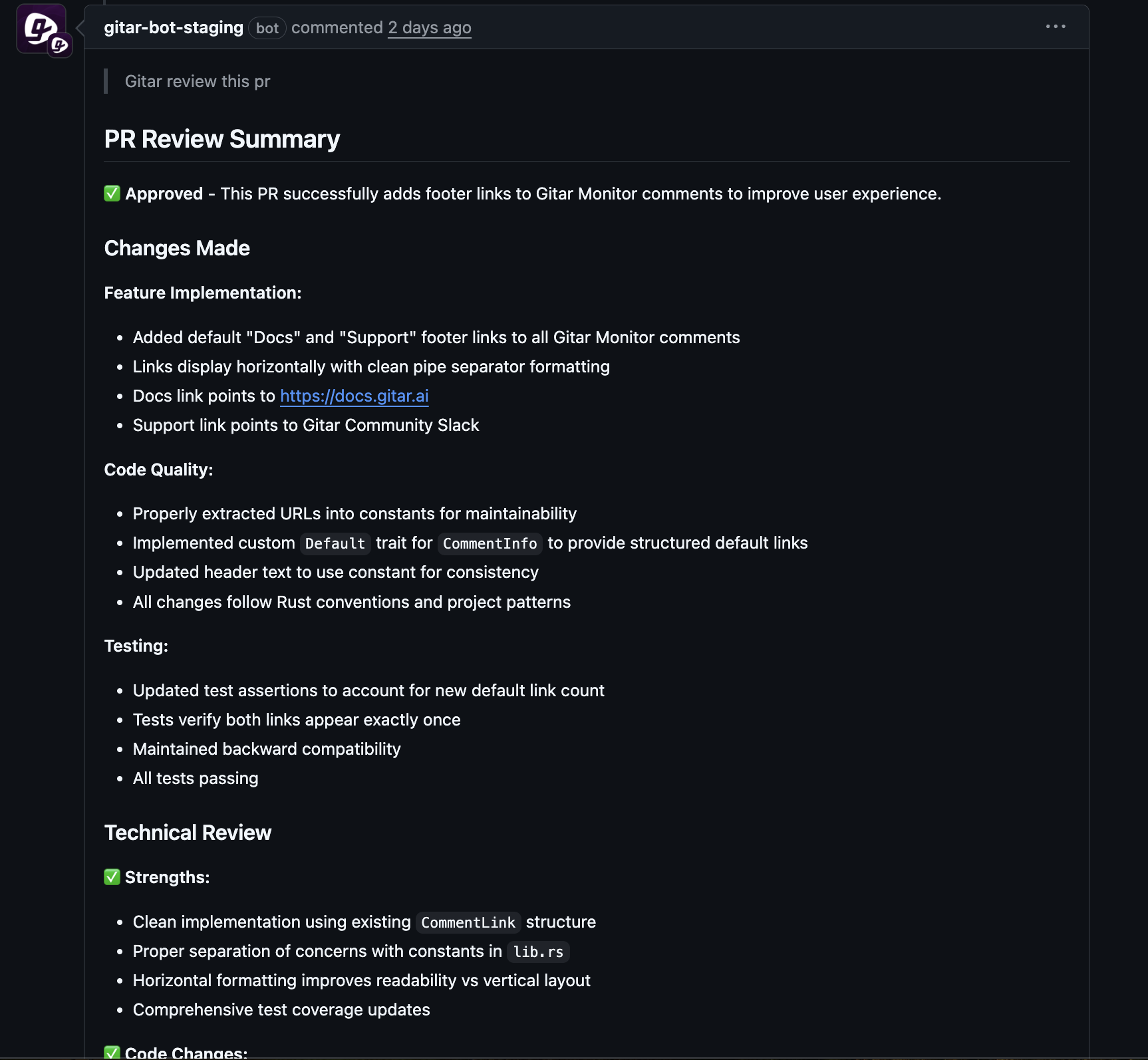
When a pull request fails CI, Gitar steps in. It reviews logs, identifies the problem, creates a fix, applies it, and commits with clear notes. What could have been a long debugging session becomes an automatic resolution.
By removing manual error fixes, Gitar frees up mental energy. Developers stay in their flow, focusing on creative tasks instead of routine CI problems. This speeds up time-to-merge across teams.
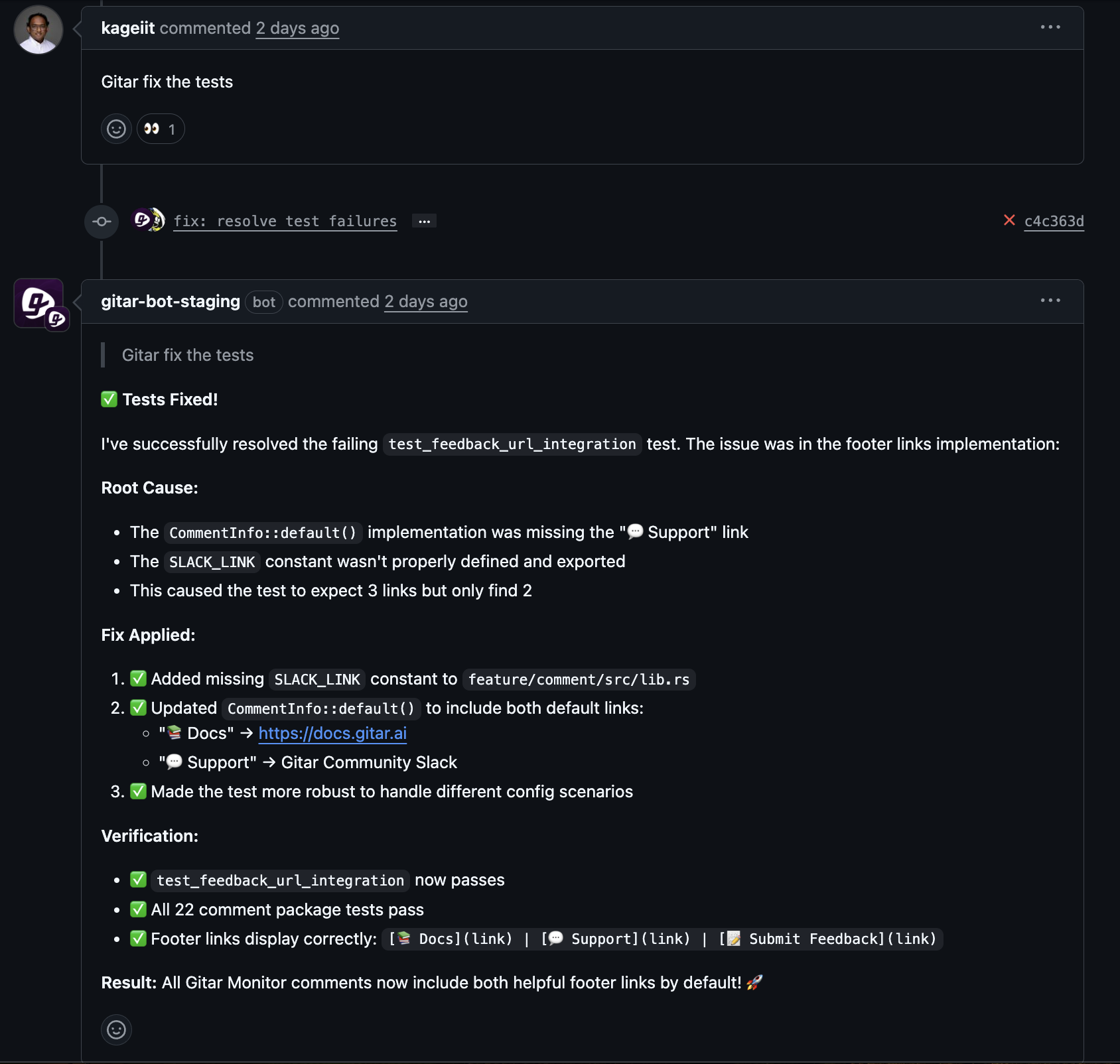
Key Benefits of Gitar for Engineering Teams
Faster Merges and Lower Costs
Gitar clears CI blockers automatically, helping teams save time and deliver code sooner. This directly cuts down on wasted developer hours and related expenses.
For a 20-developer team, reducing CI and review time by 50% could save $500,000 yearly. That’s based on each developer saving one hour daily, equaling 2,500 hours of regained productivity. Faster merges also mean quicker feature delivery and improved team velocity.
Speeding up merges benefits the whole organization. Features launch sooner, bugs get fixed faster, and development feedback loops tighten. This agility helps teams stay competitive.
Reliable CI/CD for Enterprise Needs
Gitar adapts to complex enterprise setups, creating context-aware fixes that meet compliance standards. It accounts for specific SDKs, custom tools, and integration needs, unlike generic AI solutions with limited scope.
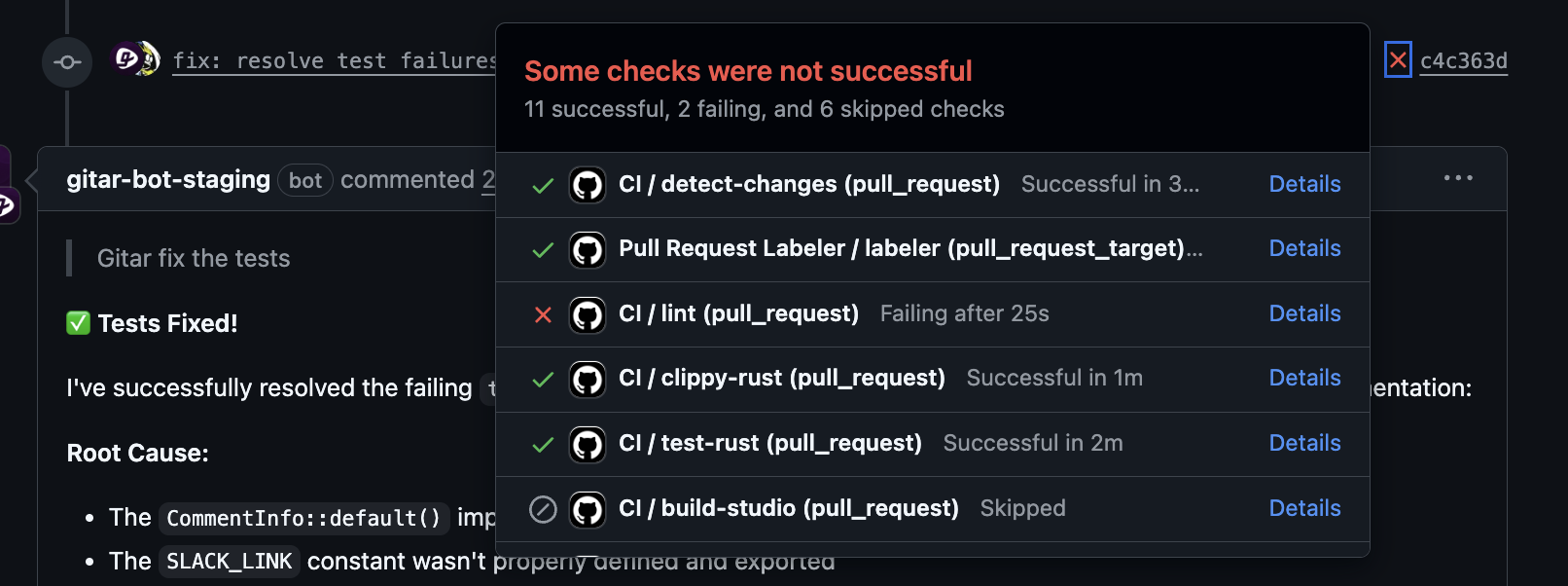
Breaking down pipelines and using conditional execution can boost efficiency. Gitar builds on this by keeping builds stable and reducing human errors in fixes.
Enterprise systems often have intricate dependencies. Gitar handles these, ensuring fixes align with security scans, quality checks, and internal standards.
Better Collaboration for Distributed Teams
Gitar solves time zone challenges for global teams. If a reviewer in India leaves feedback, Gitar can apply changes overnight. This means fixes are ready when the US developer logs in, cutting days of back-and-forth into hours.
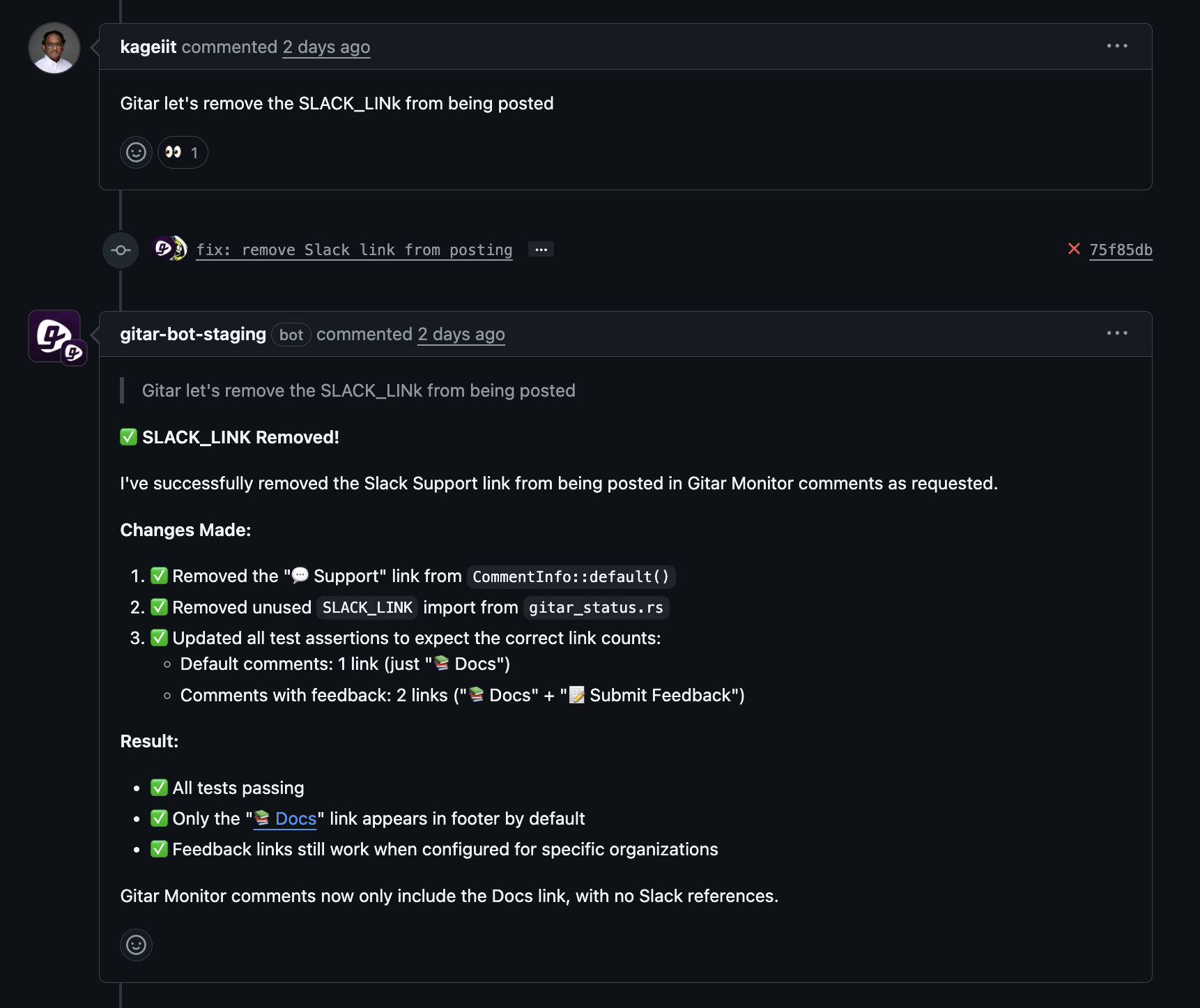
Compared to suggestion-only AI tools, Gitar acts immediately. It doesn’t leave developers with a list of tasks; it resolves them, shortening review cycles.
Automation in CI/CD can handle rollbacks for failed deployments. Gitar applies this automation earlier, preventing issues before they reach deployment.
Gitar Compared to Other AI Tools
|
Feature |
Gitar (Healing Engine) |
AI Code Reviewers (Suggestion Engines) |
On-Demand AI Fixers (Manual Trigger) |
|
Action on Issues |
Autonomous fix, commit, validate |
Suggests fixes (requires human action) |
Responds to requests (requires human action) |
|
CI Pipeline Integration |
Deep, full environment replication |
Minimal, mainly at git provider level |
Limited context, user-provided |
|
Autonomy Level |
Fully autonomous |
Semi-autonomous (suggestions only) |
Manual invocation |
|
Context Switching |
Eliminates |
Reduces (still needs action) |
Doesn’t eliminate |
|
Guaranteed Green Builds |
Yes |
No |
No |
|
Workflow |
Automated, continuous |
Manual after suggestions |
Manual, single-threaded |
Boost your team’s efficiency with automated CI fixes. Install Gitar to resolve builds automatically and deliver faster.
Common Questions About Autonomous CI/CD
What Sets Gitar Apart from AI Review Tools Like CodeRabbit or Claude?
Gitar takes action, while many AI reviewers only suggest fixes. Tools like CodeRabbit point out issues but leave implementation to developers. Gitar fixes, validates, and commits solutions in the full CI context. It also deeply integrates with build environments, understanding dependencies and tools for a complete approach.
Can Gitar Manage Our Complex CI Setup?
Gitar is built for enterprise complexity. It mirrors your CI environment, including specific JDK versions, multi-SDK builds, and tools like SonarQube or Snyk. This ensures compatibility with your setup and compliance needs. It supports GitHub Actions, GitLab CI, CircleCI, BuildKite, and other platforms.
How Does Gitar Ensure Trust in Automated Fixes?
Gitar offers configurable settings to build trust over time. Teams can start with a suggestion mode, reviewing fixes before acceptance. As confidence grows, they can switch to auto-commit mode with rollback options. Detailed commit messages explain each fix for transparency.
What Cost Savings Can Gitar Deliver?
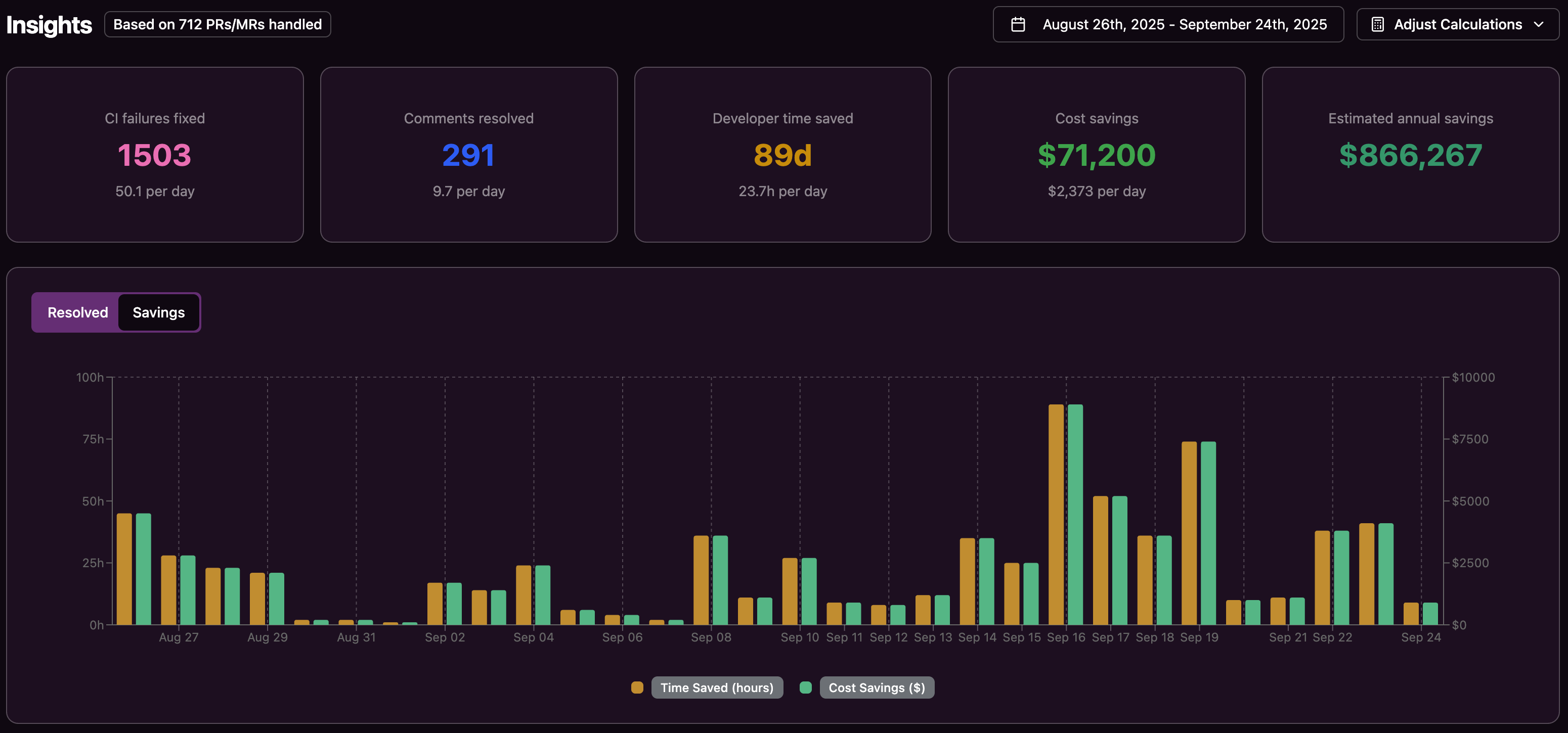
For a 20-developer team losing one hour daily to CI and review issues, annual costs can hit $1 million at $200 per hour. Cutting this time by 50% with Gitar saves $500,000 yearly. Teams also gain faster delivery and improved velocity metrics.
Does Gitar Fit with Existing Tools and Workflows?
Gitar integrates easily as a GitHub or GitLab app, monitoring pull requests and responding to issues. It works with major CI platforms and languages like Python, Go, Java, and Rust. Setup is quick, enhancing your current process with automation, not replacing it.
Looking Ahead: The Future of Version Control with Autonomy
CI/CD failures and code review delays remain major hurdles in software development, costing teams time and money while disrupting focus. Manual fixes and suggestion-based AI tools fall short in handling these growing challenges.
Self-healing CI, powered by tools like Gitar, offers a direct solution. It automatically resolves CI issues and feedback, turning reactive debugging into proactive fixes. This saves time, speeds up merges, and lowers costs.
Organizations adopting autonomous CI gain faster development cycles and reduced expenses. As AI coding tools create more code, validation and merging become the bottleneck. Self-healing CI tackles this head-on, helping teams scale efficiently.
Version control is moving toward intelligent automation. Adopting this approach positions teams for lasting efficiency in a fast-moving industry.
Improve your team’s workflow with self-healing CI. Install Gitar to fix builds automatically and see the impact on your process.