
Key takeaways
- Manual version control tasks such as CI fixes, debugging, and reviews consume most engineering time and slow delivery across teams.
- Automated CI failure resolution protects developer focus by handling routine lint, test, and configuration issues in the background.
- Automation that applies code review feedback directly reduces back-and-forth cycles and shortens time-to-merge for distributed teams.
- Environment-aware automation and CI pipeline optimization improve reliability, reduce costs, and give leaders clearer productivity insight.
- Teams can use Gitar to automatically fix broken builds, reduce reviewer toil, and modernize version control workflows with minimal setup.
The invisible cost of manual version control work
Manual version control work creates constant interruptions. Every failed CI build forces developers to stop feature work, scan logs, patch small issues, and wait for new runs. A five-minute lint error often expands into an hour of lost momentum once context switching and re-orientation time enter the picture.
One analysis of 2024 engineering teams reported developers spending only 16% of their time on actual application development, with the rest lost to supporting tasks. For a 20-developer team, 80% of software issues arising during the development step can translate into roughly $1 million in annual productivity loss when these issues are resolved manually.
Growing use of AI code generation increases this pressure. More code means more pull requests, more tests, and more CI failure points. Strategic automation that acts directly on version control events offers a practical path to reduce this overhead without changing how teams write code.
Strategy 1: Automate routine CI fixes for uninterrupted flow
Target low-complexity CI failures first
Routine CI failures such as lint errors, formatting mismatches, simple test failures, and dependency drifts take little judgment to fix but still disrupt focus. Developers must read CI logs, reproduce the problem, change code, and push again, even when the fix is mechanical.
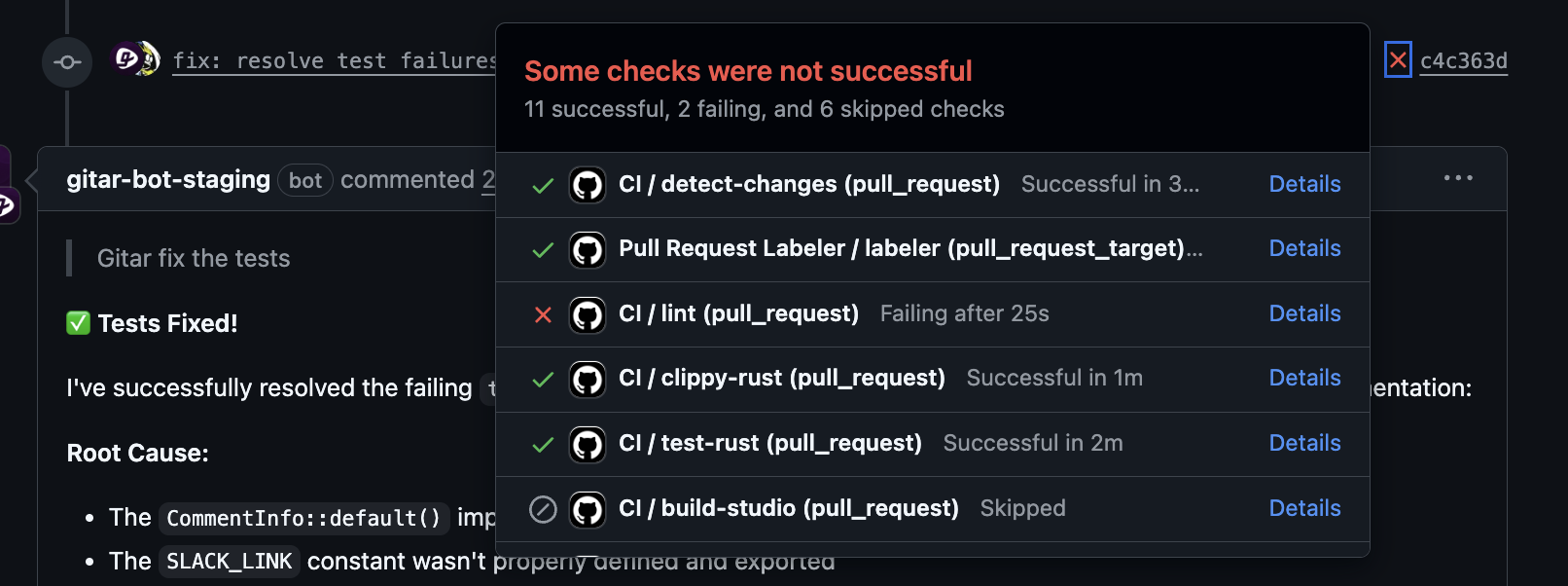
Automation that reads CI logs in real time and proposes specific code edits removes this friction. When a check such as npm run lint, pytest, or a snapshot test fails, the system generates a fix, updates the pull request branch, and triggers a new run without manual effort.
Use trust levels that match your team
Teams benefit from fine-grained control over how fixes appear. A conservative mode can open pull request suggestions that require one-click approval. This builds trust while developers review early results. A more advanced mode can commit fixes directly, with clear commit messages and easy rollback if needed.
Tools such as Gitar follow this model by applying fixes, validating them against the full CI workflow, and only surfacing results once checks pass. Developers stay focused on product work while automation handles repeatable CI noise.
Strategy 2: Streamline code review feedback with intelligent automation
Shift reviews from commentary to action
Code reviews protect quality but frequently slow delivery. Reviewers must find time to leave comments, and authors must later return, interpret feedback, and implement the requested changes. Distributed teams often experience multi-day delays as comments and revisions pass between time zones.
Modern version control platforms support real-time collaboration, yet much of the work still depends on manual edits.
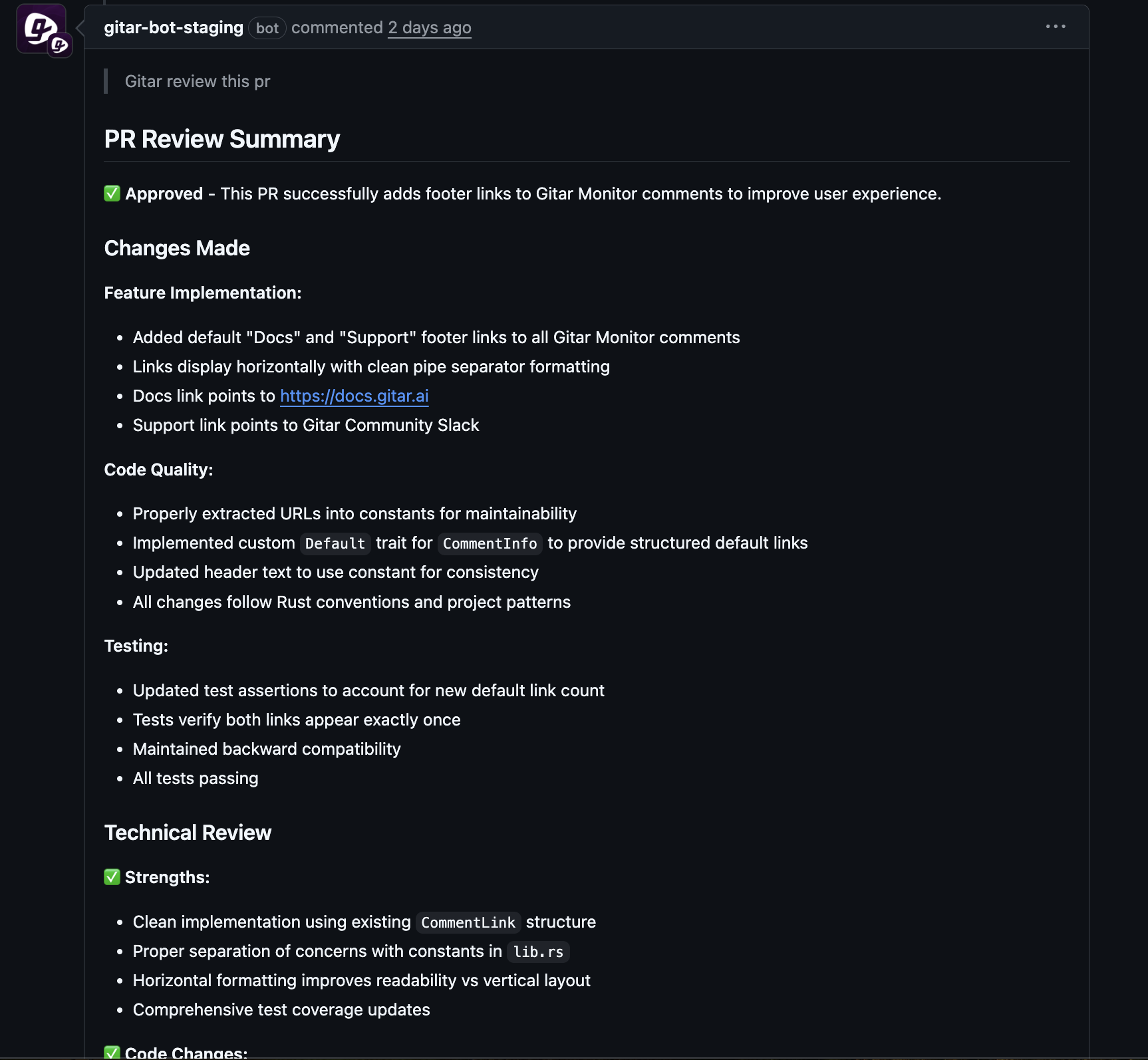
Automation can apply reviewer intent directly. A reviewer might comment, for example, that a loop should use a map, that extra logging should be removed, or that a function should split into smaller helpers. The automation engine parses the instruction, updates the code, and pushes changes back to the pull request with an explanation of what changed and why.
Support distributed teams with overnight progress
Teams working across regions gain particular value. A reviewer in one region can leave detailed feedback at the end of the day. Automation then updates the code and re-runs CI so that the original author sees a near-final pull request when work resumes. This pattern removes multiple review cycles and leads to faster, more predictable merges.
Strategy 3: Keep builds green with environment-aware validation
Match automation to real CI environments
Enterprise CI environments rarely match local laptops. Pipelines may rely on specific SDK versions, Docker images, security scanners, and multi-platform build matrices. An estimated 40% of development delays trace back to incorrect or inconsistent testing environments, which shows how often issues emerge only after code reaches CI.
Effective automation runs inside or alongside real CI jobs, not in isolated sandboxes. The system needs access to the same JDK versions, Docker configurations, SonarQube and Snyk checks, and any custom enterprise tooling. This context helps ensure that proposed fixes not only compile but also pass quality, security, and compliance gates.
Reduce reliance on generic AI tools
Generic coding assistants often fail in these environments because they lack awareness of organization-specific dependencies, secrets handling, or policy rules. Purpose-built automation engines operate with full pipeline context so that every automated change respects architecture constraints and security standards.
Strategy 4: Control CI cost and improve productivity with automated pipeline management
Cut waste from failed and repeated runs
CI minutes and parallel runners add up quickly, especially when pipelines fail for preventable reasons. Well-designed workflow automation reduces manual effort and cognitive load, and CI-specific automation extends this benefit by limiting unnecessary runs.
Automation engines can analyze commit patterns and historical failures to identify fragile tests, misconfigured jobs, or recurring dependency problems. The system can then block wasteful runs, suggest targeted changes, or apply known fixes before full pipelines execute.
Give leaders clearer visibility into impact
Pipeline automation also surfaces metrics that matter to engineering leaders. Dashboards can show time-to-merge, failure rates by repository, volume of automated fixes, and CI cost trends. Automating repetitive activities helps teams move features into production more quickly, which supports both planning and budgeting.
Cross-platform support for GitHub Actions, GitLab CI, CircleCI, Buildkite, and other systems keeps behavior consistent and reduces dependence on any single vendor.
Gitar vs. the status quo: from suggestion engines to healing engines
Many current tools act as suggestion engines. They highlight problems and propose patches, but developers still need to apply, adapt, and validate each change. One survey found that 70% of developers spent extra time debugging AI-generated code, which suggests that unvalidated suggestions can increase workload instead of reducing it.
Common approaches and their limitations include:
|
Approach |
Capability |
Limitation |
Typical time impact |
|
Manual debugging |
Full control over every change |
Complete context switching and slow feedback |
1+ hours per failure |
|
AI code reviewers |
Contextual suggestions |
No automatic validation or commits |
30+ minutes per suggestion |
|
IDE assistants |
Faster code generation |
Limited awareness of CI and production context |
Minimal effect on CI issues |
|
On-demand fixers |
Targeted assistance |
Manual triggering and narrow scope |
15–30 minutes per use |
Gitar operates as a healing engine. When CI failures occur, Gitar analyzes logs, generates fixes, applies changes, and validates the result against the full pipeline. Developers see updated pull requests with passing checks instead of raw failure messages. This shift frees engineers to focus on design and feature work while CI stability improves in the background.
Frequently asked questions (FAQ)
How does version control automation handle complex enterprise CI environments?
Enterprise-ready automation platforms connect directly to existing pipelines, use the same dependency versions and images, and respect established quality and security gates. They understand build matrices, parallel jobs, and staged workflows so that every automated fix runs through the same checks as a manual change.
What level of control do teams have over automated CI fixes?
Teams can tune automation behavior by repository, branch, or failure type. Many platforms support modes that range from suggestion-only to fully automatic commits. Detailed commit messages and audit logs provide traceability, and rollback options remain available when a human review is preferred.
What ROI can engineering teams expect from version control automation?
Teams often reclaim one to two hours per developer per day that previously went to CI troubleshooting and repetitive review changes. For a 20-developer team, even partial automation can represent hundreds of thousands of dollars in annual productivity value, along with faster releases and lower CI infrastructure usage.
Maximize version control time-saving with Gitar
Version control automation in 2026 gives teams a practical way to reduce operational overhead without disrupting existing tools. When CI fixes, routine review edits, and environment-specific adjustments run automatically, developers regain time for design, architecture, and user-facing work.
Gitar focuses on this layer of work. The platform reads CI output, updates pull requests with validated fixes, and implements reviewer instructions so that builds stay green and feedback cycles shorten. Teams maintain control through configuration and audit logs while the system handles repetitive tasks.
Install Gitar to automatically fix broken builds, reduce manual review churn, and bring environment-aware automation into your existing GitHub or GitLab workflows.