
Travis CI provides detailed logs to help debug pipeline failures, but sifting through them often requires time-intensive manual effort. Gitar, an autonomous AI agent, changes this by not only analyzing logs but also fixing issues in CI pipelines automatically. This article explores how Gitar reduces developer workload and speeds up project delivery for engineering teams.
Why Travis CI Logs Still Lead to Manual Effort
Hidden Costs of Troubleshooting CI Failures
Even with Travis CI’s in-depth logs, developers spend considerable time addressing failures. When a build breaks, engineers must pause their work, dive into error messages, and figure out the problem, often losing hours of productive coding time.
This interruption, known as the context-switching cost, slows down progress. Developers can lose up to 30% of their workday debugging CI issues or responding to feedback, draining resources. For a team of 20 developers, this equates to roughly $1 million in lost productivity each year.
Beyond time, CI failures disrupt a developer’s focus, pulling them away from solving complex problems or writing effective code. A quick fix that should take minutes can stretch into an hour when accounting for mental reset and setup time.
Distributed teams face bigger delays. A developer in one timezone might submit a pull request that fails CI while their reviewer in another timezone is offline. Resolving the issue can take days, stalling merges and frustrating project timelines.
Common Causes of Travis CI Pipeline Failures
CI pipelines fail for various reasons, forcing developers to investigate and resolve issues manually. Frequent problems include flaky tests, build errors from misconfigured scripts or version mismatches, deployment issues due to missing variables or credentials, and dependency conflicts.
- Flaky tests often pass locally but fail in Travis CI due to timing or network differences, requiring log analysis and updated testing approaches.
- Build errors can arise from version discrepancies or missing libraries in the CI environment. Even small mistakes, like an outdated Docker image or a typo in a command, can stop a pipeline.
- Deployment failures happen at the final stage due to incorrect keys or scripts. Syntax errors, failed tests, and infrastructure issues often require scanning extensive logs to pinpoint causes.
- Dependency conflicts occur when packages clash in the full application, demanding time to resolve compatibility issues through trial and error.
Ready to automate fixes for these issues? Install Gitar now to resolve broken builds and ship faster.
How Gitar Solves CI Failures with Autonomous Fixes
Gitar shifts CI troubleshooting from a reactive, manual process to an automated, proactive solution. This AI agent independently detects, diagnoses, and corrects pipeline failures, eliminating the need for constant developer input.

Key Features of Gitar for CI Automation
Gitar offers practical tools to streamline CI workflows with minimal human oversight.
- Complete Problem Resolution: Unlike tools that only suggest fixes, Gitar analyzes logs, identifies root causes, applies code changes to pull requests, and confirms all CI jobs pass, removing manual steps.
- Accurate Environment Matching: Gitar replicates specific CI setups, dependency versions, and integrations, ensuring fixes align with the actual pipeline context.
- Flexible Control Options: Teams can start with a cautious mode where Gitar suggests fixes for review and approval. As trust builds, a direct-commit mode with rollback options becomes available.
How Gitar Improves Your CI Workflow
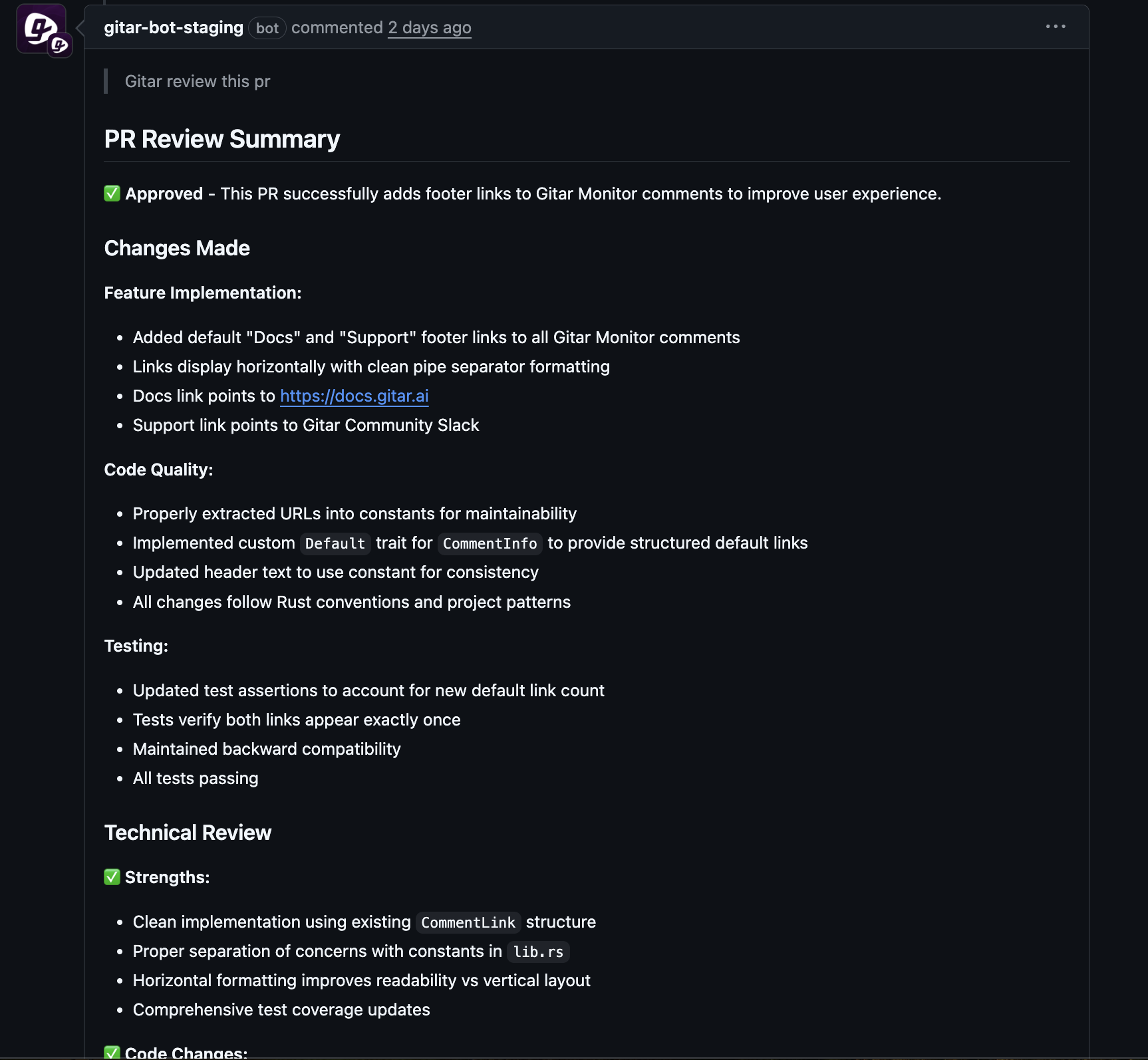
Gitar connects with CI platforms via GitHub or GitLab, tracking pull requests for failures and stepping in when issues occur. It quickly assesses logs to identify problems like linting errors, test failures, or configuration mistakes.
For linting issues, Gitar adjusts formatting to match project standards. For test failures, it updates files to fix basic errors and verifies the solution. Configuration problems, such as missing dependencies, are corrected with precise updates.
Developers no longer face constant failure alerts requiring investigation. Instead, they get notifications that Gitar has already fixed the issue, with updated commits and clear explanations of the changes. This keeps PRs moving forward without breaking focus on other tasks.
Ready to simplify CI fixes? Request a demo to see Gitar resolve pipeline failures.
Comparing Gitar to Manual Fixes and AI Suggestion Tools
From Log Analysis to Automated Solutions
Manual CI troubleshooting involves a repetitive cycle of failure alerts, log review, local testing, fix application, and resubmission. Complex issues can loop through this process multiple times, eating into developer time.
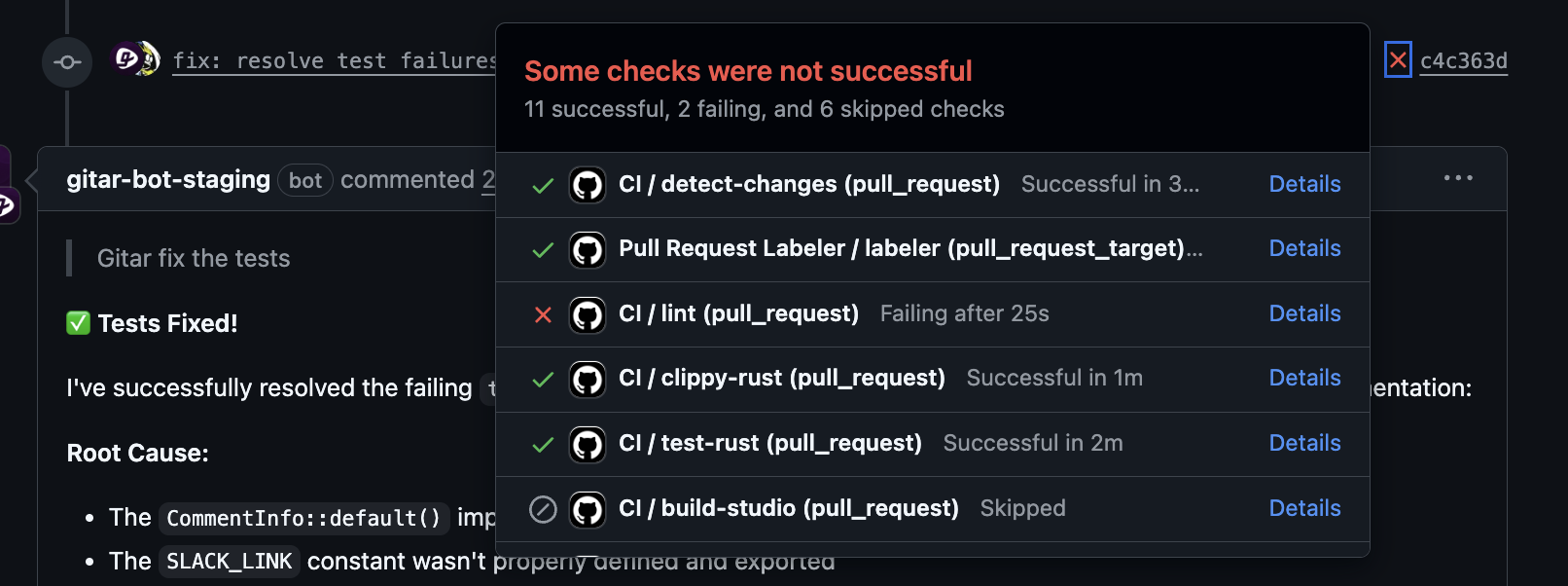
Some AI tools aid diagnosis by analyzing logs and offering fix ideas. However, these often stop at suggestions, leaving developers to apply and test changes manually. Gitar goes further by implementing fixes, verifying them in the CI environment, and ensuring builds succeed before notifying the team.
For instance, while other tools might point out a test failure due to timing and suggest a fix, Gitar applies the change, runs tests to confirm it works, and commits the solution directly to the PR without developer input.
Tangible Benefits for Engineering Teams
- Maintained Focus: Gitar handles CI issues in the background, letting developers concentrate on high-value coding tasks without interruptions.
- Faster Merges: Issues that once needed multiple cycles to resolve are fixed in one automated step, speeding up feature delivery.
- Cost Efficiency: Reduced troubleshooting time lowers operational expenses, enabling quicker customer delivery and better market responsiveness.
|
Feature |
Manual Troubleshooting |
AI Suggestion Tools |
Gitar (Autonomous Fixes) |
|
Log Analysis |
Developer Effort |
Provides Suggestions |
AI-Driven, Full Context |
|
Fix Creation |
Manual Changes |
Developer Implements |
AI-Generated Automatically |
|
Fix Application |
Manual Commit |
Manual |
Automatic Commit |
|
CI Verification |
Manual Retries |
Developer Waits |
Automatic, Confirms Success |
Answers to Common Questions About Gitar
How Does Gitar Fit Into Existing CI Systems?
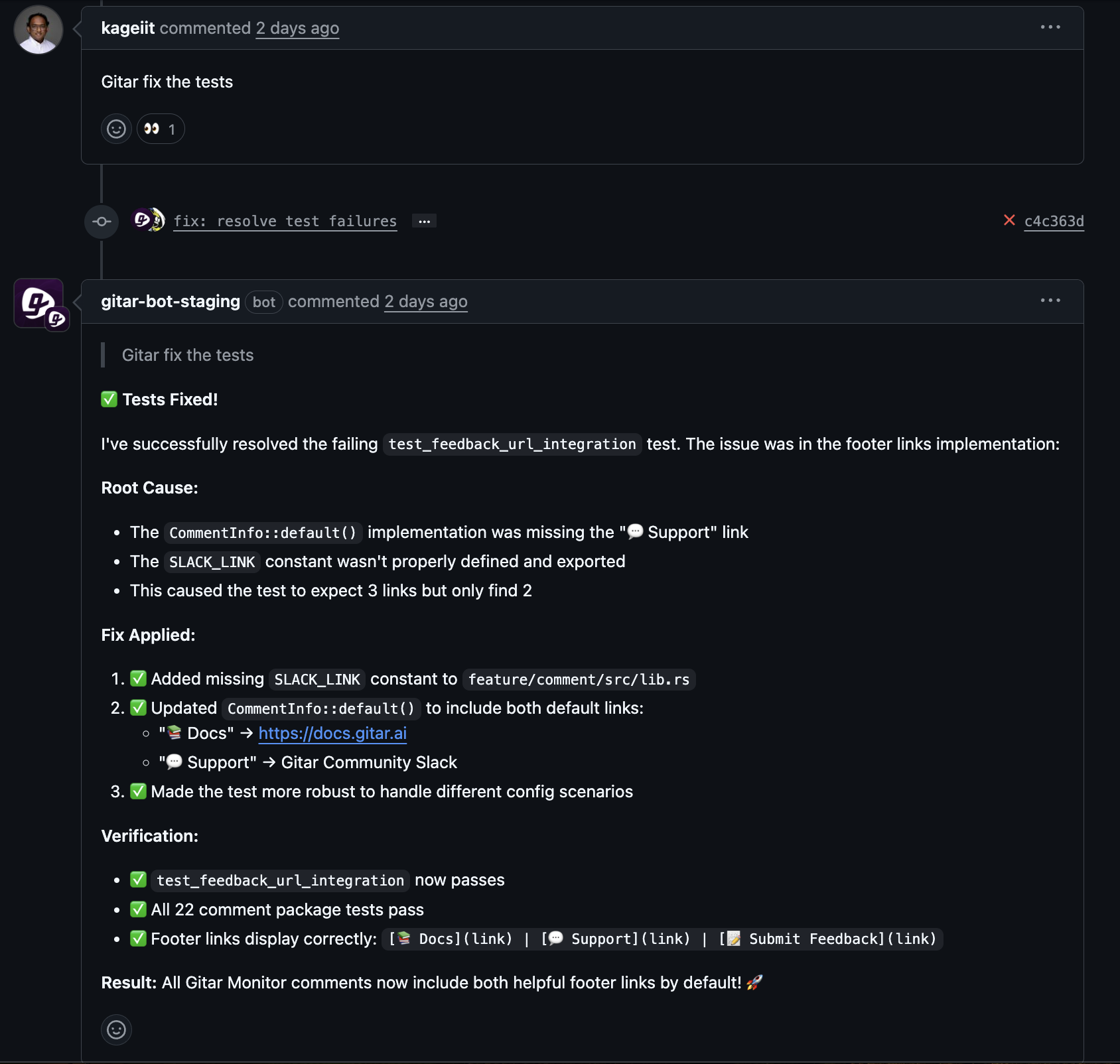
Gitar connects easily with CI platforms through GitHub or GitLab without altering your current setup. After installation as an app or integration, it monitors pull requests for failures, analyzes logs, applies fixes, and validates results directly in your workflow. It enhances rather than replaces your existing pipeline.
How Is Gitar Different From Other AI Review Tools?
While many AI tools offer code review suggestions, Gitar focuses on independently resolving CI issues. Suggestion tools identify problems but leave implementation to developers. Gitar applies fixes, tests them in your CI environment, and ensures builds pass, saving additional steps.
How Does Gitar Build Trust With Teams?
Gitar offers adjustable settings to ease teams into automation. In a cautious mode, it suggests fixes for review and approval, allowing visibility before changes apply. As confidence grows, teams can switch to a mode where fixes are committed directly with options to revert and detailed change explanations for transparency.
Can Gitar Manage Complex Enterprise CI Setups?
Gitar handles intricate enterprise environments effectively. It mirrors specific setups, including SDK versions, multi-language dependencies, and custom integrations. By understanding the full context, including unique scripts and variables, Gitar ensures fixes fit seamlessly into tailored CI/CD pipelines.
Stop spending time on CI debugging. Discover Gitar’s automated fixes to ship faster.
Conclusion: Speed Up Development With Automated CI Solutions
While Travis CI logs offer useful insights for diagnosing failures, the manual work to interpret and fix issues still slows teams down. Modern engineering requires tools that go beyond identifying problems to solving them independently.
Gitar redefines CI troubleshooting by automating fixes, reducing interruptions, and shortening merge times. This leads to better developer focus and lower operational costs with clear returns on investment.
Adopting automated CI solutions like Gitar can improve delivery speed and team efficiency. As software pace becomes critical to business success, considering such tools is a practical step forward.
Move past manual debugging. Request a demo to see how Gitar tackles CI failures and enhances your pipeline.