
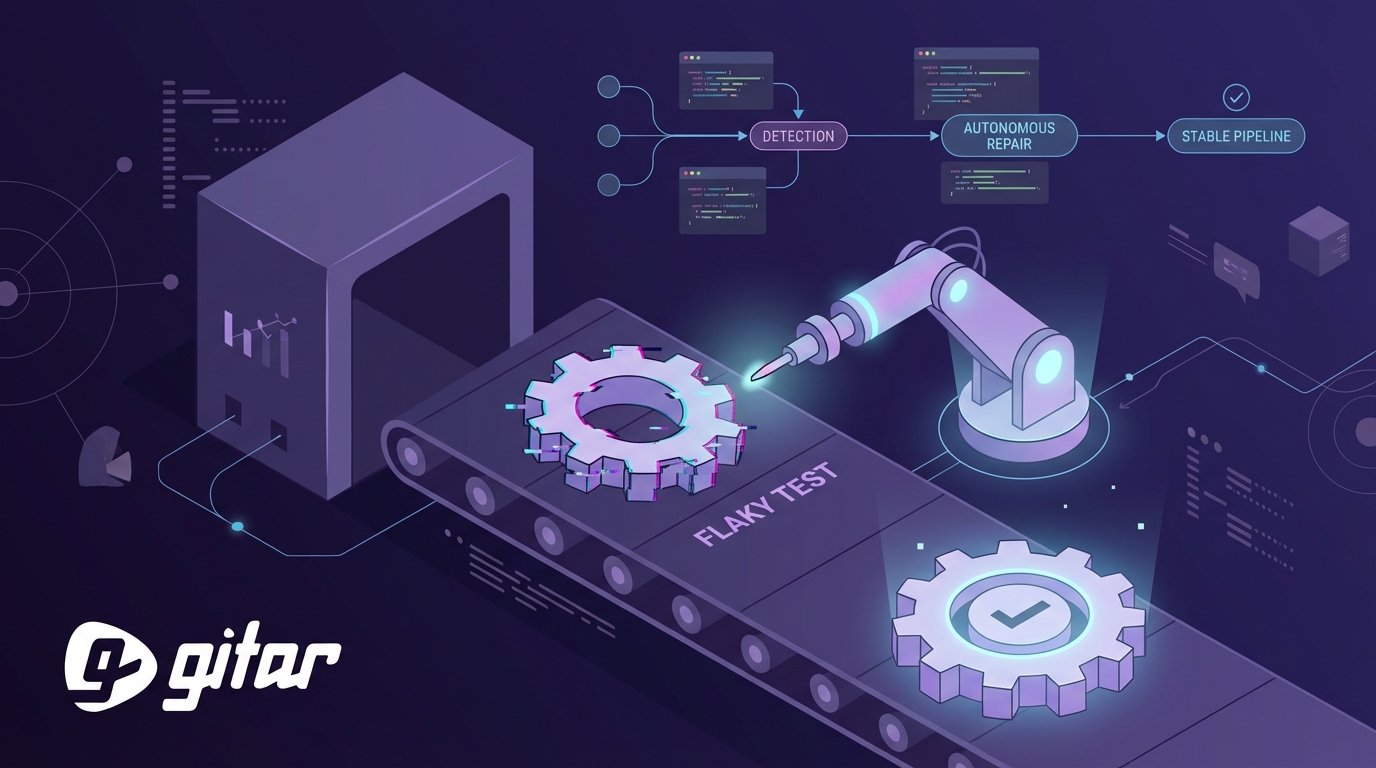
Key Takeaways
- Test flakiness turns many CI failures into noise, which slows teams, increases costs, and erodes trust in automated tests.
- Manual workarounds such as reruns or disabling tests reduce coverage, mask real issues, and create long-term technical debt.
- Autonomous CI fixing systems diagnose failures, generate code changes, and validate fixes in your real environment to keep pipelines healthy.
- Successful rollout of autonomous fixes depends on clear ROI targets, conservative initial configurations, and measurable success metrics.
- Teams can use Gitar to automatically fix broken CI builds and ship software faster.
Why Test Flakiness Slows Modern CI/CD Pipelines
Flaky tests create non-deterministic results, where tests sometimes fail even when code and environments have not changed. This behavior makes CI feedback noisy and unreliable.
Google has reported that flaky tests can consume up to 16% of a developer’s time. Microsoft has observed developer productivity reductions of up to 35% from flaky tests.
Atlassian has reported over 150,000 hours of developer time per year spent on flaky tests and reruns. Estimates suggest that 15–30% of automated test failures stem from flakiness rather than real defects.
Teams lose trust in CI when they see frequent false positives. Legitimate failures then risk being ignored alongside flaky ones. Analyses have found that 13% of failed builds involve flaky tests, and 84% of retried test failures come from flakiness rather than regressions.
Typical root causes include:
- Resource contention in parallel or heavily loaded test environments
- Timing assumptions that break under variable latency
- Shared mutable state between tests
- Race conditions in asynchronous code
- Complex setups that depend on unstable external services
Cloud-native and distributed systems often amplify these issues because resource allocation and network behavior change from run to run.
Available Options for Managing Flaky Tests
Teams often start with manual tactics such as rerunning failed jobs or temporarily disabling unstable tests. These steps can unblock work in the short term, but they consume developer time and reduce coverage.
More structured approaches fit into three categories:
- Detection tools that flag flaky tests for manual review
- Suggestion engines that propose code changes for developers to apply
- Autonomous systems that diagnose failures, generate fixes, and validate them in CI
AI-assisted coding tools have increased code output and the volume of changes under review, which raises the importance of efficient validation and failure recovery. Teams can mitigate this right-shift bottleneck by automating how CI failures are diagnosed and repaired.
Introducing Gitar: Autonomous Fixes for CI Failures
Gitar provides an autonomous CI fixing system that focuses on real remediation instead of suggestions. The platform analyzes failed checks, produces code changes, and validates those changes in your actual CI environment.
How Gitar Works: The End-to-End Autonomous Fix Process
When a CI check fails, Gitar performs several steps:
- Parses logs and metadata to identify likely root causes
- Generates code changes to resolve issues such as broken assertions or outdated snapshots
- Applies those changes to the pull request branch
- Runs the full CI workflow again to confirm the fix
Gitar only surfaces fixes after the pipeline has passed, so reviewers see a clean build rather than a list of suggested edits.
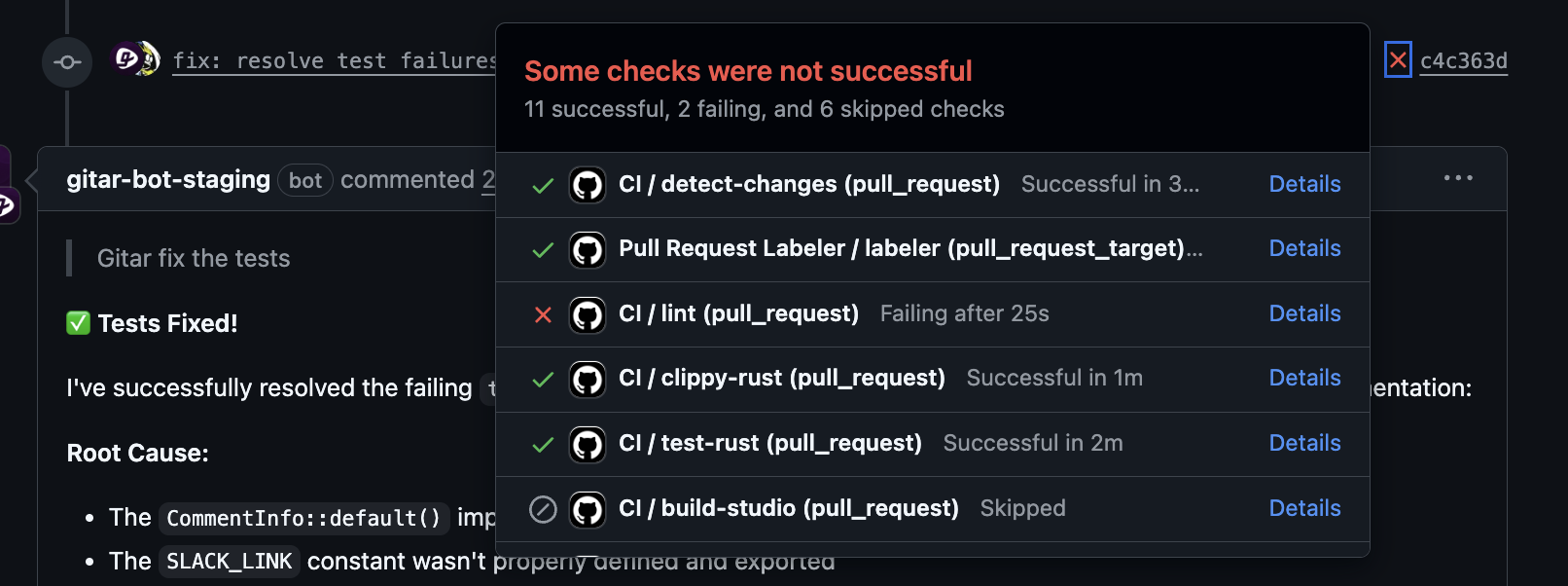
Key Differentiating Features
Gitar focuses on fitting into real-world enterprise CI environments rather than simplified demo setups.
- Environment replication: Handles specific SDK versions, multiple languages, and tools such as SonarQube and Snyk so fixes run against realistic conditions.
- Configurable trust model: Conservative mode presents suggested commits for review, while aggressive mode auto-commits fixes with clear traceability and rollback options.
- Platform coverage: Works with GitHub Actions, GitLab CI, CircleCI, BuildKite, and other major CI systems, which helps standardize handling of failures across teams.
Install Gitar to automatically fix broken builds and reduce time spent on CI toil.
How To Roll Out Autonomous CI Fixes Safely
Build-versus-buy decisions often start with in-house experiments. Atlassian’s experience with the internal tool “Flakinator” illustrates the ongoing investment required to build, operate, and evolve dedicated flakiness tooling. Dedicated platforms aim to reduce that long-term burden.
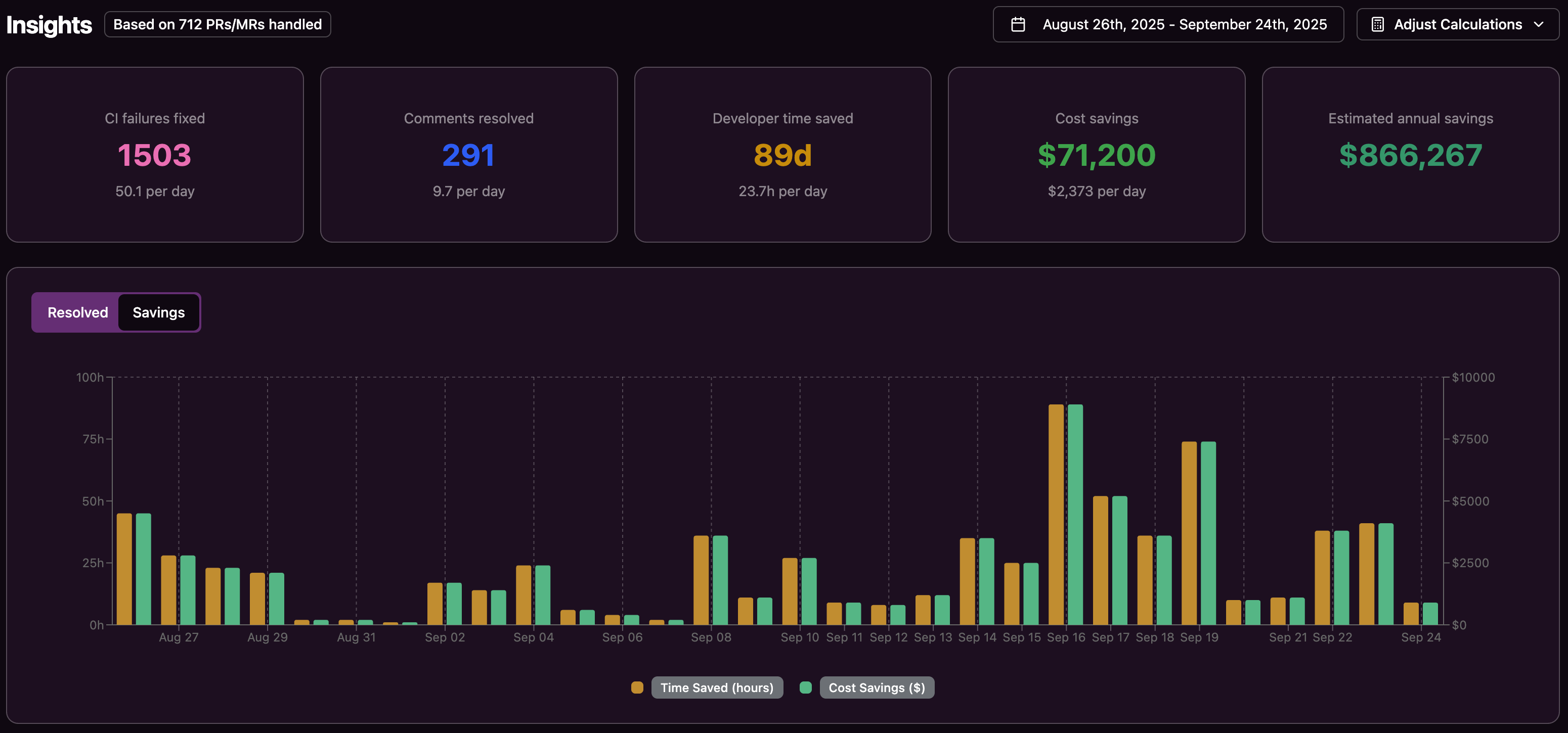
Time spent on CI failures and reviews typically converts directly into cost. For a 20-person engineering team that spends about one hour per developer each day on CI and code review issues, the fully loaded annual cost can approach $1 million. Teams using Gitar often target savings in the range of hundreds of thousands of dollars per year while aiming to improve developer satisfaction and throughput.
A phased rollout usually works best:
- Start with suggestion-only mode on a limited set of repositories.
- Measure fix accuracy, developer feedback, and impact on merge times.
- Expand to additional services and enable auto-commit for low-risk changes once trust increases.
|
Feature |
Manual Reruns/Disabling |
Suggestion Engines |
Gitar Autonomous Fixes |
|
Failure Detection |
Manual observation |
Pattern matching |
Log and metadata analysis |
|
Problem Diagnosis |
Developer investigation |
Limited context awareness |
Environment-aware analysis |
|
Fix Generation |
Manual coding |
AI suggestions |
Automated code changes |
|
Fix Validation |
Manual judgement |
Developer responsibility |
Full CI workflow verification |
Key metrics for success include lower failure rates, shorter pull request merge times, developer satisfaction scores, and CI compute usage. These indicators help refine configurations and demonstrate ROI.
Advanced Workflows and Common Pitfalls To Avoid
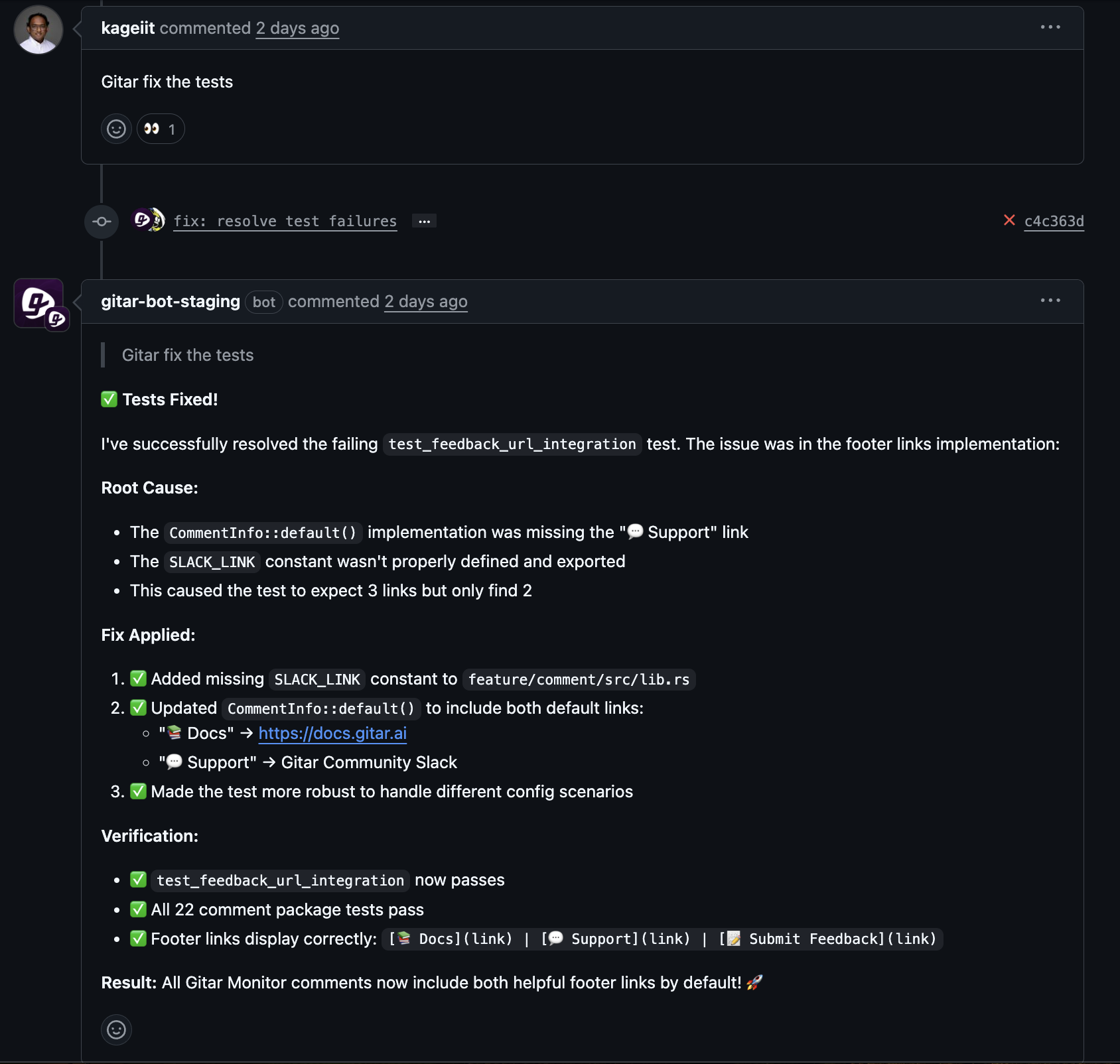
Autonomous CI repair can support more than basic failure recovery. Gitar can also add tests or refactor code when reviewers request improvements, which helps teams raise quality without constant manual edits.
Distributed teams gain particular value. Reviewers can leave comments near the end of their day, and Gitar can apply fixes and rerun CI before the next workday starts in another time zone. This pattern keeps pull requests moving without waiting for overlapping hours.
Several strategic risks tend to appear:
- Focusing on CI compute costs instead of the higher cost of developer time and context switching
- Treating CI failures solely as a QA concern rather than a core productivity issue
- Skipping the gradual rollout and trust-building, which can reduce adoption
Analyses of flaky test tooling often highlight that the largest expense is lost engineering time, not infrastructure. Gitar aims to address this by removing repetitive triage and fixing work.
Install Gitar to reduce CI-related interruptions and keep developers focused on feature work.
Frequently Asked Questions (FAQ) about Autonomous CI Fixes
How does Gitar complement existing AI reviewers for CI failures?
Many AI reviewers generate comments or code snippets that still require developers to edit files and rerun pipelines. Gitar instead applies fixes directly, runs the full CI workflow, and then presents updated pull requests with passing checks. Teams can keep AI reviewers for design feedback while delegating repetitive failure repair to Gitar.
How does Gitar support complex CI setups with many dependencies?
Gitar works with complex environments that include language-specific toolchains, custom build steps, and third-party analysis tools. The system reconstructs the relevant parts of your environment so that fixes align with the same conditions that run in CI.
What time and cost savings can teams expect with Gitar?
Time saved depends on baseline failure rates and current processes. Teams that spend about an hour per developer per day on CI issues often see large reductions in that time after adopting autonomous fixes. Those savings translate into more capacity for feature work, incident reduction, or infrastructure improvements.
How do developers maintain ownership when using automated fixes?
Gitar keeps developers in control by exposing every change as a standard commit with an explanation. Teams can start in suggestion mode, so reviewers decide which fixes to merge. Many organizations later enable auto-commit for well-understood, low-risk classes of failures once the team is comfortable with the behavior.
What safeguards exist if Gitar introduces an issue?
Every Gitar fix runs through your CI workflow before it appears as a proposed solution. If a change causes new failures, the system can discard it or present it as a non-blocking suggestion. Teams can also revert any merged fixes through normal version control practices, and they can adjust trust levels if they want tighter control.
Conclusion: Improving Engineering Outcomes with Autonomous CI Fixes and Gitar
Test flakiness and other CI failures slow delivery, reduce confidence in automated tests, and consume substantial engineering time. Manual reruns and disabled tests can keep work moving in the moment, but they do not address the underlying causes or long-term productivity impact.
Gitar offers a practical path to reduce that friction by diagnosing failures, generating fixes, and validating them in your CI environment. Teams that adopt autonomous CI repair can redirect attention from repetitive triage to higher-value engineering work, while also improving consistency in how failures are handled.
Address CI failures, accelerate your pipeline, and reclaim developer time with Gitar.