
Software development relies on efficient CI/CD pipelines, and TeamCity offers strong tools for managing builds and releases. Still, CI failures and code review delays often slow teams down. Teams can spot frequent job failures and long run times, but identifying issues doesn’t fix them. This article looks at the gaps in traditional TeamCity setups and introduces Gitar, an autonomous CI healing engine that speeds up merge times and improves developer productivity.
TeamCity provides solid build and release features, yet it focuses on visibility and coordination rather than fixing problems automatically. Teams using TeamCity often face a frustrating loop: submit a pull request, see it fail, and spend time troubleshooting. The gap between knowing a pipeline failed and resolving the issue costs teams significant time and effort every year.
Want to stop CI failures from slowing your TeamCity pipelines? Install Gitar now to fix broken builds automatically and ship software faster.
The Challenge: Manual Fixes Limit TeamCity’s Build and Release Power
TeamCity excels at managing builds, but its focus on orchestration and visibility leaves problem-solving to developers. This gap creates bottlenecks, even in well-set-up TeamCity environments.
CI Failures Disrupt TeamCity Workflows Every Day
TeamCity users often face build issues that break focus and force costly context switching. Common failures include timeouts, test errors, non-zero exit codes, memory crashes, and logged errors. Each issue demands manual effort to investigate and fix.
For many teams, these disruptions happen daily across multiple projects. A typical day might start with a failed pull request due to a linting error, a dependency conflict, or a test that works locally but fails in CI. Fixing each issue means pausing current tasks, digging into logs, switching branches, applying a solution, committing changes, and waiting for the pipeline to rerun.
Detailed job data reveals both new failures and performance drops compared to past weeks. Many of these issues are repetitive and mechanical, the kind that shouldn’t need human effort but still do in standard CI setups.
The impact goes beyond frustration. For a team of 20 developers, spending just one hour daily on CI fixes adds up to roughly $1 million in lost productivity each year. This doesn’t include delays in project timelines, lower team morale, or missed opportunities for feature releases.
Code Review Delays Slow TeamCity-Powered Teams
Code reviews often stall progress, even with TeamCity’s build validation tools. Human feedback loops create delays, especially for distributed teams working across time zones.
Imagine a developer in California submits a pull request needing review from a teammate in Bangalore. A 12-hour time difference can turn a quick review into a days-long process. Feedback might require changes, forcing the original developer to switch focus, make updates, and wait for another review cycle.
Existing AI review tools don’t fully solve this. They might flag issues, but developers still need to interpret suggestions, apply fixes, and verify nothing breaks. This creates extra steps under the guise of automation.
Distributed teams, including contractors and offshore developers, face even bigger delays. Feedback that could be quick in a shared office often stretches overnight, dragging out each review cycle.
Increased Code Volume Creates New TeamCity Challenges
AI coding tools like GitHub Copilot speed up code creation, but they also increase the volume of code to validate and integrate, leading to more potential issues.
More code means more pull requests, more tests, and higher chances of CI failures. Each line of AI-generated code risks integration conflicts or test errors. TeamCity can handle larger build volumes, but manual fixes for failures remain time-consuming.
This shows up in longer build queues, more frequent test runs, and complex dependency issues from overlapping changes. While AI boosts coding speed, it can add hurdles in shipping code. Time saved writing code often gets lost in validation and integration delays.
Manual Fixes in TeamCity Cost More Than Time
Manually fixing CI failures in TeamCity goes beyond just the hours spent. TeamCity metrics show build performance and failure trends, but they don’t cut down the hands-on work needed to resolve issues.
A failed build requires steps like reviewing logs, linking issues to recent changes, testing fixes locally, and validating solutions. Monitoring tools can connect build events to infrastructure status, yet fixing remains a manual task. Each step pulls developers away from other work, multiplying the productivity hit.
Hidden costs add up. A senior developer debugging a build loses focus on key tasks. This delays high-priority features and strategic goals. For enterprise teams, these losses grow across projects and team members. Deep failure analysis often needs extra observability tools beyond TeamCity’s reports, but data alone doesn’t solve issues.
Delays in merging code also slow feature releases, impacting customer satisfaction and market position.
The Answer: Gitar, Your Autonomous CI Healing Engine for TeamCity
Gitar changes the game by acting as an autonomous fix engine, not just another alert tool. While TeamCity handles build coordination and visibility, Gitar closes the gap between spotting issues and fixing them.
Unlike tools that only notify or suggest fixes, Gitar independently analyzes build logs, creates tested code solutions, and applies them to pull requests. This builds a self-healing CI process, turning hours of debugging into automated, hands-free resolution.

Here’s what Gitar offers:
- Automatic CI Fixes: If a TeamCity pipeline fails due to linting, tests, or build errors, Gitar reviews the logs, finds the cause, creates a fix, and commits it to your pull request, often before you notice the issue.
- Code Review Feedback Handling: Gitar goes beyond CI issues, acting on reviewer comments to make requested changes automatically. This helps distributed teams avoid delays from time zone differences.
- Accurate Environment Matching: Unlike generic AI tools with limited context, Gitar mirrors complex enterprise setups, including specific SDKs, dependencies, and integrations, for reliable fixes.
- Flexible Trust Settings: Gitar offers modes from cautious, with fixes as suggestions for approval, to direct commits with rollback options as trust grows.
- Wide Platform Support: Gitar integrates with CI/CD tools like GitHub Actions, GitLab CI, CircleCI, and BuildKite, working across varied setups.
Ready to upgrade your TeamCity workflow? Install Gitar now to fix builds automatically and ship faster.
How Gitar Improves Your TeamCity Development Process
Gitar doesn’t just automate tasks; it reshapes how teams handle CI failures and reviews. Instead of reacting to problems, you get proactive solutions that keep development moving.
End the Stress of Failed Builds with Self-Healing CI
Failed builds often pull developers away from their work. You submit code, shift to another task, then get dragged back by a failure notification. This constant interruption harms focus and slows progress.
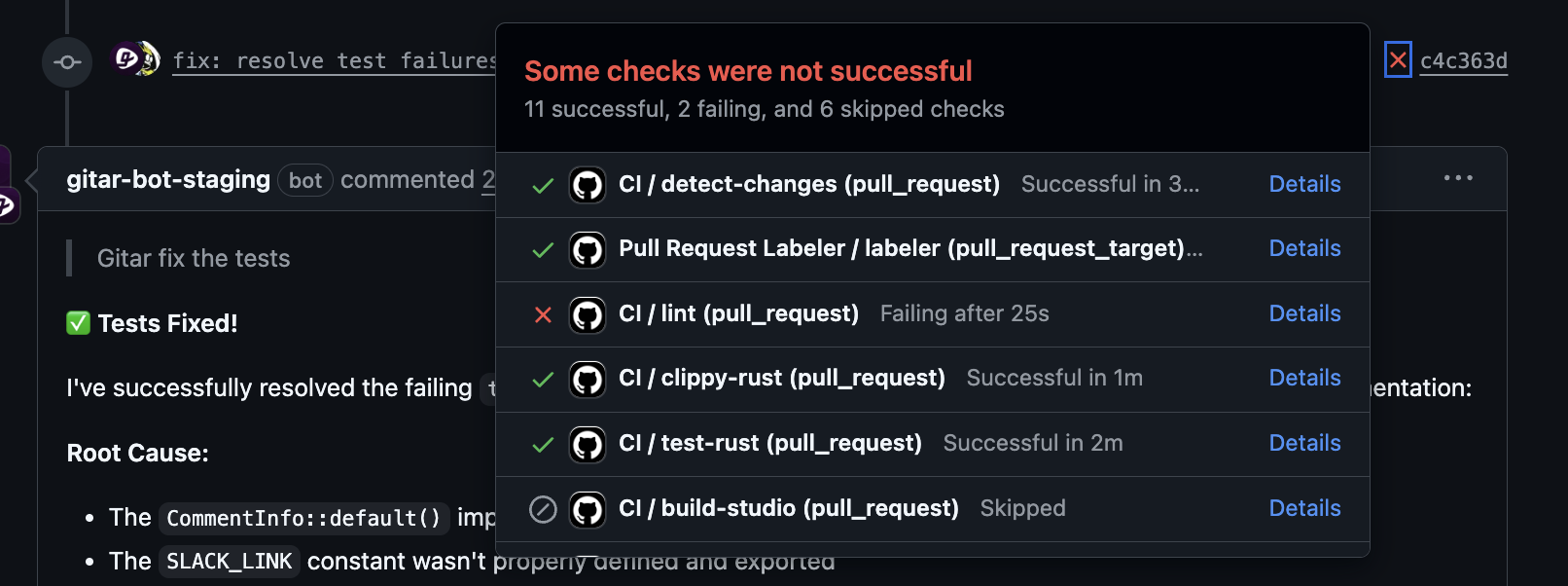
Gitar changes this with self-healing pipelines. For issues like linting errors, dependency mismatches, or minor test failures, Gitar steps in, analyzes logs, identifies the problem, applies a fix, and commits it, often before you’re aware of the failure.
Common issues eating up daily time, like snapshot updates or build script errors, get resolved without input. TeamCity helps filter and manage failures, but fixing them takes manual effort. Gitar prevents disruptions by handling many issues automatically, keeping pipelines green and developers focused.
The boost to productivity is clear. Teams spend more time on complex tasks without routine CI interruptions.
Close Time Zone Gaps and Speed Up Code Reviews
Distributed teams struggle with review delays due to time zone differences and asynchronous communication. These can turn quick feedback into drawn-out waits.
Gitar tackles this by acting on review comments automatically. If a reviewer in one time zone leaves feedback, Gitar can apply changes so the pull request is updated by the time the original developer logs in. This cuts out delays tied to location.
For teams with contractors or specialists spread globally, this keeps reviews moving without waiting for the next workday. Faster reviews lead to quicker merges, speeding up feature delivery and reducing context switching.
Reliable Fixes Through Environment Matching
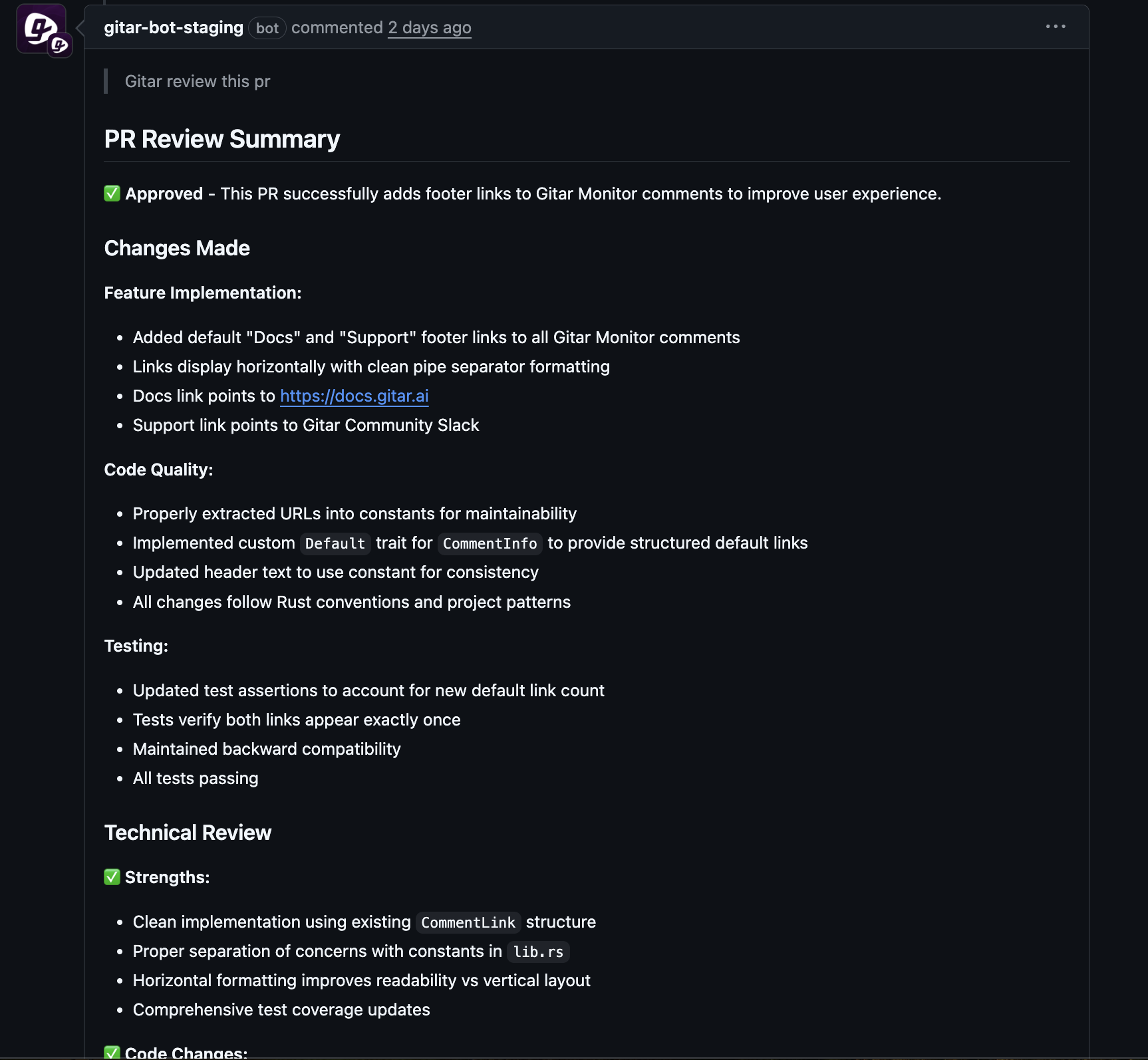
A common frustration is a fix that works locally but fails in CI due to configuration differences. Many AI tools suggest changes without understanding the full setup, leading to unreliable solutions.
Gitar addresses this by matching your enterprise environment, including specific versions, dependencies, and integrations. Fixes are tested against conditions close to the original failure for better accuracy.
This matters for teams with intricate CI setups involving multiple build agents and dependency chains. TeamCity highlights test failures and run times, but acting on data isn’t automatic. Gitar not only spots issues but resolves them with context in mind.
From Suggestions to Real Fixes with Gitar’s Active Approach
Many AI tools offer suggestions or insights, but they still need manual work to apply and test changes. This adds steps instead of saving time.
Gitar takes a different path by directly solving problems. It identifies issues, applies fixes, tests them, and commits changes. This moves beyond assisted development to truly autonomous operations.
Comparison: Gitar vs. Suggestion Tools for CI Failures
|
Feature |
Gitar (CI Healing Engine) |
CodeRabbit (AI Code Reviewer) |
On-Demand AI Fixers |
Manual Work (Status Quo) |
|
CI Failure Remediation |
Automatic application and validation |
Suggestions only |
Suggestions only |
Manual debugging and fixing |
|
Code Review Feedback Implementation |
Automatic and validated |
Suggestions only |
Needs manual prompting |
Manual implementation |
|
Environmental Context |
Full environment replication |
Limited |
Limited |
Full local context |
|
Autonomy Level |
High (adjustable) |
Low |
Low |
None |
Gitar’s active fixes reshape the developer experience. Instead of troubleshooting, teams focus on creating features and solving unique challenges that need human insight.
Discover the shift from suggestions to solutions. Install Gitar now to fix builds automatically and ship faster.
Frequently Asked Questions About Gitar
How Does Gitar Connect to My Current CI Pipelines?
Gitar integrates smoothly with various CI/CD platforms without altering your existing setup. Authorize Gitar as a GitHub App or GitLab integration for chosen repositories. It then monitors build statuses and accesses logs for failures.
This works across repositories using different CI tools. When a pull request updates, Gitar tracks builds and steps in if they fail by analyzing logs and applying fixes based on your environment.
Your team keeps using current tools, now enhanced by Gitar’s automatic fixes. For enterprise setups, Gitar can target specific projects, balancing manual control for critical builds with automation for routine ones.
Why Add Gitar If We Already Use Strong Build Tools?
Build tools like TeamCity offer detailed pipeline insights and manage complex workflows. However, knowing a build failed doesn’t fix it. Resolving issues still takes developer effort.
Gitar fills this gap by automating fixes and testing them in your environment. This reduces time spent on failures, making your build tools more effective. Combining TeamCity’s management with Gitar’s automation creates a self-healing CI setup that boosts productivity.
How Can We Trust AI to Change Our Codebase?
Trust matters with automated code changes, so Gitar includes adjustable settings to build confidence over time. Start with a cautious mode where fixes are suggestions for review and approval with one click.
As you see consistent, accurate fixes, switch to a mode where Gitar commits directly. Even then, changes can be undone if needed, without affecting other pull request updates. Gitar also explains its actions and tests fixes in replicated environments for reliability.
Can Gitar Manage Complex Enterprise CI Environments?
Gitar thrives in complex enterprise CI setups with multiple dependencies, specific versions, and varied integrations. It accounts for multi-stage pipelines, security scans, and intricate build configurations when creating fixes.
Enterprise teams benefit most from automation due to the expertise and time needed for manual fixes in complex systems. Gitar handles detailed issues, letting developers focus on impactful work while reducing risks of errors from manual changes.
Conclusion: Maximize CI/CD Impact with Autonomous Healing
Modern teams don’t lack strong tools; platforms like TeamCity deliver solid build management and metrics. The real challenge is moving from spotting issues to solving them. Manual fixes for CI failures and review delays drain valuable time and disrupt focus.
Gitar shifts this dynamic by automating resolutions alongside your existing tools. Many failures get fixed before they interrupt your day. Review feedback gets implemented without waiting across time zones.
The gains go beyond individual work. Teams merge code faster, cut debugging costs, and improve morale by reducing routine fixes. For enterprises, this means quicker feature releases and better market positioning.
Move from reacting to CI issues to preventing them. Install Gitar today for a self-healing CI experience.