
Managing CI/CD pipelines across multiple environments often slows down engineering teams. Code must navigate development, staging, production, and sometimes disaster recovery setups, each with unique configurations and potential issues. This complexity can stall deployments and drain productivity. Handling pipelines across diverse clusters creates operational hurdles and delays. This article dives into how autonomous CI fixes can streamline multi-environment workflows, speed up deployments, and cut operational costs.
Why Multi-Environment CI/CD Creates Headaches
Environment Drift Disrupts Consistency
Environment drift, where configurations and dependencies differ between setups, causes major inconsistencies. Code that runs smoothly in development might fail in staging due to a mismatched Kubernetes version or a missing variable in production. Variations in manifests and Helm charts lead to unpredictable outcomes across clusters.
For instance, an app might deploy fine in development with Node.js 18.0, but staging could use Node.js 16.14, while production runs a different containerized setup. These differences turn each environment into a potential failure point. Configuration mismatches and security variations often cause pipeline failures and rollbacks. Developers end up fixing issues in one environment, only to face new problems in the next, wasting time and effort.
Context Switching Slows Down Progress
Multi-environment CI/CD increases the mental load on developers. A minor linting error in development might be a quick fix, but if the same code fails in production due to different rules, the time and focus needed to resolve it multiply. Teams can lose 10 to 20 hours per month per developer on environment-specific issues.
The real cost comes from constantly shifting focus. A developer working on a feature must suddenly troubleshoot production setups or staging database differences. This disruption breaks concentration and turns simple deployments into long debugging tasks. Automating code promotion across environments helps developers stay focused on features instead of fixes. Yet, many teams lack the tools to fully automate this process.
Manual Fixes Drive Up Costs
The financial burden of multi-environment CI/CD goes beyond lost time. Shared testing environments often cause conflicts and failed deployments. Each failure delays releases, impacts customers, and requires extra effort to fix.
For a team of 20 developers, environment issues might take 5 to 10 hours per person monthly. At $200 per hour, that’s $20,000 to $40,000 in lost productivity each month, not counting delays in projects or drops in team morale. Costs also rise from troubleshooting, redundant infrastructure, and compliance risks. Traditional CI/CD tools treat environments separately, leading to repetitive fixes and a lack of trust in automation.
How Gitar Solves CI/CD Challenges with Autonomous Fixes
Standard solutions for multi-environment CI/CD focus on better tools or processes, but they still demand manual work when issues arise. Autonomous fixes take a different path by removing the need for manual debugging entirely.
Gitar turns CI/CD pipelines into a self-correcting system. Its AI agent detects CI failures, analyzes the context, applies fixes, and validates them across the workflow. This approach frees developers to focus on coding features, not fixing pipelines.

Install Gitar now to fix broken builds automatically and ship quality software faster.
Key Features for Tackling CI/CD Issues
Gitar offers specific capabilities to handle multi-environment complexities. Here’s what it brings to the table:
- Accurate emulation of enterprise workflows, including specific JDK versions, multi-SDK setups, and third-party tools like SonarQube or Snyk.
- Complete fix application and validation across all CI jobs, delivering ready-to-merge pull requests.
- Compatibility with platforms like GitHub Actions, GitLab CI, CircleCI, and BuildKite for broad usability.
- Flexible trust settings, allowing teams to start with suggestions and move to full auto-commits as confidence grows.
- Deep integration with local developer contexts for precise fixes tailored to the entire pipeline.
Benefits of Using Gitar for CI/CD Support
Stop Failures with Automatic Fixes
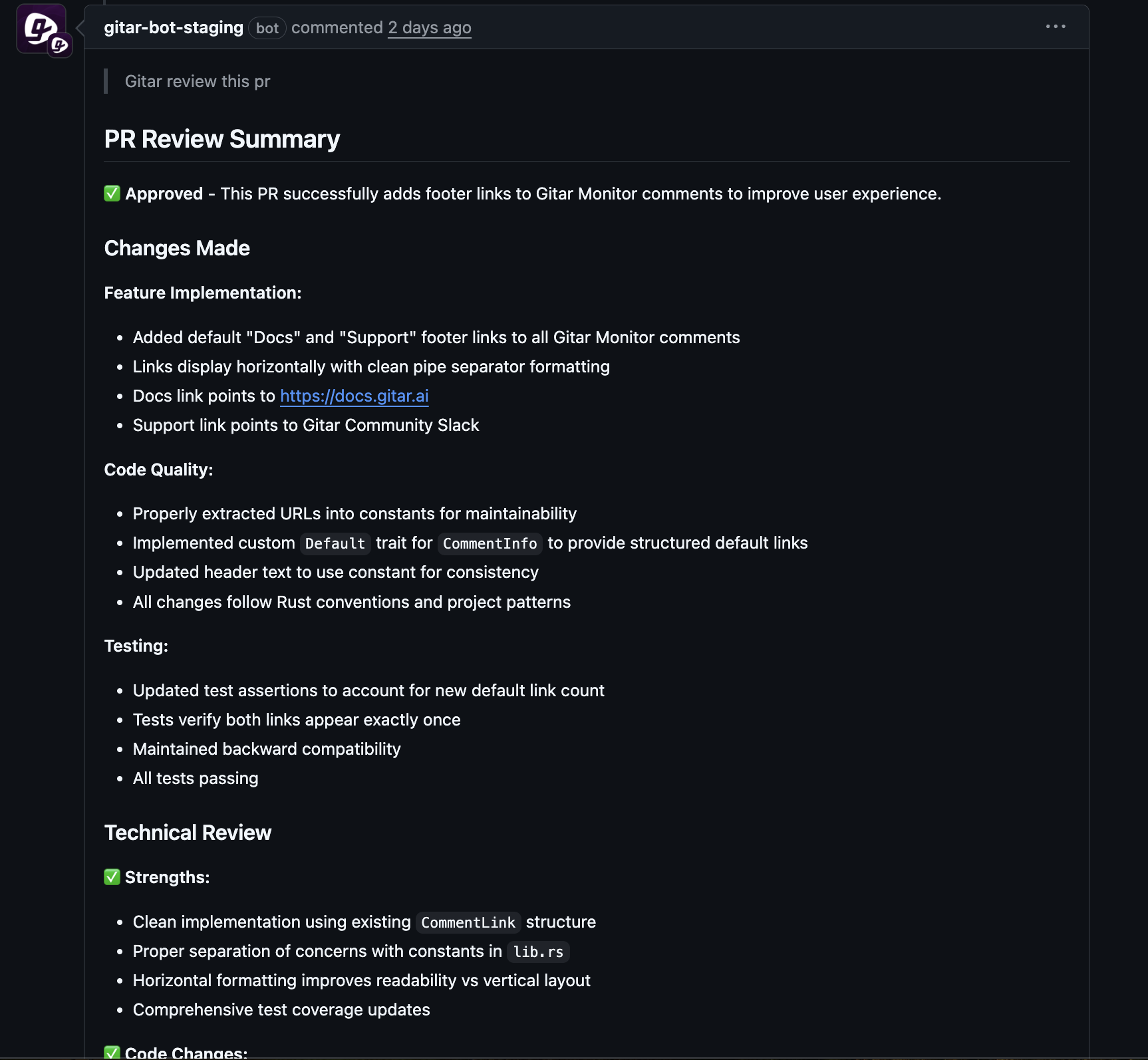
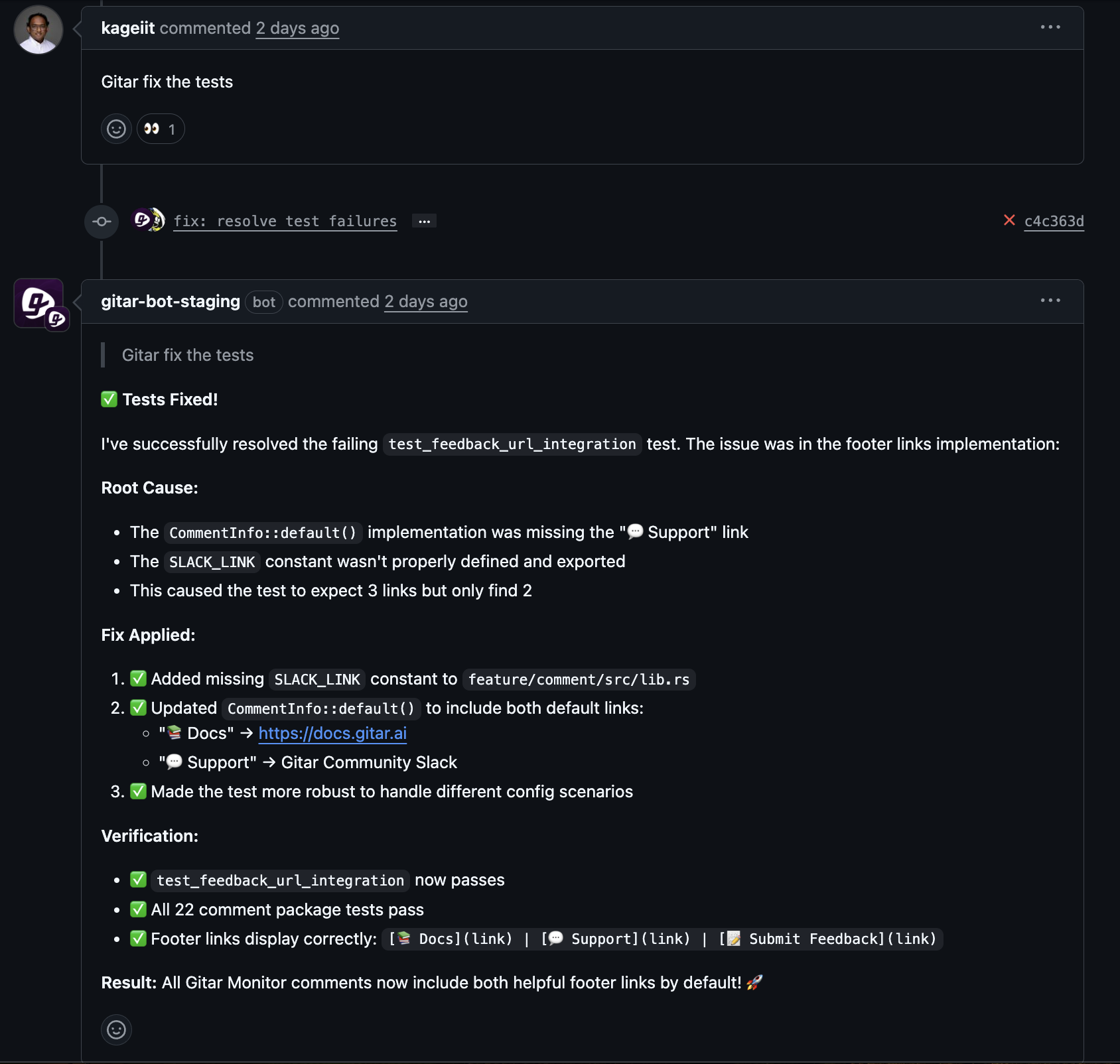
CI/CD failures often stem from subtle issues that are hard to pinpoint. Gitar analyzes these problems and applies targeted solutions. If a build fails due to a missing dependency, Gitar identifies the issue and fixes it with the right configurations.
This eliminates the typical debugging loop where developers investigate, test locally, and cross their fingers. Fixes are crafted with full awareness of environment conditions and checked against real pipeline setups.
Speed Up Deployments and Cut Context Switching
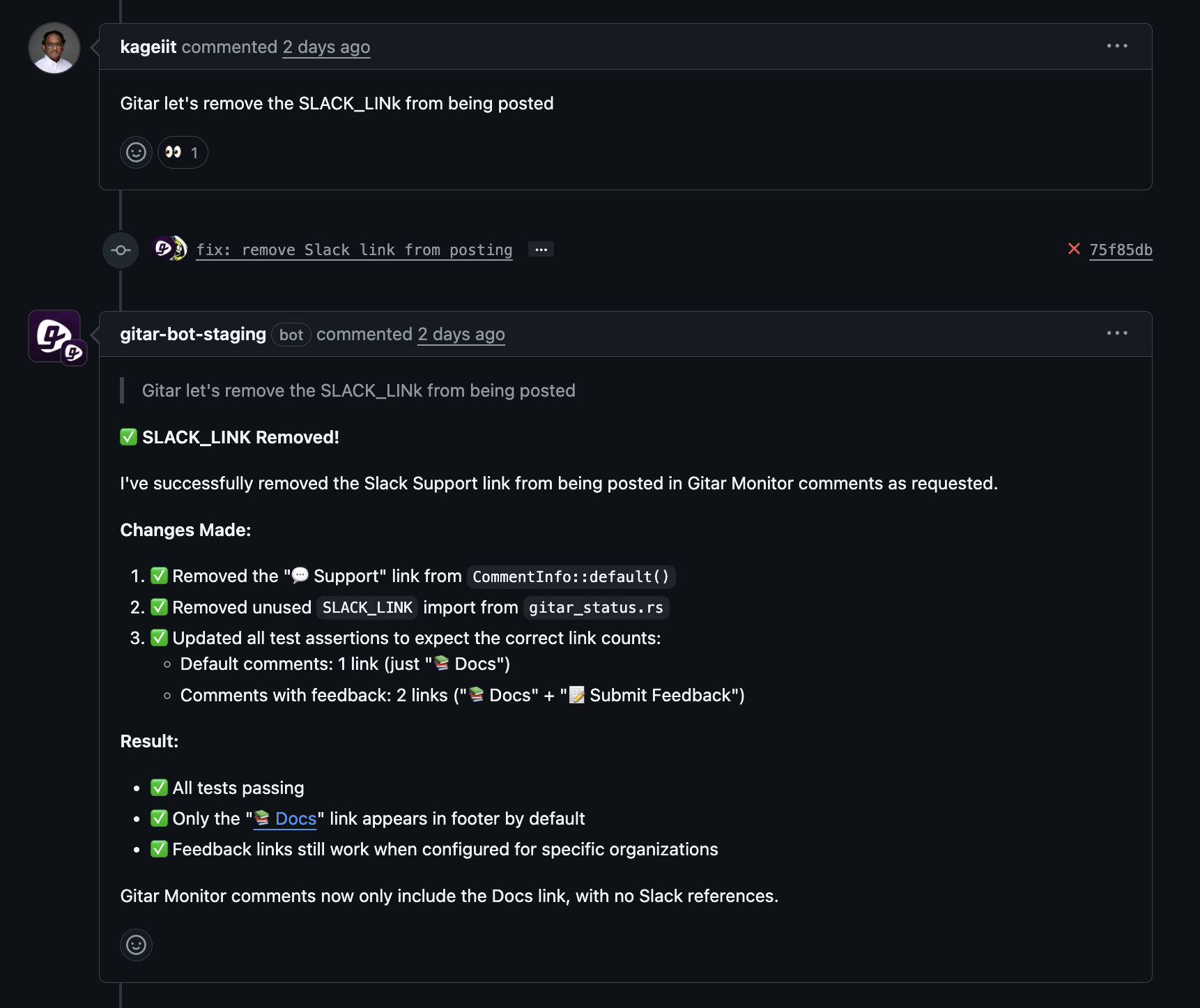
CI/CD pipelines often force developers to juggle multiple tasks. A failure means pausing feature work to troubleshoot. Gitar handles these disruptions automatically, so developers don’t need to shift focus. If a deployment hits a snag, Gitar resolves it without interrupting workflows.
This boosts deployment speed by reducing both individual fix times and the cumulative impact of repeated interruptions.
Lower Costs and Boost Team Morale
CI/CD complexity impacts budgets through wasted time, infrastructure expenses, and delayed releases. Gitar cuts these costs by reducing failed attempts and ensuring consistent results. Fewer failed runs mean lower CI expenses and less need for urgent fixes.
Developers also benefit from less frustration. Handling repetitive CI issues saps energy, but Gitar frees them to focus on creative work, improving overall job satisfaction.
How Gitar Stands Out from Traditional CI/CD Tools
Many CI/CD solutions still rely on manual effort to resolve issues. Gitar shifts the focus from speeding up debugging to eliminating it with a self-correcting system.
|
Approach |
Environment Context |
Fix Implementation |
Validation Method |
|
Manual Debugging |
Limited to Developer Knowledge |
Manual Code Changes |
Trial and Error |
|
CI Suggestion Tools |
Basic Environment Awareness |
Needs Developer Review |
Manual Testing |
|
Gitar Autonomous Fixes |
Full Environment Replication |
Automatic and Validated |
Full Pipeline Testing |
Manual methods depend on developers knowing every pipeline detail, which doesn’t scale with growing complexity. Suggestion tools offer helpful ideas but often lack full validation. Automating code promotion with minimal human input reduces errors and distractions. Gitar goes further by managing the entire fix process, ensuring consistent results across pipelines.
Install Gitar now to fix broken builds automatically and ship quality software faster.
Setting Up Gitar for Reliable CI/CD Support
Start Simple and Build Confidence
Getting started with Gitar is straightforward. Authorize it as a GitHub App on chosen repositories and use the web dashboard to tweak settings. Begin with a suggestion-only mode to see how fixes work, then shift to full automation as trust grows.
Tailor Automation to Your Needs
CI/CD scenarios vary, and Gitar offers adjustable automation levels. Teams can auto-apply fixes for minor issues like linting while requiring approval for larger changes. This balance maximizes efficiency without sacrificing oversight.
Track Performance with Clear Insights
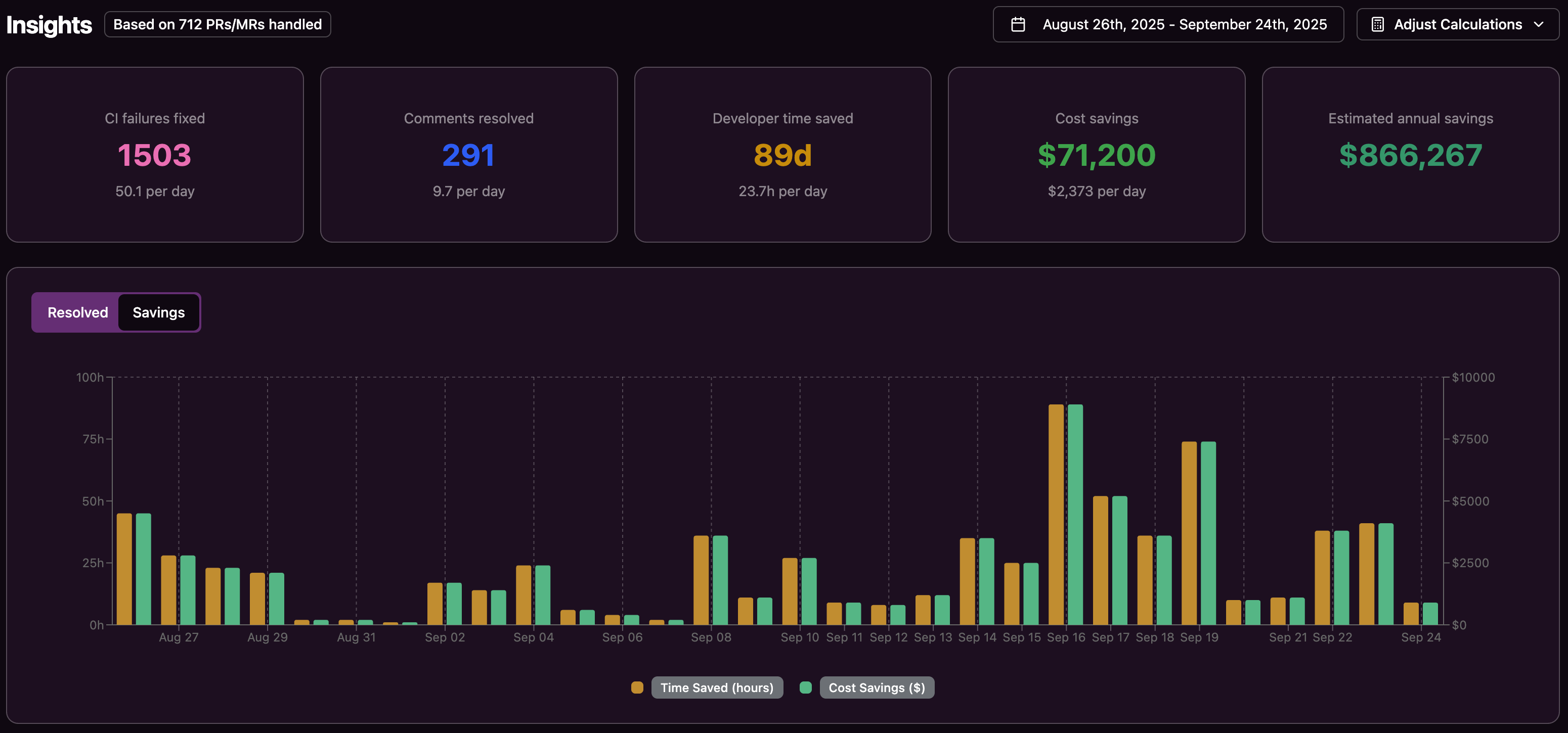
Visibility into CI/CD processes matters. Consistent observability across pipelines is essential for effective management. Gitar provides data on fix success rates, failure trends, and performance stats, helping teams spot recurring issues and refine workflows.
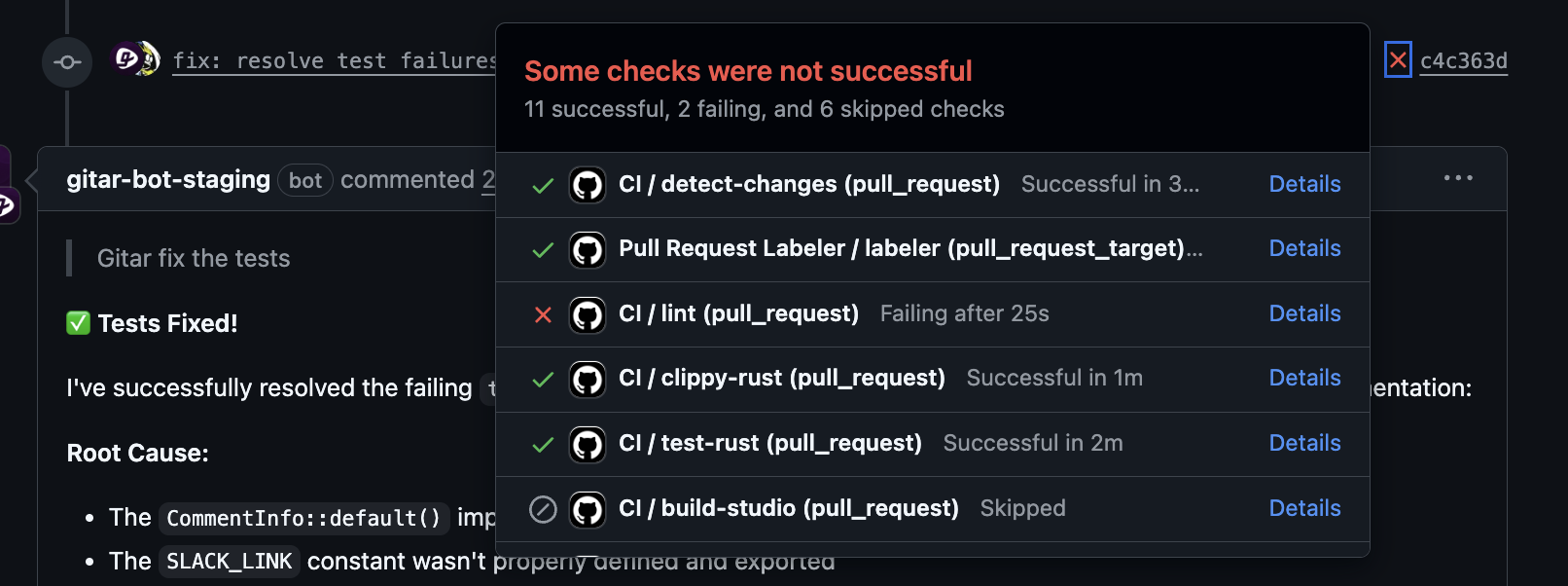
Track Improvements in Your CI/CD Workflow
Measure What Matters
Autonomous fixes should show clear gains in key areas. Focus on these metrics:
- Deployment speed, from commit to successful rollout.
- Accuracy of fixes for common pipeline issues.
- Reduction in developer interruptions from CI failures.
- Lower infrastructure costs from fewer failed runs.
Calculate Your Return on Investment
Time saved with autonomous fixes adds up fast. For a 20-developer team, the productivity boost can mean significant yearly savings, alongside better deployment reliability and happier engineers.
Install Gitar now to fix broken builds automatically and ship quality software faster.
Common Questions About CI/CD Support with Gitar
Can Gitar Handle Complex CI/CD Setups?
Gitar thrives in intricate environments by mirroring specific setups, including JDK versions, multi-SDK dependencies, and tools like SonarQube. Fixes are tailored to fit your exact workflow, minimizing errors.
How Does Gitar Differ from Other AI Code Reviewers?
Unlike AI reviewers that only suggest fixes, Gitar applies solutions and validates them across the entire CI pipeline. This prevents the common issue of suggested fixes failing to resolve problems fully.
How Does Gitar Reduce Context Switching?
CI failures often pull developers away from their main tasks. Gitar handles these issues automatically, analyzing problems and applying fixes without any interruption to workflows. Developers stay focused on building features.
What About Security and Compliance Needs?
Gitar supports security by generating environment-aware fixes and offering adjustable automation levels. Teams can set policies for manual approvals on sensitive changes while automating routine fixes, aligning with compliance needs.
Streamline CI/CD with Autonomous Solutions
CI/CD complexity hinders productivity with pipeline issues and constant debugging. Gitar moves beyond assistance to full automation, replicating environments, applying fixes, and validating results across pipelines. This shift turns CI/CD into a predictable process that speeds up deployments and reduces costs.
The impact goes beyond time savings, improving team satisfaction, cutting infrastructure expenses, and ensuring reliable releases. As development grows more intricate, automating CI/CD becomes essential. Teams adopting Gitar gain an edge in speed, reliability, and efficiency.
Ready to remove CI/CD obstacles and create a self-healing pipeline? Install Gitar now to fix broken builds automatically and ship quality software faster.