
AI-assisted coding speeds up development, but it often creates bottlenecks with broken CI builds and prolonged code review cycles. These issues drain time and focus from engineering teams. This article explains the impact on productivity and introduces Gitar, an autonomous tool that fixes CI failures and resolves review feedback, helping teams deliver merged code faster.
Why AI Coding Tools Create Hidden Productivity Issues
Faster Code, Slower Merges: The Validation Bottleneck
AI tools like GitHub Copilot and Cursor enable developers to write code quickly, producing more functions and modules in less time. However, this speed shifts the challenge to validating and merging code. With more pull requests and tests to run, the likelihood of CI failures increases, slowing down the delivery process.
This shift means that while coding is faster, the overall time to merge grows due to frequent CI runs and potential errors. The outcome is a frustrating cycle where rapid development doesn’t translate to faster releases.
CI Failures: A Constant Disruption to Workflow
Submitting a pull request often ends with failed builds, forcing developers to debug issues instead of focusing on new tasks. These failures come in many forms and disrupt daily work.
Typical CI problems include syntax errors, dependency conflicts, misconfigured build tools, and inconsistent test results. Developers must pause their work, analyze error logs, apply fixes, and resubmit, hoping for a successful build on the next attempt.
The unpredictability of these failures adds to the frustration. Random issues and retries cause delays, made worse by the need to switch contexts repeatedly. A process that should be quick turns into a time-consuming obstacle.
Code Reviews: Delays from Time Zones and Manual Fixes
Manual code reviews slow down progress, especially for teams spread across different regions. A developer in one time zone might wait hours or days for feedback from a colleague elsewhere, stretching simple tasks into lengthy delays.
Even with AI review tools, the burden of applying suggested changes falls on developers. These tools point out issues, but the actual fixes and validation remain manual, creating a repetitive cycle of feedback and corrections.
This constant back-and-forth pulls developers away from creative work, adding mental strain. Small changes become significant drags on productivity due to the effort of switching tasks.
Why Existing AI Tools Don’t Fully Solve the Problem
Despite the rise of AI development tools, core productivity hurdles remain. Developers can spend a large portion of their day on CI issues and code reviews. Most AI solutions only offer suggestions, leaving the final steps of implementation and validation to humans.
These manual steps delay project timelines, affecting overall delivery speed. The gap lies in the inability of current tools to fix and verify solutions within complex CI/CD environments, keeping the process incomplete.
Install Gitar now to automate build fixes and ship software faster.
Meet Gitar: Your Tool for Automated CI and Review Fixes
Gitar moves beyond suggestion-based AI by automatically resolving CI failures and applying code review feedback. It acts as a hands-off solution, ensuring pull requests pass quality checks without developer intervention.

Key capabilities that make Gitar different include:
- Complete Fix Application: Automatically applies and verifies fixes across full CI workflows, ensuring builds succeed.
- Environment Matching: Replicates specific setups, like JDK versions and dependencies, for accurate solutions tailored to your system.
- Review Feedback Automation: Implements changes from reviewer comments, supporting teams across time zones.
- Flexible Automation Levels: Offers options from manual approval of suggestions to fully automated commits with rollback features.
- Broad Platform Compatibility: Supports GitHub Actions, GitLab CI, CircleCI, BuildKite, and more, fitting varied setups.
Unlike tools that only suggest fixes, Gitar takes full responsibility for resolving issues, validating them in your pipeline, and preparing pull requests for merge. This automation cuts down manual effort significantly.
Book a demo to see Gitar fix your broken CI builds automatically.
How Gitar Improves Your Development Process
Reduce Context Switching and Stay Focused
Gitar helps developers avoid interruptions by handling CI issues in the background. After submitting a pull request, you can move to the next task without worrying about build failures breaking your concentration.
With Gitar monitoring and fixing issues as they occur, developers stay focused on high-value coding tasks. This uninterrupted workflow boosts productivity by preserving mental focus.
Speed Up Merges and Increase Team Output
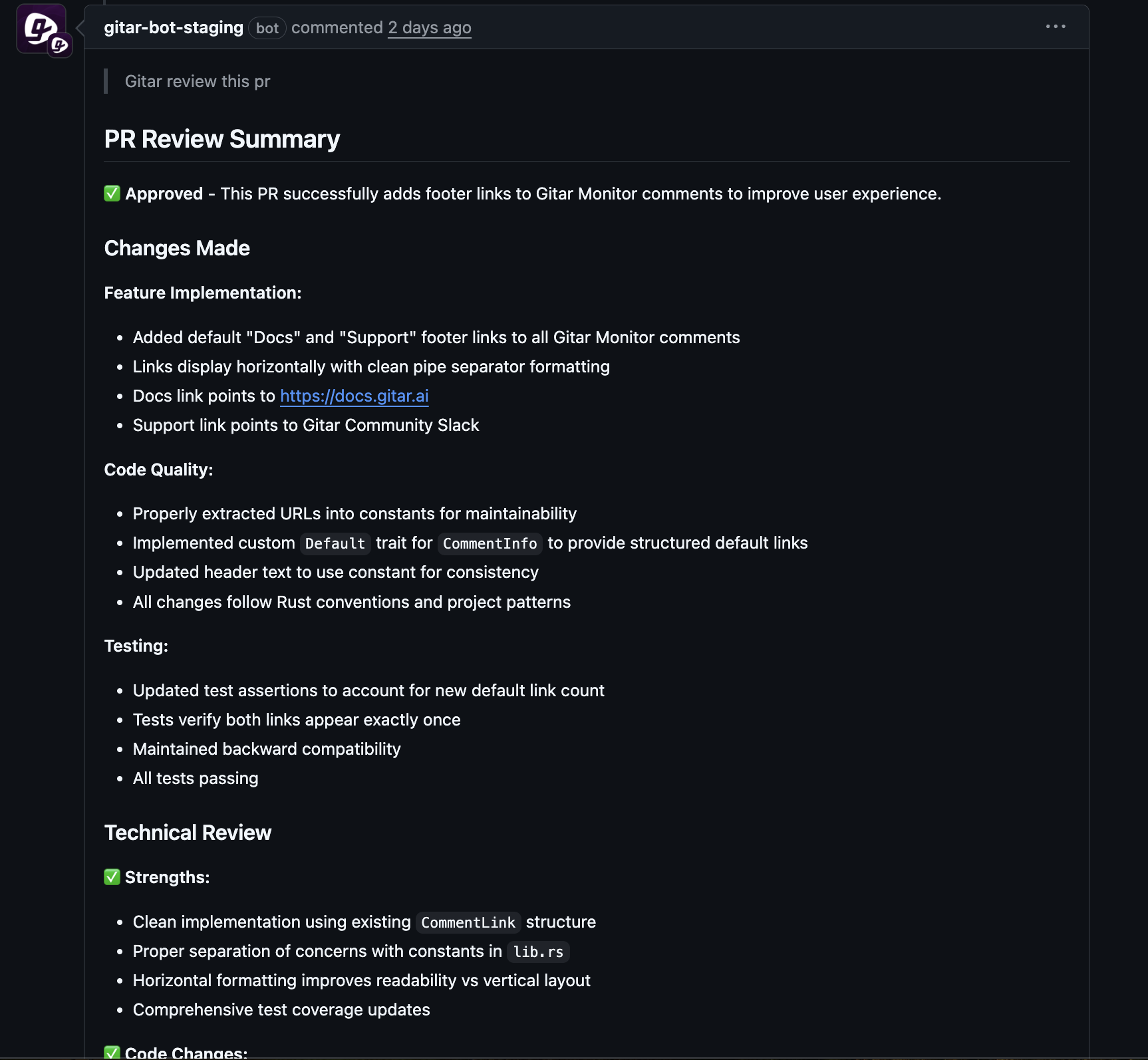
Gitar shortens the time from commit to merge by automating fixes and feedback implementation. Traditional workflows involve multiple delays as developers wait for CI results or reviewer comments. Gitar eliminates these waits.
Resolved issues and applied feedback mean pull requests progress quickly. Faster merges improve overall team output, allowing features to reach production sooner and supporting larger project goals.
Fix CI Issues Automatically with Confidence
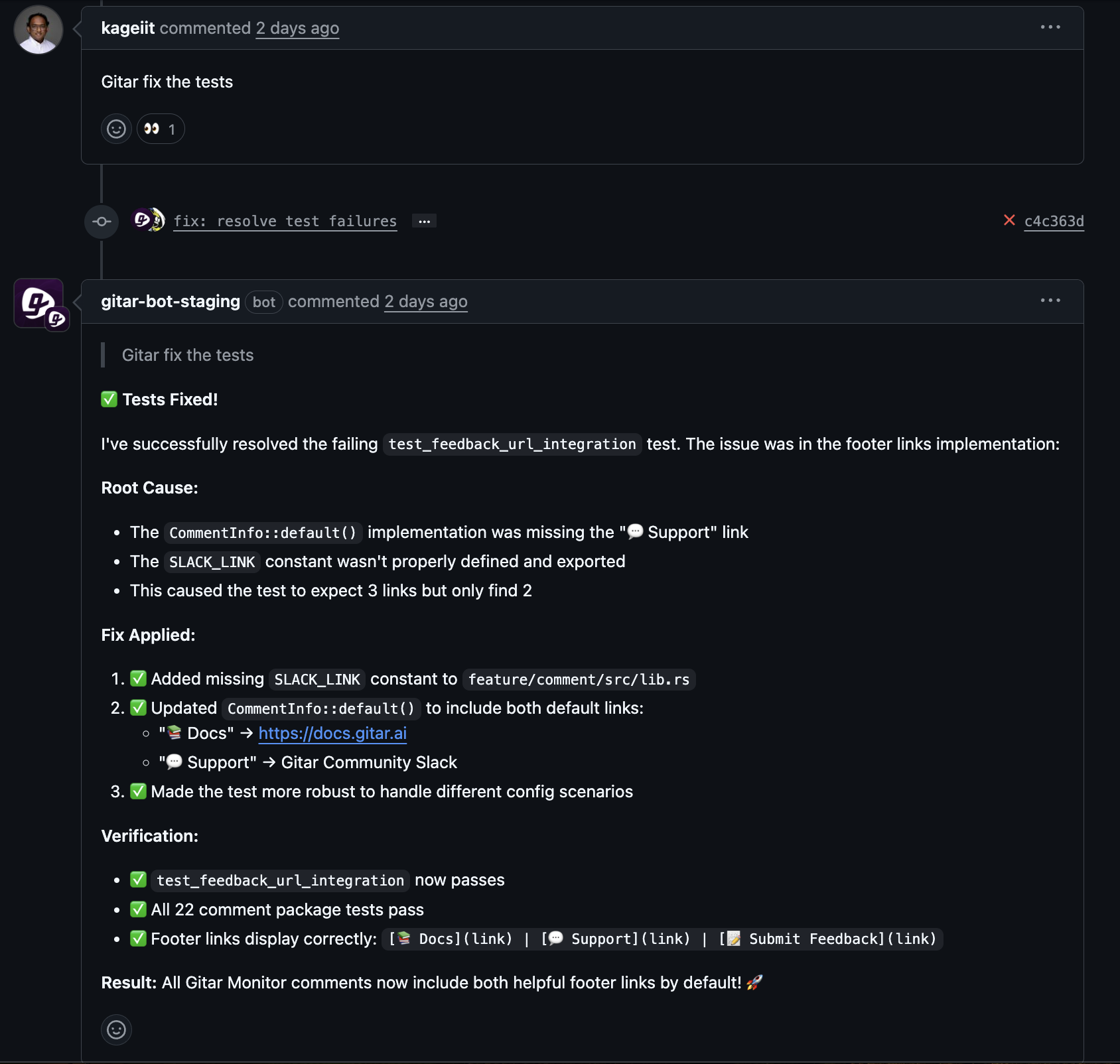
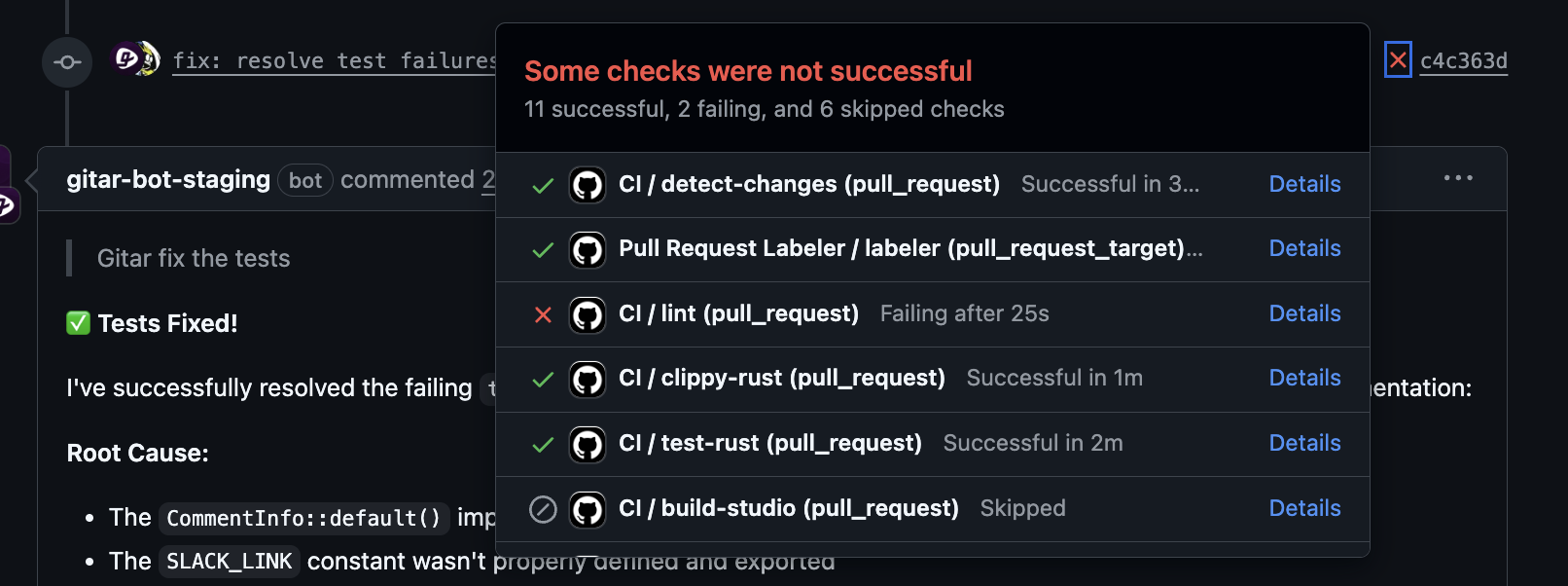
Gitar tackles a variety of CI failures, from linting errors to test issues and build script problems. Each fix is tested within your specific pipeline, ensuring reliability before submission.
This thorough validation covers test suites, formatting rules, and build checks. Fixes align with your environment, providing quick and dependable results for consistent build success.
Support Distributed Teams with Seamless Progress
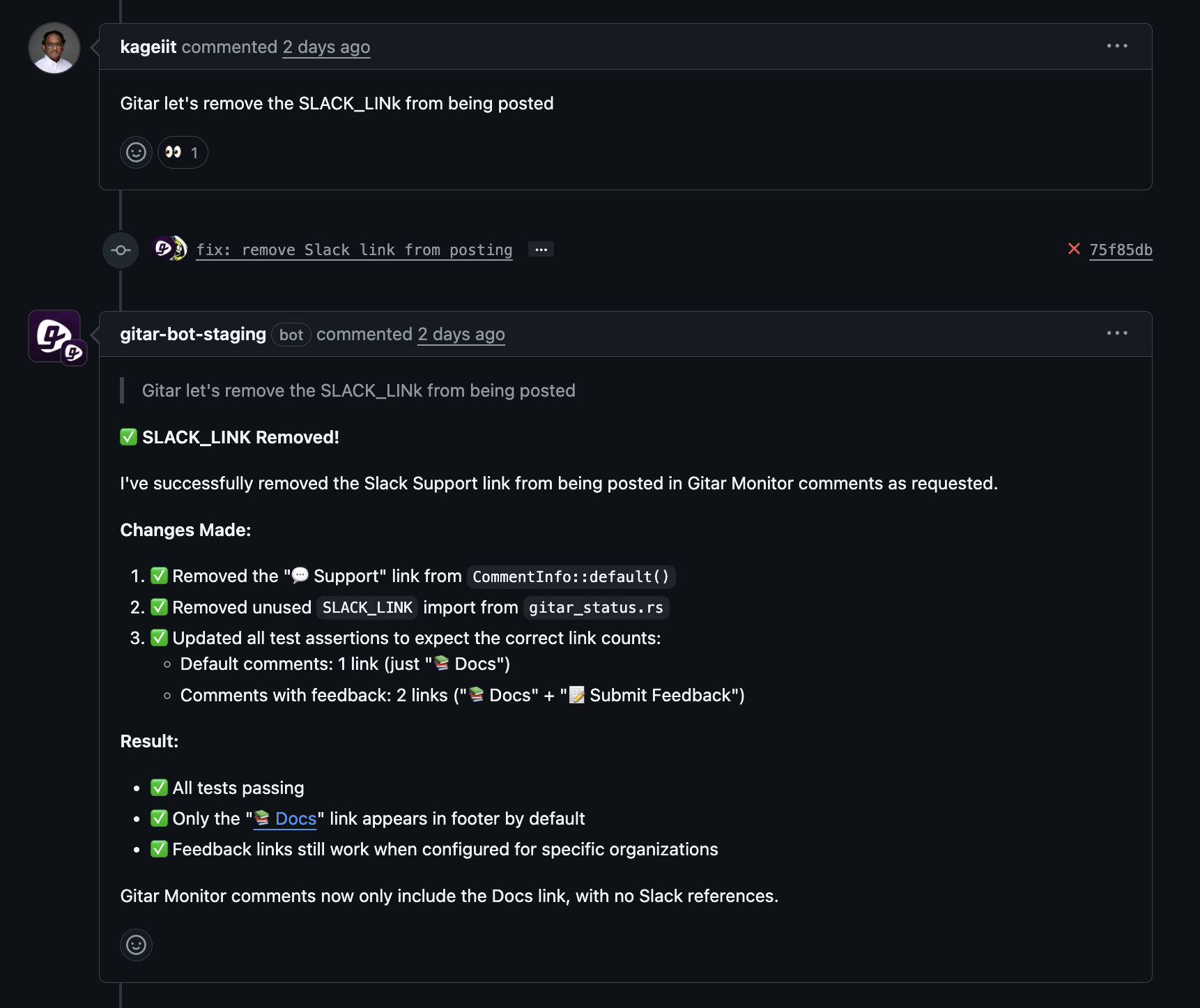
Gitar bridges time zone gaps for distributed teams by acting on feedback instantly. Whether a reviewer comments overnight or across continents, changes are applied before the original developer returns.
This reduces delays in feedback loops, ensuring continuous progress. Teams benefit from smoother collaboration, with pull requests advancing regardless of individual availability.
Gitar Compared: Automation vs. Manual Suggestions
Gitar stands out from other AI tools by fully automating fixes rather than just suggesting them. Here’s how it measures up against alternatives:
|
Feature |
Gitar (Automated Fixes) |
AI Code Reviewers (e.g., CodeRabbit) |
On-Demand AI Fixers (e.g., Claude GitHub Action) |
|
Fixes Builds Automatically |
Yes (Applies & Validates) |
Partial (Needs Configuration) |
No (Manual Trigger) |
|
Handles Review Feedback |
Yes (Fully Automated) |
Partial (Limited Automation) |
No (Human Required) |
|
Replicates CI Environment |
Yes |
No |
Partial |
|
Guarantees Build Success |
Yes |
No |
No |
Gitar’s ability to take full ownership of fixes and validation sets it apart. Other tools leave gaps by requiring manual steps, while Gitar ensures solutions work in your specific setup.
Install Gitar now to automate build fixes and ship faster.
The Cost of CI Delays and Gitar’s Value
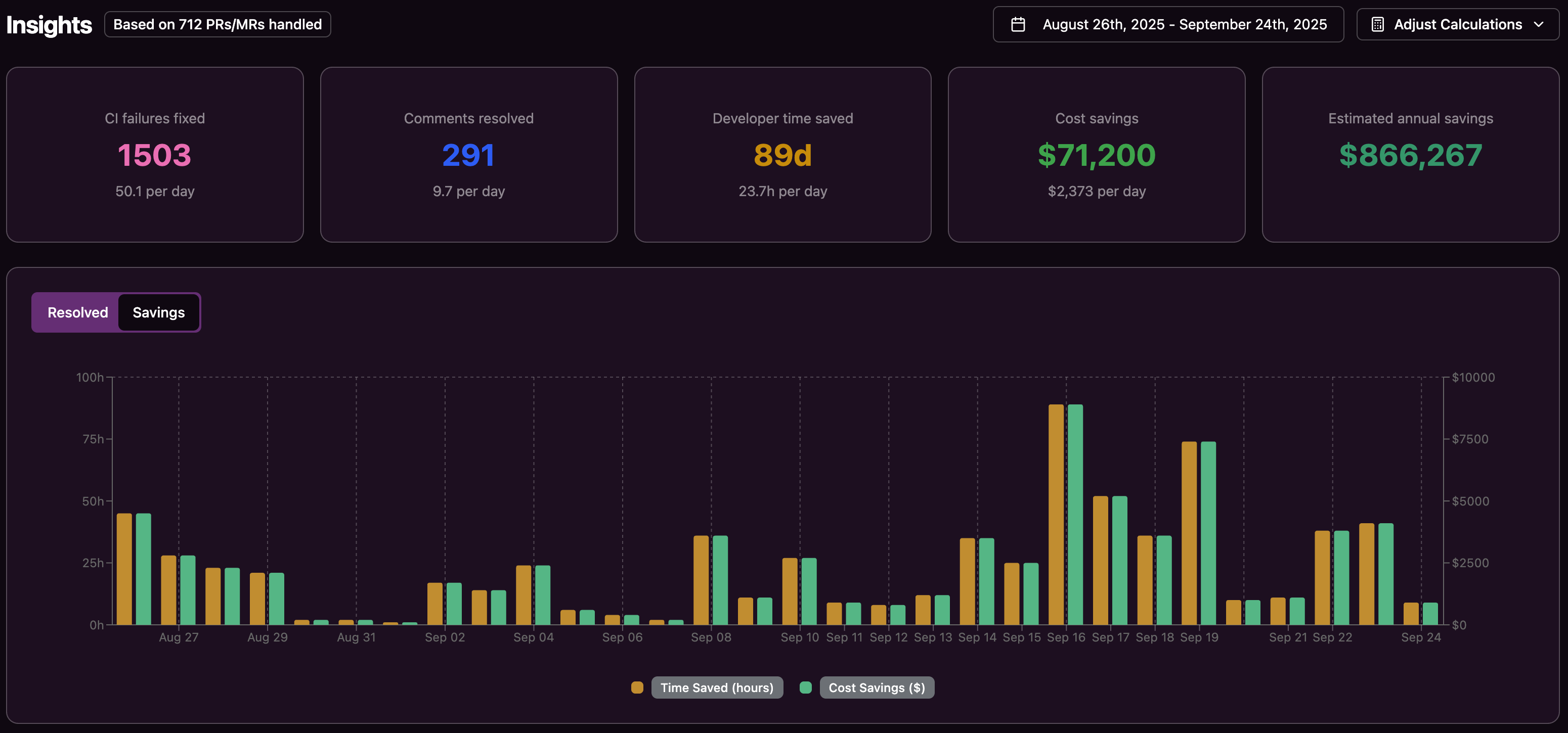
CI and review delays have a measurable financial impact. For a 20-developer team, spending just one hour daily on these issues adds up to 5,000 hours yearly.
With an average developer cost of $200 per hour, this equals $1 million in lost productivity annually for one team. Larger organizations face even greater losses from these recurring obstacles.
Additional costs include delayed features, slower market delivery, and missed innovation opportunities. Gitar reduces these expenses by automating repetitive tasks, saving time, and improving team satisfaction.
Getting Started with Gitar: Building Trust in Automation
Gitar’s implementation starts with a cautious approach to ease concerns about automated changes. Initially, it suggests fixes for review and approval, allowing teams to assess its accuracy.
As confidence grows, teams can shift to more automated settings. Rollback options and customizable policies ensure control, letting you decide which fixes need oversight and which can be applied directly.
This adaptability supports existing workflows. Senior developers can set feedback for automatic implementation, balancing efficiency with team preferences.
Looking Ahead: From Fixes to Workflow Improvements
Gitar not only resolves immediate CI and review issues but also paves the way for better development practices. It helps maintain efficiency as code volume grows with AI tools.
Adopting automated validation gives teams a speed advantage. Over time, moving from manual to autonomous processes will redefine how software is built and delivered.
Common Questions About Automated CI Fixes with Gitar
How Does Gitar Differ from Tools Like GitHub Copilot?
GitHub Copilot speeds up initial code writing but doesn’t address downstream issues like CI failures or review feedback. Gitar focuses on the post-commit stage, automating fixes to ensure code passes quality checks without extra effort.
Can Gitar Handle Complex Enterprise CI Setups?
Gitar mirrors enterprise environments, supporting specific versions, dependencies, and custom tools. It runs full pipeline validations to confirm fixes work in your unique configuration.
How Does Gitar Build Trust for Automated Fixes?
Gitar offers adjustable automation levels, starting with suggestions for manual approval. As trust builds, you can enable automatic commits with rollback options, maintaining transparency about every change.
What CI Issues Can Gitar Resolve?
Gitar fixes linting errors, test failures, dependency issues, and build script problems. It validates each solution within your pipeline to ensure readiness for merging.
How Does Gitar Fit into Existing Workflows?
Gitar connects with platforms like GitHub and GitLab through standard APIs, requiring no changes to current setups. It communicates via pull request comments, offering status updates and accepting simple commands while respecting branch rules.
Final Thoughts: Boost Team Speed with Gitar
AI coding tools have increased code output, but CI and review bottlenecks remain a challenge. Gitar closes this gap by automating fixes and validations, shifting development from manual troubleshooting to efficient resolution.
Teams using Gitar see faster delivery and reduced frustration. Automating repetitive tasks frees developers to focus on impactful work, driving better outcomes.
As code generation grows, automated solutions like Gitar provide a clear edge. Teams adopting this approach ship features quicker and maintain streamlined processes.
Ready to fix broken builds and speed up delivery? Book a demo with Gitar today.