
Key Takeaways
- Manual CI failures and slow code reviews create a persistent productivity drag in modern software development quality assurance.
- Autonomous AI agents reduce context switching by applying and validating fixes directly in CI, instead of only suggesting code changes.
- Organizations that plan for trust, environment complexity, and integration see better outcomes from autonomous SDQA tools.
- Clear ROI emerges when teams quantify time lost to CI issues and review cycles, then compare it to autonomous fix rates.
- Teams can introduce autonomous CI fixes safely and incrementally by using Gitar, with a configurable trust model and fast setup, at https://gitar.ai/fix.
The Paradigm Shift: Why Traditional Software Development Quality Assurance Falls Short
The Engineering Reality: Navigating the CI/CD Gauntlet and Context Switching Tax
Most engineers know the cycle of pushing a pull request, watching CI fail on a missing dependency or flaky test, then diving into logs, reproducing the issue locally, making a small fix, and waiting for the pipeline again. What looks like a 10-minute fix often turns into a 30-minute interruption that breaks focus and flow.
Developers rarely submit a PR and then forget about it until merge. A new task starts, then CI failures or review comments drag the developer back. Context switching between tasks and tools creates mental overhead that often doubles the apparent cost of each interruption.
Distributed teams feel this even more. A PR opened on the US West Coast might wait for review in Bangalore, and a simple back-and-forth can stretch over several days. Traditional AI review tools amplify this by offering suggestions that still need manual implementation and validation.
Current AI-assisted tools, such as AI code reviewers or on-demand AI fixers, operate as suggestion engines rather than healing engines. Developers still implement fixes manually, trigger CI, and hope builds pass, so the productivity drain continues.
The Cost of Inefficiency in Software Development Quality Assurance
Teams often see up to 30% of developer time consumed by CI failures, test issues, and code review loops. This overhead becomes a direct business cost when project schedules slip and engineering budgets expand to cover rework.
Tools like GitHub Copilot and Cursor increase code output and create a right-shift effect. More code leads to more PRs, more tests, and more CI runs to manage. The main constraint shifts from writing code to validating and merging it efficiently.
Introducing Gitar: The Autonomous AI Agent for Self-Healing CI and Automated Software Development Quality Assurance
Gitar is an autonomous AI agent that focuses on the post-commit phase. It fixes failing CI pipelines and implements code review feedback so developers spend less time on repetitive validation work and more time on design and problem solving.
The platform turns manual, hour-long context switches into an automated background process. Teams see faster time to green builds, shorter review cycles, and fewer interruptions.
- End-to-end fixing: Gitar applies code changes, reruns workflows, and returns green pull requests instead of raw suggestions.
- Full environment replication: The agent emulates real CI conditions, including specific SDKs, dependencies, and tools such as SonarQube and Snyk, so fixes match production-like workflows.
- Configurable trust model: Teams can start with suggestions only, then progress to auto-commits with rollback as confidence grows.
- Distributed team optimization: Reviewers can request changes, and Gitar implements and validates them while teammates in other time zones are offline.
- Broad CI integration: Gitar connects with GitHub, GitLab, GitHub Actions, GitLab CI, CircleCI, BuildKite, and other major CI platforms.

See how Gitar fits into your existing SDQA workflows with a short demo.
Strategic Considerations for Adopting Autonomous Software Development Quality Assurance Solutions
Market Dynamics and the Rise of Agentic AI in Quality Assurance
AI and ML in quality management systems now enable real-time decisions and prediction of quality issues, helping teams move from reactive to proactive QA. Augmented analytics extracts insights that support continuous quality improvements and process optimization.
Analysts have noted that large enterprises increased adoption of AI-enabled test automation through 2024, and AI-driven QA already cuts testing time significantly. Shorter testing cycles influence release cadence and overall competitiveness.
Looking toward 2026, autonomous testing systems using AI and natural language processing are expected to generate, run, and resolve tests with limited human intervention. Organizations that add autonomous CI healing alongside autonomous testing will be better positioned to handle higher release volumes.
Build vs. Buy: Evaluating Autonomous Software Development Quality Assurance Solutions
In-house autonomous agents for CI environments must handle concurrent users and pipelines, asynchronous events, parallel stages that share state, and long-running context that survives force pushes and rebases. Building this correctly requires significant architecture, orchestration, and observability work.
Gitar provides an agent framework that already manages context, state, memory, and orchestration across complex CI workflows. Teams integrate it with GitHub, GitLab, and existing CI systems without creating or maintaining their own agent platform.
Organizational Change Management and Trust Building in Software Development Quality Assurance
Successful adoption of autonomous SDQA depends on trust. Gitar supports a phased rollout that starts with a conservative mode where the agent posts suggested changes for review and one-click acceptance. Teams then move to more automated modes after seeing a consistent record of small, correct fixes.
This incremental approach reduces resistance, keeps developers in control, and builds confidence in automated fixes before expanding scope.
Framework for Implementation Readiness and ROI Calculation for Software Development Quality Assurance
Assessing Your Organizational Readiness for Autonomous Solutions
Implementation readiness starts with understanding how CI issues affect day-to-day work. Teams can track how often developers stop deep work for CI triage, how long reviews wait for minor fixes, and how many builds fail for noncritical issues.
Key stakeholders include engineering managers focused on velocity and cost, DevOps and platform teams responsible for pipeline reliability, and developers who want to protect their flow state. Many organizations reach a tipping point when CI and review overhead creates visible schedule risk or when total time lost approaches the cost of an additional team.
Calculating the Tangible ROI of Autonomous Software Development Quality Assurance
A team of 20 developers that spends 1 hour per day on CI failures and code review fixes loses roughly 5,000 hours per year. At a loaded cost of 200 dollars per hour, that equals about 1 million dollars in productivity.
If an autonomous agent removes even half of that overhead, the organization recovers around 500,000 dollars annually. Additional benefits include higher morale, lower burnout, and faster delivery of features that generate revenue or customer value.
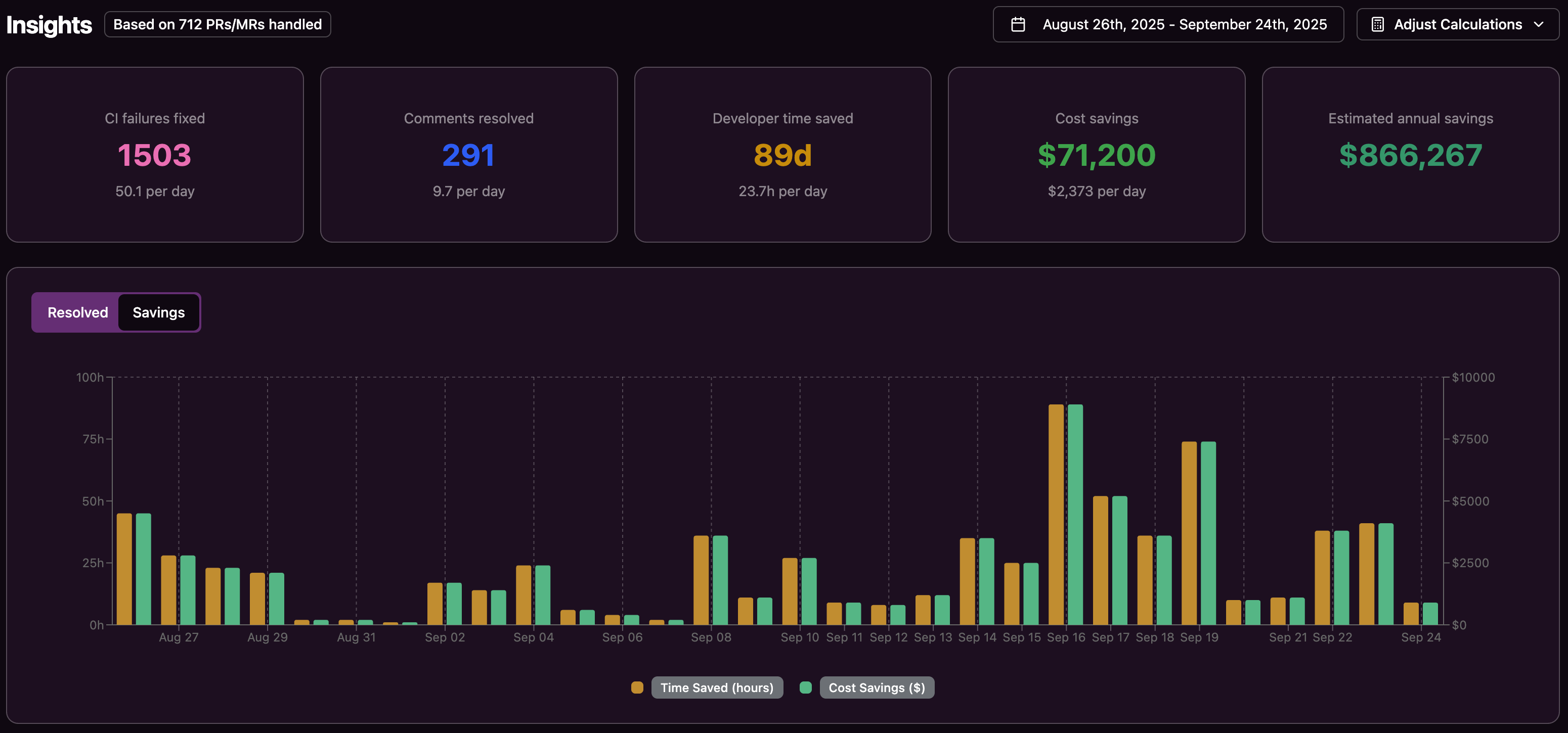
Comparison Table: Gitar vs. Traditional Approaches for Software Development Quality Assurance
|
Feature / Aspect |
Gitar (Healing Engine) |
AI Code Reviewers (e.g., CodeRabbit) |
On-Demand AI Fixers (e.g., Claude Action) |
|
Core Function |
Autonomous fixing and validation |
Suggestions and analysis |
Ad-hoc fix generation |
|
CI Integration |
Full and deep |
Varies by tool |
Limited CI context |
|
Environment Context |
Full replication (SDKs, dependencies) |
Limited |
Limited |
|
Automation Level |
Fully autonomous |
Suggestion-based |
Manual trigger |
|
Fix Validation |
Green builds before handoff |
Developer responsibility |
Developer responsibility |
|
Cost/Efficiency |
High ROI, reduced waste |
Requires manual effort |
Requires manual effort and CI minutes |
|
Trust Model |
Configurable (suggestion to auto-commit) |
Not configurable |
Not configurable |
Strategic Pitfalls to Avoid in Autonomous Software Development Quality Assurance Adoption
Underestimating the Trust Gap in Automated Software Development Quality Assurance
Rolling out full automation on day one often creates pushback. Developers want to see that an agent can handle routine, low-risk fixes before granting it broader authority. A configurable trust model that starts with suggestions and gradually moves to auto-commits helps avoid this problem.
Ignoring Environmental Complexity in Software Development Quality Assurance
General-purpose AI tools rarely model the full enterprise CI environment. Unique dependencies, language versions, build steps, and security scans all affect whether a change will pass. Gitar’s environment replication focuses on these details so fixes work reliably in real pipelines, not just in simplified local examples.
Siloed Implementation and Lack of Integration
Autonomous agents that sit outside normal tools and workflows see limited use. Effective SDQA automation connects directly to version control, CI systems, and collaboration tools so that developers can request, review, and accept fixes where they already work.
Focusing Only on Automation, Not Validation
Some teams deploy tools that generate fixes but still require manual validation in CI. This approach keeps the same bottleneck in place. A more complete solution both proposes changes and runs the full pipeline so developers review green builds instead of raw guesses.
Install Gitar to reduce CI toil and improve SDQA efficiency with autonomous fixes.
Frequently Asked Questions (FAQ) about Software Development Quality Assurance
Q1: We already use AI reviewers (CodeRabbit, Claude, etc.). How is Gitar different for Software Development Quality Assurance?
Most AI reviewers provide comments and code snippets that still require manual edits and CI runs. Gitar acts as a healing engine that applies fixes, executes your CI workflows, and hands back green builds when possible. Developers avoid repeated context switches and can focus on higher-value work.
Q2: Our CI setup is unique and complex. Can Gitar really handle it for Software Development Quality Assurance?
Gitar is built to mirror real CI environments, including language runtimes, dependencies, and tools such as SonarQube and Snyk. This design allows the agent to work within complex enterprise workflows instead of relying on generic assumptions.
Q3: What if we do not trust automated fixes to begin with for our Software Development Quality Assurance?
Teams can start with a mode where Gitar only posts suggested patches. Developers review and approve those changes, then gradually shift to more automation once the agent proves reliable on routine issues.
Q4: How does Gitar impact developer productivity beyond just fixing CI errors in Software Development Quality Assurance?
Gitar also implements code review feedback. A reviewer can request a change, and the agent updates the code and revalidates the build, which shortens review loops, especially across time zones.
Q5: What is the difference between autonomous testing and what Gitar provides?
Autonomous testing focuses on generating and executing tests. Gitar focuses on the CI and code review stages, where code must pass tests and other quality gates. Both approaches complement each other and help keep pipelines healthy.
Final Thoughts: Unlock Efficiency in Software Development Quality Assurance
Software development quality assurance in 2026 requires more than faster code generation. Teams need consistent, low-friction ways to move changes from pull request to production without repeated manual intervention in CI and reviews.
Gitar provides an autonomous agent that fixes failing pipelines, implements review feedback, and validates changes in real CI environments. Teams that adopt this model can reduce wasted time, improve developer experience, and deliver reliable software more quickly.
Book a demo with Gitar to explore autonomous CI fixes for your SDQA workflows.