
Key Takeaways
- AI-assisted code now accounts for 42% of commits, so PR review has become the main development bottleneck that self-hosted automation tools target.
- Integrated Git platforms like GitLab CE deliver full DevOps coverage but need 8GB or more RAM, while lightweight options like Gitea and Forgejo typically use about 170MB.
- Specialized tools such as Gerrit and OneDev center on code quality workflows and integrate with existing Git systems but still lack full AI auto-fix support.
- Self-hosted AI agents like Gitar Enterprise apply validated auto-fixes inside CI pipelines and outperform suggestion-only tools like PR-Agent with Ollama and Kodus AI, which detects 79% of known issues.
- Gitar provides green build guarantees with minimal infrastructure; start your 14-day Gitar Team Plan trial for autonomous code review that heals CI failures.
How We Evaluated Self-Hosted Code Review Tools
This evaluation focuses on production-ready deployments and real-world constraints. Criteria include resource utilization such as RAM, CPU, and Docker requirements, setup complexity, AI integration depth, Git platform compatibility, scalability limits, and security features. Benchmarks come from production environment testing, vendor documentation including Gitar’s technical specifications, and 2026 performance analyses from independent accuracy benchmarks.
Integrated Git Platforms for End-to-End DevOps
Integrated Git platforms combine version control, code review, and CI/CD into a single environment. These tools simplify DevOps workflows but demand more infrastructure than lightweight Git servers.
GitLab CE leads this category with 8GB or more RAM requirements for production deployments and support for 50,000-user reference architectures. The platform delivers full DevOps integration with automated merge request workflows, CI/CD pipelines, and security scanning. Docker deployment uses multiple containers with persistent volumes for Git repositories and PostgreSQL databases.
Gitea offers a lightweight alternative with approximately 170MB RAM requirements for teams under 50 developers. Production-ready pull request workflows include automated testing integration and webhook support. Docker setup stays simple with a single container and SQLite or PostgreSQL backends.
Forgejo matches Gitea on resource efficiency with 170MB to 200MB RAM requirements, far lower than comprehensive platforms like GitLab CE. This community-driven fork emphasizes federation features and stronger privacy controls.
|
Platform |
RAM Requirements |
Team Size Limit |
Docker Complexity |
|
GitLab CE |
8GB+ |
50,000 users |
High (multi-container) |
|
Gitea |
170MB |
Suitable for small teams |
Low (single container) |
|
Forgejo |
170-200MB |
Suitable for small teams |
Low (single container) |
Specialized Code Review Platforms for Code Quality
Specialized review platforms focus on code quality workflows and policy enforcement. These tools usually integrate with existing Git hosting instead of replacing it.
Gerrit excels at change-based review workflows for large organizations. Production testing does not provide detailed resource benchmarks, so teams should run their own sizing tests. The platform enforces strict review policies with fine-grained permissions and supports complex branching strategies.
Review Board delivers web-based code review with support for Git, SVN, and Mercurial. The platform runs on Python and Django with moderate resource overhead and suits teams that want a review layer across multiple version control systems.
OneDev combines self-hosted Git with integrated CI/CD, AI-assisted code review and explanations, and a lower resource footprint than GitLab. Symbol search improves code navigation during reviews and helps reviewers trace logic quickly.
Self-Hosted AI Agents for Automated Fixes
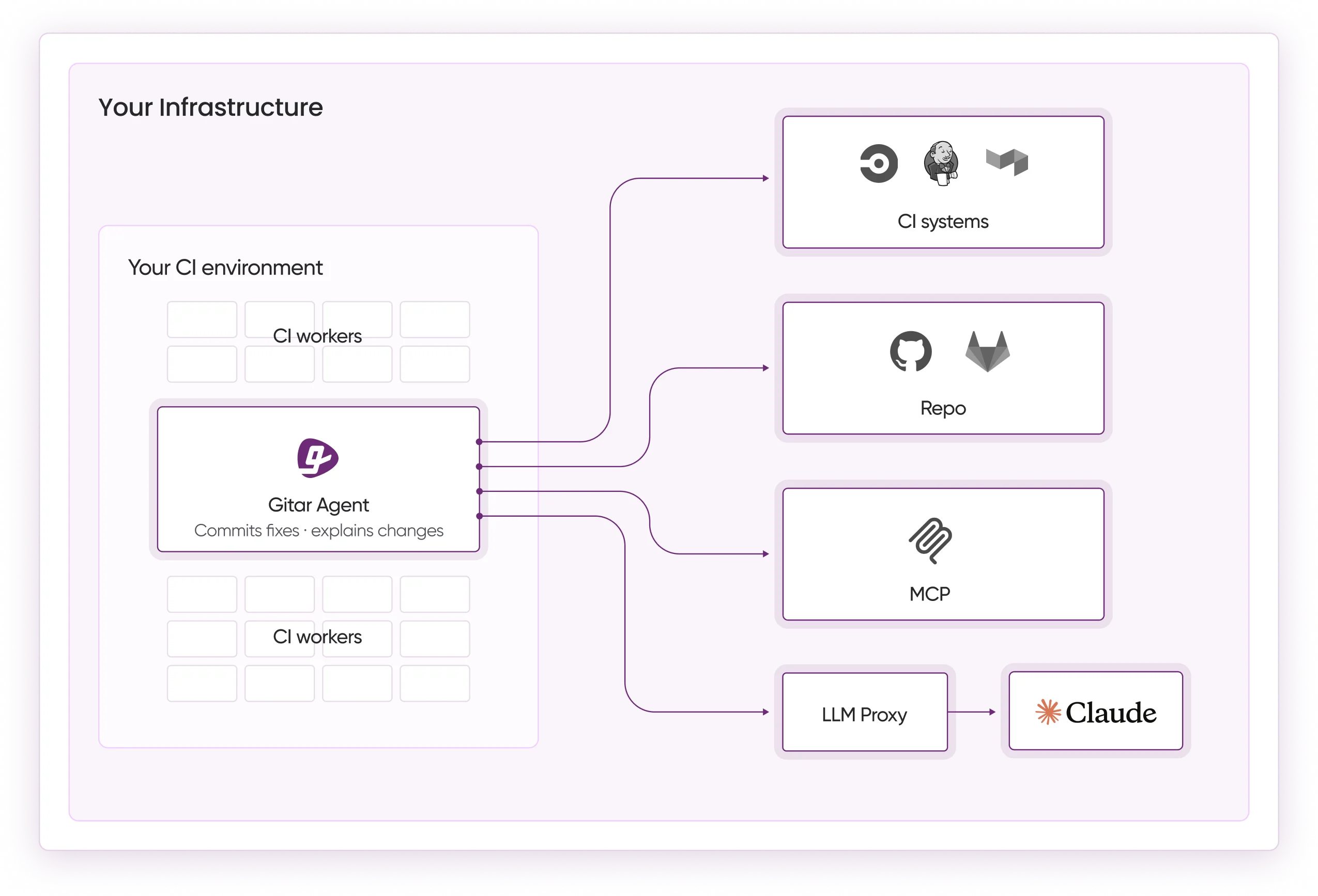
1. Gitar Enterprise serves as the leading choice for production CI automation. Gitar’s healing engine automatically fixes CI failures, implements review feedback, and validates corrections against the real build environment. The Enterprise Plan runs the agent in your CI pipeline with full access to configurations, secrets, and caches, so fixes work in production rather than in isolated sandboxes.
Gitar deploys across GitHub Actions, GitLab CI, CircleCI, and Buildkite. Natural language rules in .gitar/rules/*.md automate workflows without complex YAML. Integration with Jira, Slack, and Linear provides cross-platform context that competing tools do not match. For complete setup details, see the Gitar documentation.
Start your 14-day Team Plan trial to experience CI healing that guarantees green builds.
2. PR-Agent + Ollama delivers an open-source AI agent that supports true data sovereignty with zero external API calls when configured correctly with Ollama for local model deployment. Self-hosted runners are required because GitHub-hosted runners cannot access localhost Ollama, which adds infrastructure complexity. Configuration reliability issues include ignored environment variables and inconsistent model quality.
3. Kodus AI supports self-hosting for strict data privacy requirements and uses a hybrid AST plus LLM architecture.
4. SonarQube Community Edition offers self-hosted deployment but needs substantial infrastructure capacity with a high setup and maintenance burden. The platform provides mature static analysis with extensive security rules and detailed technical debt tracking.
|
AI Agent |
Auto-Fix Capability |
CI Integration |
Accuracy Rate |
|
Gitar Enterprise |
Yes (validated) |
Full pipeline |
Green build guarantee |
|
PR-Agent + Ollama |
Suggestions only |
Limited |
Model-dependent |
|
Kodus AI |
Suggestions only |
Basic |
79% issue detection |
|
SonarQube CE |
No |
CI/CD hooks |
Static analysis focused |
Side-by-Side Comparison of Key Tools
|
Tool Category |
Resource Requirements |
Auto-Fix |
Platform Support |
|
Gitar Enterprise |
Minimal (agent-based) |
Yes |
GitHub, GitLab, CircleCI, Buildkite |
|
GitLab CE |
8GB+ RAM |
CI/CD only |
Self-contained |
|
Gitea |
170MB RAM |
No |
Git hosting |
|
Kodus AI |
Variable |
No |
GitHub, GitLab |
Self-Hosted vs Cloud AI and Common Challenges
Self-hosted AI tools address major concerns that teams face with cloud-based AI services. Ninety-six percent of developers report doubts about AI-generated code reliability, and 53% have seen unreliable code that appears correct while 35% use AI tools through personal accounts, which raises data exposure risks. Self-hosted deployments remove external API dependencies and give teams full control over model selection and data processing.
Teams often face GPU infrastructure requirements for local models, configuration complexity with environment variables, and a gap between suggestion engines and real fix implementation. Gitar’s hybrid approach addresses these limits by running agents inside existing CI infrastructure while preserving data sovereignty.
Experience autonomous code review with Gitar’s 14-day trial, the only platform in this group that heals CI failures instead of only suggesting fixes.

Frequently Asked Questions
Best Ollama Setup for Self-Hosted AI Code Review
PR-Agent with Ollama currently offers the most mature open-source integration for local AI code review. This setup requires Docker deployment with GPU access and self-hosted runners. Configure models such as CodeLlama or Mistral for code-focused tasks, and plan for configuration complexity and variable model quality compared with cloud-based services.
How Gitar Handles Self-Hosting Compared to Other Tools
Gitar Enterprise runs the agent inside your existing CI pipeline instead of on separate infrastructure. This design gives the agent full access to your build environment, secrets, and caches while keeping all code inside your infrastructure. Unlike suggestion-only tools, Gitar validates fixes against your actual CI configuration before applying them. See the Gitar documentation for detailed deployment instructions.
Cost Differences Between Free and Paid Self-Hosted Options
Open-source platforms such as Gitea and GitLab CE remove licensing costs but require infrastructure management and ongoing maintenance. Specialized AI agents like Kodus provide free tiers with usage limits that suit evaluation or small teams. Gitar offers a 14-day full-feature trial to demonstrate ROI before commitment, with pricing tied to value delivered rather than seat counts.
Tools That Fit Existing Git Workflows
GitLab CE delivers the most comprehensive integration as a complete DevOps platform. For teams already on GitHub or GitLab, Gitar Enterprise plugs into existing workflows without disruption. Lightweight platforms like Gitea support teams moving away from hosted solutions and seeking minimal infrastructure overhead.
Expected ROI from Automated Code Review
Teams typically save about 45 minutes per developer each day on CI and review issues. That time savings translates to roughly $750,000 in annual productivity gains for a 20-developer team. Tools that actually fix code deliver higher ROI than suggestion-only tools because manual implementation still consumes developer time and attention.
Conclusion: Where Gitar Fits in the 2026 Tool Landscape
Self-hosted code review automation in 2026 falls into three main approaches. Comprehensive platforms like GitLab CE provide complete DevOps integration. Lightweight solutions like Gitea keep infrastructure overhead low. AI agents deliver intelligent automation on top of existing workflows.
Gitar stands apart by combining powerful AI code review, minimal infrastructure requirements, and real code fixes instead of comments alone. For teams that prioritize data sovereignty and still want strong automation, Gitar offers a practical balance of security, efficiency, and measurable results. Start your 14-day Team Plan trial to experience CI healing that accelerates development while keeping full control of your code and data.