
Key Takeaways
- Manual CI failure debugging consumes large amounts of developer time, damages focus, and delays product releases across teams.
- Common CI failures often come from environment drift, dependency conflicts, and configuration errors that are hard to spot in local setups.
- Self-healing CI uses autonomous AI agents to diagnose, fix, and validate CI issues so developers can stay focused on feature work.
- Gitar acts as a healing engine that replicates CI environments, fixes failures end-to-end, and supports different trust levels for teams.
- Teams that adopt Gitar at https://gitar.ai/fix reduce CI toil, shorten time-to-merge, and improve developer satisfaction.
The Problem: The Unseen Costs of Manual CI Failure Resolution
Developer Burnout and Lost Productivity
Manual CI failure work disrupts focus and drains time. Build failures in CI environments slow product release pipelines, reduce team productivity, and raise software production costs, with some projects losing more than 2,000 hours to failures. Bug-fixing changes also cause most CI failures compared to new feature work, so developers often pause feature development to repair regressions.
The context switching tax makes this worse. A short debugging session can cost far more than the minutes on the clock because developers must reload complex mental context. When a build procedure breaks, collaborative development often pauses until someone fixes the issue, which increases pressure and fatigue.
Delayed Time-to-Market and Business Impact
Persistent CI failures slow releases and reduce responsiveness. Teams lose days to stalled pipelines, blocked merges, and slow feedback loops. Many organizations report CI pipeline failures as a primary reason projects slip past planned release dates, which directly affects commit-to-merge latency and revenue timing.
Distributed teams feel these delays more acutely. A minor CI issue can stretch across time zones, turning what should be a quick fix into several days of back-and-forth between developers and reviewers.
Common Causes of CI Pipeline Breakage
Teams that understand typical CI failure patterns can design better automation. Environment mismatches between local machines and CI containers, including version drift in language runtimes and dependencies, frequently break builds. Code that passes locally may fail in CI because the pipeline runs in a cleaner, stricter environment.
Dependency issues such as missing, outdated, or conflicting packages are another common source of failures. Configuration errors in files like YAML or JSON, including syntax problems, incorrect paths, and misconfigured variables, also directly cause CI jobs to fail.
The Solution: Self-Healing CI for CI Failures in 2026
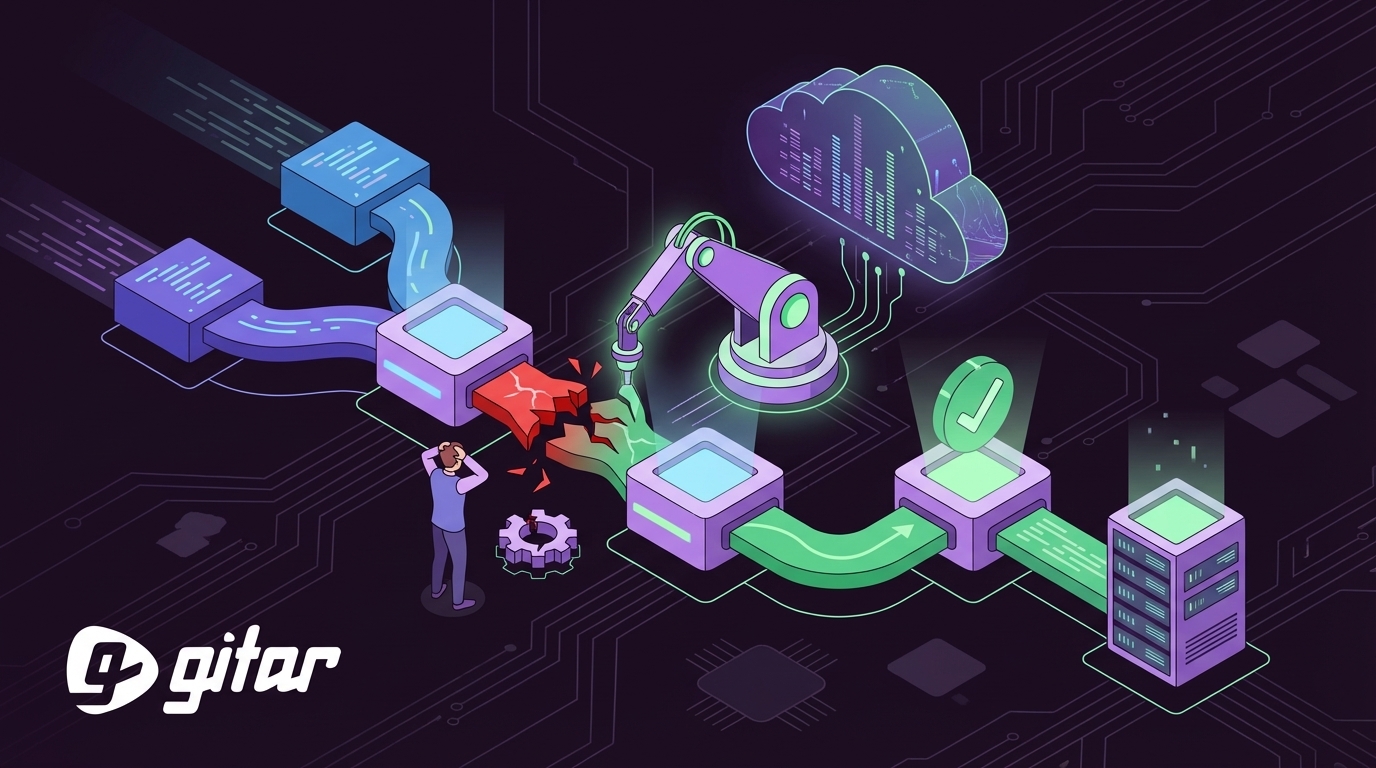
Self-healing CI shifts teams from reactive debugging to automated correction. Autonomous AI agents observe pipeline runs, identify failures, propose fixes, and apply them, then re-run validation. Developers no longer need to stop feature work to diagnose every broken build.
This approach protects flow state. Instead of context switching between creative work and infrastructure issues, developers keep working while CI heals itself in the background. As AI-assisted coding tools such as GitHub Copilot and Cursor increase code volume and pull requests, self-healing CI reduces the new bottleneck on code review and pipeline stability.
Install Gitar to automatically fix broken builds and keep your CI pipeline healthy.
Gitar: An Autonomous AI Healing Engine for CI/CD Pipelines
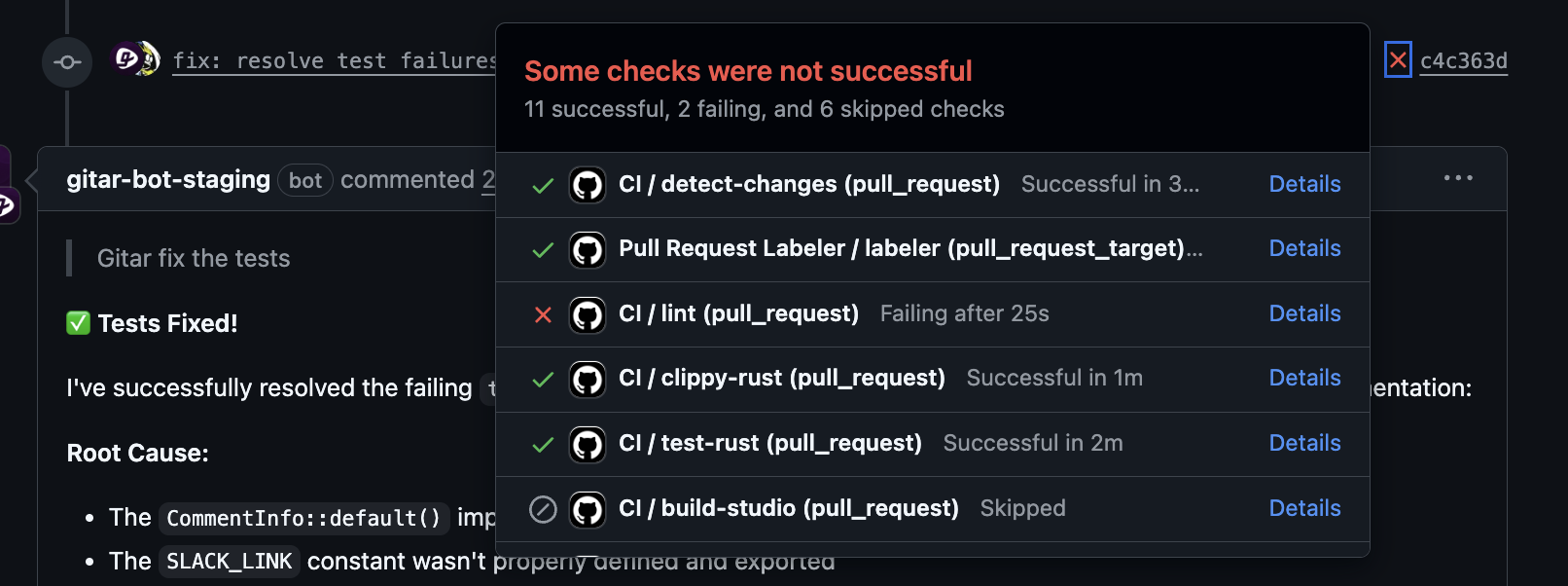
Gitar implements self-healing CI as an autonomous healing engine. The system monitors CI failures, repairs them in a full replica of your environment, and validates results before proposing or committing changes.
Key capabilities include:
- End-to-end fixing: Gitar applies code changes, adjusts configuration, re-runs pipelines, and confirms that all CI jobs pass before surfacing results.
- Full environment replication: The platform mirrors complex workflows, including specific JDK versions, multiple SDKs, tools such as SonarQube and Snyk, and snapshot testing, so fixes align with real production conditions.
- Actionable code review support: Gitar acts on reviewer comments, implements requested changes, and pushes updates, which reduces slow loops between reviewers and authors, especially across time zones.
- Configurable trust and developer-in-the-loop: Teams can start with suggestion mode for one-click approvals, then move to auto-commit mode with rollback once they gain confidence.
- Cross-platform support: Gitar integrates with GitHub and GitLab and works across CI providers like GitHub Actions, GitLab CI, CircleCI, and Buildkite.
Request a demo to see Gitar’s healing engine operating in your CI/CD pipeline.
Benefits of Self-Healing CI for Engineering Teams
Reduce Manual CI Failure Toil
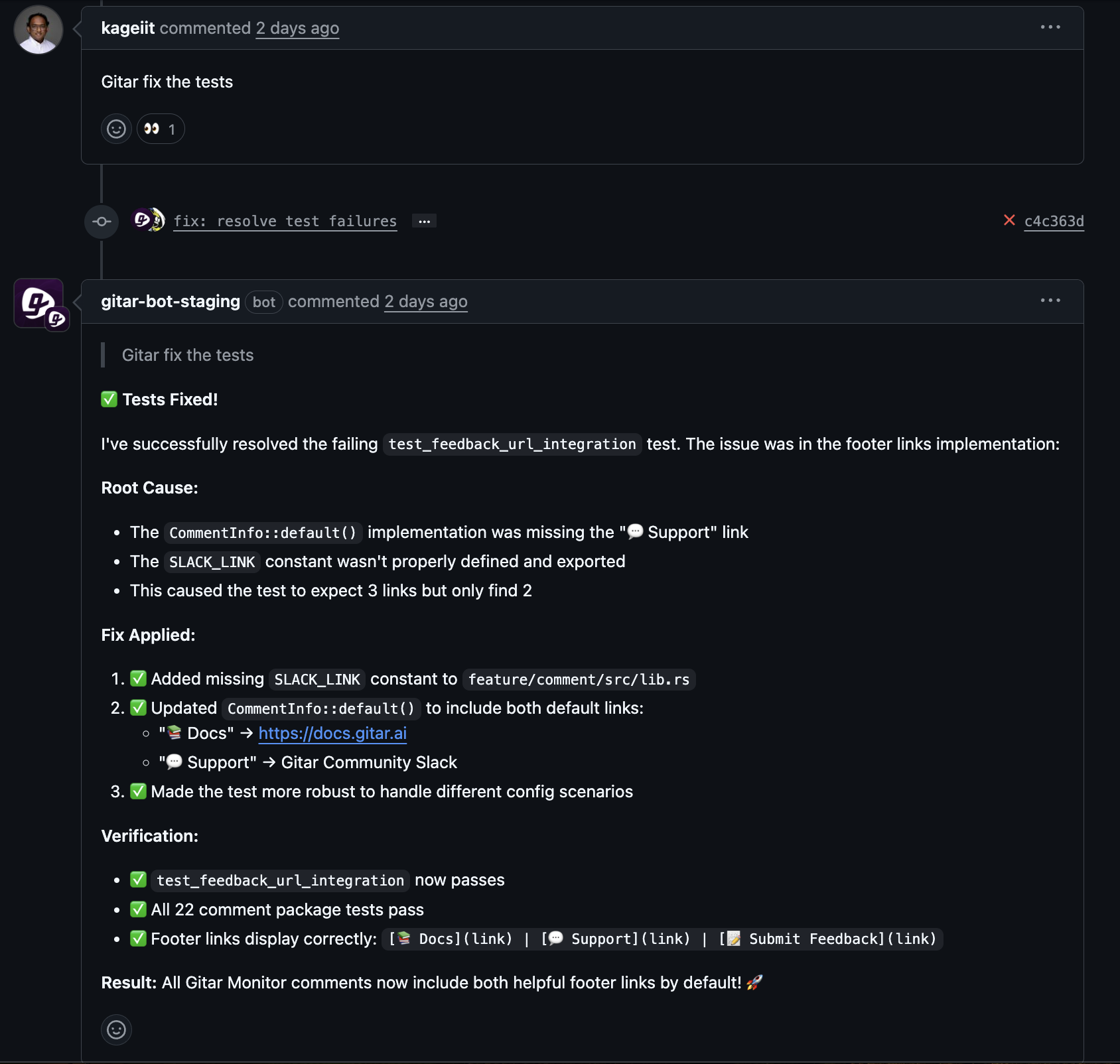
Gitar identifies the root cause of failures, proposes a concrete change, applies it, and validates outcomes. The engine uses project-wide context, including code relationships, configuration, and test structure, to make decisions that usually require a human engineer.
Keep Pipelines Green and Stable
Gitar handles frequent sources of noise, such as linting issues, outdated snapshots, and brittle scripts. The engine updates formatting, refreshes snapshots when appropriate, and adjusts dependencies or builds scripts to restore stability.
Environmental replication is a core advantage. Gitar runs fixes in a CI-like environment that matches your pipeline, which reduces the trial-and-error loop where developers guess at fixes, push changes, and wait for another failure.
Accelerate Time-to-Merge and Improve Developer Morale
Reduced time in CI toil directly affects delivery metrics. A 20-person engineering team that spends one hour per day on CI and review issues incurs roughly 5,000 hours of work each year. At a loaded rate of $200 per hour, this equals about $1 million in cost. If Gitar offsets even half of that work, the savings reach $500,000 while freeing time for higher-value tasks.
Developers gain more uninterrupted time for design and feature work. Distributed teams also see faster turnaround because reviewers can leave instructions for Gitar, and updated commits appear without waiting for the original author’s next workday.
Healing Engine vs Suggestion Engines in Self-Healing CI
Many tools act as suggestion engines that propose code changes but rely on developers to implement and verify them. Gitar operates as a healing engine that takes responsibility for application, validation, and feedback.
|
Feature |
Gitar (Healing Engine) |
Traditional/Manual |
AI Suggestion Engines |
|
Primary action |
Autonomous fixing and validation |
Manual debugging and resolution |
Code suggestions and analysis |
|
Fixes CI failures |
Yes, applies and validates |
Yes, through human effort |
Partially, requires human action |
|
Environmental context |
Replicates full CI environment |
Relies on local dev context |
Limited or manual configuration |
|
Developer interaction |
Low, protects flow state |
High, frequent context switches |
Moderate, manual application |
Gitar also provides flexible trust modes. Teams can start in conservative mode, where the system posts proposed changes as pull request suggestions. After seeing consistent, correct fixes, teams can shift to more automated modes where Gitar commits changes directly while keeping rollback options.
Install Gitar to turn CI failure handling into an automated healing process.
Common Implementation Questions About Self-Healing CI
Handling Complex Enterprise CI Setups
Gitar replicates full enterprise workflows, including specific JDK versions, multiple SDKs, containerized runners, and tools such as SonarQube and Snyk. This depth helps ensure fixes behave the same way in CI as they do in development and production pipelines.
Using Self-Healing CI with Existing AI Code Reviewers
AI code reviewers remain useful for design feedback and style guidance. Gitar complements these tools by implementing, validating, and adjusting changes until CI passes, which removes manual work that typically follows suggestions.
Controlling and Trusting Automated Changes
Teams keep control through operation modes. Conservative mode surfaces proposed changes for review, while aggressive mode allows direct commits once teams have enough evidence to trust Gitar’s behavior, always with clear explanations and revert paths.
Validating Fixes and Handling New Issues
Gitar evaluates each fix against the full CI workflow before marking it complete. If a change introduces a new failure, the engine detects it, attempts a further correction, and records each step in standard Git history so teams can audit and roll back.
Types of Issues Gitar Can Resolve
Gitar addresses a wide range of CI problems, including lint and formatting errors, test failures such as outdated snapshots or broken assertions, and build issues caused by dependency conflicts or script problems. The engine also works with multi-SDK setups, third-party scanners, and custom build processes.
Conclusion: Move CI Failure Work from Manual to Autonomous
CI failures create ongoing drag on developer productivity, delay releases, and contribute to burnout. Manual debugging and suggestion-only AI tools still require engineers to stop their work, interpret feedback, and experiment with fixes inside complex pipelines.
Self-healing CI with Gitar turns failure handling into an automated workflow that operates inside your existing tools. Teams cut time spent on toil, shorten commit-to-merge cycles, and create a more sustainable environment for developers.
Visit Gitar to enable self-healing CI in your pipelines and reduce time lost to CI failures.