
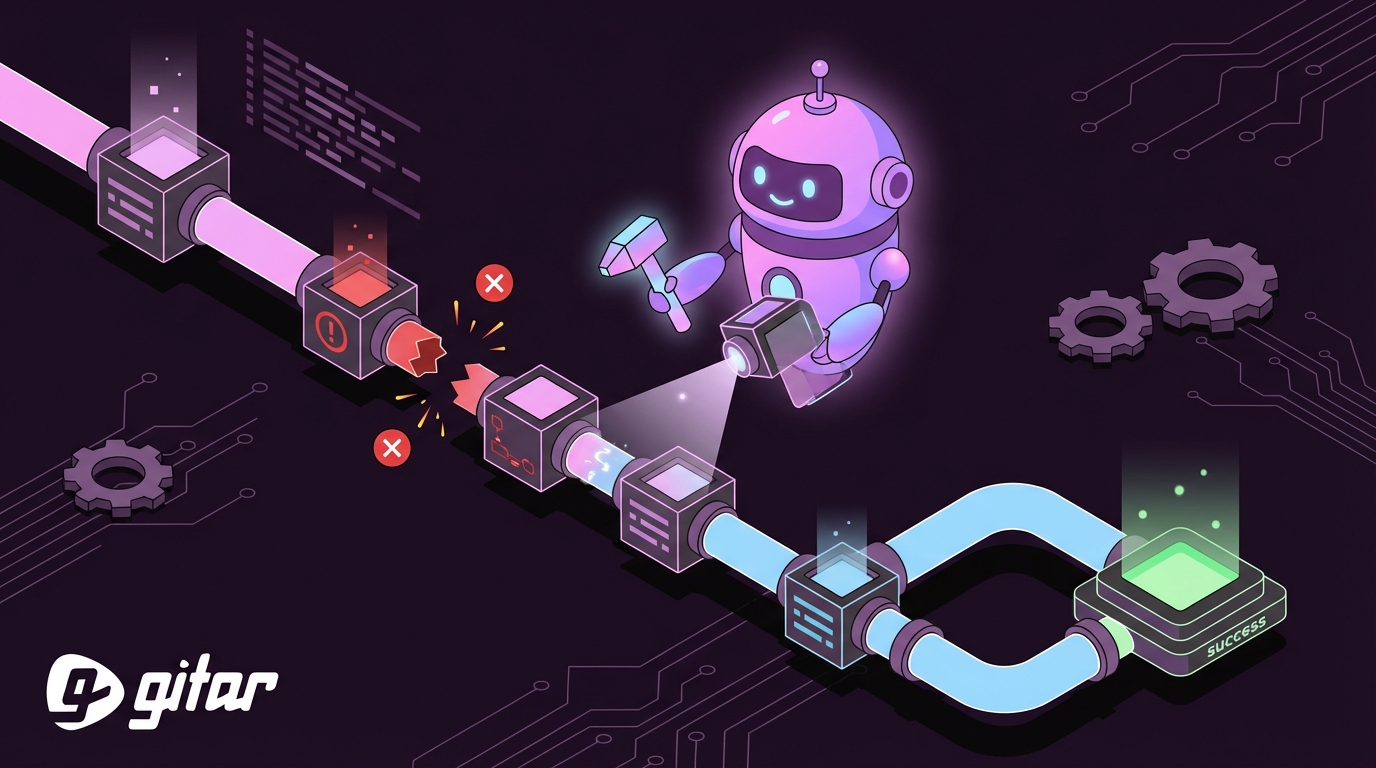
Key Takeaways
- 84% of developers now use AI tools, yet CI/CD bottlenecks keep sprint velocities flat even as code generation speeds up.
- Self-healing AI agents detect failures, analyze root causes, validate fixes, and auto-commit changes, cutting debugging time by 75% versus suggestion-only tools.
- Gitar stands out as the top free option with unlimited code review, a 14-day autofix trial, and support for GitHub Actions, GitLab CI, CircleCI, and Buildkite.
- Competitors like GitLab Duo and CodeRabbit only suggest fixes, lack auto-commit, and charge $15-30 per seat, while Gitar delivers more than $750K in annual ROI for 20-developer teams.
- Install Gitar now for zero-setup self-healing CI that keeps builds green and increases shipping velocity.
Why Self-Healing AI CI/CD Pipelines Matter Right Now
Traditional CI/CD pipelines slow teams with flaky tests, unrelated failures, and constant notification noise. Engineering leaders report losing 30% of development time to CI and review issues, which equals roughly $1 million in annual productivity losses for a 20-developer team. The core problem goes beyond individual failures and includes context switching, repeated debugging cycles, and manual intervention for every incident.
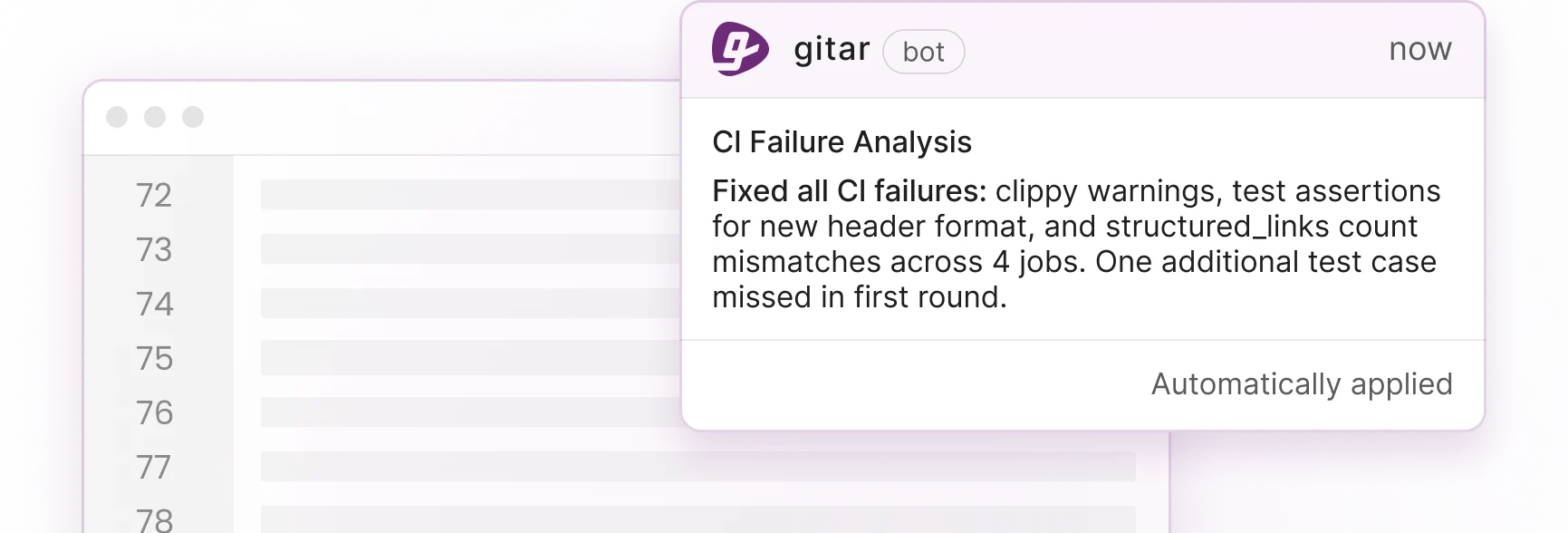
Self-healing AI agents change this pattern through a clear four-step workflow. They detect pipeline failures automatically, perform AI-powered root cause analysis using logs and codebase context, generate and validate fixes in the real CI environment, and then auto-commit working solutions. This workflow cuts debugging time by 75% compared to suggestion engines that leave developers guessing whether fixes will pass.
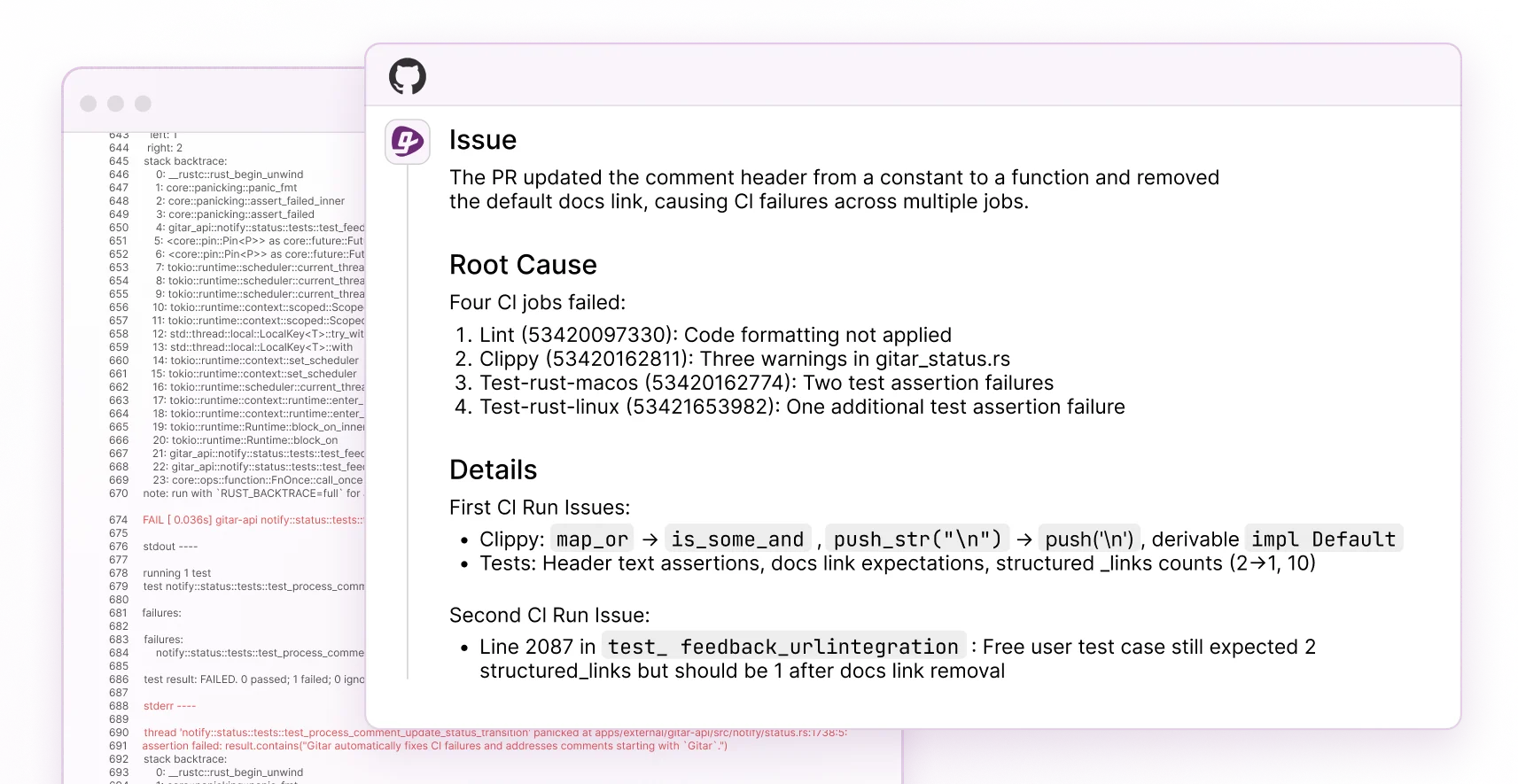
The gap between healing and suggesting becomes critical at scale. GitLab Duo provides root cause analysis with fix suggestions, yet still requires manual implementation. True self-healing agents like Gitar validate fixes through CI emulation before committing, which delivers consistently green builds instead of educated guesses.
Install Gitar now to automatically fix broken builds and ship higher quality software, faster.
Top 6 AI Agents for CI Pipeline Fixes Compared
1. Gitar: Free Self-Healing CI With Autofix Trial
Gitar offers free unlimited code review plus a 14-day free trial of autofix features. It analyzes GitHub Actions, GitLab CI, CircleCI, and Buildkite to deliver detailed root cause analysis of CI failures. The platform validates fixes against CI before committing to pull requests and posts a single, continuously updated dashboard comment instead of noisy inline threads.
Real-world validation includes Pinterest’s deployment across more than 50 million lines of code and reliable detection of unrelated failures that saves significant debugging time. Gitar’s hierarchical memory system tracks context per line, per pull request, per repository, and per organization. The system learns team patterns over time instead of starting from scratch on every review.
|
Metric |
Before Gitar |
After Gitar |
Annual Savings |
|
CI Debug Time |
1 hour/day/dev |
15 min/day/dev |
$750K (20-dev team) |
|
Context Switching |
Multiple/day |
Near-zero |
25% velocity increase |
|
Tool Costs |
$450-900/month |
$0 |
$5,400-10,800/year |
2. GitLab Duo: GitLab-Native Suggestions Without Auto-Commit
GitLab Duo’s Root Cause Analysis automatically troubleshoots failed CI/CD jobs by examining logs and configurations to pinpoint failure causes. The system provides actionable suggestions such as configuration updates and dependency fixes. It remains limited to the GitLab ecosystem and does not include auto-commit capabilities.
3. Dagger: Composable Framework for Custom Fixing Agents
Dagger gives teams a composable framework for building pull-request-fixing agents with log analysis and validation in containerized environments. It supports agent-native workflows that can automate fixes and submit pull requests. Teams must still invest engineering effort to build and maintain these workflows, which contrasts with fully managed solutions like Gitar.
4. CodeRabbit: Paid PR Suggestions Without CI Healing
CodeRabbit delivers pull request summaries and inline suggestions starting at $15 per seat each month. The platform excels at refactoring recommendations and provides concise feedback tuned for CI/CD pipelines. It focuses on code review and does not offer full CI failure analysis or automated resolution.
5. Greptile: Deep Code Graph Analysis Without Autofix
Greptile provides deep codebase context through repository graph analysis at $30 per seat each month. The platform claims 3x bug detection but shows lower actual bug detection rates than several competitors. Its strength lies in analysis rather than automated fixes.
6. Semaphore: Early-Stage Self-Healing Experiments
Semaphore experiments with AI-driven self-healing features and offers limited automated fix implementation. The platform focuses on CI/CD performance and workflow tuning but does not yet provide full auto-commit functionality.
|
Tool |
Auto-Fix/Commit |
Platforms |
Pricing |
|
Gitar |
14-day Free Trial |
GitHub, GitLab, CircleCI, Buildkite |
Free (Code Review) |
|
GitLab Duo |
Suggestions Only |
GitLab Only |
Premium Plan |
|
CodeRabbit |
No |
GitHub, GitLab |
$15-30/seat |
|
Greptile |
No |
Multiple |
$30/seat |
Gitar separates itself from competitors through real fix implementation during a 14-day free trial, broad platform coverage, and zero cost for core code review. This combination directly addresses the main weakness of suggestion-only tools.
Install Gitar now to automatically fix broken builds and ship higher quality software, faster.
How to Roll Out Gitar for Self-Healing CI in Minutes
Gitar rollout follows a simple four-phase path. Teams start with a 30-second GitHub App installation that requires no account setup or credit card. They then run in suggestion mode to build trust while developers review and approve fixes. After that, teams enable autofix for validated failure types and finally configure advanced rules with Jira and Slack integrations.
Gitar supports complex CI environments with zero manual configuration. The platform automatically detects SDK versions, dependency requirements, and third-party integrations. Enterprise customers can run agents inside their own CI pipelines, which preserves full data sovereignty while still allowing access to internal secrets and caches.
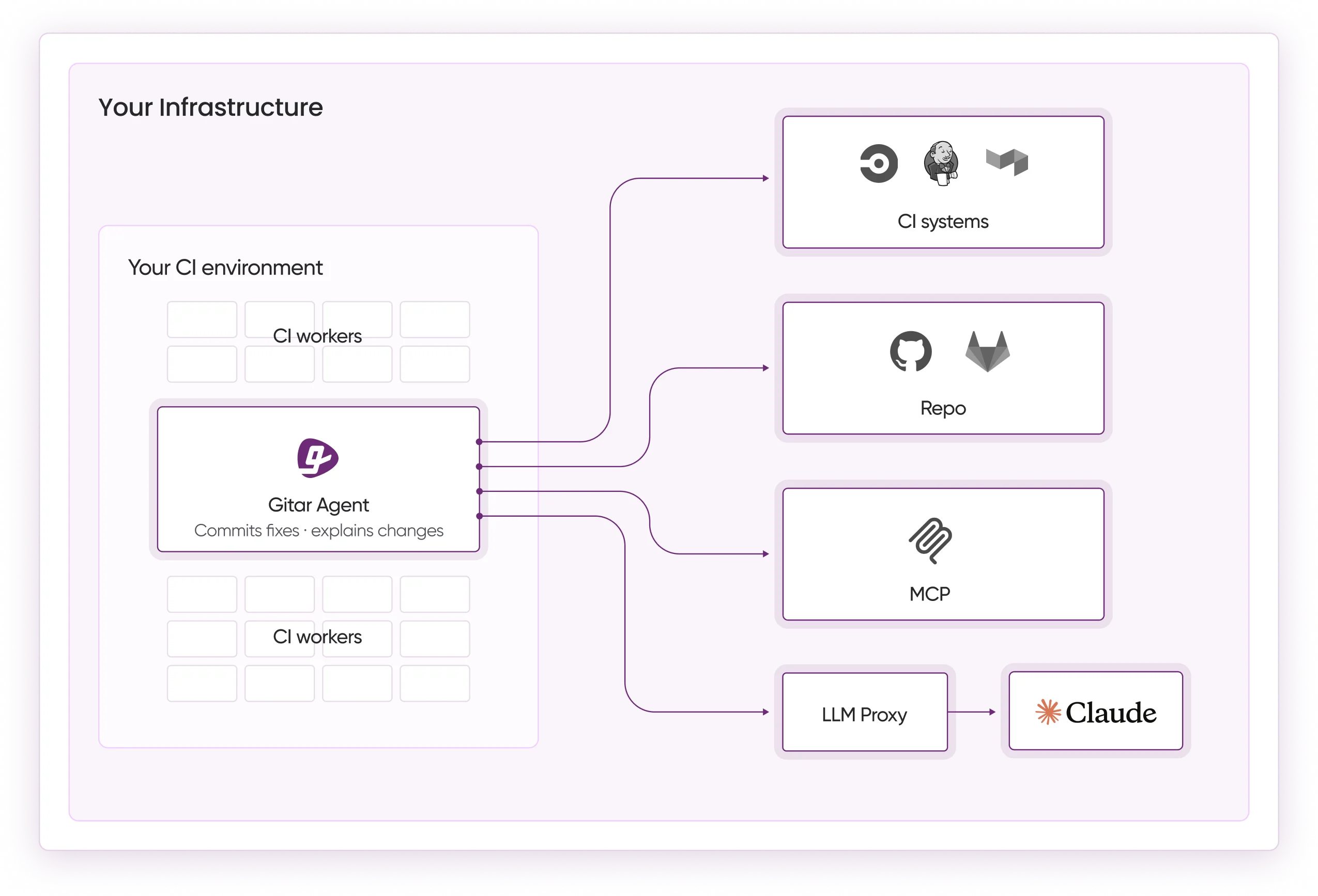
Gitar vs. Competitors: Automation Gaps and ROI Impact
Market analysis highlights major gaps in current tools. Suggestion engines charge premium prices while leaving implementation work to developers, which erases much of the promised productivity gain. Platform lock-in forces teams onto a single CI system, and notification overload from many inline comments increases cognitive load for reviewers.
|
Feature |
Gitar |
GitLab Duo/CodeRabbit |
Others |
|
Auto-Apply Fixes |
14-day Free Trial |
No |
Limited |
|
CI Validation |
Yes |
None |
Basic |
|
Cost |
Free (Review) |
$15-30/seat |
$15-50/seat |
|
Cross-Platform |
Yes |
Limited |
Varies |
ROI calculations show a clear advantage for Gitar. Cutting CI debugging from 1 hour to 15 minutes per developer each day saves about $750,000 per year for a 20-person team. Removing separate tool costs adds another $5,400 to $10,800 in yearly savings. Teams address trust concerns through configurable automation levels and SOC 2 Type II compliance.
Frequently Asked Questions
How AI Agents Fix CI Failures Automatically
AI agents like Gitar read CI failure logs, identify root causes using codebase context, and then generate targeted fixes. They validate these fixes by emulating the CI environment and only commit code that passes checks. This approach differs from suggestion tools that simply recommend changes without validation or direct implementation.
Best Free Tool for Self-Healing CI Pipelines
Gitar offers the most complete free option for self-healing CI. It includes unlimited code review, cross-platform CI support across GitHub Actions, GitLab CI, CircleCI, and Buildkite, plus a 14-day auto-fix trial. Gitar focuses on true healing with validated fixes instead of suggestions alone.
How Gitar Compares to CodeRabbit for CI Issues
Gitar automatically fixes CI issues and commits solutions, while CodeRabbit only provides suggestions that developers must apply manually at $15 or more per seat. Gitar also includes CI failure analysis and automated resolution features that CodeRabbit does not provide.
Handling Flaky Tests and Unrelated PR Failures
Advanced AI agents perform root cause analysis to separate code-related failures from infrastructure or environment issues. Gitar’s unrelated failure detection flags CI problems that come from flaky tests or system issues instead of pull request changes. This behavior prevents wasted debugging cycles on unrelated noise.
Gitar Integration Speed With GitHub Actions
Gitar installs as a GitHub App in under 30 seconds with no manual configuration. The platform automatically discovers CI workflows and starts analyzing failures immediately. It then posts consolidated updates through a single dashboard comment instead of many scattered messages.
Expected ROI for Small Teams Using Automated CI Fixes
Small teams often see up to 3x velocity gains from reduced context switching and shorter debugging sessions. Even a five-person team can save 15 to 20 hours each week on CI issues. These gains translate to more than $50,000 in annual productivity value while Gitar’s free tier keeps direct tool costs at zero.
Conclusion: Ship Faster With Self-Healing CI
The AI coding wave requires self-healing infrastructure instead of suggestion engines that keep manual bottlenecks in place. Gitar turns CI/CD from reactive debugging into proactive automation by delivering validated fixes and cross-platform coverage that keep builds green. While competitors charge premium prices for partial automation, Gitar delivers complete healing capabilities at no cost for core review features.