
Key Takeaways
- AI coding tools reached 85% developer adoption by 2025 but increased PR review times by 91% and created $1M annual CI losses for 20‑dev teams.
- AI agents deliver autonomous DevOps integration that cuts MTTR by up to 79% through failure prediction, auto-remediation, and validated fixes.
- Gitar provides free unlimited PR analysis, security scanning, and a 14-day autofix trial with GitHub, GitLab, and CircleCI integration plus natural language rules.
- Compared to paid tools like CodeRabbit at $15-30 per developer or Harness, Gitar guarantees green builds at zero core cost and removes notification noise.
- Teams use Gitar’s free AI agents to ship faster and improve software quality without expanding headcount.
The New DevOps Bottleneck After AI Coding Adoption
AI coding tools accelerated individual productivity, yet they exposed a new system-level bottleneck. Developers using Copilot complete tasks 55% faster, but sprint velocities often remain flat. The constraint moved from writing code to validating, reviewing, and merging it.
Teams now lose about 30% of development time to CI friction. At the same time, nearly 1 billion commits pass through GitHub annually, a 25.1% year-over-year increase. This surge overwhelms manual review processes and triggers cascading CI/CD failures.
The financial impact compounds quickly. A 20-developer team that spends one hour per day on CI and review issues burns roughly $1M in annual productivity. Paid suggestion tools add another $450-900 per month while still requiring manual fixes. The combined cost of the post-AI-coding bottleneck strains most engineering budgets.
Why AI Agents Matter for DevOps Integration
AI agents act as autonomous systems that analyze, decide, and act inside CI/CD environments. They move beyond fixed scripts and adapt to context, which lets them handle scenarios that usually need human judgment. This shift turns CI from a static pipeline into a responsive system.
The impact shows up clearly in reliability metrics. Real-world deployments report MTTR reductions between 27% and 79%, with Western Digital cutting MTTR from 5.7 hours to 1.2 hours through AI diagnostics and predictive maintenance. Task completion speeds rise by 55% when AI assistance integrates cleanly into daily workflows.
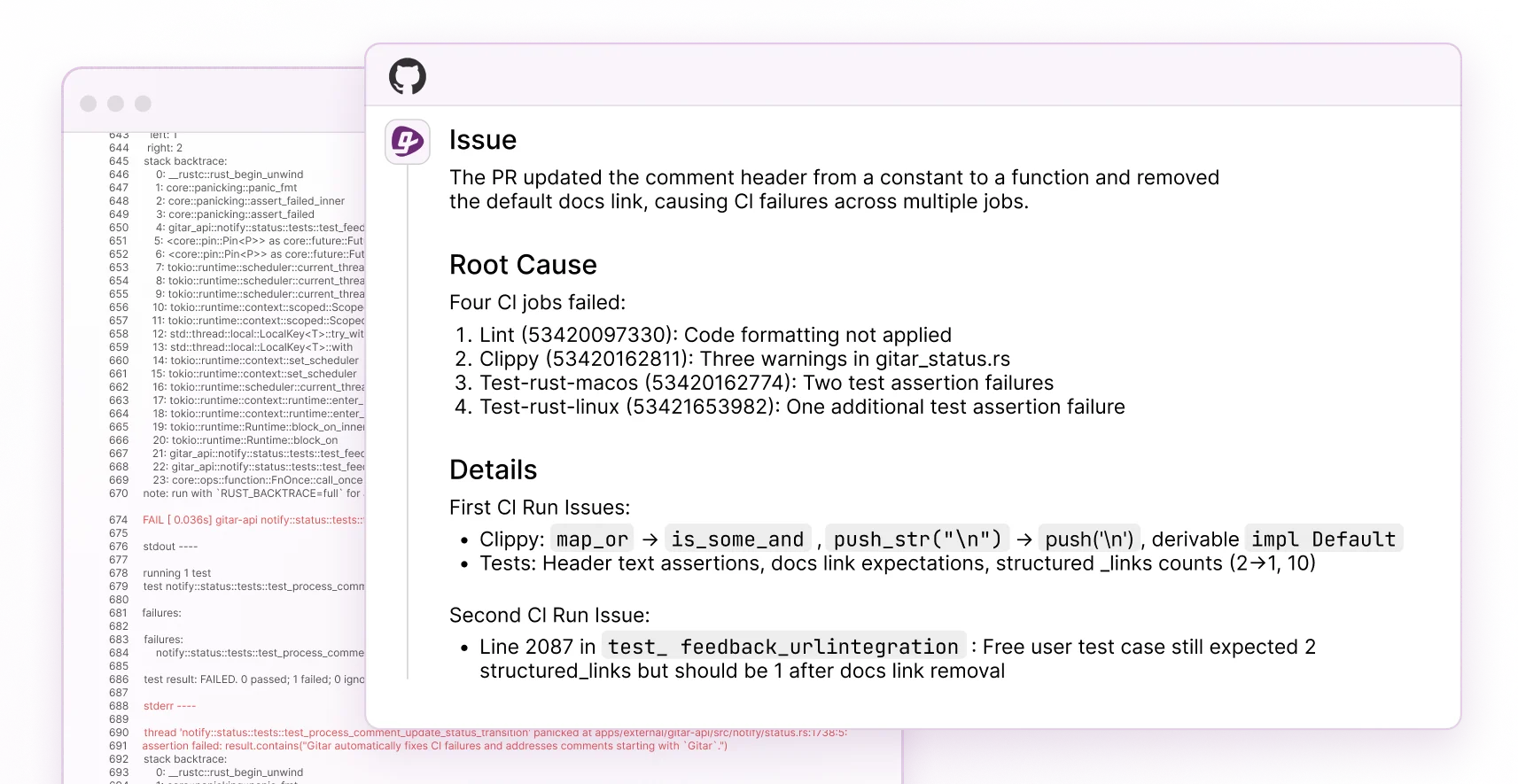
AI agents focus on three core capabilities. They predict and prevent failures, perform autonomous remediation, and learn continuously from patterns. They parse CI logs in real time, pinpoint root causes, generate validated fixes, and apply them automatically. This approach replaces reactive debugging with proactive healing.
Gitar’s Role as a Free Auto-Fixing DevOps AI Platform
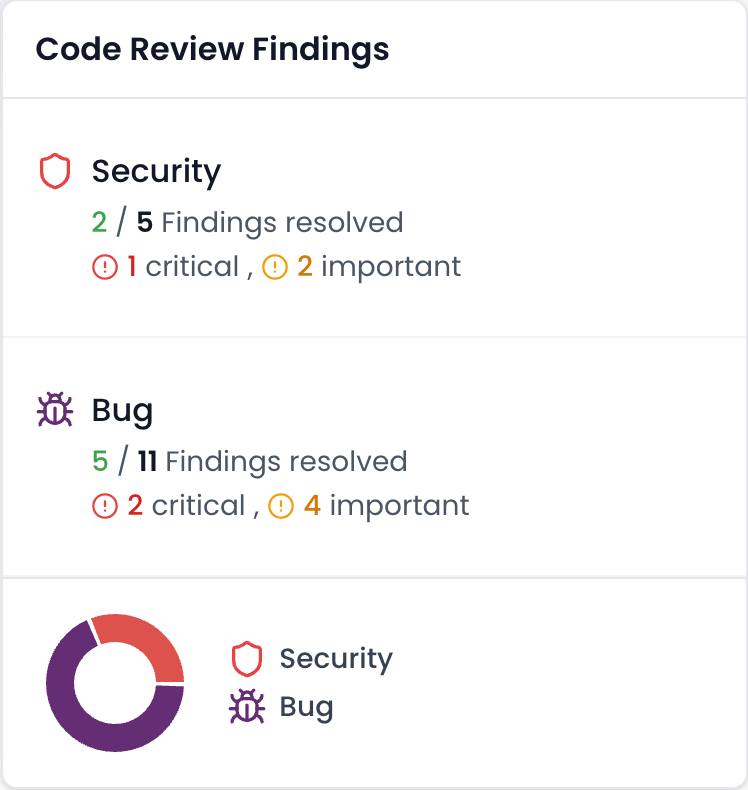
Gitar delivers a free platform that moves beyond traditional AI code review. While many competitors sell suggestion engines, Gitar includes code review, security scanning, bug detection, performance review, and full PR analysis at no cost for unlimited repositories.
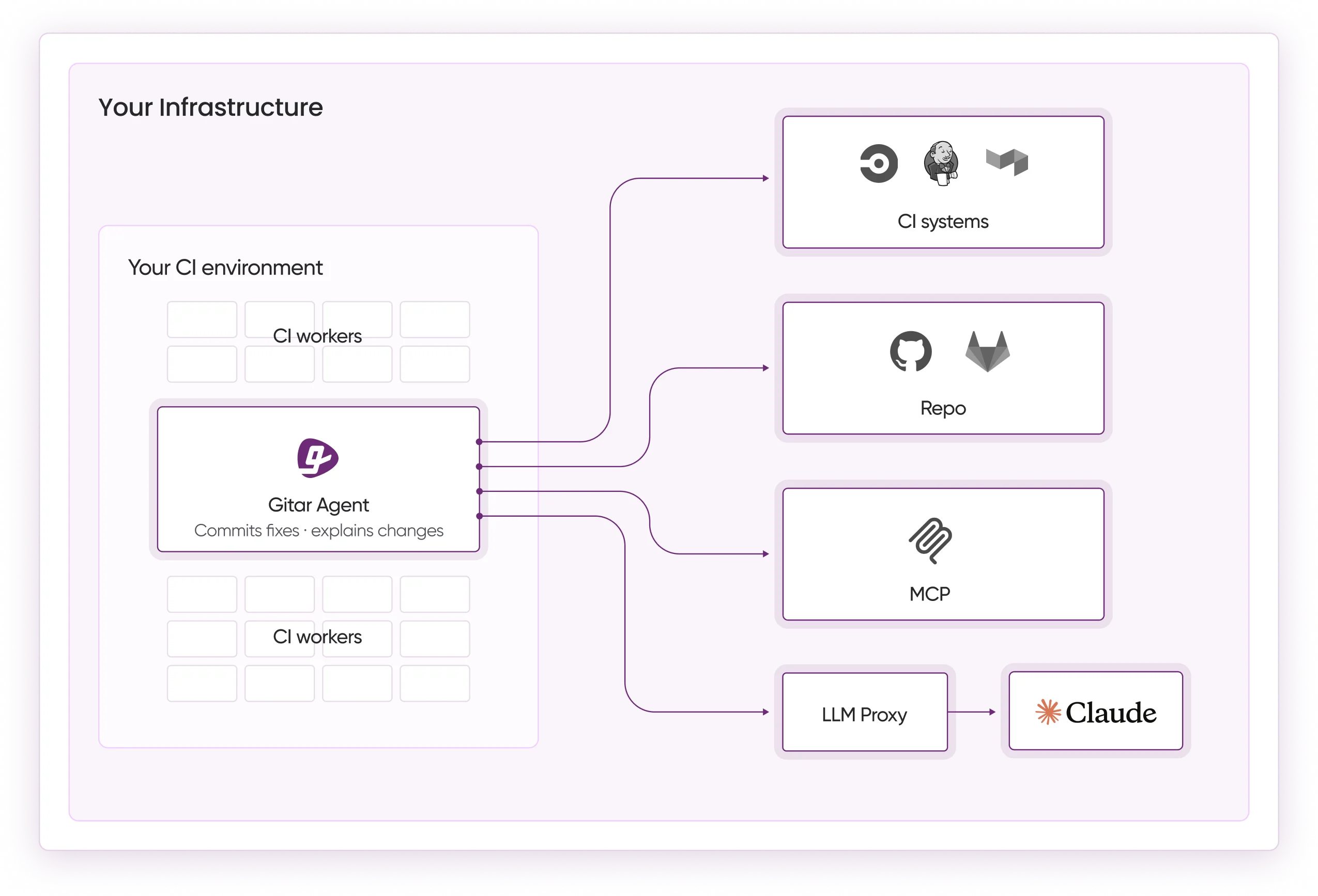
Key capabilities cover unlimited PR analysis for public and private repos, automatic CI failure detection and analysis, and CI autofix with a 14-day free trial. Teams define workflows using natural language rules in .gitar/rules/*.md files. Gitar integrates with GitHub, GitLab, CircleCI, and Buildkite. A single updating comment consolidates insights and prevents notification overload.
Gitar’s healing engine validates fixes inside the actual CI environment before committing changes. This safeguard ensures that automated commits resolve issues instead of creating new ones. Validation separates Gitar from suggestion-only tools that offer advice without proof of effectiveness. Teams can explore autofix during the 14-day free trial.
|
Metric |
Before Gitar |
After Gitar |
Savings |
|
Time on CI/review |
1hr/day/dev |
~15min/day/dev |
$1M/yr (20-dev team) |
|
PR Review Time |
+91% surge |
Reduced |
Green builds guaranteed |
|
Tool Cost |
$450-900/mo |
$0 |
Free core + trial autofix |
Install Gitar now to automatically fix broken builds and ship higher quality software faster. https://gitar.ai/
Comparing DevOps AI Agent Options for 2026
The DevOps AI agent market spans several tool categories with different strengths and tradeoffs. Clear comparisons help teams choose platforms that match their workflows and risk tolerance.
|
Capability |
CodeRabbit/Greptile |
Harness |
Gitar |
|
Pricing |
$15-30/dev |
Paid |
Free (autofix trial) |
|
Autofix CI |
No |
Robust self-healing |
Yes, validated |
|
Integrations |
Multi-platform |
Multi |
GitHub/GitLab/CircleCI/Buildkite |
|
Rules |
YAML |
Complex |
Natural language |
Traditional open-source tools such as Jenkins, GitLab CI/CD, and Ansible provide strong automation and can extend with AI plugins, integrations, and platform features. These platforms handle core CI/CD needs effectively. Gitar layers on intelligent failure analysis and autonomous CI remediation that align with modern AI-generated code patterns.
Gitar stands out through its focus on CI healing rather than simple suggestions. Cross-platform coverage and natural language rules keep configuration accessible for teams with varied DevOps maturity and limited bandwidth for complex YAML.
Step-by-Step Gitar Integration in DevOps Pipelines
Building AI agents for DevOps automation depends on balancing deterministic and non-deterministic workflows. AI agents shine when investigating pipeline failures and ambiguous scenarios. Traditional automation still fits predictable tasks with clear failure modes.
The Gitar setup process follows a simple sequence. First, install the GitHub or GitLab application from the marketplace. Next, start with free code review and enable the 14-day autofix trial to unlock autonomous CI failure resolution.
Then create .gitar/rules/*.md files using natural language to describe workflow automation. Connect Slack, Jira, and Linear to provide cross-platform context. Configure auto-commit preferences based on team trust levels, beginning from suggestion mode.
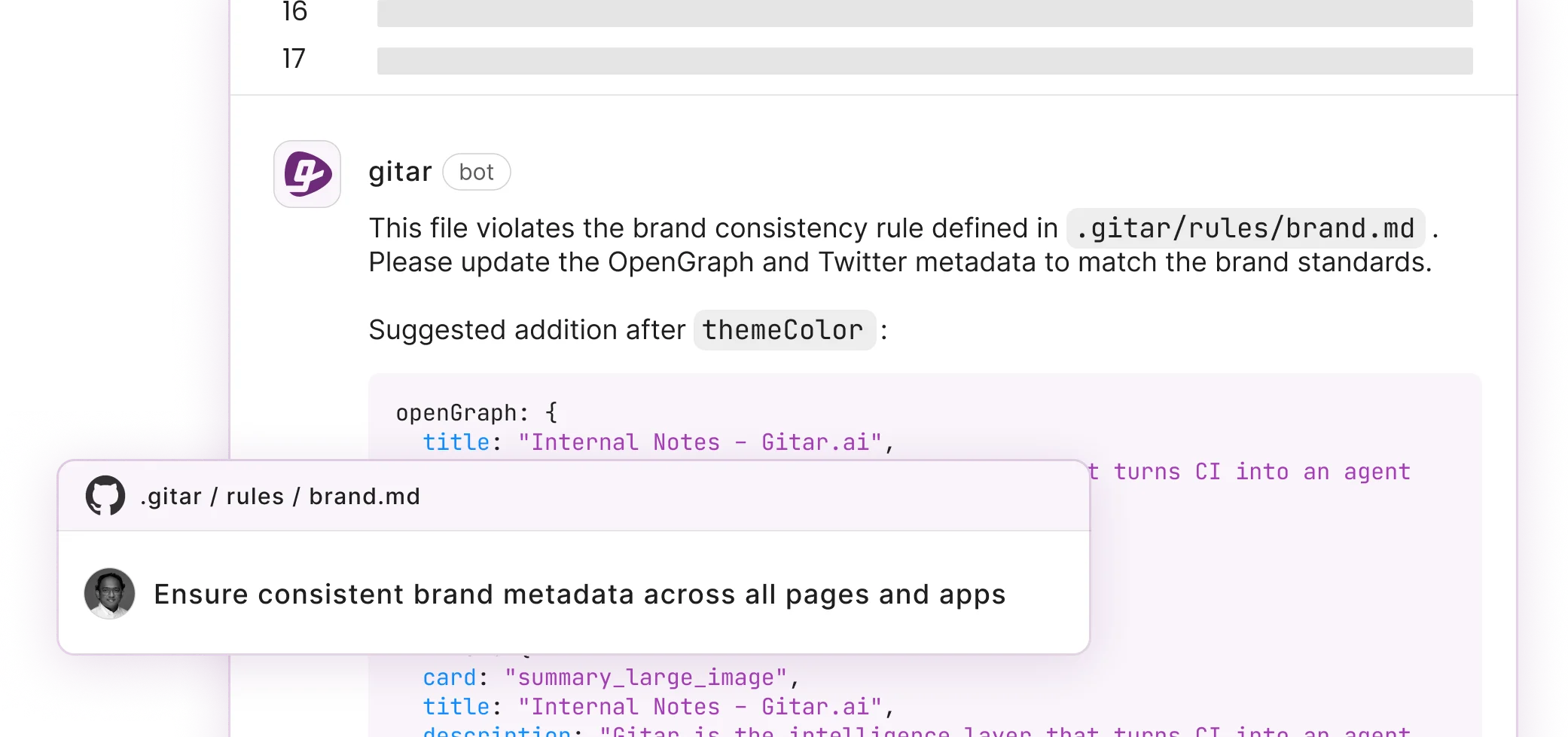
Trigger a test by commenting @gitar on a sample PR. Finally, monitor analytics to understand CI failure patterns and refine rules. This flow keeps risk low while teams learn how the agent behaves.
Example natural language rule configuration:
` ` `markdown
—
title: “Security Review”
when: “PRs modifying authentication or encryption code”
actions: “Assign security team and add label”
—
` ` `
This pattern removes YAML complexity that often slows DevOps automation adoption. Developers can define useful rules without deep infrastructure expertise.
From AI Code Suggestions to Fully Applied Fixes
AI code review has evolved from suggestion-only feedback to autonomous fixing. Earlier tools inspected code and produced recommendations, but developers still had to apply changes, re-run pipelines, and manage fallout from incorrect suggestions.
Gitar’s healing engine follows a different path. When CI fails, Gitar analyzes logs to identify root causes, generates fixes with full codebase context, validates those fixes in the real CI environment, and then commits working changes automatically. This closed loop removes the manual validation cycle that drains developer focus.
The validation step matters most for larger organizations. Suggestion engines can flood teams with advice that may not work. Gitar instead confirms that each automated fix resolves the underlying issue. This reliability lets teams trust autonomous commits and reduce the need for constant human review.
Addressing Trust, Security, and Scale for AI Agents
Enterprise teams adopt AI agents only when they feel confident about trust, security, and scalability. Each area needs clear controls and evidence.
Gitar builds trust through flexible auto-commit settings. Teams can begin in suggestion mode, then enable auto-commits for specific failure categories as confidence grows. Complex or risky changes can still require manual approval.
Security protections include SOC 2 Type II certification and deployment models that run agents inside customer CI pipelines. This design keeps sensitive code within organizational boundaries while preserving full AI functionality.
Scale has been proven in production environments that manage more than 50 million lines of code and thousands of PRs per day. Gitar’s architecture supports enterprise workloads while staying responsive enough for real-time CI failure resolution.
Frequently Asked Questions
How to use AI agents in DevOps?
Teams start by installing AI agent platforms such as Gitar that connect directly to existing CI/CD tools. They focus first on non-deterministic workflows where agents can investigate failures and propose context-aware fixes. Natural language rules define automation behavior without complex YAML. Most teams begin in suggestion mode, then enable autonomous fixes for well-understood failure types. Analytics dashboards help track performance and guide adjustments.
What tools can AI agents use?
Modern AI agents integrate with version control systems like GitHub and GitLab, CI/CD platforms such as GitHub Actions, GitLab CI, CircleCI, and Buildkite, and project tools including Jira, Slack, and Linear. They read build logs, test reports, security scan results, and deployment metrics to make informed decisions. Advanced agents also connect to monitoring, incident management, and infrastructure-as-code platforms to coordinate automation across the full software lifecycle.
What are the best free DevOps AI alternatives?
Gitar leads the free DevOps AI category with unlimited code review, security scanning, and trial autofix across multiple platforms. Open-source tools like Jenkins, GitLab CI, and Ansible deliver strong automation that teams can extend with AI plugins and integrations. Most specialized AI-powered platforms require paid licenses, which makes Gitar unusual in offering broad AI agent capabilities at no cost. Cross-platform support and natural language configuration give it an edge over both paid tools and traditional open-source stacks.
How to integrate AI in automation workflows?
Integration typically follows seven steps. Install AI agent applications, configure repository access, and define automation rules using natural language. Connect external tools for notifications, set commit preferences, and test behavior with sample scenarios. Finally, monitor performance metrics and expand automation gradually. Teams focus first on repetitive, high-value tasks while keeping manual control over sensitive decisions.
Conclusion: Achieving Green Builds and Higher Velocity in 2026
AI coding has reshaped software development and flooded CI systems with unprecedented code volume. Many teams now pay $15-30 per developer each month for suggestion-only tools while losing more than $750,000 annually to CI friction. They need autonomous systems that resolve issues instead of just flagging them.
Gitar’s free AI agents integrate across DevOps tools and convert reactive debugging into proactive healing. Validated autofix, cross-platform support, and natural language configuration help teams break the cycle of broken builds while preserving quality and security.
DevOps now moves toward intelligent automation that adapts to context and fixes problems autonomously. Teams that adopt AI agents early gain faster delivery, higher reliability, and lower operational overhead.
Install Gitar now to automatically fix broken builds and start shipping higher quality software faster. https://gitar.ai/