
Key Takeaways
- Manual CI and code review workflows consume a large share of engineering time, especially for teams that manage many repositories and services.
- Context switching, right-shifted validation, and distributed teams combine to slow delivery and increase the cost of each pull request.
- Autonomous GitHub automation reduces routine manual work by detecting CI and review issues, applying fixes, and validating results in the real environment.
- Gitar focuses on CI healing and code review implementation for complex, enterprise-grade setups across multiple CI providers.
- Teams that want to reduce CI toil and speed up code review can start using autonomous fixes with Gitar for GitHub and other CI systems.
How Manual GitHub Workflows Reduce Engineering Productivity
Many engineering teams now spend a significant portion of development time on CI failures and code review loops rather than on feature work. Across a team, this can reach roughly 30 percent of total capacity once CI issues, review back and forth, and local reproduction are included.
This time loss often comes from two sources. First, CI failures interrupt active work, forcing developers to leave their current task, parse logs, apply fixes, and rerun pipelines. Second, the context switching tax keeps developers from quickly regaining deep focus, so even small fixes expand into long interruptions.
Financial impact scales quickly. For a 20 developer team, the combination of interruptions and delayed merging can approach one million dollars per year in lost productivity once salaries, overhead, and opportunity cost are factored in.
AI assisted coding tools now generate code faster than before, so the main constraint often appears after code is written. More pull requests lead to more test runs, more lint checks, and more chances for failures. Many organizations now face a right shifted bottleneck around validation and merging, rather than around authoring.
Distributed teams face additional friction. A simple review that should take hours can stretch across multiple days as comments, fixes, and approvals move between time zones. Suggestion only tools still require manual implementation, so they reduce some thinking but not the overall cycle time.
Autonomous GitHub Automation For More Predictable Delivery
Autonomous GitHub automation replaces many of these reactive steps with proactive and continuous oversight of repositories. Instead of waiting for a developer to notice a failure and decide what to do, an autonomous system interprets context, proposes a fix, applies it, and validates the result in CI.
This approach reduces developer toil, the repetitive work that does not deliver direct product value. Automation monitors pipelines, triages failures, and applies safe changes such as lint fixes, dependency updates, or snapshot refreshes. Developers can then stay focused on design and problem solving.
Automation also helps distributed teams. Reviewers can leave instructions at the end of their day, and an autonomous agent can apply and validate those changes before the original author returns. This compresses multi day cycles into a single follow up review.
Security remains important as teams add automation to CI. Prompt injection and unsafe agent behavior can affect GitHub Actions or GitLab pipelines. Purpose built autonomous systems address this with scoped permissions, clear audit trails, and controlled trust levels. Teams that want to reduce CI toil can begin with Gitar as a controlled autonomous agent in their pipelines.
Gitar Overview: Autonomous CI Healing For GitHub And Beyond
Gitar provides an autonomous CI healing layer for GitHub and other CI providers. The system behaves as an agent that reads failure logs, understands repository structure and configuration, proposes changes, validates them in CI, and commits the final fix when confidence is high.
Key capabilities include:
- End to end fixing that applies and validates changes so pipelines return to green without extra developer steps.
- Full environment replication that models real CI conditions, including specific SDK versions, dependencies, and integrations.
- An intelligent code review assistant that implements reviewer comments in pull requests.
- A configurable trust model, ranging from suggestion only mode to automatic commits with rollback.
- Cross platform support, including GitHub, GitLab, CircleCI, BuildKite, and other CI systems.
These features focus on handling enterprise scale complexity rather than only simple repositories. Gitar works within each team’s existing CI configuration to keep fixes aligned with current policies.
Protect Developer Flow State By Offloading CI Fixes
Problem: Failing CI Pipelines Interrupt Deep Work
CI failures often arrive while developers are focused on other tasks. Each failure requires log analysis, local reproduction, and a new commit. These steps interrupt complex work such as architecture design or debugging.
Productivity loss does not come only from the fix itself. Many developers need several minutes to return to full focus after an interruption, so frequent CI issues reduce total deep work time across the week.
Solution: Automated CI Healing With Gitar
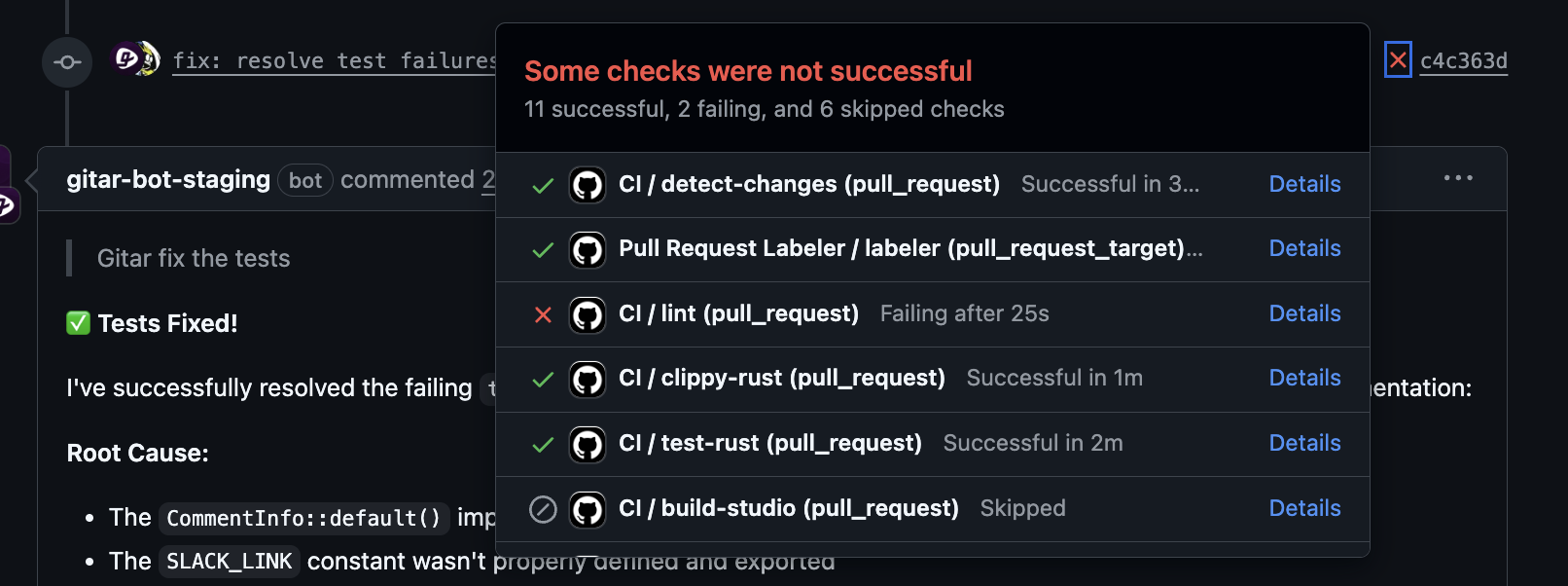
Gitar watches CI runs and responds when pipelines fail due to lint issues, dependency problems, or test failures. The agent reads logs, inspects relevant files, proposes changes, and re runs checks. When validations succeed, Gitar commits the fix back to the branch.
Engineers can then continue with their current tasks while Gitar manages routine CI maintenance. Developers still review changes as needed, but they no longer have to stop their work to handle each failure.
Shorten Code Review Cycles For Distributed Teams
Problem: Review And Rework Stretch Across Time Zones
Code review often becomes the longest stage in the lifecycle of a pull request. Teams that span regions must wait for reviewers to add comments, for authors to implement changes, and for another review cycle to complete.
Suggestion based AI tools can flag issues but usually still require developers to apply edits and rerun tests, which keeps review loops slow.
Solution: Autonomous Review Feedback Implementation
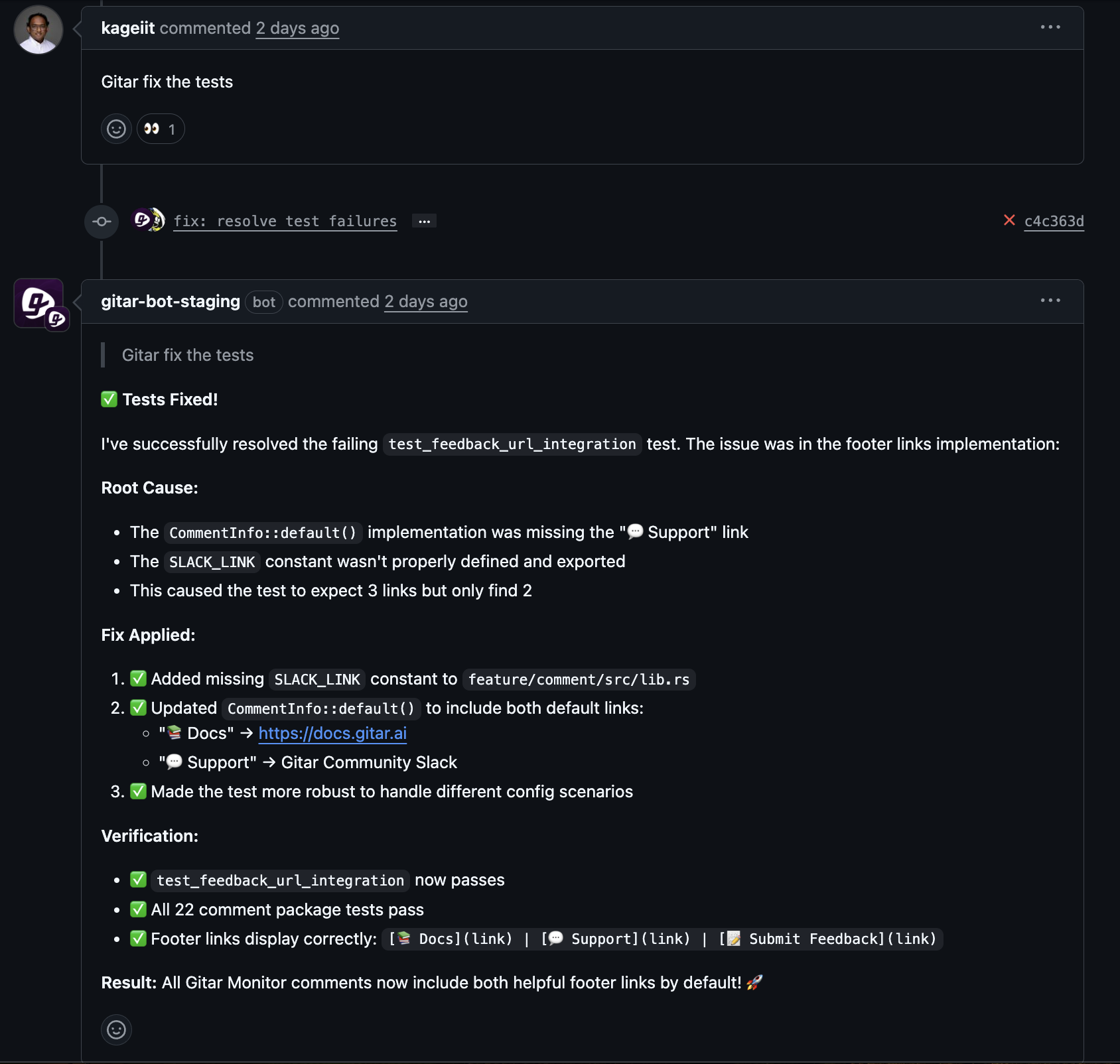
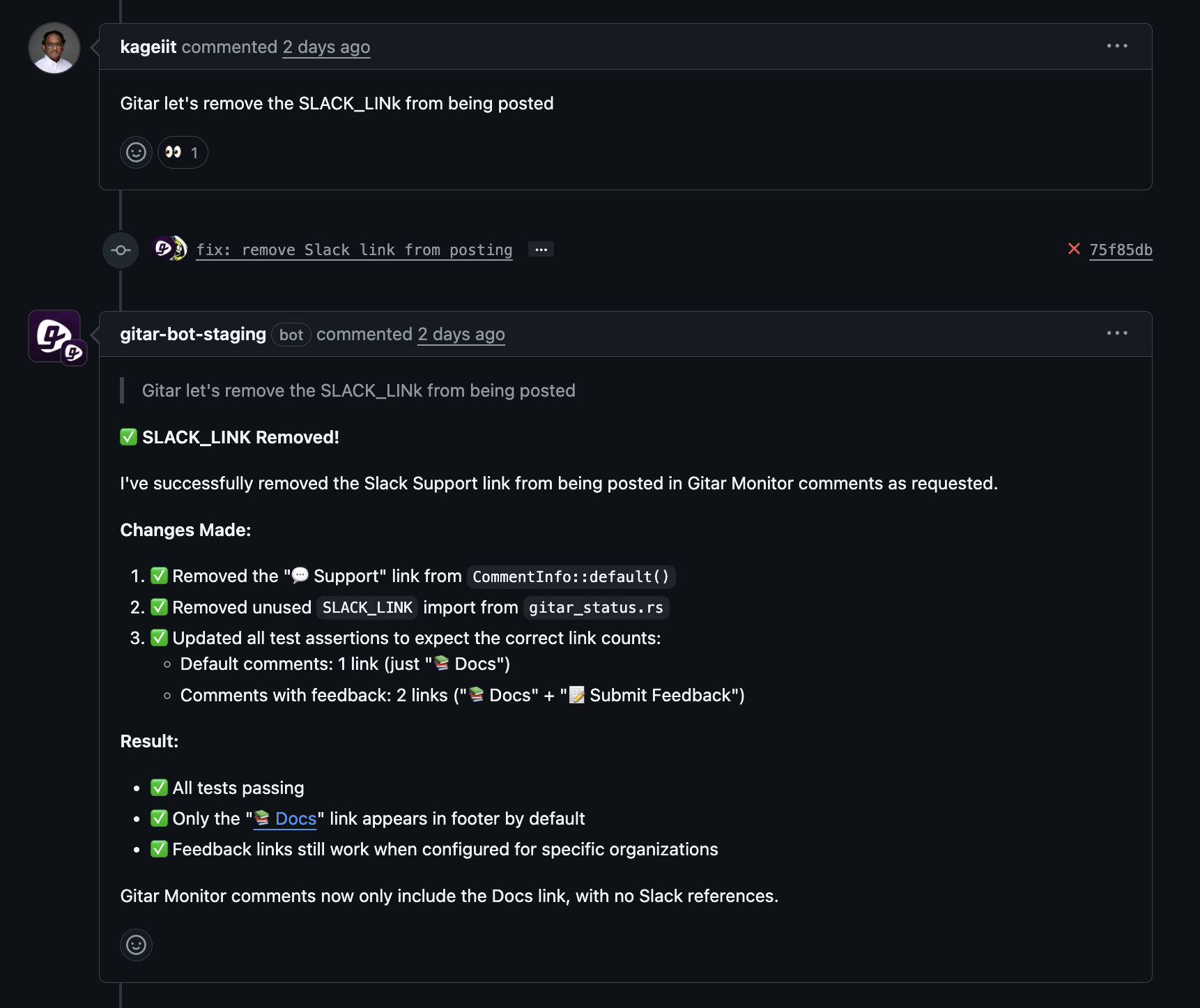
Gitar lets reviewers direct the agent from within pull request comments. Instructions such as “Gitar, review this code and apply your suggestions” trigger a full review cycle. Gitar can also apply specific requested changes, update tests, and push validated commits.
This pattern turns time zone gaps into useful processing windows. Reviewers in one region can leave feedback at the end of their day, and developers in another region can start their day with a ready to review set of changes already applied by Gitar.
Teams that want to reduce review cycle time can begin by adding Gitar to a subset of repositories and measuring merged pull request duration before and after adoption.
How Gitar Differs From Suggestion Only Tools
Gitar As A Healing Engine Instead Of A Suggestion Engine
|
Feature |
Gitar (CI Healing Engine) |
AI Code Reviewers |
On Demand AI Fixer |
|
Fixes and validation |
Applies changes and validates until CI is green |
Usually suggests changes, often needs manual validation |
May apply fixes, validation behavior varies |
|
Environment awareness |
Replicates full enterprise CI environment |
Understands code context, limited CI context |
May not model full environment |
|
Autonomy |
Runs autonomously with configurable trust levels |
Requires frequent human supervision |
Often triggered manually per request |
|
Target workflow stage |
Focuses on post commit CI and review |
Operates during authoring and review |
Supports on demand or continuous use |
This focus on end to end resolution means Gitar takes responsibility for both proposing and validating fixes. Developers review results and adjust trust levels, but they do not have to manage every step directly.
Handling Enterprise Complexity Through Environment Replication
Enterprise CI setups often include specific runtime versions, multiple SDKs, security scanners, and snapshot testing. Gitar replicates these environments so that proposed fixes reflect the real constraints of each pipeline.
This approach helps ensure that automated changes respect existing security controls and compliance rules. Fixes that pass Gitar’s validation are already proven against the same CI configuration that teams rely on for production readiness.
Scalable GitHub Repository Automation: Common Questions About Gitar
How does Gitar build trust with engineering teams for autonomous fixes?
Gitar offers several trust modes so teams can adopt autonomy gradually. Many teams begin with suggestion mode, where Gitar opens pull requests or comments with proposed changes. After reviewing the quality of those fixes, teams can shift to auto commit for low risk categories, while keeping manual review for more critical changes.
Can Gitar support very complex CI setups?
Gitar is designed for complex environments that include specific JDK versions, multiple language runtimes, third party scanners, and custom scripts. The agent runs within a replica of each project’s CI environment so that fixes are validated against actual dependencies and tools, not a simplified model.
How does Gitar improve collaboration for distributed engineering teams?
Gitar enables asynchronous collaboration by acting on reviewer comments between time zones. Reviewers describe desired changes once, and Gitar applies and validates them. Developers then review a concrete implementation instead of a long list of to do items.
What is the ROI of implementing Gitar for GitHub repository automation?
Teams that lose a large share of time to CI failures and review cycles can reclaim a substantial portion of that cost. For a 20 developer team facing roughly one million dollars in annual productivity loss from manual workflows, even partial automation that removes half of the repetitive work can represent hundreds of thousands of dollars in value each year.
Next Steps: Introduce Autonomous CI Healing To Your Team
Manual CI and review workflows remain a major productivity challenge in 2026. As repositories and services grow, so does the volume of small issues that interrupt developers and delay merging.
Gitar provides an autonomous layer that focuses on fixing CI failures and implementing review feedback in real environments. Teams that want to improve throughput and reduce engineer frustration can start with a limited rollout.
Request access to Gitar to evaluate autonomous CI healing on your own GitHub or other CI based workflows.