
Inefficient code reviews often slow down engineering teams with delays, long feedback cycles, and constant context switching. These issues not only hinder progress but also affect developer morale and project deadlines. This article explores ‘vibe coding,’ an AI-driven approach to simplify communication and automate fixes. You’ll see how Gitar, a platform built for this concept, helps teams request reviews, get practical feedback, and apply fixes automatically, speeding up merges and improving workflow.
Why Slow Code Reviews Hurt Developer Productivity
Delays and Context Switching Cost Time and Focus
Code reviews often disrupt a developer’s rhythm. After submitting a pull request, feedback or CI failures force you to stop your current task, interpret errors, and address minor issues. This interruption breaks your focus and slows down your work significantly.
The impact goes beyond frustration. Over half of developers feel delayed by poorly managed review processes, which leads to missed deadlines and stalled projects. For teams, this creates a widespread loss of efficiency that affects entire organizations.
Financially, the numbers add up quickly. Debugging takes up about half of a developer’s time, costing around $160 per hour. For a team of 20 spending just one hour daily on review interruptions, that’s roughly $1 million in lost productivity each year.
Beyond time, the mental toll is real. Switching tasks to handle feedback or failures pulls you out of deep focus, making it harder to solve complex problems or think creatively.
Manual Feedback and CI Fixes Create Bottlenecks
Traditional code reviews often lead to delays at multiple stages. Pull requests waiting over 24 hours for review can turn minor fixes into week-long holdups. This drags out what should be quick iterations.
Manual feedback integration adds more friction. Reviewers leave comments, and you must interpret them, apply changes, test locally, push commits, and wait for CI results, hoping you understood correctly. Each round of this cycle consumes hours or even days.
CI failures make things worse. A small linting or formatting error can stall a nearly complete PR, forcing you to stop other work, fix the issue, and restart validation. On average, code reviews take about 18 hours from start to finish, with much of that spent on routine fixes instead of meaningful analysis.
Distributed teams face extra challenges. Time zone differences can stretch a minor change into a full-day delay. For example, a developer in San Francisco might submit a PR, only to find the next day that a small issue flagged by a London reviewer has halted progress, creating yet another wait.
Hidden Impact on Morale and Project Speed
Inefficient reviews affect more than just productivity. Developers unhappy with review processes are over twice as likely to seek new jobs. This turnover risk adds costs in hiring and training while losing valuable team knowledge.
Frustration grows when time is spent on mundane tasks instead of creative coding. Developers want to solve tough challenges, not fix formatting errors. When reviews focus on trivial issues, motivation drops, and so does team performance.
These inefficiencies slow down entire projects. Bottlenecks in reviews directly lower team output and speed. Idle PRs also waste developer time and delay delivery, impacting product timelines and customer commitments.
Ready to break free from review delays? Install Gitar now to fix broken builds automatically and ship quality software faster.
How ‘Vibe Coding’ Solves Feedback Challenges with AI
Understanding ‘Vibe Coding’ for Effortless Reviews
‘Vibe coding’ redefines development by automating feedback and fixes, letting you stay focused on your work. Instead of manually handling reviews and CI issues, an AI system takes care of these tasks in the background, minimizing interruptions.
This approach shifts reviews from a manual burden to an intelligent process. You submit code and keep working, while AI fixes issues and validates them against CI workflows. It reduces friction and clears the mental load of managing reviews.
AI automation cuts the typical 18-hour review time down significantly for common problems. With ‘vibe coding,’ you often return to find your PR updated, CI checks passed, and everything set for approval, saving both time and energy.
Efficient Communication with AI Automation
‘Vibe coding’ changes how teams discuss code. Reviewers can focus on big-picture topics like architecture or logic, while AI handles routine corrections, reducing back-and-forth over details.
AI also bridges the gap between feedback and action. If a reviewer suggests, “Use a map instead of a for-loop for better performance,” the system interprets and applies the change accurately, avoiding misunderstandings that lead to extra review rounds.
This tackles the core issue of review delays. Manual processes waste time on tasks that machines can handle more consistently. With automation, you stay focused on complex work, and reviewers provide strategic input without getting stuck on minor fixes.
Meet Gitar: Your Tool for ‘Vibe Coding’ in CI/CD
Gitar takes AI in development to the next level by not just suggesting fixes but applying them autonomously. It’s designed for teams looking to adopt ‘vibe coding’ with full awareness of complex environments and automatic implementation.

Automatic Feedback Integration and CI Fixes with Gitar
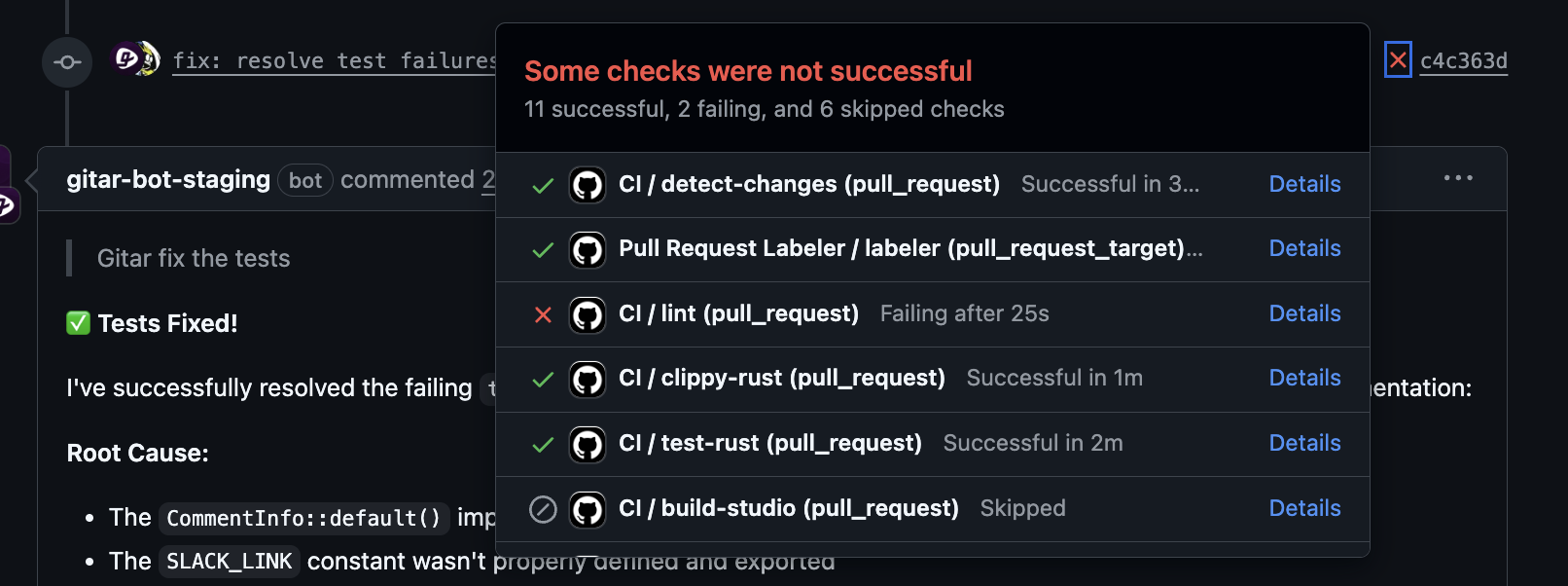
Gitar acts as a powerful CI repair tool. When a check fails or feedback is given, its AI assesses the issue, creates a solution, applies the change, and tests it in the full CI setup, all without your input.
It manages a wide range of issues, from fixing lint errors, formatting problems, and failing tests to handling reviewer requests like “remove this feature” or “add error handling.” Gitar executes these with the skill of a seasoned coder.
What makes Gitar unique is its ability to work in complex setups. It mirrors exact CI conditions, including specific software versions, multiple dependencies, security scans, and custom builds, ensuring fixes hold up in real-world scenarios.
Key features of Gitar include:
- AI understanding of reviewer comments for accurate code changes.
- End-to-end resolution, from identifying issues to applying fixes.
- Full CI environment testing to confirm fixes work in production.
- Adjustable automation levels, from suggestions to full commits.
- Support for global teams to keep momentum across time zones.
Gitar connects easily with tools like GitHub, GitLab, and CircleCI. You can start with minimal automation and scale up as you build trust in the system.
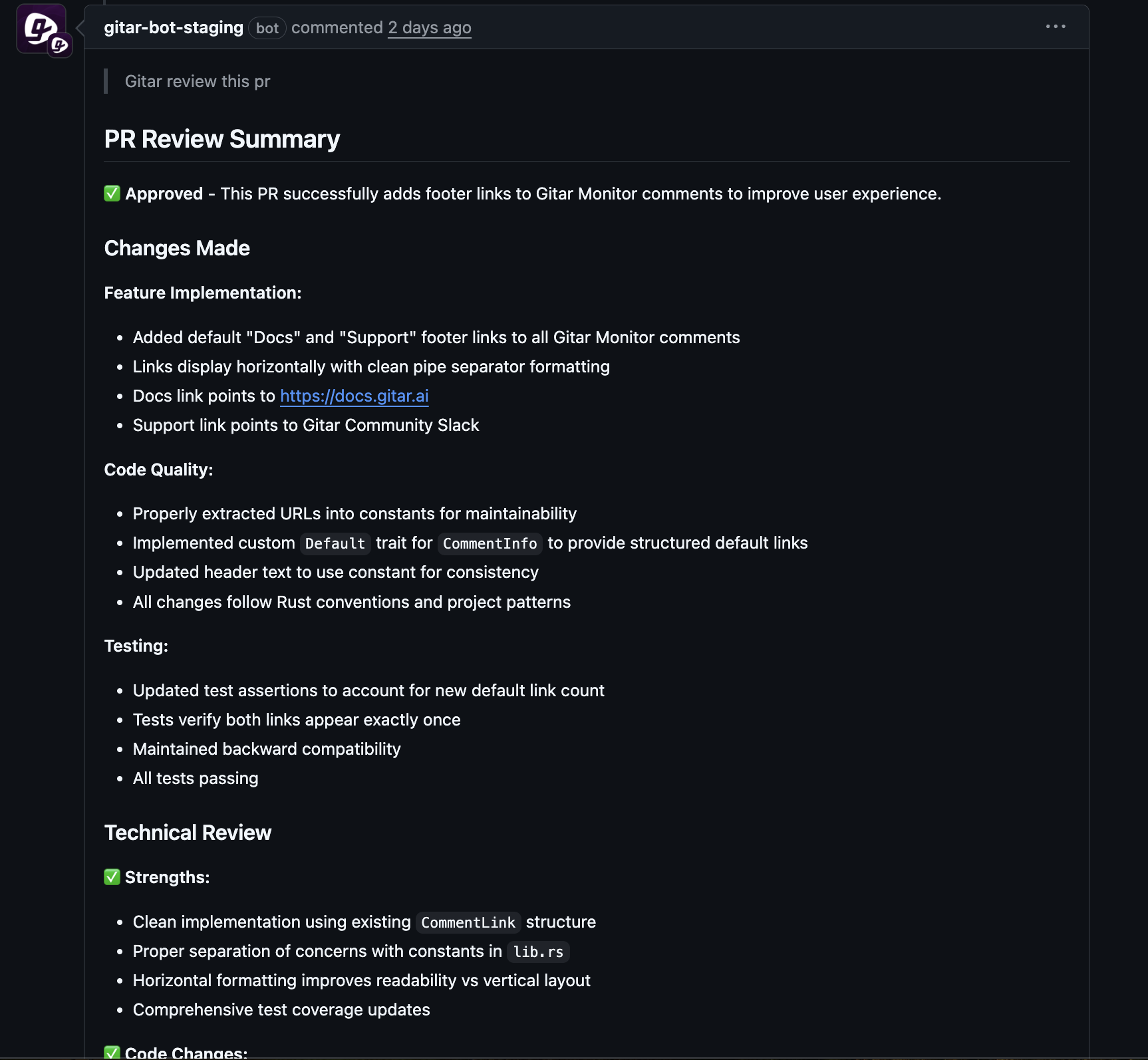
Want to see faster code reviews? Book a demo with Gitar to explore AI-driven ‘vibe coding’ for your CI/CD.
Key Advantages of Using Gitar for ‘Vibe Coding’
Speed Up Merges and Team Output
Gitar cuts down the time it takes to merge pull requests by automating the fix-test-commit loop. This turns a stop-start process into a smooth workflow, saving hours on each PR.
Without automation, PRs often wait over 24 hours, stretching small fixes into days. Gitar resolves issues quickly, maintaining review quality without the usual delays.
Faster merges mean quicker feature releases and better responses to customer needs. Teams using Gitar often see a 60-80% drop in merge times, creating a cycle of frequent, manageable commits that speed up reviews even more.
Keep Focus by Cutting Context Switches
Gitar helps you stay in a productive flow by handling review tasks in the background. Over half of developers feel held back by review inefficiencies, largely due to interruptions.
With Gitar, submit your PR and move to the next task. Hours later, you’ll often find it updated, with fixes applied and CI checks passed. This removes the stress of tracking reviews or waiting for feedback.
This focus also lifts team discussions. Reviewers can talk about design and logic instead of nitpicking code, while uninterrupted deep work leads to better solutions and innovation.
Lower Costs and Prevent Burnout
Gitar saves money by reducing lost time. For a team of 20 developers spending an hour daily on reviews, the yearly cost is around $1 million. Gitar can recover 60-80% of that, offering clear value.
It also helps retain talent. Developers unhappy with reviews are far more likely to leave. By easing daily frustrations, Gitar keeps your team engaged and reduces turnover costs.
CI compute expenses drop too. Automatic fixes on early attempts cut down retry cycles, saving resources, especially for complex pipelines. Teams can achieve more without expanding headcount, freeing budgets for other needs.
Gitar Compared to Traditional Review Tools
Why Gitar’s Healing Engine Outperforms Suggestion Tools
Many AI review tools only suggest fixes, leaving the work to you. Gitar stands out as a healing engine, automatically applying and validating solutions, saving you from manual effort.
Suggestion tools can add to your workload by requiring you to assess and apply fixes yourself. Gitar handles the entire process, from issue spotting to resolution, for true time savings.
|
Feature |
Gitar (Healing Engine) |
AI Suggestion Tools |
Manual Reviews |
|
Fix Implementation |
Automatic (generates and commits fixes) |
Suggestions (manual action needed) |
Fully manual (you code and push) |
|
CI Validation |
Full environment testing for reliable builds |
None (you validate) |
Manual (you debug CI loops) |
|
Context Switching |
None (fixes happen automatically) |
Some (suggestions interrupt flow) |
Constant (full interruptions) |
|
Time-to-Merge |
Much faster |
Slightly better (manual steps remain) |
Slow (delays and back-and-forth) |
Experience the impact of automatic fixes. Install Gitar to resolve broken builds and deliver quality software faster.
Common Questions About ‘Vibe Coding’ with Gitar
How Does Gitar Manage Complex CI Setups?
Gitar is built for enterprise environments, replicating exact CI workflows with specific software versions, multiple dependencies, Docker setups, and tools like SonarQube or Snyk. It tests fixes in conditions matching production, ensuring they work right away, even in unique setups like monorepos or strict security rules.
Is It Safe to Rely on Automated Fixes?
Gitar offers a flexible trust system. Start with suggestions for review before moving to automatic commits with clear explanations and rollback options. Safety features limit change types and log actions for audits, letting you build confidence over time.
What Feedback Can Gitar Handle?
Gitar interprets a range of feedback, from simple tasks like “remove this” to complex refactoring like “use a map.” It also auto-fixes CI issues like lint errors or failing tests and suggests improvements for efficiency or design patterns, with plans for major changes awaiting approval.
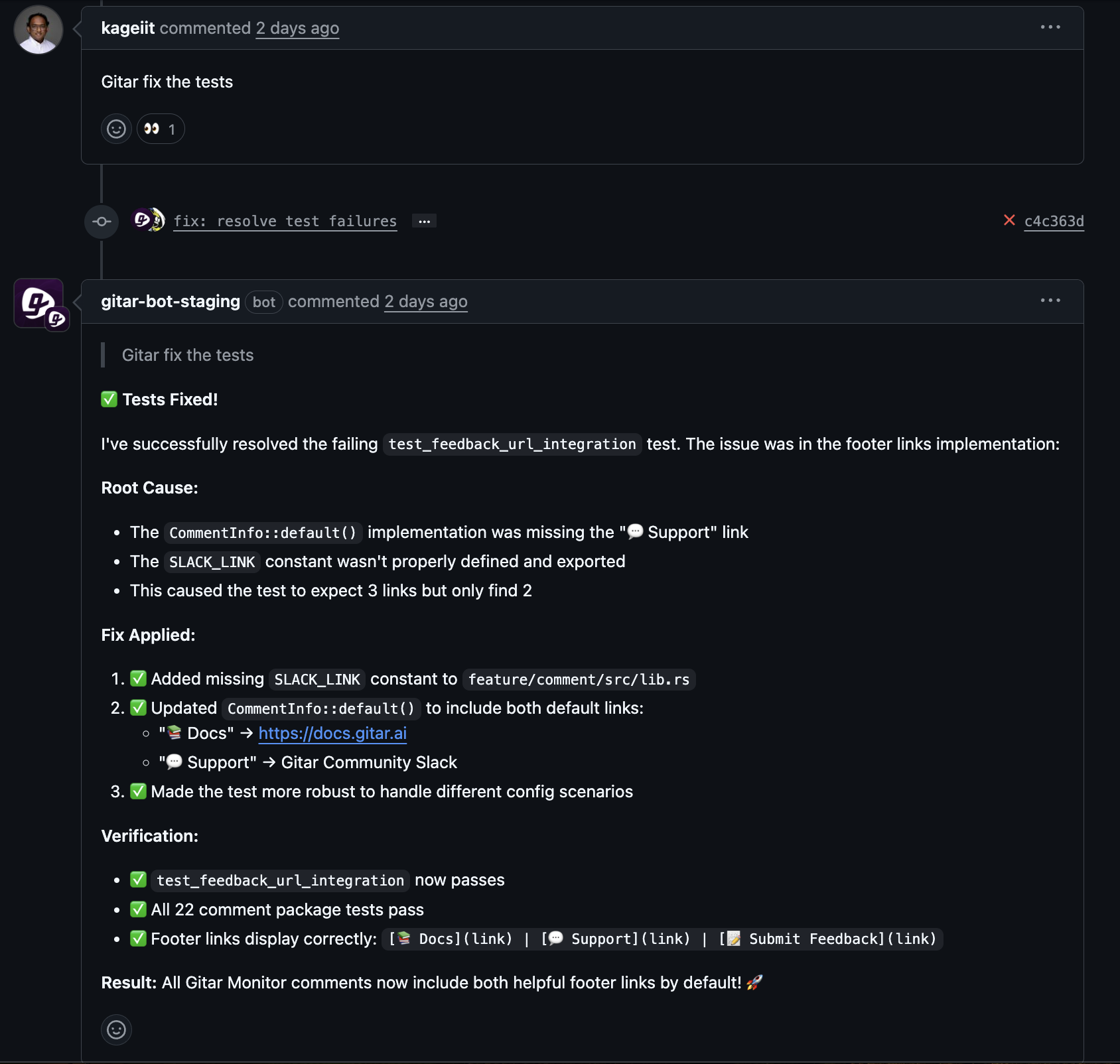
How Does ‘Vibe Coding’ Support Distributed Teams?
Gitar helps distributed teams by applying fixes overnight across time zones. A reviewer’s feedback in one region is often resolved by the time the developer in another region starts their day, cutting wait times and maintaining consistent review quality globally.
How Does Gitar Fit Into Current Workflows?
Gitar integrates with tools like GitHub, GitLab, CircleCI, and Jenkins, needing just 15 minutes to set up. It works with your existing review and approval processes, adding automation without disruption, and connects to IDEs and notification systems for smooth updates.
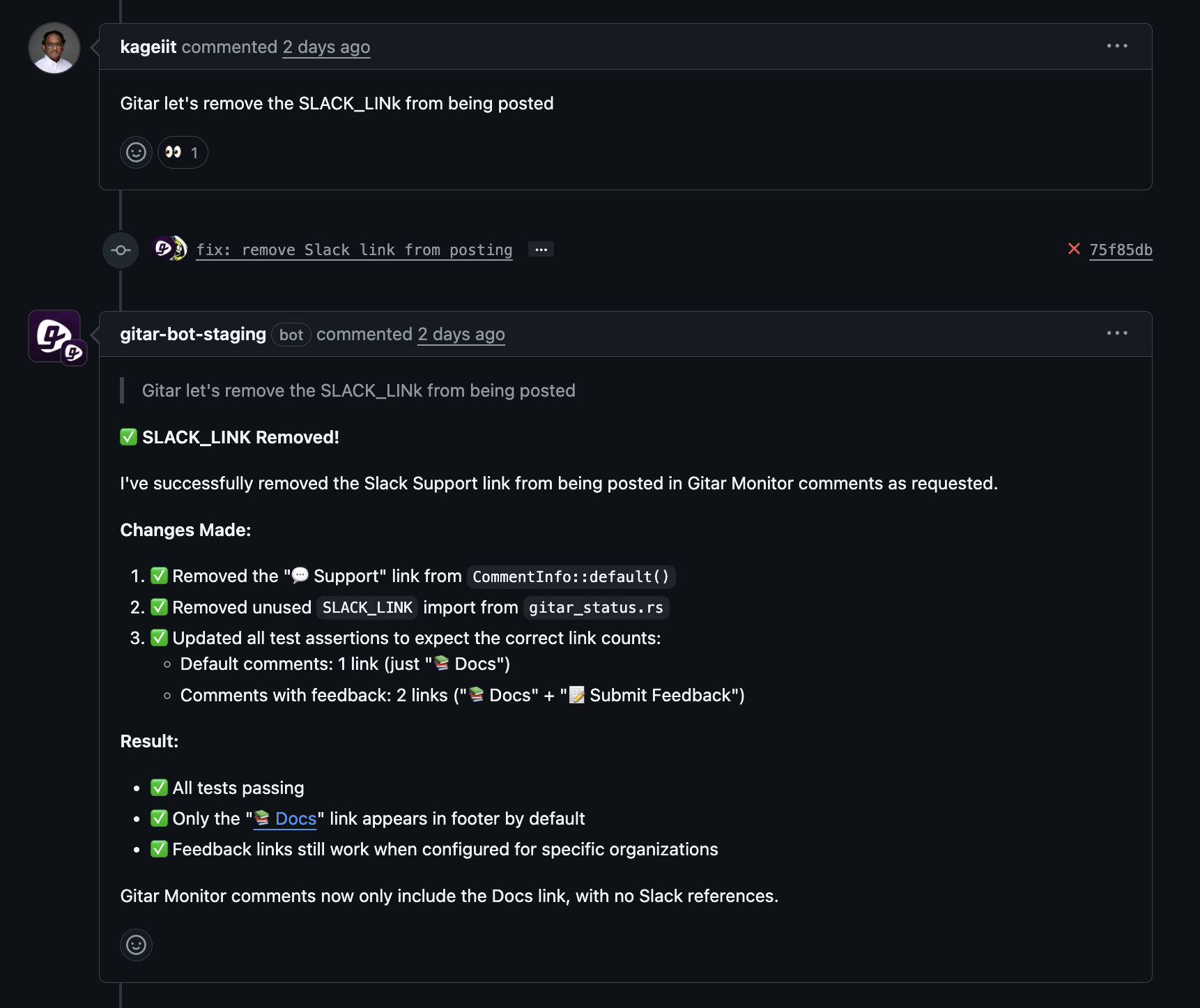
Boost Productivity with Gitar and ‘Vibe Coding’
Inefficient code reviews are a solvable problem, and Gitar offers a direct solution through ‘vibe coding.’ By automating tedious review tasks, teams can save significant time and improve developer satisfaction.
‘Vibe coding’ goes beyond automation, rethinking how teams collaborate and deliver value. With routine issues handled by AI, you focus on innovation and complex challenges. This leads to faster iterations and better software quality.
Gitar addresses key pain points like context switching, time zone delays, and manual work, helping teams operate efficiently. The result is quicker delivery and higher morale.
Adopting ‘vibe coding’ now sets your team ahead in AI-driven development trends, building advantages that grow over time.
Stop losing hours to slow reviews. Book a demo with Gitar to see AI-powered ‘vibe coding’ and start delivering quality software faster.