
Key Takeaways
- Extended time to merge slows teams through CI failures, review delays, and frequent context switching.
- Autonomous AI can diagnose and fix many CI failures, reducing manual debugging and keeping pipelines healthy.
- AI that also applies code review feedback helps distributed teams move pull requests forward while engineers stay focused.
- Healing engines that validate fixes in your actual CI environment provide more reliable outcomes than suggestion-only tools.
- Teams can use Gitar to automatically fix CI issues and review comments, cutting time to merge and improving delivery speed. Install Gitar.
Why Time to Merge Has Become Your Engineering Team’s Biggest Bottleneck
Modern development workflows often slow down long before code reaches production. Pull requests stall in CI, wait in review queues, and bounce between reviewers and authors.
Context switching creates a major productivity cost. When a pull request fails CI, developers stop their current work, parse logs, patch issues, and re-run pipelines. A small failure can stretch across hours as focus shifts away from deeper problem-solving.
Distributed teams add another delay. Time zone gaps push each review cycle into the next working day. A developer in San Francisco who depends on a reviewer in Bangalore might see a simple change turn into a multi-day merge process.
AI coding assistants now generate code faster than teams can review it. More pull requests mean more tests, more potential failures, and more time spent on routine fixes instead of new features.
How Gitar Reduces Time to Merge with Autonomous Fixes
Gitar focuses on the specific problems that slow merges: CI failures and unaddressed review comments. The AI agent analyzes issues, generates fixes, and validates changes so developers spend less time on repetitive repair work.
Key capabilities include:
- End-to-end fixing that applies and validates changes against full CI workflows so builds pass before developers return to a pull request.
- Full environment replication for complex CI setups, including language versions, SDKs, and tools such as static analyzers or security scanners.
- An intelligent code review assistant that implements requested changes based on reviewer comments.
- A configurable trust model that ranges from suggestion-only mode to fully autonomous commits with rollback options.
- Support for popular CI platforms, including GitHub Actions, GitLab CI, CircleCI, and Buildkite, so teams keep existing pipelines.
Start reducing your time to merge with Gitar.
Fixing CI Pipeline Failures Before Developers Lose Focus
Gitar targets common CI failures that frequently block merges. When pipelines fail on lint errors, broken tests, or dependency problems, Gitar reviews logs, identifies root causes, and generates fixes.
The agent then applies the changes and re-runs checks in the same CI workflow. Developers see updated results and a clear explanation of what changed instead of raw error logs and failing jobs.
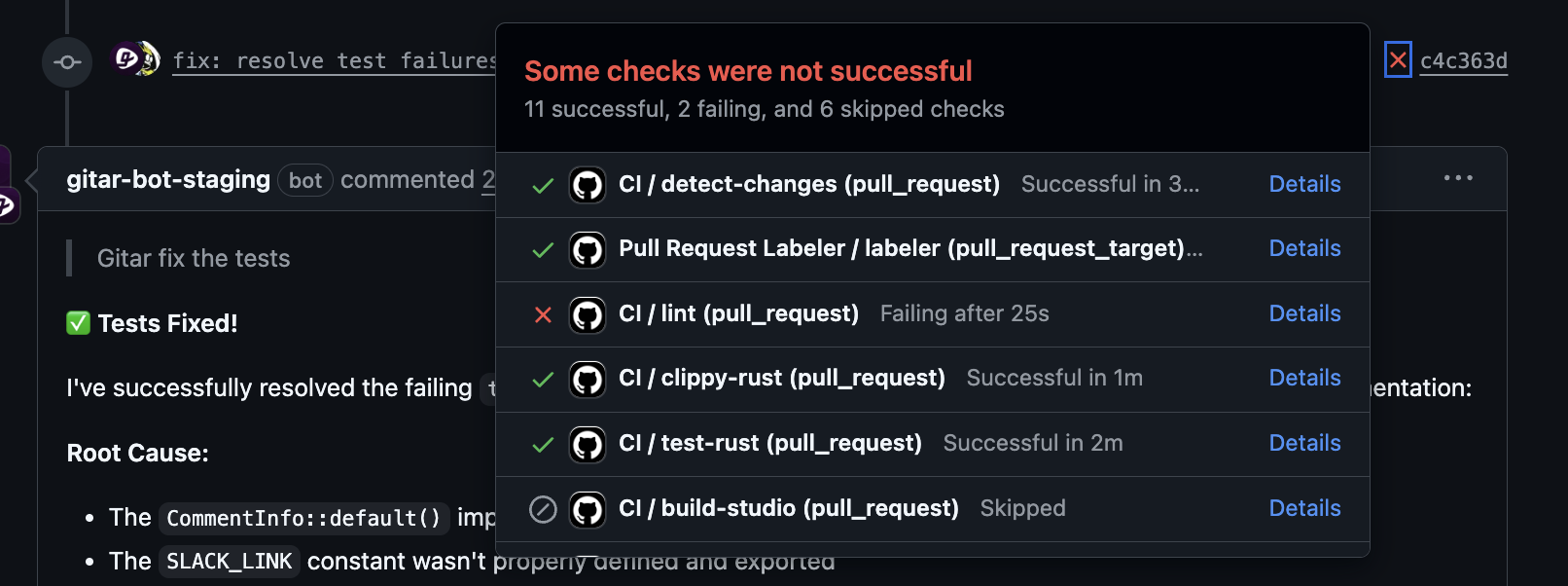
This approach turns many failures into background tasks. Developers can keep working on higher-value problems while Gitar handles repetitive CI repair work.
Turning Code Review Feedback into Concrete Commits
Gitar also shortens review cycles by implementing reviewer feedback. When a reviewer leaves a comment that asks for changes, Gitar interprets the intent and applies the requested update.
For example, a reviewer might comment that a feature does not belong in the current pull request. Gitar identifies the related code, removes it where appropriate, and pushes a new commit with a summary of the edits.
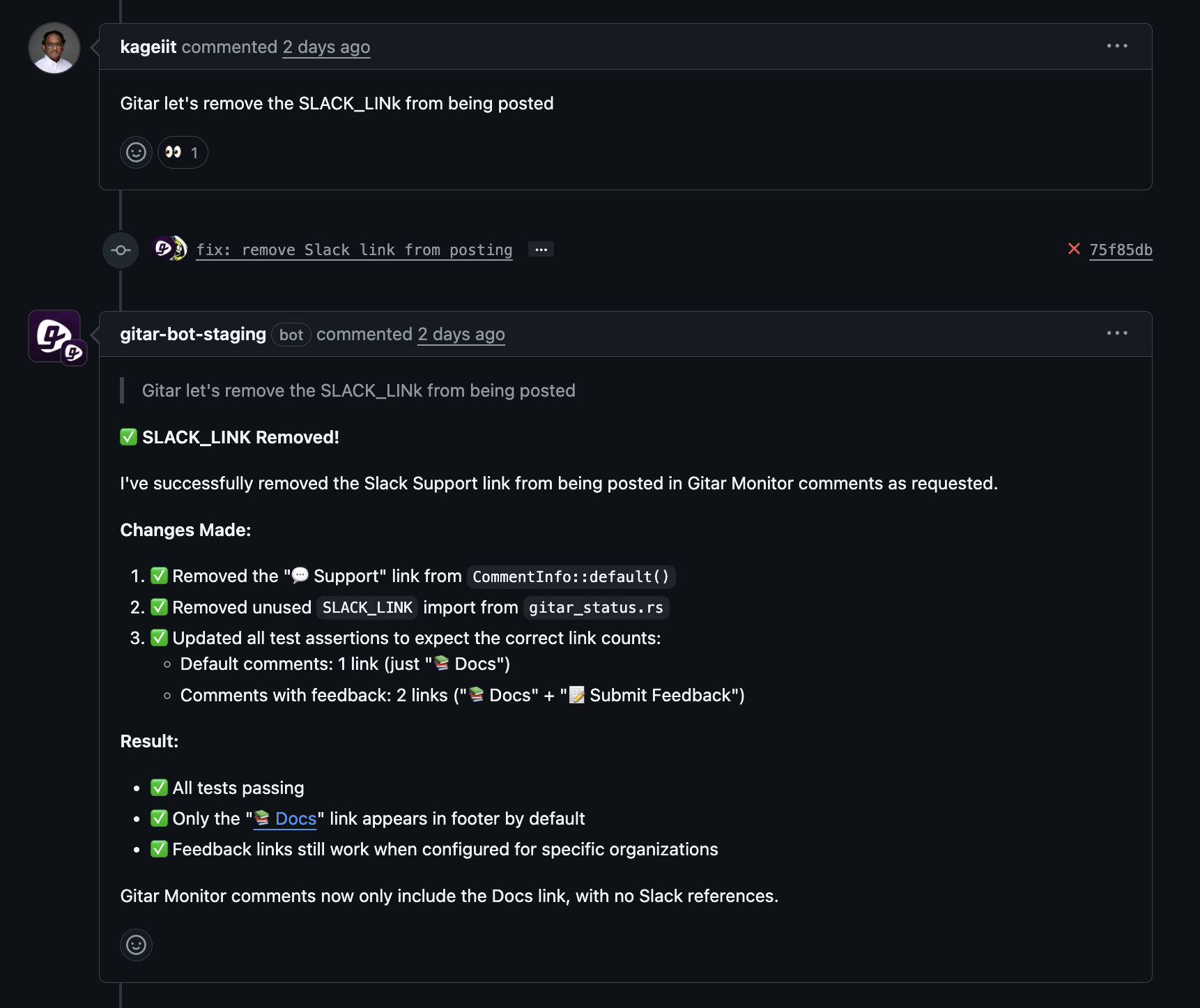
This workflow is especially useful for distributed teams. Reviewers can leave clear instructions at the end of their day, and Gitar can apply changes before the author next checks the pull request.
Protecting Developer Flow and Reducing Context Switching
Gitar helps preserve flow state by resolving issues while developers focus on their main tasks. When engineers return to a pull request, they see passing checks or ready-to-review suggestions instead of a queue of failures.
Teams that reduce CI-related interruptions across a 20-developer group can avoid large amounts of lost focus time each year, which improves both delivery speed and engineering satisfaction.
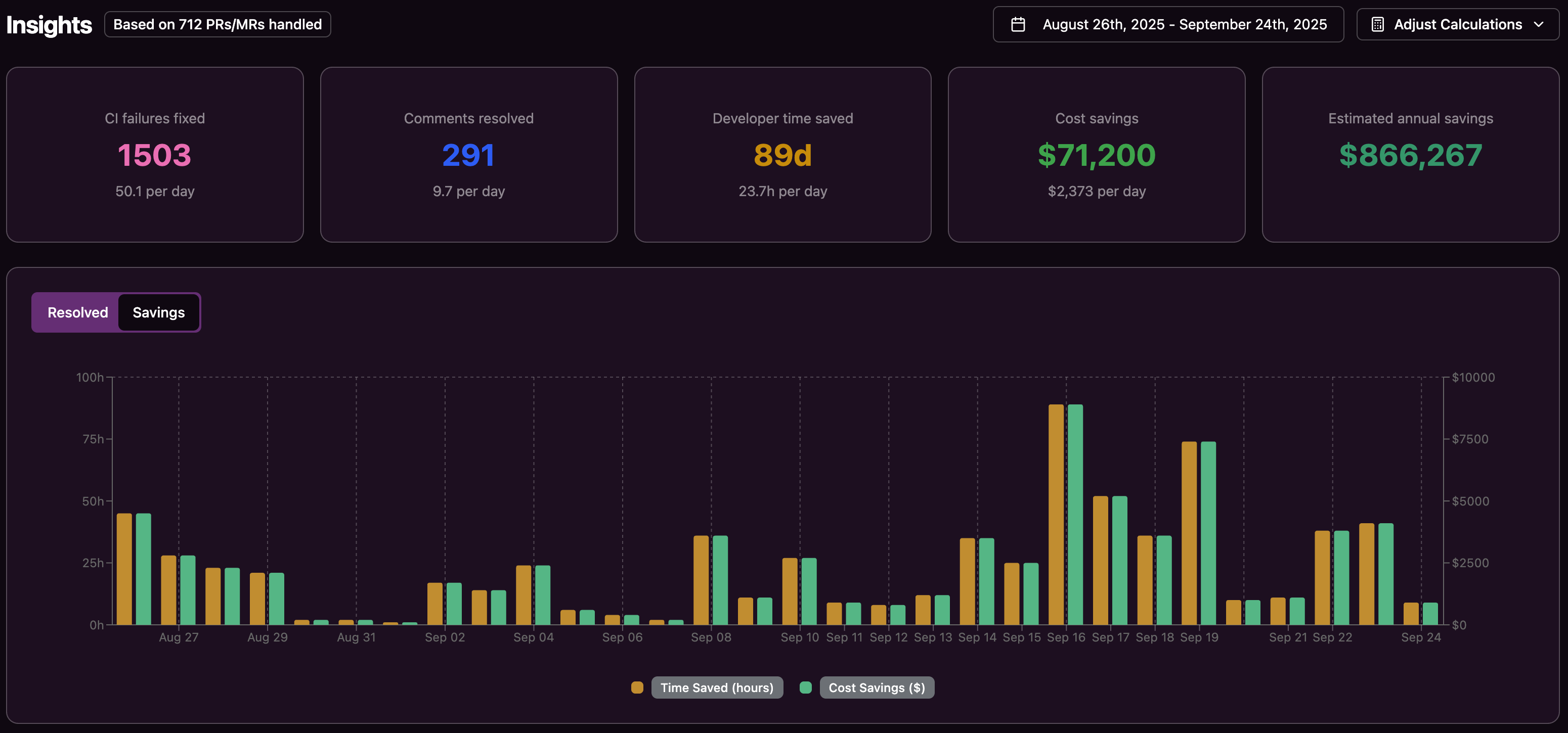
Install Gitar to cut CI interruptions and keep developers in flow.
Healing Engines vs. Suggestion Engines for Faster Merges
AI development tools often fall into two groups: suggestion engines that recommend fixes and healing engines that implement solutions autonomously. This difference matters when the goal is to reduce time to merge.
|
Feature |
Gitar (Healing Engine) |
AI Code Reviewers (e.g., CodeRabbit) |
On-Demand AI Fixers (e.g., Anthropic GitHub Action) |
|
Action taken |
Applies and validates fixes autonomously |
Suggests and sometimes applies fixes with developer oversight |
Generates fixes configured for automated or manual use |
|
Fix validation |
Validates against the full CI workflow |
Often relies on developers to run and verify checks |
Typically relies on developers for validation |
|
Environmental context |
Replicates the CI environment, including tools and dependencies |
Uses repository and static code context |
Uses repository context through workflow integration |
|
Autonomy |
Operates in the background once enabled |
Requires regular prompts or direct interaction |
Runs on triggers or manual invocation |
Gitar focuses on autonomy and validation in the target environment so teams see fixes that already pass CI, not just suggestions that still need manual follow-through.
Key Details About Reducing Time to Merge with Gitar
Gitar support for complex enterprise CI setups
Gitar replicates real CI environments, including specific JDK or language versions, multi-SDK setups, and tools such as SonarQube or Snyk. This replication helps ensure that automated fixes match how pipelines actually run and keeps changes reliable in production workflows.
Differences from AI reviewers such as CodeRabbit
AI reviewers can provide comments and sometimes propose patches. Gitar operates as a healing engine that focuses on applying and validating fixes directly against your CI workflow, which reduces manual intervention and shortens the path from failure to mergeable state.
Managing trust and code quality with automated fixes
Teams control how Gitar commits changes through a configurable trust model. Many organizations start with a conservative mode where Gitar posts suggested patches for quick review and one-click merge. As confidence grows, teams can enable direct commits with rollback support for specific repositories or pipelines.
Types of CI failures Gitar can address
Gitar handles routine CI issues such as lint and formatting violations, failing unit or integration tests, outdated snapshots, and dependency-related build errors. These fixes remove a large share of repetitive work that often delays merges.
How Gitar fits into existing workflows
Gitar installs as a GitHub or GitLab app that monitors pull request events and CI results. When failures occur, the agent proposes or applies fixes and updates the pull request with details. Teams do not need to redesign pipelines, and they can adjust autonomy levels over time as they gain experience with the tool.
Conclusion: Shorten Time to Merge with Autonomous Remediation
Manual CI debugging, slow code reviews, and constant context switching combine to limit engineering throughput. These delays create a structural bottleneck between writing code and deploying it.
Gitar addresses these problems by automatically fixing CI failures and implementing code review feedback in the background. This approach helps teams move pull requests to a mergeable state faster while developers stay focused on higher-value work.