
Key Takeaways
- Manual CI failure triage and code review delays consume large blocks of developer time and slow delivery across distributed teams.
- Self-healing CI uses autonomous agents to detect, fix, and validate common CI failures directly in your real pipeline, not just suggest changes.
- Shifting from suggestion-only tools to end-to-end fixing reduces context switching, shortens review cycles, and keeps developers focused on feature work.
- Gradual rollout with clear trust and rollback controls helps teams adopt CI automation while maintaining quality and standards.
- Gitar provides a self-healing CI agent that installs into your existing workflow and automatically fixes CI failures and review comments, so you can start now by installing Gitar.
Why Automatically Reducing CI Failures Protects Team Productivity
Manual CI failure resolution creates a direct and measurable drag on engineering productivity. A 20-developer team that loses one hour per person per day to CI failures and review back-and-forths gives up about 5,000 hours per year, or roughly $1 million at a loaded rate of $200 per hour.
This drag now operates in a 2026 development environment where tools like GitHub Copilot and Cursor increase code output and pull request volume. More code ships to CI, more tests run, and more failures surface, while distributed teams still rely on manual fixes stretched across time zones. Traditional, developer-driven CI triage no longer scales with this level of throughput.
How Self-Healing CI and Autonomous Agents Reduce Manual CI Work
Self-healing CI changes the default response to failures from stop-and-wait to detect-and-fix. Autonomous agents monitor pipelines, interpret failures, generate targeted fixes, validate those fixes in the CI environment, and commit changes when builds pass.
Gitar focuses on acting as a healing engine rather than a suggestion engine. The agent responds to CI failures and review comments, applies and validates fixes, and returns pull requests in a ready-to-merge state. Key capabilities include:
- End-to-end fixing, from detection and diagnosis through code change, validation, and commit.
- Full environment replication for enterprise workflows, including specific SDK versions, dependency graphs, and tools such as SonarQube or Snyk.
- A configurable trust model that supports suggestion-only flow, auto-commit with review, and rollback controls.
- Direct code review integration so reviewer feedback is implemented without forcing the original author to context-switch.
- Support for major CI/CD platforms, including GitHub Actions, GitLab CI, CircleCI, and Buildkite.
This approach removes much of the repetitive implementation and validation work that generic AI suggestions still leave to developers.
Install Gitar to add autonomous fixing to your existing CI pipelines.
How Gitar’s Autonomous AI Agents Resolve CI Failures
Root Causes Gitar Targets for Automatic Fixing
Effective automation starts with predictable failure modes. Gitar focuses on common, high-volume problems such as lint and formatting errors, unit and integration test failures, and dependency or build configuration issues that repeatedly break pipelines.
The agent analyzes logs and context from each run to classify the failure and select the right resolution strategy, instead of relying on generic patterns that ignore project-specific configuration.
End-to-End Self-Healing Flow in Your CI Environment
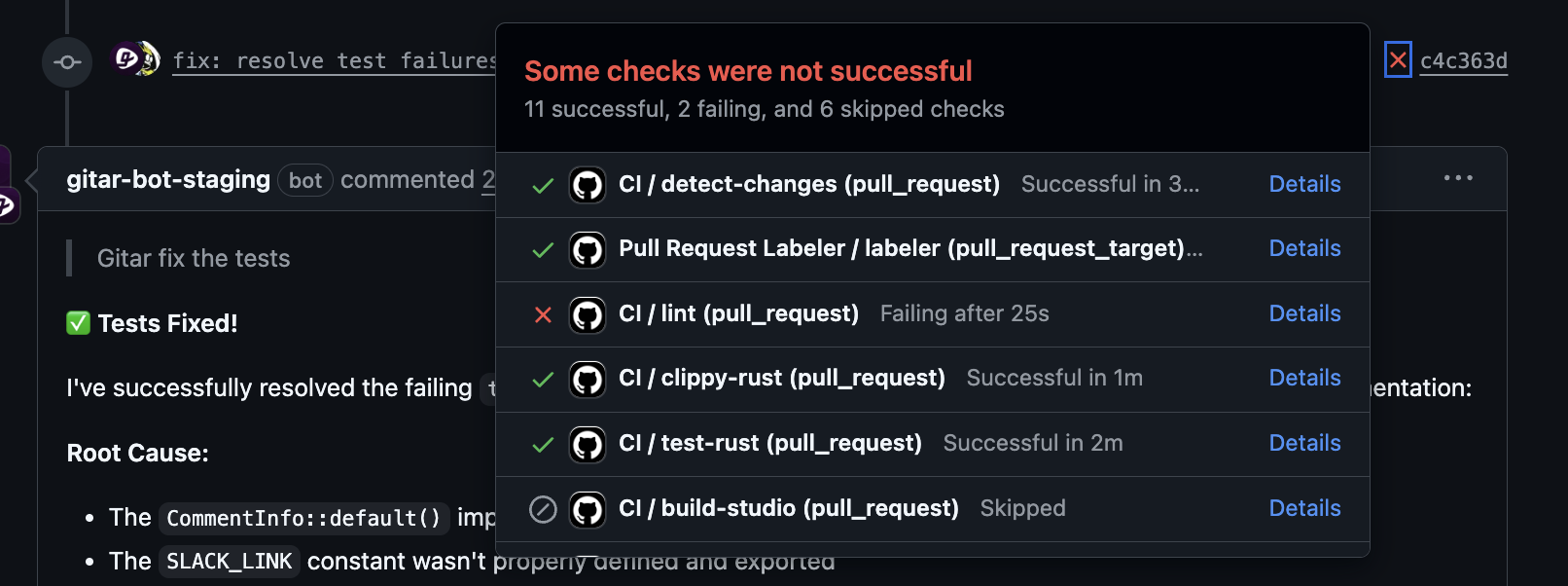
When a failure occurs, Gitar parses CI logs, infers the root cause, and proposes a minimal, targeted code change. The agent factors in project structure, dependency versions, and active CI checks so fixes align with how the code actually builds and runs.
The agent then spins up a mirrored environment, applies the fix, and runs the relevant checks and tests. Only when the pipeline passes does Gitar commit the change back to the pull request. This validation-first model reduces the risk of new regressions and limits noisy re-runs.
Implementing Code Review Feedback Without Extra Back-and-Forth
Gitar also responds to review comments. When a reviewer asks to remove a feature from a pull request or adjust an implementation detail, the agent edits the code, updates tests when necessary, and commits the change with a clear explanation.
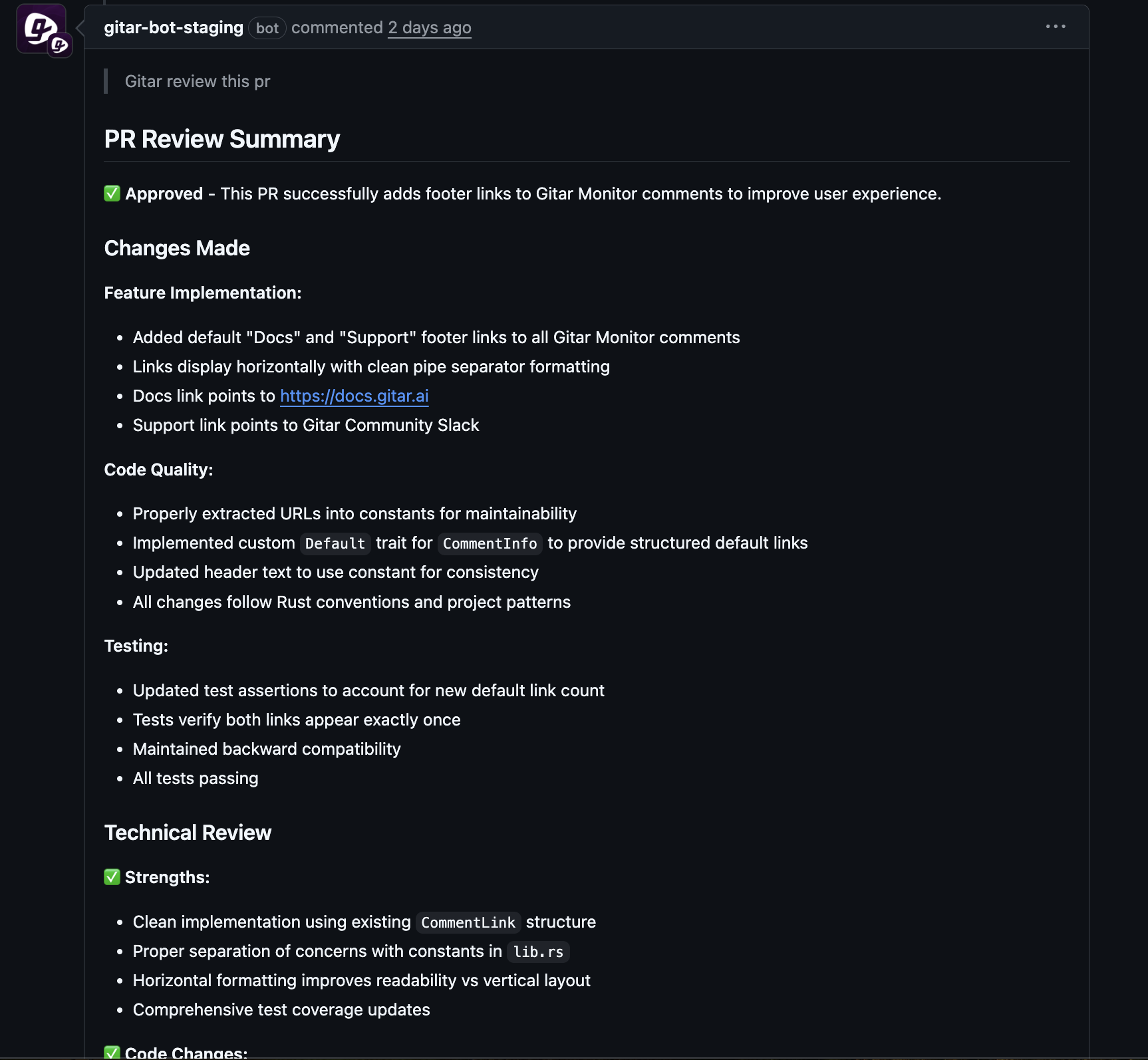
This behavior is especially useful for teams spread across time zones, where reviewer feedback often turns into full-day delays. Developers can start their day with a passing build and review feedback already applied.
Strategic Considerations for Adopting Autonomous CI Failure Resolution
Build vs. Buy for CI Automation
Engineering leaders can either build internal automation or adopt a platform like Gitar. Building requires prompt design, state and context management, environment replication, event routing, and validation frameworks around general-purpose models, along with ongoing maintenance as CI stacks change.
Gitar offers a managed agent that attaches to existing CI/CD pipelines and repositories. The platform owns the complexity of agent orchestration, environment replication, and model upgrades, so internal teams can focus on product work rather than infrastructure for CI automation.
Measuring ROI and Impact
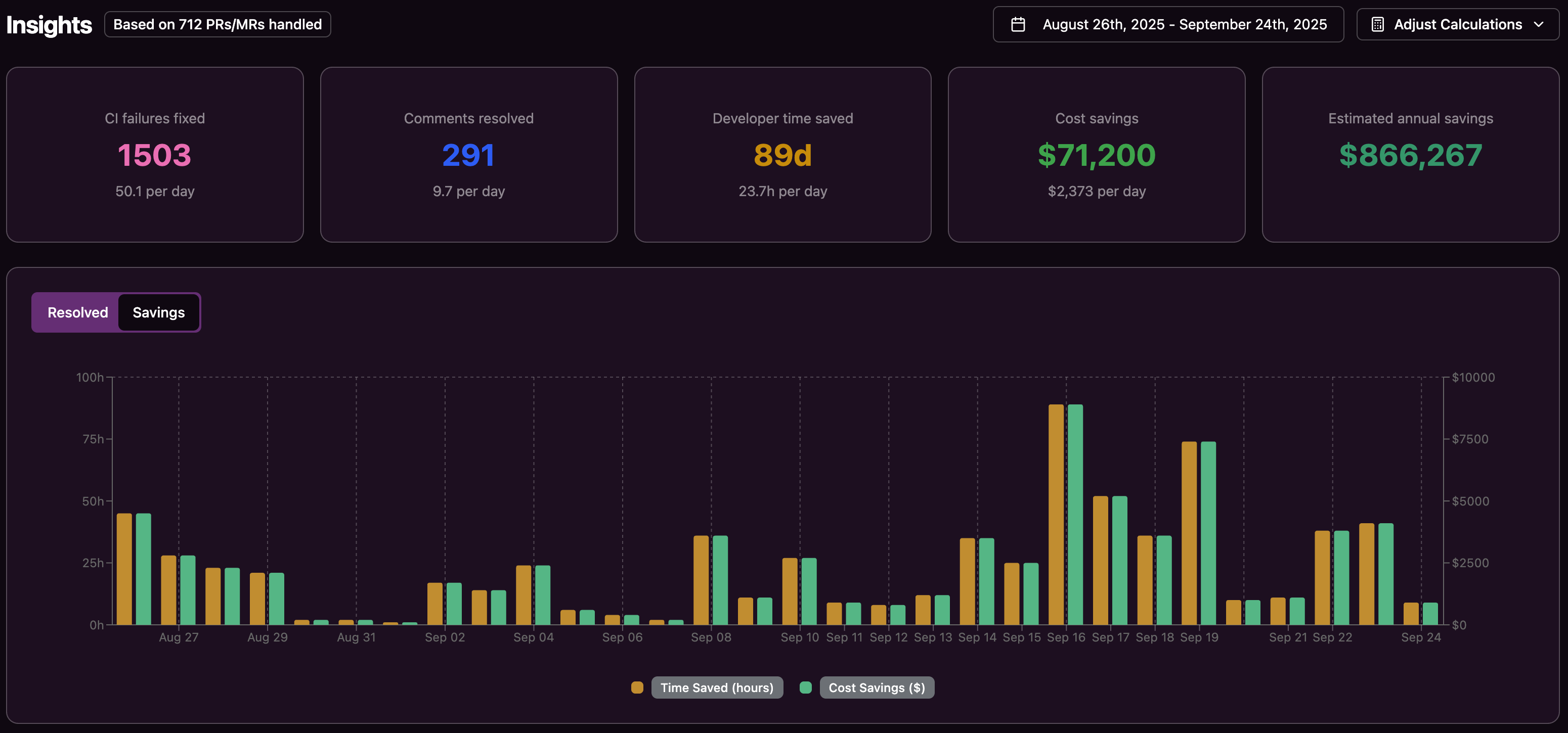
Time recovered from CI failures and review-based rework creates the core ROI. A team that currently loses one hour per developer per day to CI issues can recover hundreds of engineering days per year, even if automation only removes a portion of that overhead.
Useful metrics include mean time to fix CI failures, merge frequency, time from first PR open to merge, and developer satisfaction with review and CI processes. Faster merges and shorter feedback loops also support more frequent releases and quicker customer iteration.
Adopting Automation Gradually to Build Trust
Teams usually see the best results by starting in suggestion-only mode. Gitar can propose fixes, attach them to pull requests, and allow developers to approve them with a click, which validates accuracy and style alignment with minimal risk.
After teams gain confidence, they can enable more aggressive modes where Gitar auto-commits for low-risk categories such as formatting, linting, and simple test repairs, while keeping manual review for complex logic. Clear audit trails and rollback options give teams control at each step.
Pitfalls and How to Avoid Them
Stopping at Suggestions Instead of Fixes
Many AI tools identify issues and suggest patches, but still require developers to implement, test, and validate changes. This pattern preserves the context switching and local test workflows that already slow teams down.
Self-healing CI should include implementation and CI validation by default. Gitar focuses on completing the entire loop, so developers receive a passing build rather than a list of suggestions.
Ignoring CI/CD Environment Complexity
Enterprise CI pipelines often rely on specific compiler versions, internal registries, security scanners, and custom build steps. Generic AI that operates only on code, without accurate environment replication, can generate fixes that pass locally but fail in CI.
Replicating the real CI environment, including configuration and integrations, keeps automated fixes aligned with how code runs in production pipelines.
Addressing Developer Concerns About Automation
Developers reasonably want assurance that automated fixes meet quality and style standards. Clear diff views, audit logs for each change, and a safe rollback path help address these concerns.
Starting with narrow, low-risk categories of fixes and widening scope based on real results allows teams to develop confidence based on experience rather than assumptions.
Install Gitar to reduce manual CI triage and shorten your review cycles.
Comparison: Gitar vs. Traditional and AI-Assisted Approaches to Reducing CI Failures
|
Feature / Approach |
Traditional (Manual) |
AI Code Reviewers |
Gitar (Autonomous CI Fixer) |
|
Issue Resolution |
Manual and slow |
Suggestions only |
Autonomous and end-to-end |
|
CI Integration |
Often interrupts the pipeline |
Limited or no direct CI validation |
Deep integration with full environment replication |
|
Developer Intervention |
High, with frequent context switching |
High, due to manual implementation |
Low, with self-healing behavior |
|
Trust and Safety |
Human review only |
Human review of suggestions |
Configurable from suggest-only to auto-commit with rollback |
Conclusion: Move Toward Faster Releases and Less CI Overhead
Manual CI failure handling and elongated review cycles continue to consume a large share of engineering capacity. Suggestion-only AI tools provide partial help but keep most of the implementation and verification effort on developers.
Self-healing CI with autonomous agents like Gitar offers a more complete approach by diagnosing failures, applying fixes, validating them in your real CI pipeline, and committing changes with traceability. Teams that adopt this pattern reduce CI noise, shorten feedback loops, and free developers to focus on shipping product improvements.
Install Gitar to bring self-healing CI into your existing repositories and pipelines.
Frequently Asked Questions about Automating CI Failures
How does Gitar handle highly unique or complex CI setups that standard AI might miss?
Gitar replicates full enterprise workflows, including specific JDK or SDK versions, multi-language builds, third-party scans such as SonarQube and Snyk, and snapshot testing. The agent works against this mirrored environment before generating and validating fixes, which keeps automated changes aligned with your actual CI configuration.
Our team is concerned about fully automated fixes introducing new bugs. How does Gitar ensure code quality and stability?
Gitar validates every fix against your complete CI workflow and supports conservative modes that surface changes as suggestions for developer review. Teams can expand to auto-commit only after they see consistent, high-quality results, while rollback and audit logs remain available at all times.
We already use AI code reviewers like CodeRabbit. How is Gitar different for CI failure resolution?
AI code reviewers focus on analysis and suggestions, while Gitar focuses on execution. The agent applies fixes, runs your CI checks, and updates the pull request only when the build passes, which removes most of the manual follow-through that still exists with reviewer-only tools.
How does Gitar help with growing code volume from tools like GitHub Copilot?
Faster code generation increases the number of pull requests and test runs that can fail for predictable reasons. Gitar absorbs much of this extra CI load by automatically fixing failures and updating pull requests, so increased code velocity does not produce a matching increase in manual CI work.
What happens if Gitar makes a fix that does not align with our coding standards or introduces an unexpected issue?
Gitar records every automated change with a clear diff and explanation, and supports simple rollback of individual commits. Teams can tune automation levels by change type, keeping stricter review in place for complex logic while allowing autonomous handling of formatting, lint, and other low-risk categories.