
Last updated: January 23, 2026
Key Takeaways
- Coverage drops trigger red CI builds and stall PRs, while AI coding increases weekly code commits by 13.5%.
- Manual fixes like smart thresholds and the Boy Scout Rule demand constant effort and cost teams about $1M per year.
- Gitar’s AI reads CI logs, creates validated fixes for coverage failures, and auto-commits them during a 14-day trial.
- Supports Python, JavaScript, and Java with tools like pytest-cov, Istanbul/nyc, and JaCoCo across GitHub Actions, CircleCI, and more.
- Install Gitar free to keep builds green, cut CI time by up to 75%, and ship higher quality software faster.
The Problem: Why Coverage Builds Fail in Modern CI
Coverage build failures come from technical gaps and process friction that stack up in modern development workflows. Chasing 100% code coverage often breaks CI builds because teams write superficial tests that do not assert real behavior. Developers gravitate toward easy-to-cover code and miss bugs in branching logic, exception flows, and legacy modules. Coverage then drops when these critical paths stay untested.
Language-specific tooling adds more failure points. Python projects using pytest-cov see flaky threshold enforcement when new code ships without matching tests. JavaScript projects with nyc or Istanbul lose coverage on untested async and error handling paths. Java projects using JaCoCo struggle when legacy coverage baselines collide with new development patterns.
Coverage thresholds in CI tools fail builds whenever measured coverage falls below configured minimums. Pressure increases as AI-assisted coding accelerates delivery and expands total code volume. Dead code builds up, inflates the coverage denominator, and makes percentages look worse even when new code has solid tests.
Manual Coverage Strategies and Their Hidden Costs
Engineering teams usually rely on six manual strategies to handle coverage build failures:
- Smart thresholds – Set realistic coverage targets, such as 70–80%, instead of chasing 100%.
- New-code-only gating – Enforce coverage requirements only on changed lines.
- JaCoCo/Maven configuration – Tune build tool settings to exclude unstable or irrelevant paths.
- Dead code removal – Delete unused functions and imports to improve coverage ratios.
- Boy Scout Rule application – Leave code slightly cleaner than you found it by renaming confusing variables, extracting logic into clear functions, or deleting dead code.
- Critical path prioritization – Focus testing on high-risk or high-traffic code paths.
These approaches fall short because they depend on constant human effort and frequent context switches. Manual investigation of coverage drops consumes significant developer time in large codebases and causes recurring CI failures. The Boy Scout Rule improves quality but sparks scope creep debates during reviews. Teams often spend about one hour per developer per day on coverage-related CI issues, which adds up to roughly $1 million per year for a 20-developer team.
Gitar’s AI Healing Engine for Coverage Failures
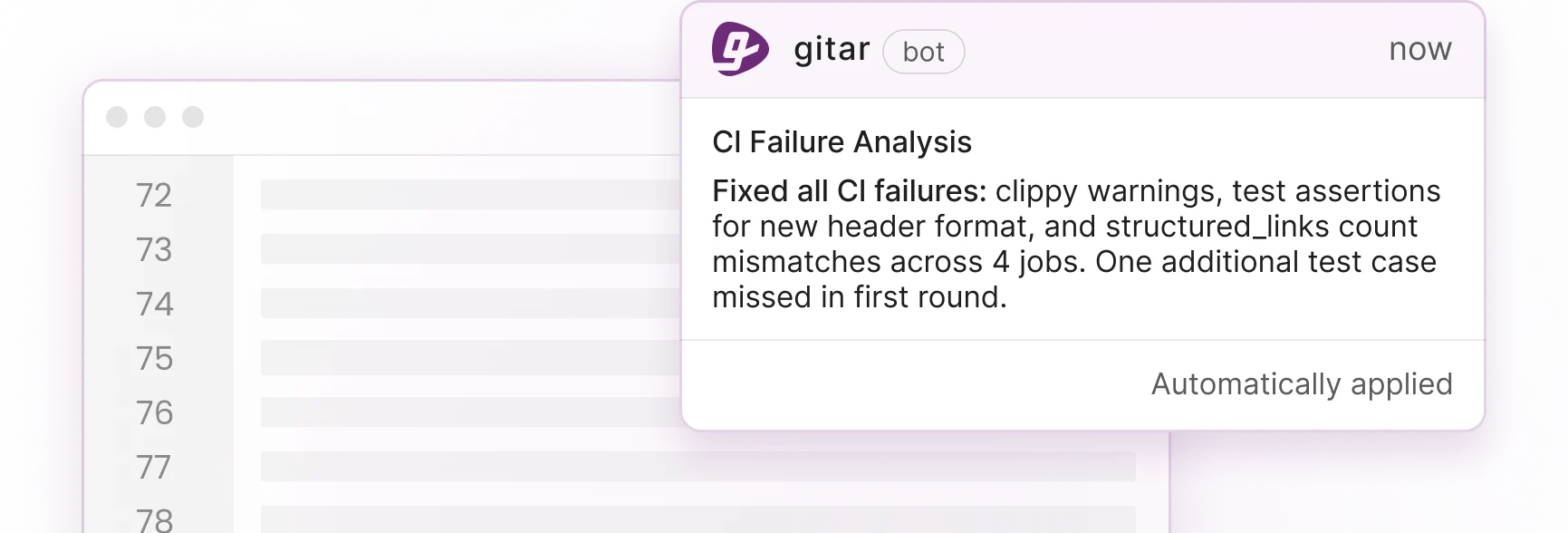
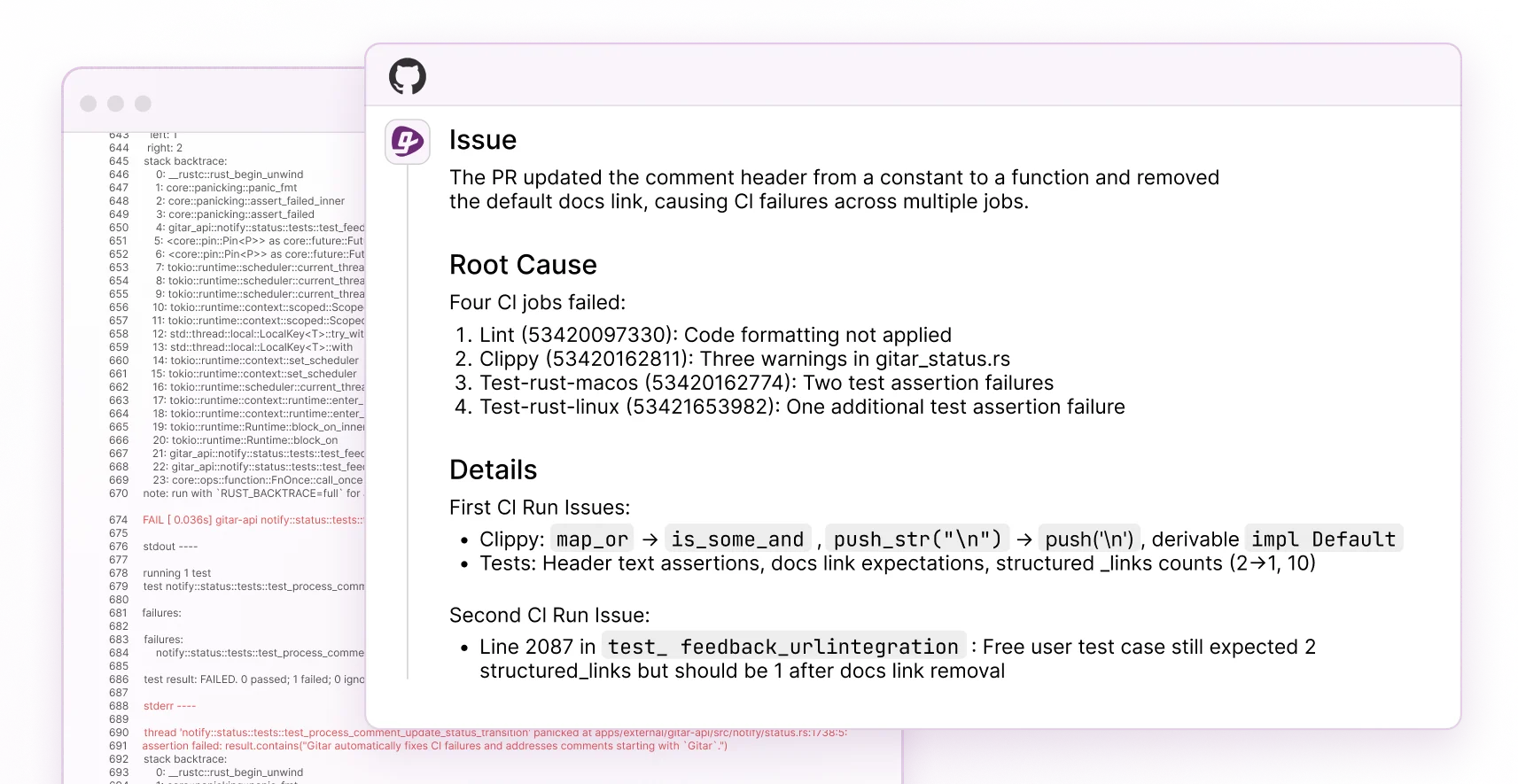
Gitar’s AI healing engine replaces manual CI debugging with automated, validated fixes. The platform offers free, unlimited code review for all repositories and includes a 14-day trial of autofix capabilities. When CI fails because of coverage drops or related issues, Gitar reads the failure logs, finds the root cause, generates fixes with full codebase context, tests them in CI, and commits them during the trial.
- Log Analysis – Parses CI failure logs and pinpoints the root cause.
- Fix Generation – Produces targeted code changes that address the specific failure.
- Validation – Runs fixes against the full CI environment to confirm they pass.
- Auto-commit – Applies validated fixes directly to the PR with a single, updated comment during the autofix trial.
This workflow delivers green builds for supported failure types and removes repetitive CI firefighting from developer workloads.
|
Capability |
SonarSource/JaCoCo |
CodeRabbit |
Gitar |
|
Auto-apply Fixes |
No |
No |
Yes (14-day trial) |
|
CI Log Analysis |
Manual |
No |
Yes |
|
Free Core |
Paid Config |
$15+/dev |
Yes |
|
Green Build Guarantee |
No |
No |
Yes |
Rolling Out Coverage-Healing Workflows with Gitar
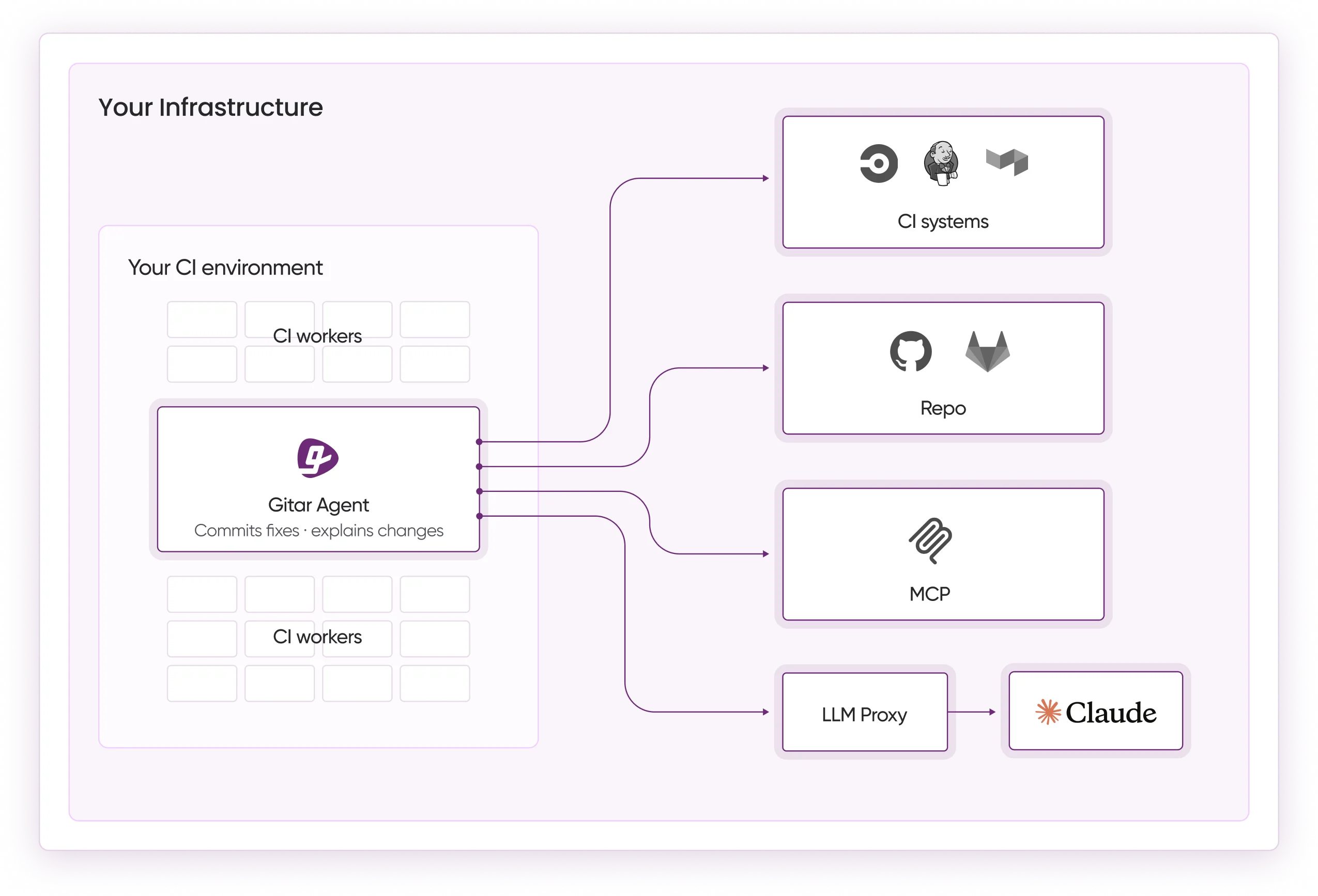
Gitar plugs into existing CI/CD pipelines through GitHub Actions, CircleCI, GitLab CI, and Buildkite without heavy configuration. Teams define coverage rules in natural language inside .gitar/rules/*.md files, which removes the need for complex YAML setups. The platform supports enterprise-scale environments, handling more than 50 million lines of code and thousands of daily PRs while keeping zero data retention policies for security.
Customer results confirm Gitar’s reliability at scale. Pinterest-level deployments show production readiness in demanding environments. Engineering teams report that Gitar’s PR summaries are “more concise than Greptile/Bugbot” because a single updating comment reduces notification noise.
Real-World ROI: Cutting Coverage-Related CI Time by 75%
Diffblue Cover delivers 4.9x to 29x better line coverage than AI assistants within the same time window, which highlights how automated tools outperform manual methods. Gitar produces similar productivity gains for coverage-related CI work by shrinking time spent from about one hour per developer per day to roughly 15 minutes.
|
Metric |
Before Gitar |
After Gitar |
|
Daily CI/Coverage Time |
1 hour/dev |
15 min/dev |
|
Annual Productivity Cost |
$1M (20 devs) |
$250K |
|
Context Switching |
Multiple/day |
Near-zero |
Frequently Asked Questions
AI Reliability for Fixing Coverage Issues
Gitar reliably fixes coverage issues by validating every change against the full CI environment. It emulates specific SDK versions, multi-dependency builds, and third-party integrations. The platform outperforms manual efforts because it keeps context across the entire codebase and learns from previous fixes. Unlike suggestion-only tools, Gitar guarantees that applied fixes will pass CI by testing them before committing.
Support for JaCoCo, Python, and JavaScript CI Setups
Gitar handles JaCoCo, Python, and JavaScript CI configurations by analyzing logs from GitHub Actions, GitLab CI, CircleCI, and Buildkite. It then generates appropriate fixes for coverage-related failures in languages such as Python, JavaScript, and Java. The engine understands language-specific tooling and repository context, which allows it to create validated fixes during the autofix trial.
Handling Complex CI Environments and the Boy Scout Rule
Gitar supports complex CI environments by separating code-related coverage drops from infrastructure or environment flakiness. The platform applies fixes in small, safe steps that avoid new technical debt. This behavior complements Boy Scout Rule practices by automating cleanup work that developers would otherwise perform manually during reviews.
Fast Resolution for “Coverage Checks Not Met” Errors
Gitar resolves “coverage checks not met” errors quickly by analyzing coverage-related CI failures and generating targeted fixes with full codebase context. It then applies validated solutions during the autofix trial and focuses on the exact issues that caused the failure while confirming that they pass CI.
Pricing for Gitar’s Coverage Fixing Features
Gitar’s core code review features remain free for unlimited repositories and users. Autofix capabilities, including coverage failure resolution, are available through a 14-day free trial. Teams can experience the full impact of automated CI healing before deciding on any paid plan.
Conclusion: Keep Coverage High and Builds Green
Coverage-related CI failures no longer need to slow development or block releases. Manual approaches drain developer time and increase context switching, while Gitar’s AI healing engine resolves coverage drops with validated fixes that keep builds green. The platform’s free code review and trial autofix capabilities remove productivity losses that can cost teams millions each year. Install Gitar now to automatically fix broken builds and ship higher quality software faster.