
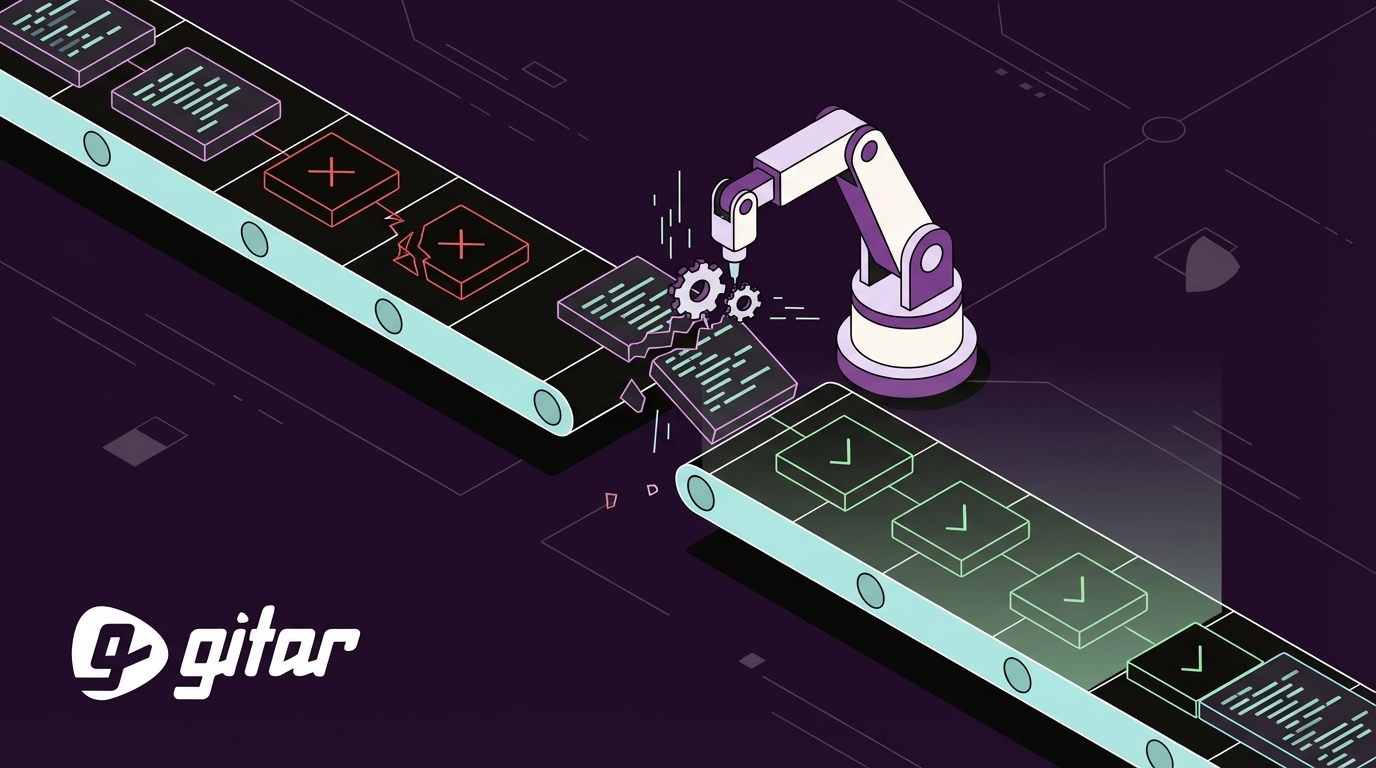
Key Takeaways
- CI pipeline failures, flaky tests, and slow manual reviews consume a large share of developer time and slow delivery.
- Environment drift, misconfigurations, and dependency conflicts are frequent root causes of broken builds and unstable pipelines.
- Autonomous CI fixing tools can analyze failures, apply changes, and validate fixes so developers stay focused on core work.
- A configurable trust model and environment-aware automation help large teams use CI automation safely in complex setups.
- Teams can start reducing CI toil today by trying Gitar for autonomous CI fixes at https://gitar.ai/fix.
Why CI Pipeline Failures Drain Engineering Productivity
CI pipeline instability creates a direct hit on delivery speed and developer focus. Pipeline failures prevent code from being properly built, tested, or deployed, which introduces delays and rework. Common triggers include syntax or lint errors, failing tests, misconfigured jobs, and incorrect environment variables.
Environment drift adds another layer of friction. Inconsistency between development, staging, and production environments often leads to flakiness and deployment failures. Dependency conflicts, mismatched SDK versions, and missing configuration values can all cause failures even when builds appear green.
Manual reviews amplify these issues for distributed teams. Time zone gaps extend feedback cycles into days, while AI-assisted coding tools increase pull request volume. More PRs mean more CI runs, more breakage, and more time spent in review queues instead of shipping value.
Hidden costs accumulate over time. Flaky tests that intermittently fail due to timing or external dependencies force manual retries and workarounds. Every interruption forces context switching between debugging CI, responding to comments, and writing new code, which reduces overall output.
Install Gitar to automate fixes for broken builds and reduce time lost to CI firefighting.
How Gitar Works as an Autonomous CI Fix Assistant
Gitar focuses on turning CI failures and review comments into resolved issues without constant developer involvement. When a pipeline fails or a reviewer leaves feedback, Gitar analyzes the context, proposes or applies a code change, and validates it against the CI workflow.
Autonomous CI fixing targets frequent sources of failure such as lint errors, formatting problems, test failures, and build issues. Instead of requiring engineers to inspect logs and patch code manually, Gitar performs the diagnosis and generates a fix that is validated in the same environment.
Intelligent code review assistance supports reviewers and authors. A reviewer can tag Gitar in a pull request comment, and Gitar will implement the requested change, update the code, and push the fix so that PRs move forward while teams stay focused on higher-level feedback.

Full environment replication helps Gitar operate reliably in complex enterprise setups. The system mirrors specific dependencies, SDK versions, and services such as SonarQube and Snyk so that suggested or committed changes match the real CI environment instead of a simplified mock.
A configurable trust model lets teams adopt automation at a comfortable pace. In Conservative Mode, Gitar posts fixes as suggestions that developers can review and accept with one click. In Aggressive Mode, Gitar commits directly with clear messages and rollback options so teams keep control while reducing manual work.
Cross-platform support allows Gitar to plug into existing workflows on GitHub Actions, GitLab CI, CircleCI, and BuildKite, so teams do not need to redesign their pipelines.
Request a demo to see Gitar handle real CI failures in your workflow.
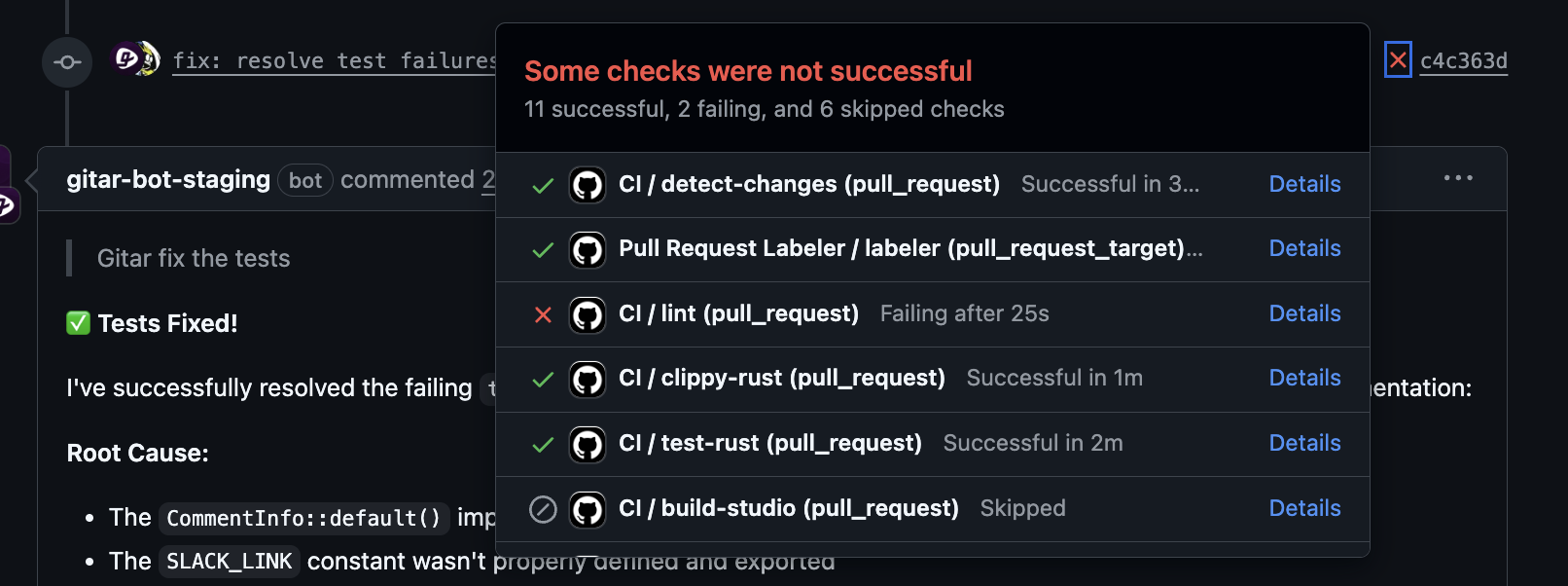
Give Developers More Focus Time by Offloading CI Toil
Developer flow improves when CI issues stop interrupting deep work. Gitar runs fixes in the background so that engineers stay in their editor and on their current task while pipelines heal.
Flow state benefits from fewer forced stops to read logs or tweak configuration. With Gitar handling many common CI failures, teams can focus on design, architecture, and user-facing features.
Developer satisfaction rises when non-creative tasks shrink. Routine chores such as updating snapshots, fixing trivial lint issues, or adjusting tests for minor changes move from manual labor to automated handling.
How Gitar Compares to Traditional CI Failure Handling
|
Feature |
Gitar (Autonomous Healing Engine) |
Manual Work (Status Quo) |
AI Code Reviewers (Suggestion Engines) |
|
CI failure resolution |
Autonomously applies and validates fixes |
Manual investigation and patching |
Flags issues without applying fixes |
|
Code review feedback |
Implements feedback directly in code |
Manual edits and validation |
Provides comments or code snippets |
|
Impact on productivity |
Reduces context switching and rework |
Frequent interruptions and slow cycles |
Partial help, still needs manual work |
|
Environment awareness |
Runs with replicated CI environment |
Depends on individual developer knowledge |
Often limited to static code context |
Speed Up Time-to-Merge Across the SDLC
Time from first commit to merged pull request shrinks when feedback loops shorten. Gitar reduces the cycle of pushing code, waiting for CI, reading logs, and pushing another fix by handling many of those iterations automatically.
Business velocity improves when technical teams ship changes more frequently. Faster, more reliable merges can support quicker feature releases and faster responses to customer needs.
The right-shift bottleneck that arrives with higher code volume becomes easier to manage with automation. As tools like GitHub Copilot generate more code and more PRs, Gitar scales the validation and fix side of the process instead of pushing more work onto reviewers.
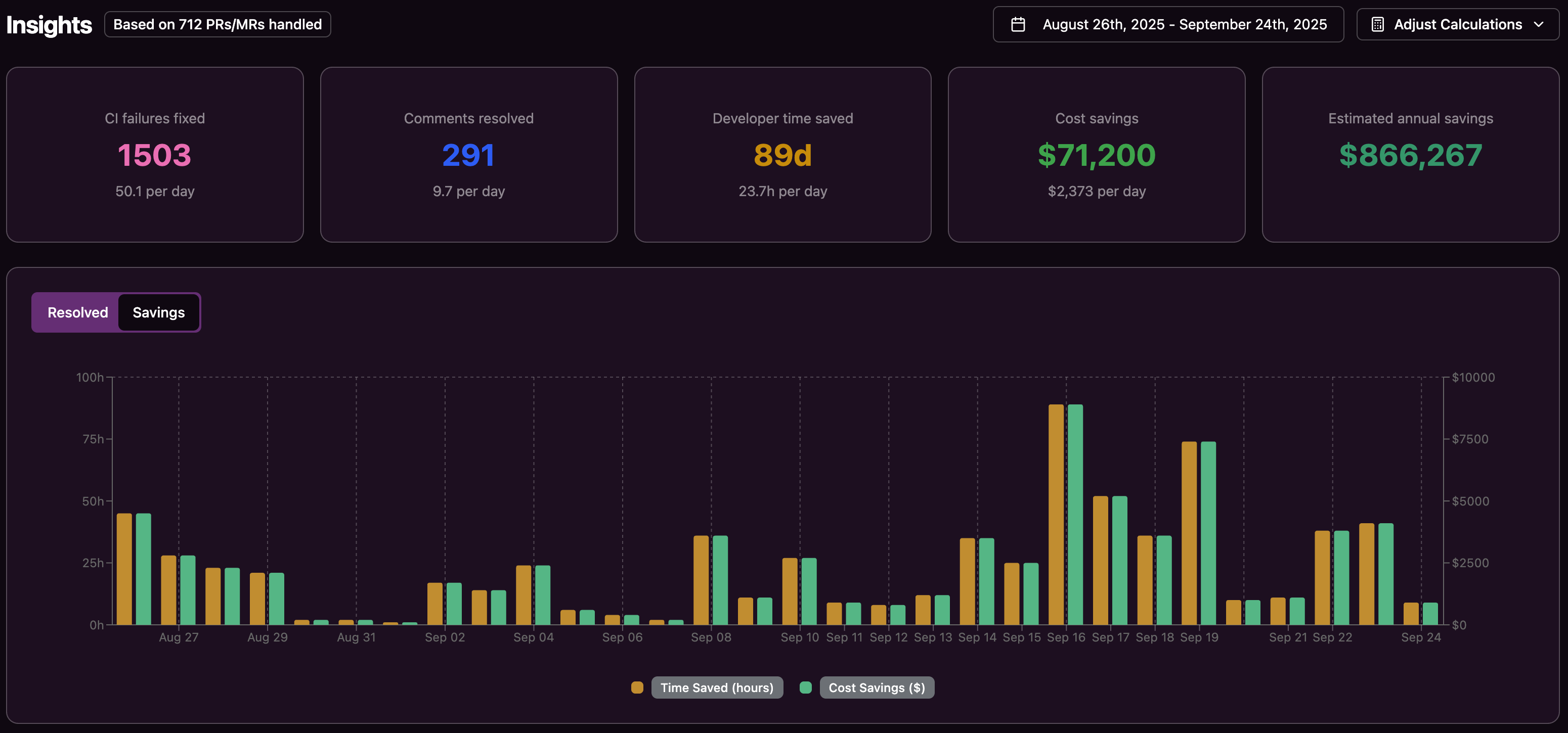
Keep CI/CD Pipelines Reliable at Enterprise Scale
Large organizations need CI/CD systems that stay reliable under heavy load. Overtaxed servers and saturated networks often increase test execution time and failure rates as teams grow, which slows feedback and raises the risk of broken builds.
Self-healing CI/CD capabilities help stabilize pipelines under these pressures. Gitar adapts its fixes to the actual environment, validating changes against real workflows so that intermittent or resource-related issues are caught early.
Common enterprise CI/CD challenges benefit from automation. Issues such as test flakiness, configuration mistakes, environment variable problems, and dependency conflicts can cause repeated disruption. Gitar focuses on resolving these categories of failure before they block teams for long periods.
Context-aware fixes respect the specifics of each organization. Multi-SDK builds, monorepos, and third-party integrations all factor into Gitar’s environment replication so that fixes align with real-world constraints.
Explore how Gitar can support more reliable CI/CD pipelines in your environment.
FAQ: Practical Questions About Reducing CI Pipeline Failures
How does Gitar build trust when it applies automated CI fixes?
Gitar supports trust-building through its configurable modes. Teams often begin with Conservative Mode, where Gitar proposes fixes as comments or suggested changes. Developers review and accept these with a click, then monitor impact. When teams gain confidence, Aggressive Mode allows Gitar to commit directly while still providing clear commit messages and rollback options.
Can Gitar handle a unique CI setup with many dependencies?
Gitar is designed to work with complex, custom environments by replicating CI workflows, dependencies, SDK versions, and tools such as SonarQube and Snyk. This approach helps ensure that fixes align with your specific infrastructure rather than a generic baseline.
How is Gitar different from other AI code review tools?
Gitar operates as a CI healing engine that both identifies issues and applies validated fixes. Traditional AI review tools typically provide suggestions that still require manual editing and verification. Gitar aims to handle detection, code change, and CI validation as a single automated flow.
What happens if Gitar introduces a problem while fixing a failure?
Gitar minimizes risk by validating fixes against your CI pipeline and by using clear, descriptive commit messages. Teams can rely on rollback options in Aggressive Mode and can keep tighter oversight in Conservative Mode for critical areas of the codebase.
Does Gitar integrate without forcing us to redesign our pipelines?
Gitar integrates with GitHub Actions, GitLab CI, CircleCI, and BuildKite and connects to selected repositories through a web dashboard. Teams can start in Conservative Mode so existing workflows remain intact while automation gradually takes over repetitive CI fixes.
Conclusion: Next Steps to Reduce CI Pipeline Failures in 2026
Modern engineering teams face growing pressure to ship quickly while dealing with more code, more PRs, and more complex environments. Manual debugging and slow review cycles make it difficult to keep CI pipelines healthy and responsive.
Gitar offers a way to reduce that burden through autonomous CI fixing, environment-aware automation, and a trust model that fits different risk profiles. The result can be fewer interruptions, more stable pipelines, and more time for meaningful engineering work.
Teams that invest in autonomous CI fixes position themselves for faster delivery, better developer experience, and clearer insight into where time and effort go in the SDLC.
Start reducing CI pipeline failures by trying Gitar on your own repositories.