
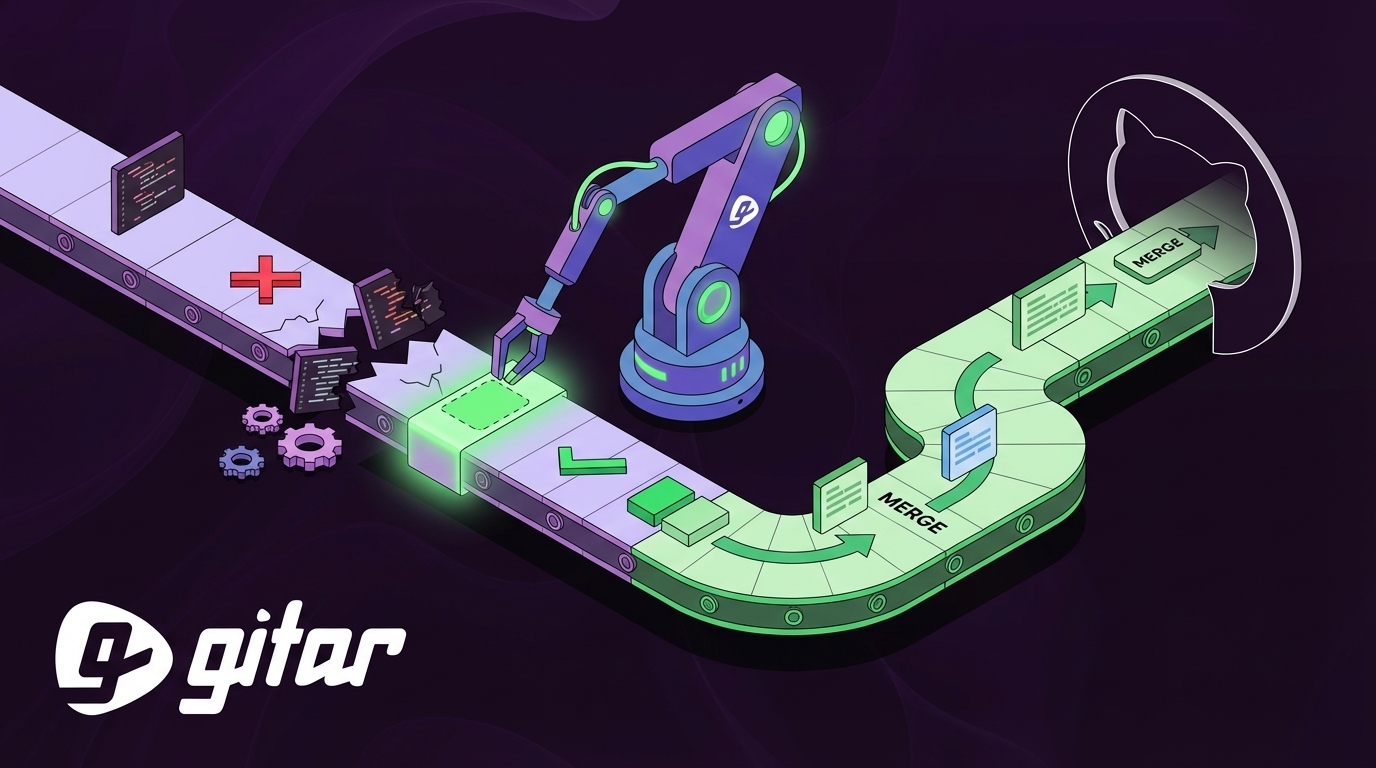
Key Takeaways
- Slow responses to CI build failures in GitHub automation drain engineering time, increase frustration, and delay releases.
- Manual debugging and notification-only tools increase context switching and extend the time needed to diagnose and fix build failures.
- Autonomous CI fixes that understand your full environment shorten the path from failure detection to green builds and stable merges.
- Gitar reduces build failure response time by analyzing logs, applying fixes, validating them in your CI environment, and re-running workflows across common CI platforms.
- Teams that install Gitar can cut manual CI toil, reduce build failure response time, and ship reliable software faster.
The High Cost of Slow Build Failure Response Times in GitHub Automation
Slow build failure response times create a large, recurring productivity loss. For a team of 20 developers spending one hour daily on CI failures and code review issues, annual productivity loss can approach $1 million in loaded costs. That loss reflects direct debugging time and the hidden impact of constant context switching.
GitHub Actions often struggles with conditional workflows that break in subtle ways and require manual intervention. Many teams repeatedly adjust configuration files, re-run jobs, and chase intermittent failures. These reliability issues increase time spent on maintenance instead of feature work.
Most tools still separate failure detection from resolution. Dashboards and alerts notify developers about failures, but developers must read logs, infer root causes, and write fixes. Issue trackers and notifications add process overhead while leaving the hardest part, the fix itself, to manual effort. As AI-assisted coding in 2024 and 2025 increased code volume, the main bottleneck shifted from writing code to validating, fixing, and merging it. Gitar helps close this gap by fixing broken builds automatically.
Autonomous CI Fixes: A Practical Path to Faster Responses
Autonomous CI fixes move CI/CD from passive reporting to active remediation. The system detects a failure, diagnoses it, applies a fix, and validates the result in the same workflow, with minimal developer involvement.
Traditional approaches introduce delays at every step. Developers receive a notification, stop current work, open CI logs, identify the error, push a new commit, and wait for another run. Autonomous CI fixes compress this loop by acting on failures as soon as they appear, which preserves developer focus and shortens time to resolution.
An autonomous system can understand the CI environment, including dependencies, integrations, and platform behaviors. That context allows it to propose and validate practical fixes instead of generic suggestions. The result is faster merges, fewer blocked branches, and more predictable delivery timelines.
Introducing Gitar: Autonomous CI Fixes for GitHub
Gitar provides an autonomous CI fixing layer that reduces build failure response time in GitHub-based workflows and other CI platforms.
Key platform capabilities include:
- End-to-end fixing that goes beyond suggestions to apply changes, validate them in full CI workflows, and ensure jobs pass before presenting a green pull request
- Full environment replication for complex workflows, including specific JDK or SDK versions, multi-language dependencies, and third-party scans such as SonarQube and Snyk
- A configurable trust model that lets teams tune automation levels, from proposed changes that require review to auto-commits with rollback options
- An intelligent code review assistant that applies review feedback, which reduces time zone delays and repeated back-and-forth in code reviews
- Cross-platform support for GitHub Actions, GitLab CI, CircleCI, and BuildKite, which avoids lock-in to a single ecosystem
Gitar uses an agent architecture that maintains context across jobs, users, and runs. The agent can handle concurrent pipelines, asynchronous events, and wave-based execution patterns that appear in real CI setups, while keeping state consistent as workflows evolve.

Book a demo to see how Gitar can reduce build failure response time in your workflows.
How Gitar Reduces Build Failure Response Time and Boosts Efficiency
Automated Fixes That Cut Developer Toil and Context Switching
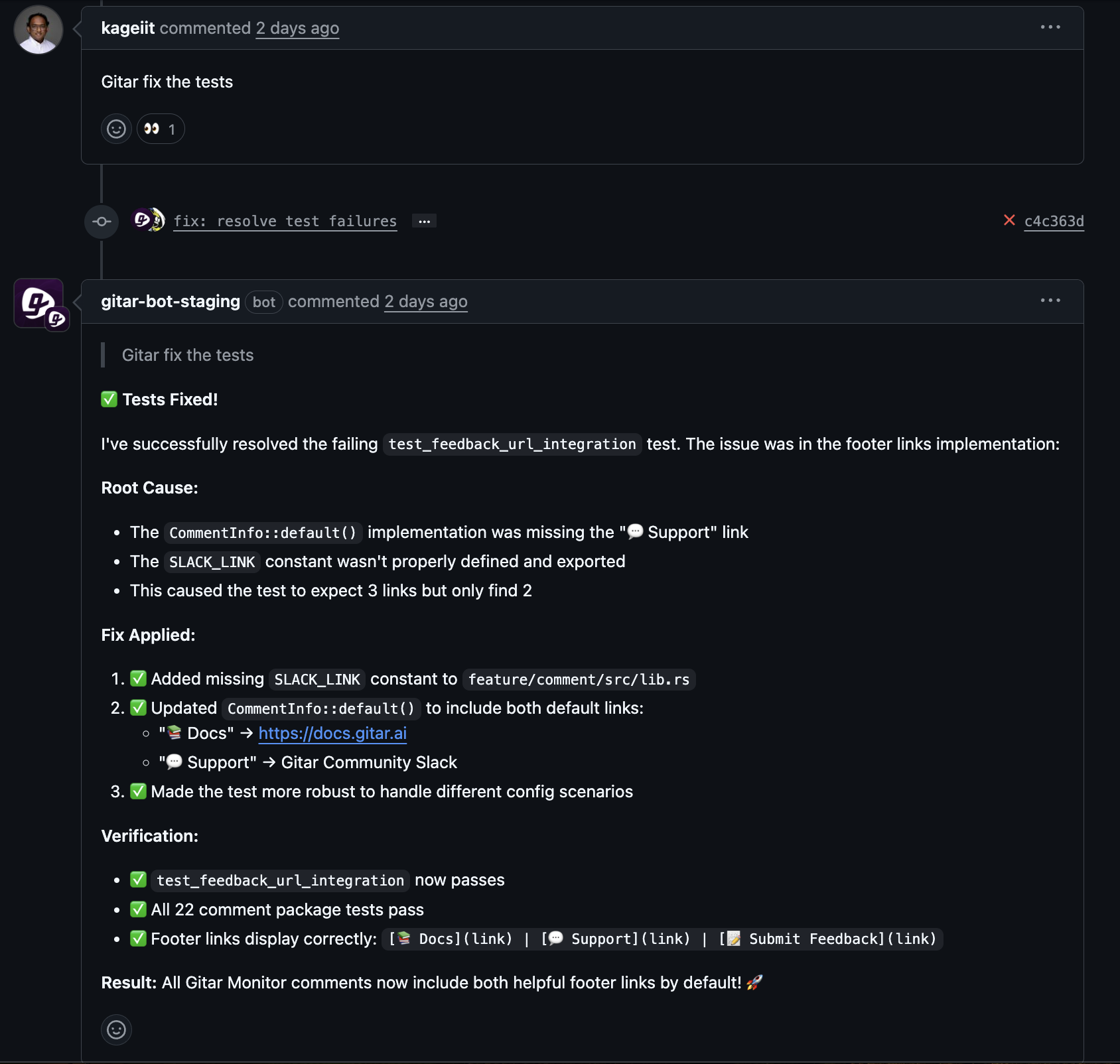
Gitar reduces context switching by taking over the repetitive work that follows a CI failure. Manual debugging typically involves scanning logs, correlating errors with recent changes, and crafting a patch. Gitar instead analyzes failure logs, identifies the likely root cause, and prepares a fix that fits the repository and workflow.
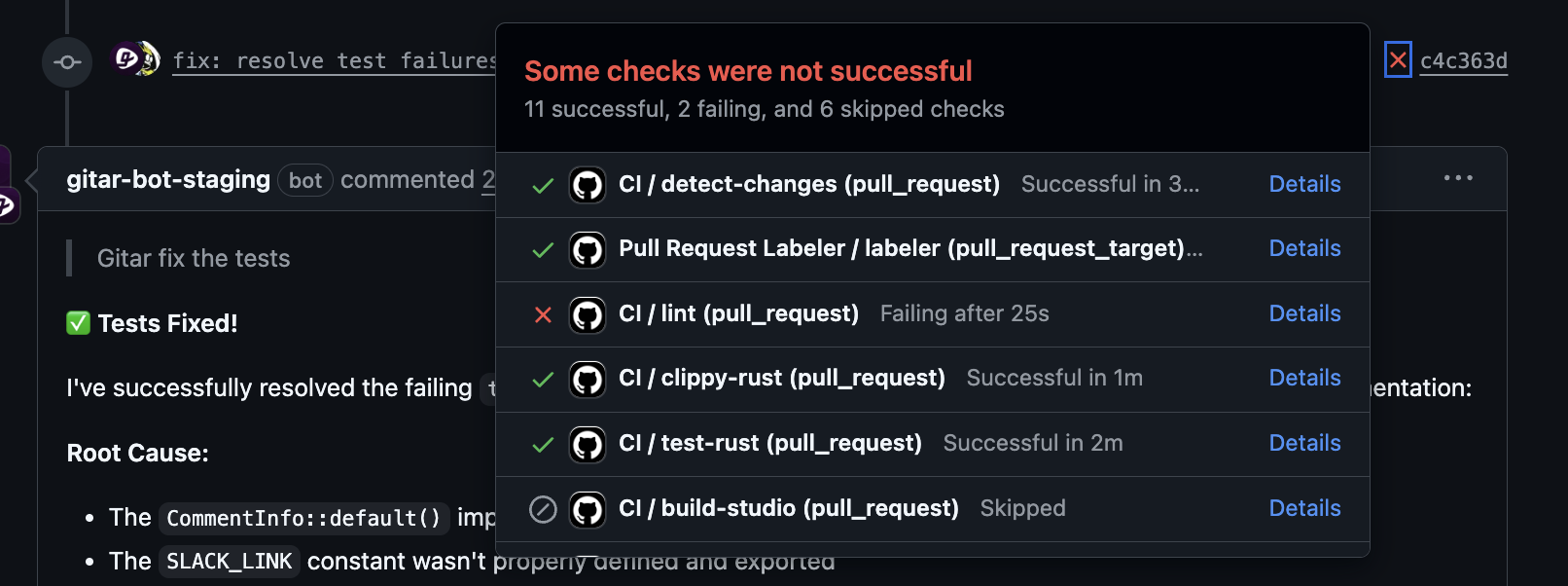
The platform preserves developer flow by handling routine CI maintenance tasks. When a lint error, formatting issue, or failing test appears, Gitar can generate the appropriate fix, run the CI workflow against that fix, and commit the result if the pipeline passes. Developers spend less time on low-level CI work and more time on design, architecture, and feature development.
Faster Time to Merge and Shorter Deployment Cycles
Gitar shortens the loop between code submission and merge readiness. Instead of waiting for notifications, investigating issues, and pushing follow-up commits, teams can rely on Gitar to respond to failures as soon as they occur.
This automation helps address the right-shift bottleneck created by rising code volume and more frequent pull requests. As AI-assisted coding increases output, Gitar helps keep validation and merging aligned with that pace, which reduces queue length in CI, prevents long-running branches, and supports faster delivery of features and fixes.
Reliable Fixes That Respect Complex CI Pipelines
Gitar emphasizes full environment replication so that fixes are validated under real conditions. The system accounts for language versions, test frameworks, security scans, and organizational policies before applying changes. That approach helps prevent new failures and maintains pipeline reliability.
Install Gitar to automatically fix broken builds and ship software faster.
Gitar vs. Alternative Solutions for Reducing Build Failure Response Time
The way tools handle failures, fixes, and CI validation creates clear differences in response time and developer effort.
|
Feature |
Gitar (Autonomous CI Fixes) |
Manual Work (Status Quo) |
AI Code Reviewers |
|
Failure Response |
Automated and real-time |
Manual and delayed |
Suggestions first, then manual |
|
Issue Resolution |
Autonomous fixing |
Developer debugging |
Developer implements |
|
Context Switching |
Reduced significantly |
High cost |
Reduced, but still required |
|
CI Pipeline Validation |
Full environment replication |
Manual reruns |
No direct validation |
Manual work represents the default approach where developers stop current tasks, open CI logs, write corrective code, push updates, and wait. Each interruption breaks concentration and can turn a simple error into a long, fragmented debugging session. Across a team, that pattern compounds into large annual losses in productive engineering time.
AI code reviewers such as CodeRabbit focus on suggestions. They highlight likely problems and propose edits but do not run full CI validation or apply fixes autonomously. Developers still need to accept or modify the suggestions, push commits, and wait for CI to confirm success. Some diagnostic effort improves, yet the core manual implementation and validation steps remain.
On-demand AI fixers require explicit prompts and often operate without full awareness of the CI environment. Many consume customer CI resources for every attempt and support only a subset of platforms, which limits their usefulness for complex organizations. Gitar addresses these gaps with background operation, environment-aware fixes, and broad CI coverage.
Key Questions on Reducing Build Failure Response Time
How Gitar differs from existing AI code reviewers
Gitar functions as a CI healing engine instead of a suggestion engine. AI code reviewers provide recommendations that developers must implement and validate. Gitar instead detects failures, applies fixes, and validates them in the complete CI workflow before marking the build as passing. This closed loop reduces manual implementation and re-run cycles that consume developer time.
How Gitar handles complex CI setups and dependencies
Gitar is built for complex environments with multiple languages, frameworks, and integrations. The platform replicates the CI environment, including SDK versions, dependency graphs, and tools such as SonarQube and Snyk. Its architecture supports concurrent pipelines and asynchronous events, which helps ensure that applied fixes behave correctly in the real configuration.
How Gitar reduces manual debugging and log examination in GitHub Actions
Gitar reduces log spelunking by parsing workflow logs and pinpointing the root cause of failures. Instead of reading through long job outputs and mapping stack traces to specific commits, teams can let Gitar perform that analysis and propose or apply a validated fix. Developers stay focused on higher-level work while CI issues resolve in the background.
Conclusion: Automate CI Fixes to Shorten Response Times
Slow build failure response times in GitHub automation create a persistent drag on engineering productivity and release speed. Manual debugging, notification-only tools, and suggestion-focused AI helpers leave teams exposed to repeated interruptions and extended CI cycles.
Gitar offers autonomous CI fixes that detect failures, apply changes, and validate them in real workflows. By reducing manual debugging, cutting context switching, and supporting complex CI environments, Gitar helps teams move from reactive CI maintenance to proactive, reliable delivery.
Teams that want to reduce build failure response time and improve GitHub automation can request a Gitar demo and see how autonomous CI fixes improve CI efficiency.