
Written by: Ali-Reza Adl-Tabatabai, Founder and CEO, Gitar
Key Takeaways for CI Teams Fighting Flaky Tests
- Flaky tests cause 60% of CI pipeline delays, wasting the 6–8 hours of weekly developer time mentioned later and up to $1M annually for 20-developer teams.
- Qodo PR Agent lacks native flaky test detection, so teams rely on YAML workarounds with basic retries that never fix root causes.
- Gitar’s AI healing engine detects, analyzes, and fixes CI failures, including flaky tests, across GitHub Actions, GitLab CI, CircleCI, and Buildkite.
- Gitar validates fixes in your actual CI environment and rolls feedback into a single updating dashboard comment, which removes notification noise.
- Try Gitar’s 14-day free trial to build flaky-resistant pipelines and reclaim lost developer productivity.
How Flaky Tests Break Your CI Pipelines
Flaky tests are automated tests that behave inconsistently, passing and failing without any code changes. Research from Google and Microsoft shows that 15–16% of test failures are actually flaky, often caused by environmental instability, asynchronous timing issues, or non-deterministic test design.
|
Aspect |
Flaky Impact |
Industry Statistic |
|
Build Restarts |
False failure investigation |
|
|
Developer Time |
Weekly productivity loss |
|
|
CI Pipeline Blocks |
Delayed deployments |
The cascade effect hits every stage of delivery. Flaky tests trigger reruns, consume CI resources, block legitimate PRs, and erode team confidence in automated testing. Across the industry, flaky tests waste over 150,000 hours of developer time, so reliable detection and resolution become essential for maintaining development velocity.
Qodo PR Agent Flaky Test Limits and YAML Retry Workaround
Qodo PR Agent excels at code generation and CI feedback through commands like /checks and /test, but it does not provide native flaky test detection. The agent operates at Level 3 autonomy, where it struggles with complex tasks requiring execution context such as separating legitimate test failures from environmental flakiness.
|
Feature |
Qodo Support |
Details |
Limitation |
|
Test Generation |
Yes |
/test command creates tests |
No execution validation |
|
CI Feedback |
Yes |
/checks analyzes failures |
No historical context |
|
Flaky Detection |
No |
No flip-rate tracking |
Cannot distinguish patterns |
|
Auto-Fix |
Yes |
/implement applies changes |
No flaky test specialization |
Teams often pair Qodo with simple retries in CI. Here is a practical YAML workaround for GitHub Actions that combines Qodo with basic retry logic:
name: Qodo + Flaky Test Handling on: [pull_request] jobs: test-with-retry: runs-on: ubuntu-latest steps: – uses: actions/checkout@v4 – name: Run Tests with Retry uses: nick-invision/retry@v2 with: timeout_minutes: 10 max_attempts: 3 command: npm test – name: Qodo Analysis if: failure() run: | # Custom script to flag potential flakies echo “::warning::Potential flaky test detected”
This approach adds resilience through retries but still misses deeper flaky patterns and root causes. Get comprehensive flaky test detection that goes beyond simple retries to automatically fix broken builds and help your team ship higher quality software, faster.
Gitar’s Auto-Fix Engine for Flaky Tests and CI Failures
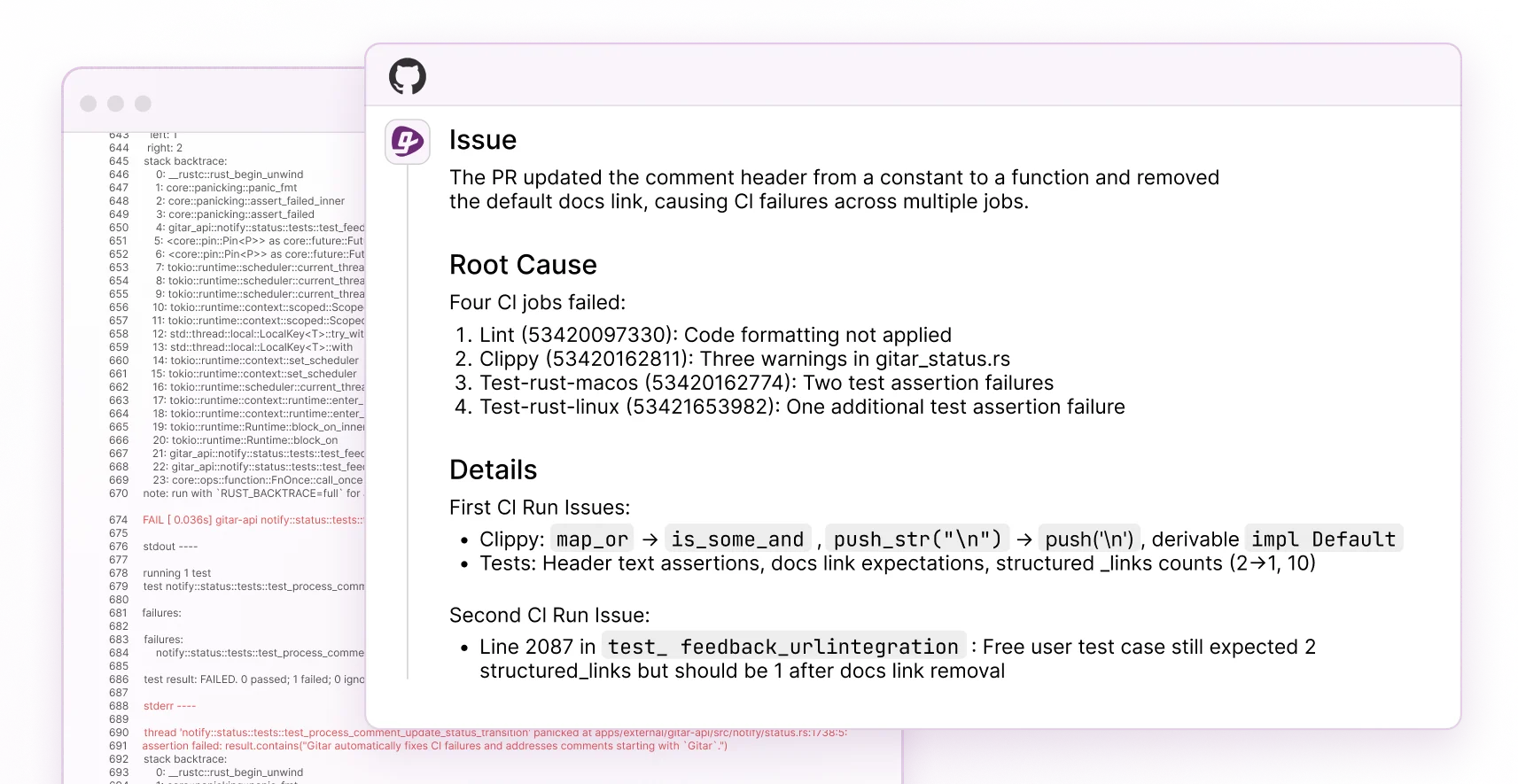
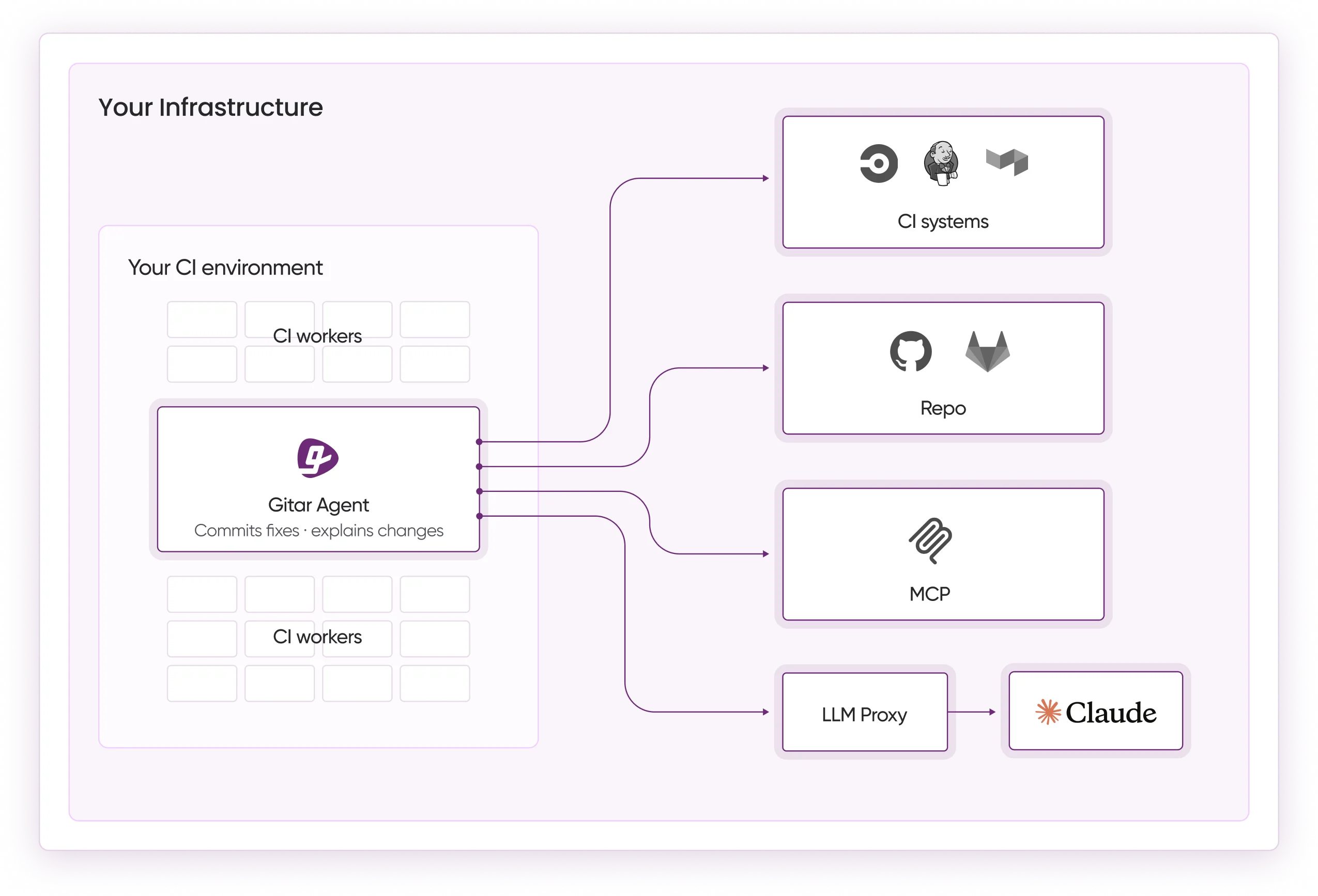
Gitar improves CI pipeline reliability with an AI-powered healing engine that analyzes and fixes CI failures such as build errors, lint failures, test failures, and dependency issues. The platform delivers end-to-end automation across GitHub Actions, GitLab CI, CircleCI, and Buildkite, and it separates code issues from infrastructure flakiness through detailed failure log analysis.
|
Feature |
Qodo PR Agent |
CodeRabbit/Greptile |
Gitar |
|
CI Failure Analysis |
No |
No |
Yes |
|
CI Auto-Fix |
Yes |
No |
Yes |
|
Historical Analysis |
No |
Yes |
Yes |
|
Cross-Platform |
Multiple git providers |
GitHub |
All major CI |
Gitar’s approach aligns with proven enterprise strategies. GitHub achieved an 18x reduction in flaky failures through intelligent retry strategies and impact scoring. In the same report, Slack reduced its test-job failure rate from 57% to under 4% with automated detection and suppression.
5 Ways Gitar Eliminates CI Failure Pain
1. Instant CI Log Analysis
Gitar analyzes your CI logs in real time and identifies root causes of failures, including test failures. To do this accurately, the system examines failure logs, environmental conditions, and historical patterns to understand whether issues come from code defects or infrastructure flakiness.
2. Auto-Generated Fixes with Context
When CI failures occur, Gitar generates targeted fixes that address root causes such as test failures, lint issues, or dependency problems. The AI works with full codebase context instead of focusing on isolated files, which improves the relevance of each proposed change.
3. Validation in Your CI Environment
Gitar tests its solutions within your actual CI environment rather than relying on abstract assumptions. This validation step is critical because it confirms that fixes work with your specific configurations, dependencies, and infrastructure setup, not just in a controlled test scenario.
4. Single Updating Dashboard Comment
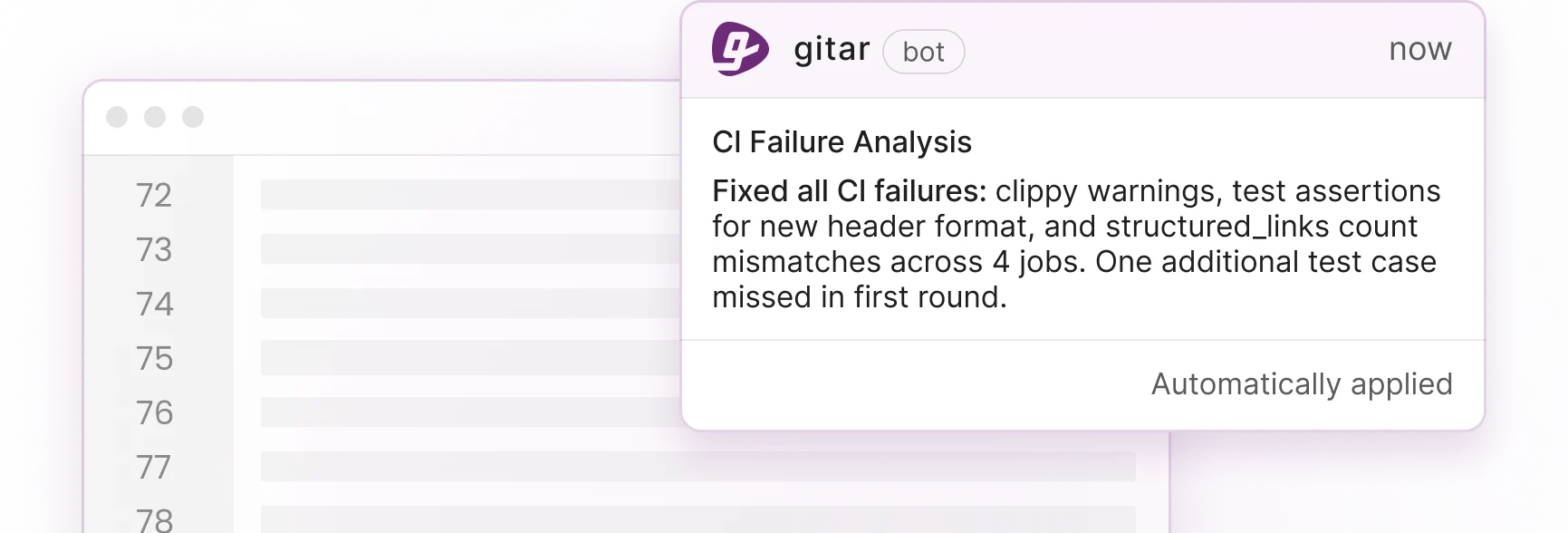
Gitar consolidates all findings into one clean comment that updates in place on your PR or merge request. This approach removes notification spam and gives reviewers a single source of truth for current issues, applied fixes, and remaining action items.
5. Analytics and Rules Expansion
Gitar’s natural language rules system lets you define custom policies for handling CI failures without complex YAML configuration. Teams track patterns, set thresholds, and automate responses through simple markdown files that live alongside the codebase.
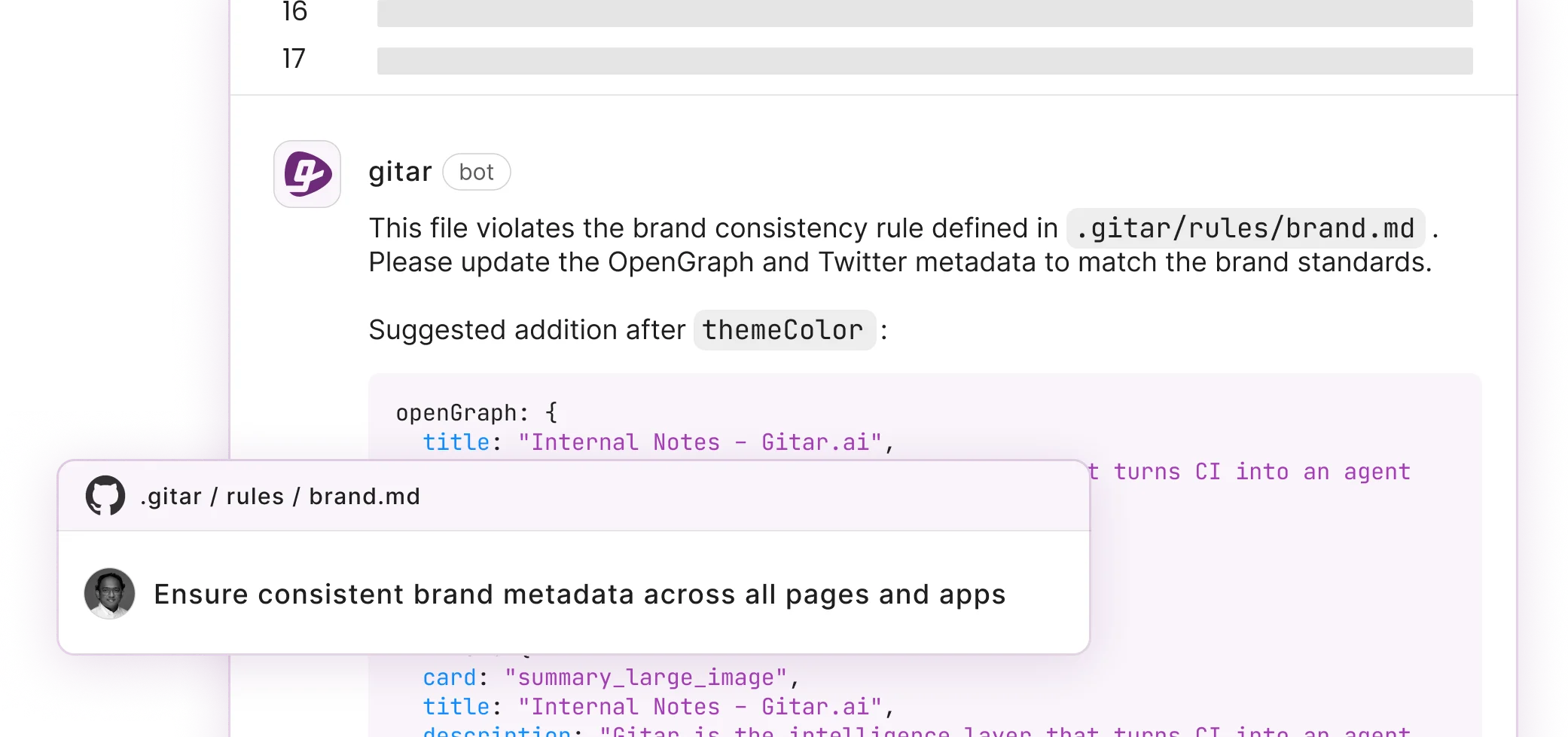
The ROI is substantial for teams facing chronic CI instability. Many organizations recover roughly $750,000 annually by cutting into the typical $1 million productivity loss that 20-developer teams experience from CI issues. Review the full platform capabilities in our documentation, or jump straight into your 14-day free trial to experience automated CI healing firsthand.
FAQ
Does Qodo natively detect flaky tests?
No. Qodo PR Agent does not include native flaky test detection. It provides strong code generation and CI feedback through commands like /checks and /test, but it lacks the historical analysis and pattern recognition required to identify intermittent test failures. Teams either maintain custom YAML workarounds with retry logic or adopt specialized tools like Gitar for full flaky test management.
How do you handle flaky tests in CI/CD pipelines?
Effective CI failure handling relies on automated detection through log analysis, intelligent retry strategies, and root cause fixes. Gitar’s healing engine identifies CI failures by analyzing logs across multiple runs, generates targeted fixes for underlying issues such as test failures, validates solutions in your CI environment, and commits working fixes directly to your PRs.
What is an AI code review pipeline?
An AI code review pipeline combines automated code analysis, CI failure detection, and fix generation inside your development workflow. Gitar delivers end-to-end automation that extends beyond traditional code review by analyzing PR changes, detecting CI failures, generating validated fixes, and keeping builds green while consolidating feedback into a single updating comment.
How does Qodo compare to Gitar for flaky CI issues?
Qodo focuses on code generation and basic CI feedback, but it does not provide comprehensive CI failure detection or flaky test auto-fix capabilities. Gitar offers full CI healing that includes failure analysis, root cause identification, automated fixes, and cross-platform support for GitHub Actions, GitLab CI, CircleCI, and Buildkite. Qodo supports general implementation tasks, while Gitar specializes in validating and automating solutions for flaky test issues.
How can I start a Gitar trial for CI failure detection?
Teams can start with Gitar in about 30 seconds. Install the GitHub App or GitLab integration, activate your 14-day free Team Plan trial, and Gitar immediately begins analyzing your CI pipelines for failures. The trial includes full access to auto-fix capabilities, custom rules, and all integrations so you can measure the impact on development velocity before choosing a paid plan.
Conclusion: Turn Flaky Tests into a Managed Risk
Flaky tests create a critical bottleneck in modern, AI-accelerated development. Tools like Qodo PR Agent excel at code generation but do not deliver the comprehensive CI healing required for reliable pipelines. The substantial weekly productivity losses and high false failure rate discussed earlier call for automated solutions that move beyond basic retry logic.
Gitar’s healing engine fills that gap with intelligent flaky test detection, root cause analysis, validated fixes, and seamless integration across all major CI platforms. The platform distinguishes legitimate failures from environmental flakiness and then applies auto-committed fixes, which turns CI reliability from a constant frustration into a competitive advantage.
Start your free trial today to automatically fix broken builds and start shipping higher quality software, faster.