
Key Takeaways
- Manual CI failures and constant context switching reduce developer focus, slow delivery, and increase project costs.
- Autonomous self-healing CI pipelines detect, correct, and validate failures so many issues resolve without developer intervention.
- A phased rollout, starting with suggestions and moving toward automation, helps teams build trust and measure ROI.
- Healing engines like Gitar go beyond AI code review suggestions by applying, testing, and committing fixes in the full CI environment.
- Teams can use Gitar to automate CI fixes and code review workflows, reducing toil and improving delivery speed.
The Critical Juncture: Why Traditional CI/CD Falls Short
The Developer Productivity Drain: The CI/CD Gauntlet and Context Switching Tax
Most engineers know the cycle of opening a pull request, seeing red CI failures, and bouncing between logs, local changes, and repeated pushes. A missing dependency, flaky test, or linter warning can trigger a long loop of investigation and reruns.
The ideal of pushing code and moving on rarely holds. Developers shift to other tasks, then get pulled back by CI failures or review comments. Each interruption forces a context switch that breaks concentration. A 30-minute CI fix often costs an hour or more of productive time once mental overhead is included.
The Right-Shift Bottleneck: Code Generation Accelerating CI Failures
AI-assisted coding tools such as GitHub Copilot and Cursor increase the volume of code and the number of pull requests. More code means more tests, more CI runs, and more potential failures. The main bottleneck shifts from writing code to validating and merging it.
Review delays amplify this effect. For distributed teams, a few comment cycles on a pull request can stretch what should be a short review into days because of time zone gaps and dependency on manual responses.
The High Cost of Inefficiency: Financial Impact on Time-to-Market and Revenue
CI failures and slow code review create a measurable productivity drag. Developers can spend a large share of their time on CI and review issues instead of shipping features. This time loss affects delivery dates, increases engineering costs, and slows revenue-impacting releases for many organizations.
Install Gitar to reduce manual CI debugging and shorten the path from pull request to production.
Unpacking Autonomous Self-Healing CI: A Paradigm Shift for Software Delivery
Defining the Future: What Is an Autonomous Self-Healing CI Pipeline?
An autonomous self-healing CI pipeline moves CI from passive reporting to active repair. These systems detect failures, analyze root causes, generate fixes, and validate changes without requiring manual steps for many common issues.
The autonomous behavior allows the system to decide which fixes to apply, when to apply them, and how to validate them in the real build environment. CI failures become background tasks instead of constant interruptions for developers.
Core Pillars of Autonomy: Detection, Correction, and Validation
Detection focuses on real-time identification of failures by analyzing CI logs, code changes, dependency updates, and test output. The system isolates the cause rather than just flagging a failing job.
Correction turns that insight into action. The system updates code and configuration to resolve lint errors, broken tests, dependency conflicts, and formatting issues, reducing repetitive work for developers.
Validation confirms that the fix works by running builds and tests in the full CI environment. Only validated fixes surface to developers, so pipelines act as an acceleration layer instead of a blocking gate.
The Evolution from Reactive to Proactive: Moving Beyond Troubleshooting
Modern self-healing CI surfaces problems quickly and often resolves them before a developer returns to the pull request. This model replaces after-the-fact debugging with proactive, automated correction that keeps pipelines flowing.
Automation in Action: Resolution in CI Pipelines
Detecting Failure: Immediate Identification of Issues
Autonomous systems watch CI runs in real time, correlating failing tests, log messages, and recent changes. This visibility enables quick isolation of issues and prepares the ground for an automated fix.
Intelligent Correction: Automating the Fix
During correction, algorithms interpret error messages and stack traces, then generate targeted changes. Common examples include adjusting test expectations, updating snapshots, fixing import paths, and resolving dependency mismatches.
Validation and Adaptation: Ensuring Effective Solutions
Each automated fix runs through the same CI checks as any manual change. Passing builds signal a successful correction, while failures trigger further refinement. Over time, the system adapts to recurring patterns in your codebase and pipeline.
The Current Landscape: Trends Driving Self-Healing CI
Mainstream Adoption and Market Growth
Interest in autonomous CI is growing as teams look for ways to offset rising CI complexity and heavier review loads. Self-healing capabilities are moving from experimental projects into standard expectations for modern delivery pipelines.
Distinguishing Healing Engines from Suggestion Engines
Many tools still operate as suggestion engines that highlight issues and propose edits but stop short of applying and validating changes. Healing engines like Gitar go further by implementing fixes, running the full CI workflow, and surfacing green builds with minimal developer effort.
Install Gitar to move from static suggestions to validated, autonomous CI fixes.
Strategic Implementation: How to Adopt Self-Healing CI in Your Organization
Building Trust: From Conservative Suggestions to Aggressive Automation
Effective rollout starts with conservative modes. The system first proposes fixes for developer review and one-click application. Teams observe accuracy and gain confidence in low-risk areas such as lint, formatting, and simple test corrections.
After establishing trust, teams can enable partial automation for routine changes and eventually full automation with safeguards such as approvals and rollbacks. Trust in the system is essential because CI environments include force pushes, overlapping runs, and frequent updates that demand precise context tracking.
Quantifying the Benefit: Calculating ROI for Engineering Leaders
For a 20-developer team that spends 1 hour per day on CI and review issues, the impact is clear:
Time cost: 20 developers × 1 hour/day × 250 work days = 5,000 hours/year
Financial cost: 5,000 hours × $200/hour loaded cost = $1,000,000 annual productivity loss
Autonomous CI impact: At 50% effectiveness, autonomous self-healing CI can reclaim about $500,000 of that lost value each year
These numbers do not include additional gains such as faster releases, lower burnout, better code quality, and higher team morale.
Organizational Readiness: Assessing Your Team and Workflow
Teams that feel daily pain from CI failures and review delays are strong candidates for self-healing CI. Clear signals include distributed teams slowed by time zones, rising pull request volume, complex pipelines with many dependencies, and leadership focus on measurable productivity gains.
Established CI practices and reliable tests provide the foundation for safe automation, since the system depends on those checks to validate fixes.
Gitar: Your Partner in Building Autonomous Self-Healing CI Pipelines
Introducing Gitar: The Autonomous CI Fixer for Engineering Teams
Gitar extends AI from code assistance into CI and review operations. When a pull or merge request has a review comment or a failing pipeline, Gitar receives a signal, analyzes the issue, proposes or applies a fix, and updates the branch.
This behavior creates a self-healing CI experience where many blockers clear without manual effort. Developers spend less time revisiting old work and more time moving new work forward.

How Gitar Works: End-to-End Fixing and Environmental Replication
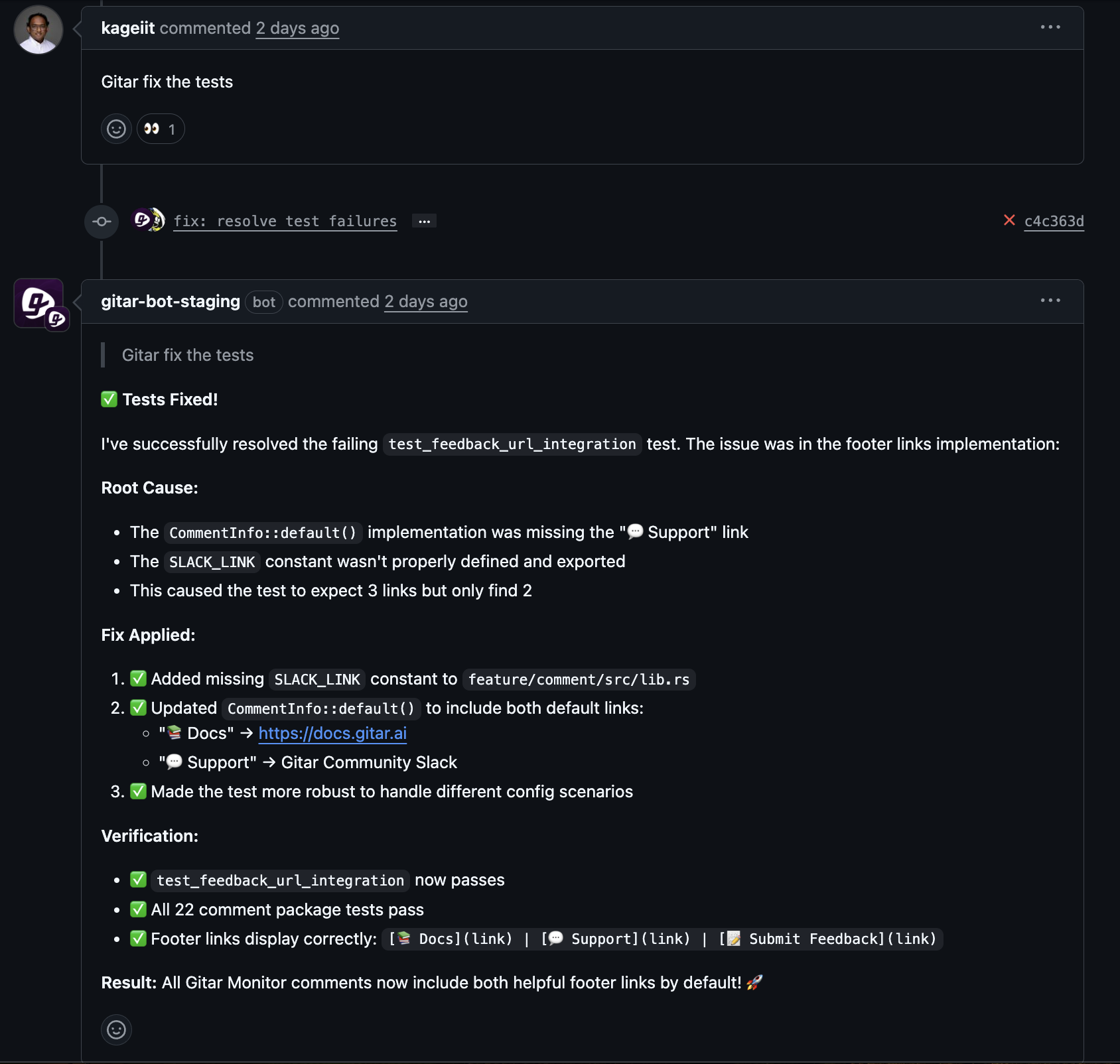
Gitar does more than flag issues. When a CI check such as npm run lint or pytest fails, Gitar inspects the logs, identifies the root cause, edits the code, and commits the fix to the pull request branch.
The system emulates complex enterprise workflows, including specific JDK versions, multiple SDKs, third-party scans such as SonarQube and Snyk, and snapshot tests. It coordinates concurrent users, overlapping pipelines, and parallel stages that share state.
Intelligent Code Review Assistance and Distributed Team Optimization
Gitar also supports human reviewers. A reviewer can tag Gitar to generate a summary of changes, highlight potential risks, and suggest improvements. Reviewers can leave comments that instruct Gitar to implement specific edits, which Gitar then applies and validates.
Distributed teams benefit from this asynchronous workflow. A reviewer can leave instructions at the end of the day, and Gitar can implement and validate changes so that the original author starts the next day with a ready-to-merge pull request.
Evaluating Solutions: Gitar vs. Alternatives
|
Feature |
Gitar (Healing Engine) |
AI Code Reviewers |
Manual Work (Status Quo) |
|
Solution Type |
Autonomous fixer |
Suggestion provider |
Manual debugging |
|
Fix Application |
Automatic and validated |
Manual implementation |
Manual creation |
|
Environment Context |
Full replication |
Limited |
Developer-dependent |
|
Developer Effort |
Low operational toil |
Manual validation and fixing |
High with frequent context switches |
The key difference is that Gitar operates as a healing engine. Instead of only suggesting edits, it applies and validates fixes inside your full CI workflow, then presents green builds to the team.
Common Obstacles and How to Overcome Them
Teams That Already Use AI Reviewers
Teams that rely on AI code reviewers often still perform manual implementation and validation of suggested fixes. Gitar reduces this effort by applying changes and running the full pipeline, so developers spend less time translating suggestions into working code.
Teams Concerned About Trusting Automated Fixes
Trust concerns are natural, so Gitar offers configurable automation levels. Teams can begin with suggestion-only mode, then move to automatic fixes for low-risk issues as they gain confidence. Detailed change logs and rollback options provide transparency and control.
Teams with Complex or Unique CI Setups
Complex CI environments are a primary use case for Gitar. The platform emulates real environments, including dependencies, SDK versions, and security tools such as SonarQube and Snyk. Fixes align with your actual workflows instead of generic assumptions.
Install Gitar to introduce autonomous self-healing into your existing CI/CD pipeline.
Frequently Asked Questions
Reliability of Automated Error Corrections in Complex CI/CD Environments
Modern automated correction systems can be reliable in complex environments when they replicate full build contexts and apply context-aware fixes. Gitar recreates enterprise environments, including SDK versions, dependencies, and external tools, so that generated fixes match real conditions and pass CI checks.
Impact of Autonomous Self-Healing CI on Infrastructure Costs
Initial setup introduces some overhead, but autonomous self-healing CI typically reduces total cost. Fewer failed runs, fewer retries, and less developer time spent debugging lower operational expenses. Many teams see net savings as pipelines stabilize and manual intervention declines.
Cultural and Training Considerations for Adopting Self-Healing CI
Adoption mainly involves building comfort with automated fixes. Teams often start with review-and-approve modes so developers can inspect proposed changes. Over time, reduced toil and smoother flow tend to improve satisfaction, as developers focus more on design and feature work than on repetitive CI cleanup.
Handling Security and Compliance Requirements
Enterprise-ready self-healing CI platforms integrate with existing security scanners, maintain detailed audit trails, and support role-based access. Organizations can require approvals for sensitive repositories or change types. Deployment options that keep code within company infrastructure and comprehensive logging support compliance needs.
Conclusion: Secure Your Competitive Edge with Autonomous Self-Healing CI
Autonomous self-healing CI pipelines help teams remove manual bottlenecks, reduce context switching, and ship reliable software faster. Organizations that adopt these capabilities gain advantages in delivery speed, developer experience, and operational efficiency.
The shift from suggestion-only tooling to validated, automated fixes is underway. Teams that modernize their CI now will be better positioned than those that continue to rely on manual debugging for routine failures.
Engineering leaders who want to improve throughput and reduce operational waste can treat self-healing CI as a core capability, not an optional add-on. Install Gitar to add autonomous CI fixes to your pipelines and give developers more time for high-value work.