
Key Takeaways
- Merge conflicts in large, collaborative codebases are a persistent productivity drain and occur regularly in modern development workflows.
- Manual resolution and suggestion-only tools struggle with complex logic changes, dependency updates, and enterprise CI environments.
- Autonomous AI agents that understand repository history, CI logs, and runtime environments can detect, fix, and validate many conflicts without blocking developers.
- Teams that adopt autonomous conflict resolution reduce context switching, shorten review cycles for distributed teams, and improve overall build reliability.
- Engineering teams that want automated conflict resolution and CI repair can use Gitar to automatically fix broken builds and resolve merge issues in their pipelines.
The Critical Problem: Merge Conflicts Hindering Large Codebases
Merge conflicts have become a systematic productivity issue for modern teams. Merge conflicts occur in approximately 9.38% of collaborative development scenarios, and the rate rises when contributions touch shared or tightly coupled code.
Time loss compounds quickly. Developers often spend a significant portion of their day on CI and code review issues instead of core feature work, which can represent hundreds of thousands of dollars in annual productivity costs for mid-sized teams. Root causes include long-lived branches, parallel changes to shared modules, formatting differences, and dependency updates that traditional tools cannot fully interpret.
Lost developer productivity shows up in rushed decisions and rework. Merge conflicts force developers to make fast decisions during resolution, which may introduce bugs, inconsistencies, and regressions. Each resolution often requires digging through logs, reproducing failures, writing fixes, and rerunning tests, which breaks flow state and stretches small issues into long interruptions.
Distributed teams feel the impact even more. Time zone differences extend every feedback loop, so a conflict that needs clarification can push reviews from hours to days. These delays ripple into missed deadlines and slower delivery.
Traditional methods like three-way merging tools and basic linting fall short for large codebases because they lack context about logic, dependencies, and real CI environments. They surface conflicts but do not reliably resolve them.
Teams that want to cut this overhead can install Gitar to automatically fix broken builds and reduce time spent on merge-related issues.
How Gitar Uses Autonomous AI To Resolve Conflicts
Gitar shifts conflict management from suggestion-based assistance to autonomous action. The system acts as a repair engine that observes CI failures, understands their root causes, and applies validated fixes inside the same environment where builds run.
Key solution capabilities include:
- End-to-end fixing: Gitar applies code changes, runs relevant CI workflows, and only surfaces results when builds pass.
- Full environment replication: The agent mirrors enterprise CI environments, including SDK versions, multiple language runtimes, and tools such as SonarQube and Snyk.
- Context-aware intelligence: The system combines code diffs, CI logs, repository history, and dependency graphs to choose appropriate fixes.
- Configurable trust model: Teams can select between suggestion-only mode, gated automation, or fully autonomous commits with rollback options.
- Cross-platform support: Gitar connects with GitHub Actions, GitLab CI, CircleCI, Buildkite, and other major CI/CD platforms.
When CI failures or merge-related issues appear, Gitar inspects logs, identifies likely causes, proposes or applies code changes, and validates them through CI. Developers receive clean pull requests or detailed suggestions instead of red builds and cryptic logs.

The Benefits of Autonomous Merge Conflict Resolution for Your Team
Maintain Developer Focus and Reduce Context Switching
Gitar handles many conflict-related fixes before developers stop their current task. Engineers stay focused on feature work while Gitar reads logs, edits code, and verifies changes. Clear commit messages and comments summarize what changed, so developers can review results quickly instead of reconstructing the entire debugging path.
Protect Code Quality and Stability at Scale
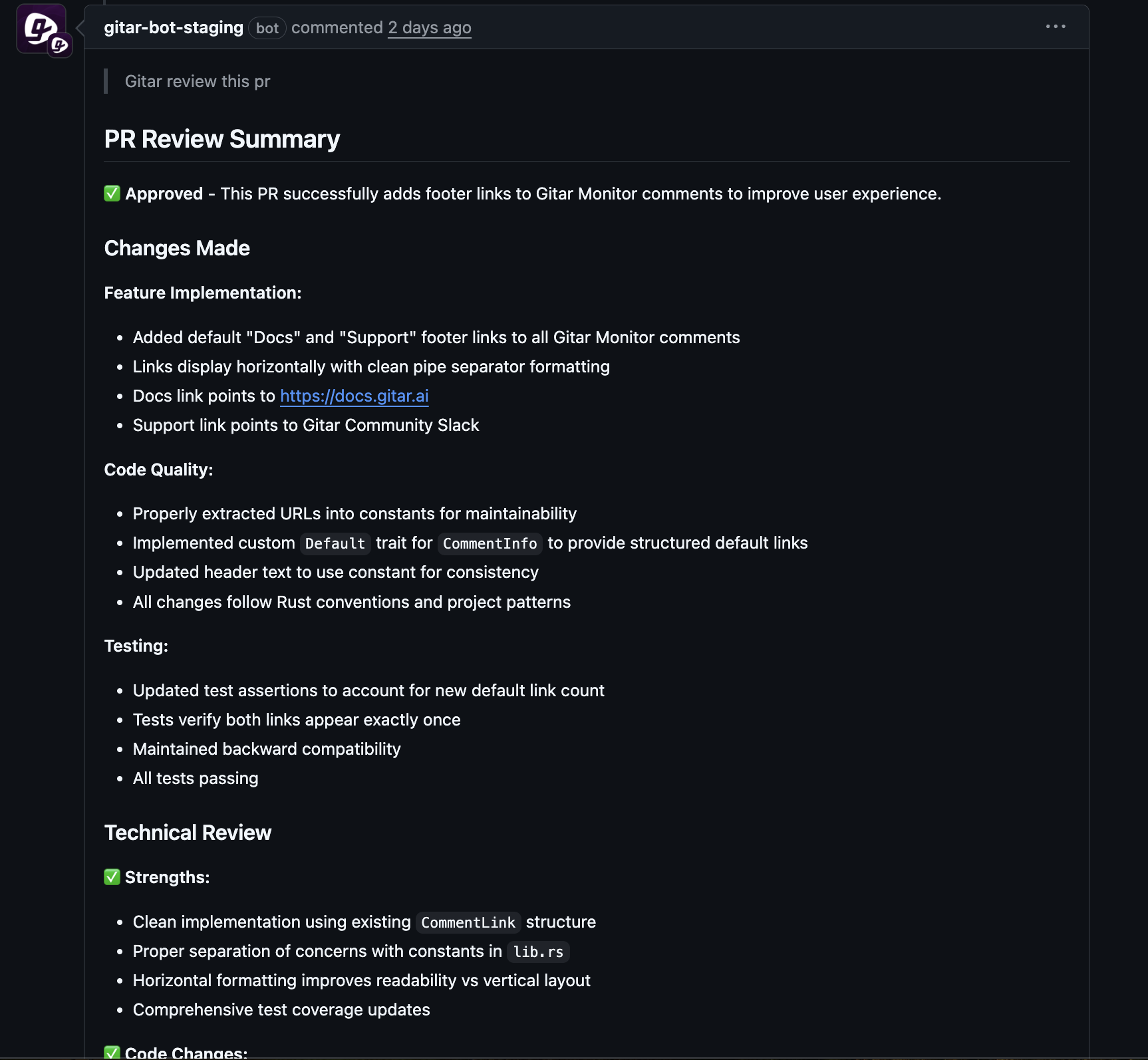
Gitar validates each fix against real CI workflows instead of relying only on static analysis. The agent accounts for complex dependency trees and external integrations, so accepted changes match the behavior of production-like environments rather than only local setups. This reduces regressions that arise from shallow or rushed conflict resolution.
Improve Delivery Speed and Lower Operational Costs
Faster conflict resolution reduces idle time and waiting on red builds. Even partial automation can reclaim a large portion of the hours teams usually spend on CI breakages and merge cleanups. Over time, this shift raises effective throughput without expanding headcount and lowers the cost of each feature shipped.
Support Distributed Teams With Asynchronous Fixes
Gitar fits naturally into asynchronous workflows. Reviewers can leave comments that instruct Gitar to modify or fix code. The agent then applies and validates those changes while teammates in other time zones are offline. Developers start their day with updated branches, passing builds, and concise summaries instead of a backlog of failing pipelines.
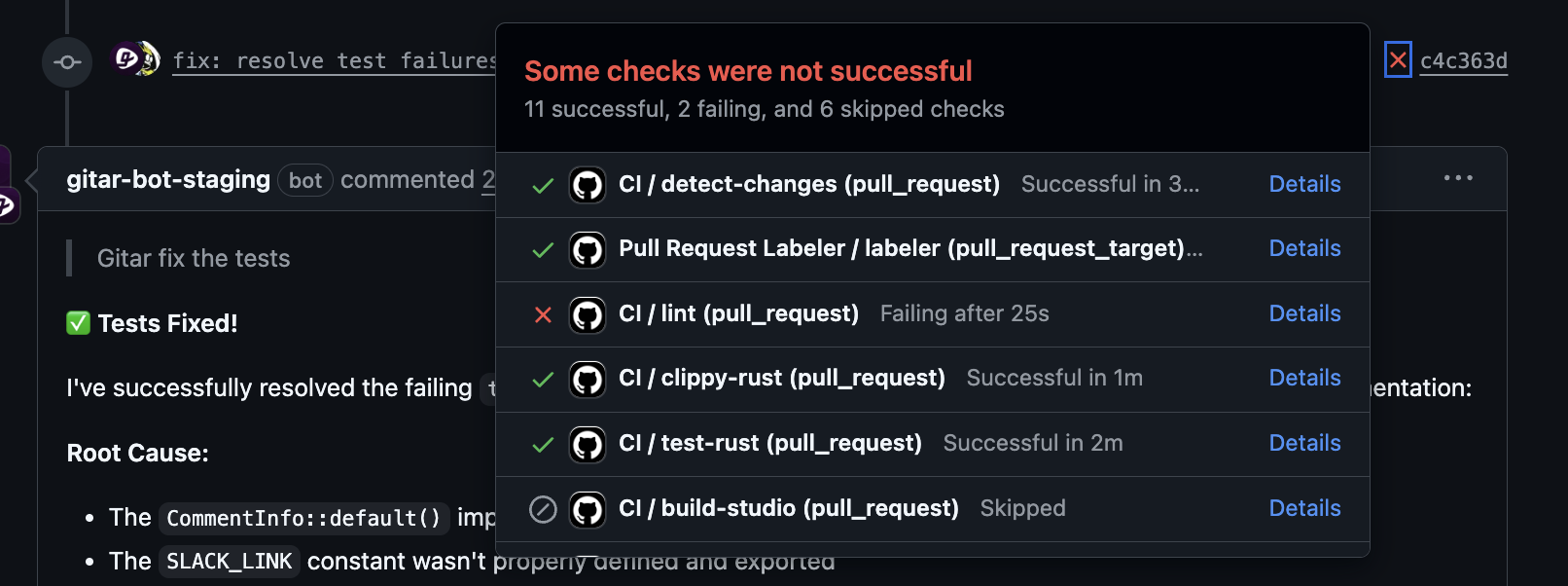
Teams that want these benefits can install Gitar to automatically repair CI failures and reduce manual conflict cleanup.
Gitar vs. The Status Quo: Conflict Resolution Approaches
|
Attribute |
Manual Resolution |
AI Suggestion Engines |
Gitar (Autonomous Engine) |
|
Conflict Detection |
Developer inspects CI logs and diffs |
Tool flags issues and suggests edits |
Real-time detection with automated next steps |
|
Resolution Method |
Developer edits code and re-runs CI |
Developer applies suggested patches |
Agent applies changes and runs full validation |
|
Developer Flow Impact |
Frequent context switching and delays |
Reduced, but still requires manual effort |
Minimal interruption; reviews focus on final diffs |
|
Enterprise Scalability |
Limited by developer time and attention |
Reliant on humans to integrate suggestions |
Environment-aware automation scales with codebase size |
Frequently Asked Questions about Autonomous Merge Conflict Resolution
Q: How does Gitar handle complex merge conflicts that involve logic changes?
A: Gitar uses environment replication and context-aware analysis to reason about logic changes, not only formatting. The agent reviews repository history, CI logs, and dependency relationships to propose or apply fixes that address the underlying cause of a failure. For especially complex cases, Gitar can surface a detailed proposal for developers to approve with a single action.
Q: We already use formatters and linters. Will Gitar still help?
A: Formatters and linters reduce style-related conflicts, but many conflicts arise from simultaneous feature work, refactoring, and dependency shifts. Gitar focuses on these deeper issues by understanding how changes interact in shared code and by validating solutions in CI, which extends coverage beyond what formatting tools provide.
Q: How can our team control the level of autonomy Gitar has?
A: Gitar offers a configurable trust model. Teams can begin with a conservative mode where the agent posts suggested fixes as comments or pull requests. After building confidence, teams can allow Gitar to commit changes directly while still retaining clear audit trails and rollback options.
Q: Does Gitar replace code reviews for preventing merge problems?
A: Gitar complements human review rather than replacing it. Reviewers continue to focus on architecture, design choices, and security. Gitar handles many routine CI failures and conflict cleanups, which keeps reviews centered on higher-value decisions.
Q: What happens if a Gitar fix introduces an issue?
A: Gitar validates each change against the full CI pipeline before promoting it, which reduces the chance of faulty fixes. If a problem still appears, teams can revert the change using standard version control workflows, supported by detailed commit messages that describe what Gitar modified and why.
Conclusion: A Practical Path to Faster, More Reliable Merges
Merge conflicts in large codebases no longer need to be a recurring obstacle. Manual workflows and suggestion-only tools identify problems but often extend the time developers spend resolving them.
Gitar applies autonomous AI to detect, fix, and validate many of these issues inside real CI environments. Teams that adopt this approach improve developer focus, stabilize builds, and move features to production more quickly.
Teams that want to reduce merge-related overhead and CI noise can install Gitar to automatically fix broken builds and improve conflict resolution across their repositories.