
Key Takeaways
- Merge conflicts and CI failures create major productivity losses, especially for teams that already use AI coding tools and ship code frequently.
- Manual merge conflict resolution carries high hidden costs from context switching, extended lead times, and scaling limits as codebases grow.
- Suggestion engines and IDE assistants improve analysis and code creation, but they often stop short of fully resolving CI failures and merge issues.
- Autonomous healing engines that replicate CI environments and apply fixes directly to pull requests can deliver faster lead times and lower operational costs.
- Gitar provides an autonomous CI healing engine that fixes failing builds, reduces context switching, and helps teams ship reliable software faster; you can get started at https://gitar.ai/fix.
The Developer Productivity Impact of Merge Conflicts and CI Failures
Merge conflicts and CI failures now block many development workflows. Developer productivity metrics highlight CI failures and code review cycles as major bottlenecks, with up to $1M in annual productivity loss for a 20-developer team at typical loaded rates.
DORA metrics connect lead time and deployment frequency to business agility, yet developers still spend large portions of the day inspecting logs, reproducing failures, and retrying builds. Each interruption breaks flow state, so a simple fix can expand into an hour of lost momentum.
AI-assisted coding has increased this pressure. Most developers now use AI tools and report productivity gains, which means more code, pull requests, and CI runs. The main bottleneck has shifted from writing code to validating and merging it, so organizations need automation that focuses on CI and code review, not only code generation.
Gitar’s Autonomous CI Healing Engine for Merge Conflict ROI
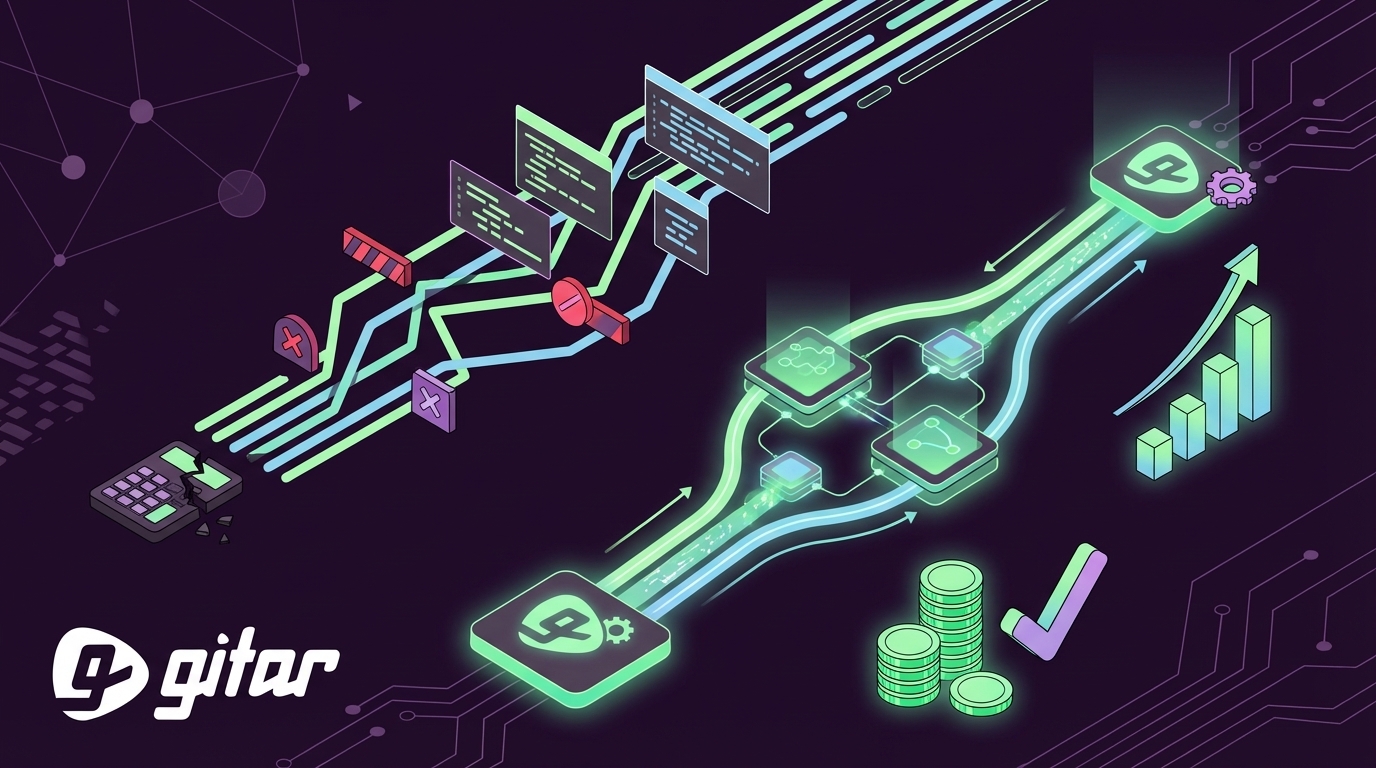
Gitar moves beyond suggestion-based AI and focuses on autonomous action. The system monitors failing CI pipelines, identifies the root cause, applies fixes, and commits changes back to pull requests so developers receive passing builds rather than failure notifications.
When a build fails due to lint errors, test failures, or build issues, Gitar analyzes logs, proposes a fix internally, updates the code, and re-runs checks. This closed loop reduces manual validation cycles and lowers the need for developers to switch contexts between feature work and CI debugging.
Gitar recreates CI environments with high fidelity, including SDK versions, dependency graphs, and integrations such as SonarQube and Snyk. This replication improves the likelihood that a fix passing in Gitar’s environment will also pass in production CI pipelines.

Teams can choose a trust model that fits their risk profile. They may start in a suggest-only mode where developers approve each fix with a click, then move toward auto-commit modes once the organization has validated Gitar’s behavior across common scenarios.
Comparing Merge Conflict Automation Options for ROI
Merge conflict automation tools differ in how much work they remove from developers and how much integration effort they require. Understanding these tradeoffs helps leaders choose the approach that best matches their team and budget.
Manual Merge Conflict Resolution: High Hidden Cost and Poor Scalability
Manual workflows require developers to stop current tasks, inspect error logs, reproduce issues locally, patch code, push changes, and wait for new CI runs. Each step adds delays and context switching overhead.
Lead time metrics show how small delays compound across teams, especially in distributed organizations where a single back-and-forth across time zones can push a simple fix into the next day. As codebases and teams grow, CI complexity increases faster than available human attention, so manual resolution becomes increasingly expensive.
AI Code Reviewers: Helpful Suggestions Without Full Resolution
AI code reviewers such as CodeRabbit assist during code review. They summarize pull requests, flag possible bugs, and suggest better patterns, which reduces analysis time compared to pure manual review.
Many of these tools still depend on developers to apply and validate suggested changes. That requirement limits their impact on merge conflicts and CI failures, because developers must return to stalled branches, adjust code, and re-run pipelines before work can proceed.
On-Demand AI Fixers and DIY Toolkits: Flexible but Labor Intensive
Some teams build custom workflows on general-purpose AI models to fix CI failures on demand. These setups can handle complex cases when well designed, and they give teams full control over prompts and context.
The tradeoff comes from integration and maintenance work. DIY systems often require internal platforms, custom orchestration, and ongoing updates as CI systems and repositories evolve. Longer payback periods appear when upfront platform costs arrive before visible productivity gains, which can slow adoption.
IDE-Based Coding Assistants: Strong at Creation, Limited at CI Healing
GitHub Copilot and similar tools speed up coding inside the IDE. Time-savings estimates per developer translate into meaningful annual productivity value, especially for individual contributors.
These assistants primarily focus on pre-commit activities. Some offer pull request help, but they usually do not run inside CI pipelines or manage multi-step remediation. Faster code creation still flows into the same CI and review processes, so teams need complementary automation to unlock full delivery gains.
Feature and ROI Comparison Across Approaches
|
Capability |
Manual Resolution |
AI Code Reviewers |
Gitar Healing Engine |
|
Autonomous implementation |
None, full manual effort |
Primarily suggestions, many changes require manual work |
End-to-end automated fixes in pull requests |
|
Environment replication |
Depends on each developer’s local setup |
Limited awareness of CI environments |
Full workflow emulation, including dependencies and scanners |
|
Context switching impact |
High, frequent interruptions |
Moderate, suggestions still need attention |
Low, most work runs in the background |
|
Lead time improvement |
Negative, adds delay |
Incremental, depends on adoption |
Significant, faster resolution of CI failures |
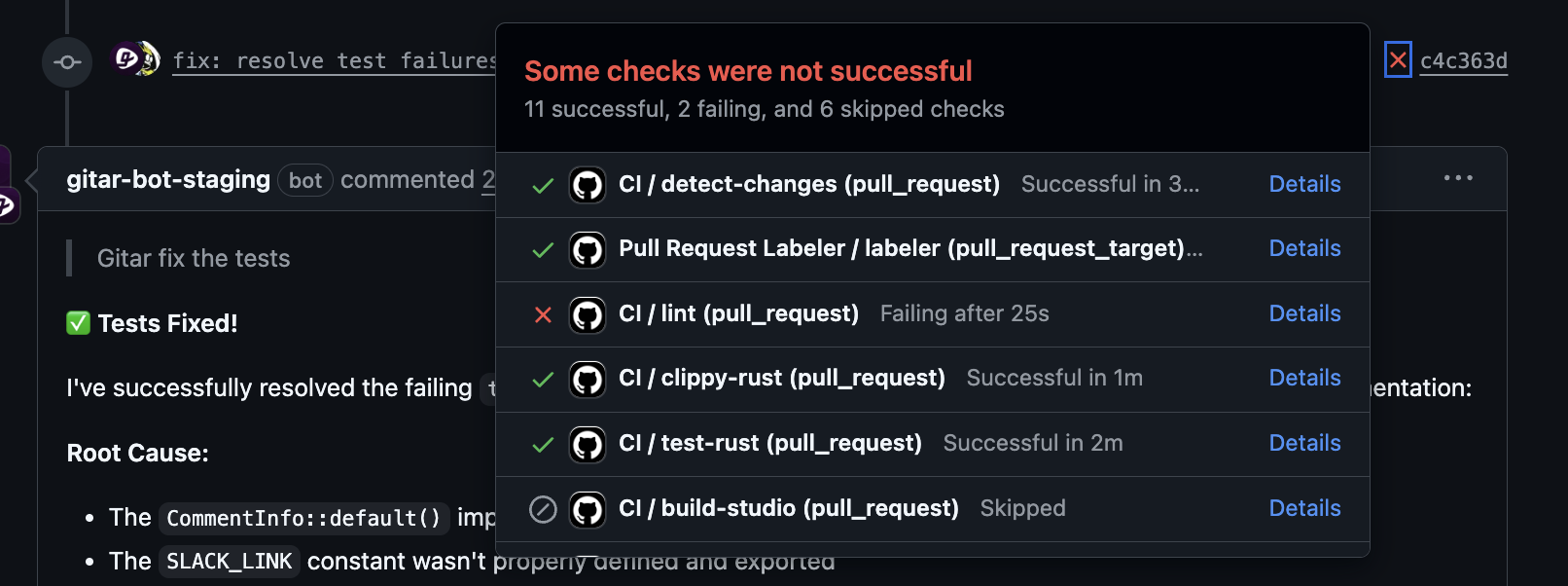
Install Gitar to automatically fix broken builds and improve software delivery speed and quality.
Quantifying ROI From Automated Merge Conflict Resolution
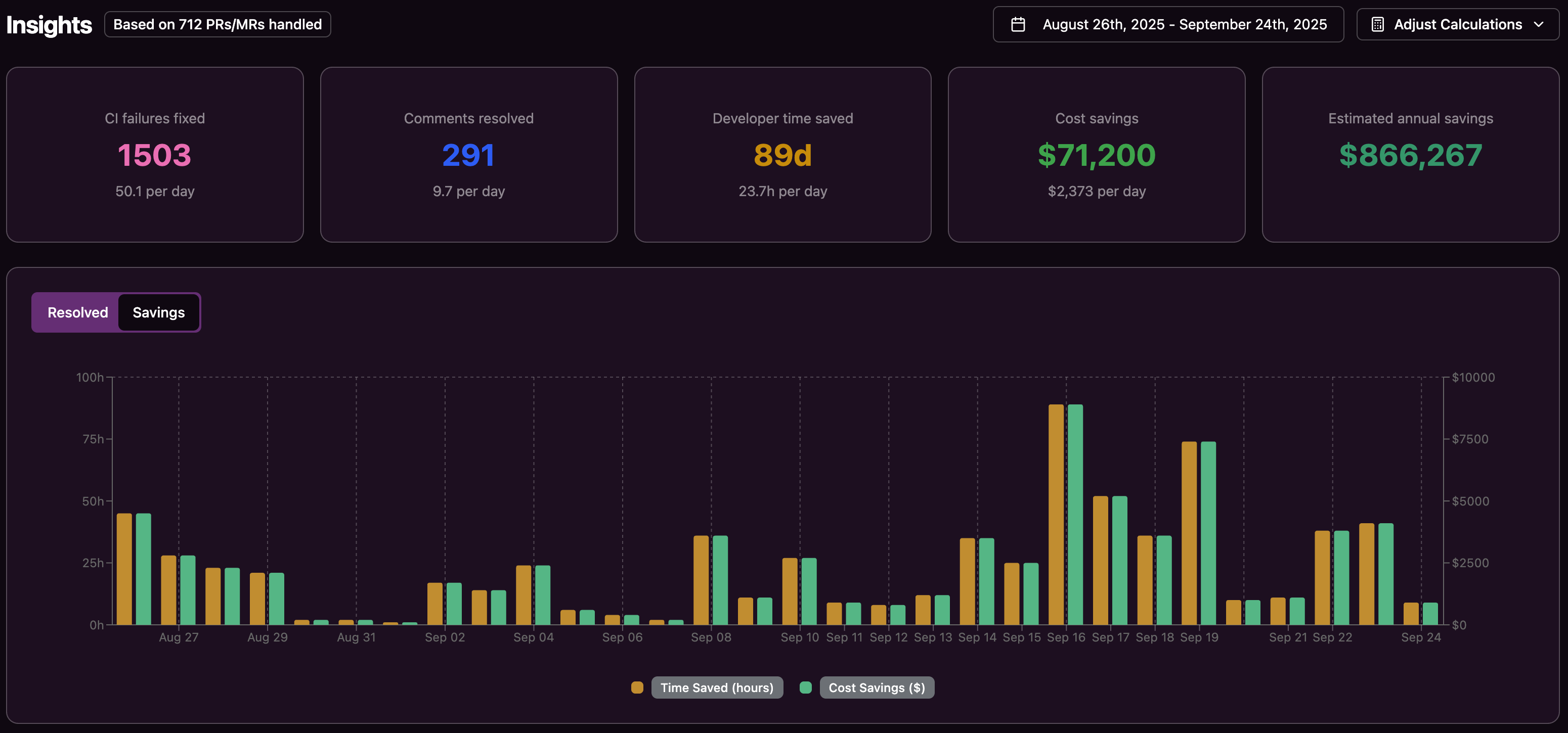
Merge conflict automation produces value across engineers, managers, and platform teams. Per-developer productivity benchmarks show thousands of dollars in annual value from reclaimed time, even before considering broader organizational effects.
Engineering leaders see benefits through reduced lead times and fewer blocked pull requests. For a 20-developer team, partial automation of CI failures can represent hundreds of thousands of dollars in annual savings once loaded costs and delayed delivery are included. Revenue per engineer metrics connect these gains directly to business outcomes.
DevOps and platform teams benefit from fewer repeated CI runs, lower infrastructure waste, and fewer support tickets from blocked developers. DORA metrics offer a clear way to track these improvements, including deployment frequency, lead time for changes, change failure rate, and mean time to recovery.
Developer experience also contributes to ROI. Booking.com reported a measurable productivity lift after combining AI tools with satisfaction surveys, illustrating how reduced friction can improve engagement and retention. Three-year ROI models that reach several hundred percent show how these gains compound over time as teams refine workflows and expand automation coverage.
Key Considerations for Merge Conflict Automation ROI
Gitar ROI Compared With AI Code Review Tools
AI code reviewers focus on analysis, while Gitar focuses on implementation. Tools like CodeRabbit highlight issues and sometimes apply small fixes, but developers often remain responsible for validation and for resolving many CI failures. Gitar instead applies fixes, re-runs checks, and returns passing builds in many cases, which reduces context switching and the amount of manual work per incident.
Fit for Complex Enterprise CI Environments
Complex environments with multiple SDKs, security scanners, and layered test suites benefit from accurate replication. Gitar emulates these workflows, including tools such as SonarQube and Snyk, and verifies fixes inside that context. This accuracy lowers the risk of repeated failures from incomplete patches and supports ROI through reduced retries and fewer production surprises.
Impact on Developer Satisfaction and Burnout
Developer satisfaction improves when repetitive CI debugging steps disappear from daily work. Gitar handles many of these tasks, so engineers spend more time on feature work and less time on firefighting. Better day-to-day experience supports higher engagement, lower burnout, and stronger retention, all of which contribute to long-term productivity.
Measuring ROI After Adoption
Teams that adopt merge conflict automation track improvements with both technical and human metrics. They monitor DORA metrics before and after rollout, run developer surveys on time use and satisfaction, and watch CI usage data for changes in failed and retried runs. Leaders then estimate value by multiplying saved hours by loaded costs and adding infrastructure savings and retention gains.
Start using Gitar to reduce merge conflict costs and improve CI reliability.
Conclusion: Selecting the Right Merge Conflict Automation Strategy
Merge conflict automation in 2026 ranges from manual workflows and suggestion engines to autonomous healing engines. Manual approaches incur large hidden costs, and suggestion tools improve analysis but often leave final resolution steps to developers. Healing engines that operate inside CI pipelines offer a more complete way to reduce context switching and shorten lead times.
Gitar provides an autonomous CI healing engine that focuses on reliable fixes, environment replication, and cross-platform support. Teams that want measurable ROI from merge conflict automation can evaluate how much time developers currently spend handling CI failures, then compare that baseline with the savings possible when Gitar handles most of those incidents in the background. Explore Gitar to see how autonomous CI healing can fit into your organization’s merge conflict strategy.