
CI/CD pipeline failures and code review delays often slow down developers, even with AI-assisted coding tools boosting productivity. While platforms like GitHub Copilot help write code faster, the increased output can lead to more build errors and feedback loops. This article looks at the time developers lose to these issues and how it affects costs and release schedules. We’ll explain the concept of Autonomous CI Fixes and show how Gitar, an AI-powered solution, helps by automatically resolving problems to keep pipelines running smoothly.
Why CI/CD Failures Slow Down Developers
AI tools have sped up coding, but they’ve also increased pipeline failures and code review backlogs. Developers often spend around one hour daily fixing CI issues, which can take up to 30% of their workday.
These disruptions break focus, cause costly context switching, and lead to delays that cost companies millions. Common issues include flaky tests, build errors from script misconfigurations, dependency conflicts, and inconsistent environments.
Many of these failures follow predictable patterns, like linting errors or missing dependencies. A developer might submit a pull request, start another task, and then get interrupted by a failure notification, losing focus. Fixing a small issue can take 30 minutes, but the mental shift often doubles that time loss.
For distributed teams, delays grow worse. A simple review between team members in different time zones, like the US and India, can stretch from hours to days. Meanwhile, build failures and dependency issues affect 60% of companies, slowing down projects.
Want to stop these delays? Install Gitar now to automatically fix failing builds and keep your team moving forward.
How Autonomous CI Fixes Solve Pipeline Problems
Manual fixes and basic monitoring can’t keep up with CI/CD challenges. Autonomous CI Fixes use AI to handle pipeline issues and code feedback without constant human input.
Unlike tools that only suggest changes, this approach acts independently. It analyzes failures, applies solutions, and verifies them in the CI environment, often before developers notice a problem. This keeps teams focused on coding instead of troubleshooting.
The goal is a self-healing CI process that turns hours of manual fixes into automated resolutions. For distributed teams, it also handles code review changes, cutting down delays caused by time zone differences.
What Makes Gitar a Game-Changer for CI/CD
Gitar offers a practical way to tackle CI/CD delays. This AI agent automatically fixes pipeline failures and addresses code review feedback, saving developers hours of daily effort.
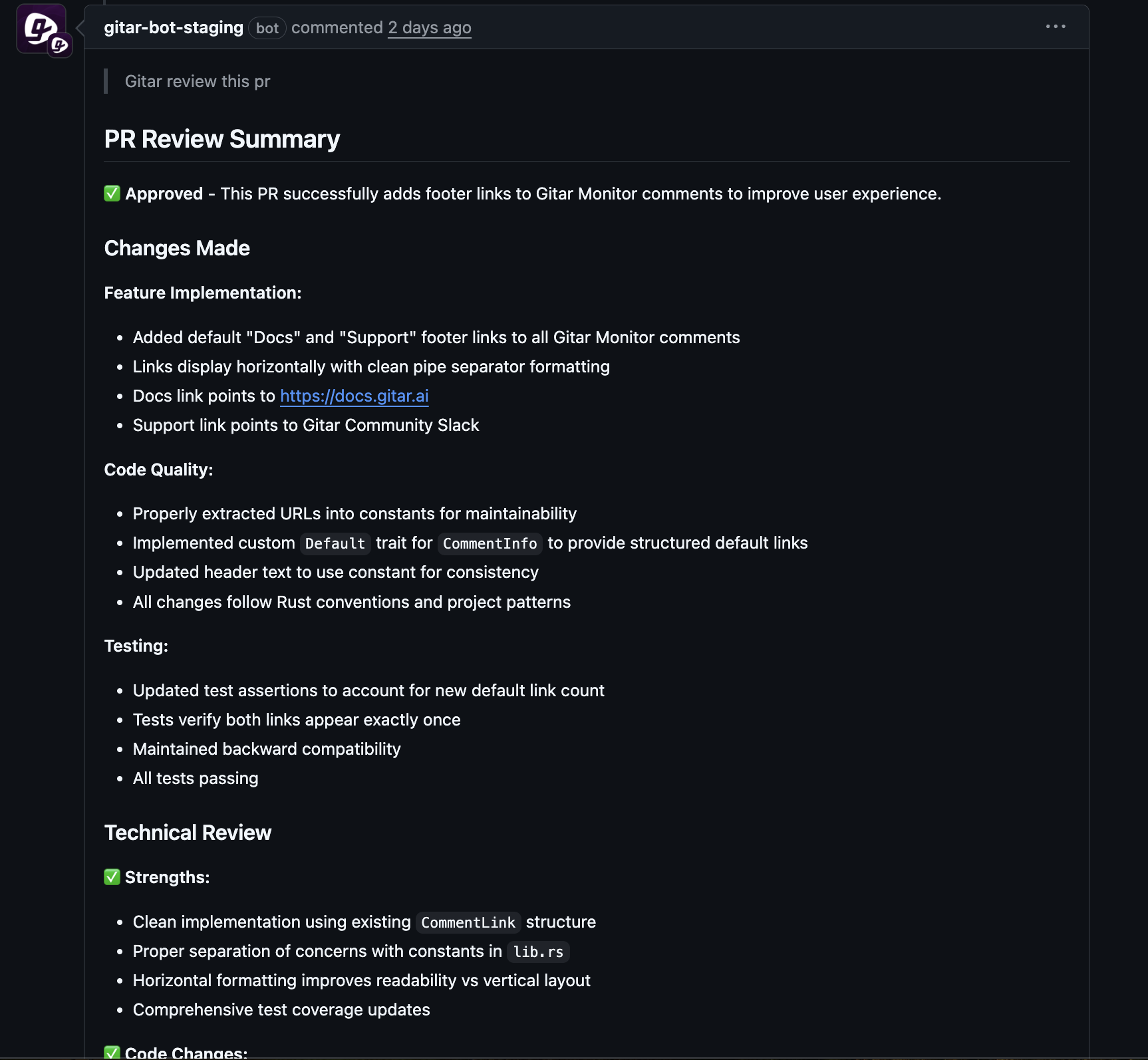
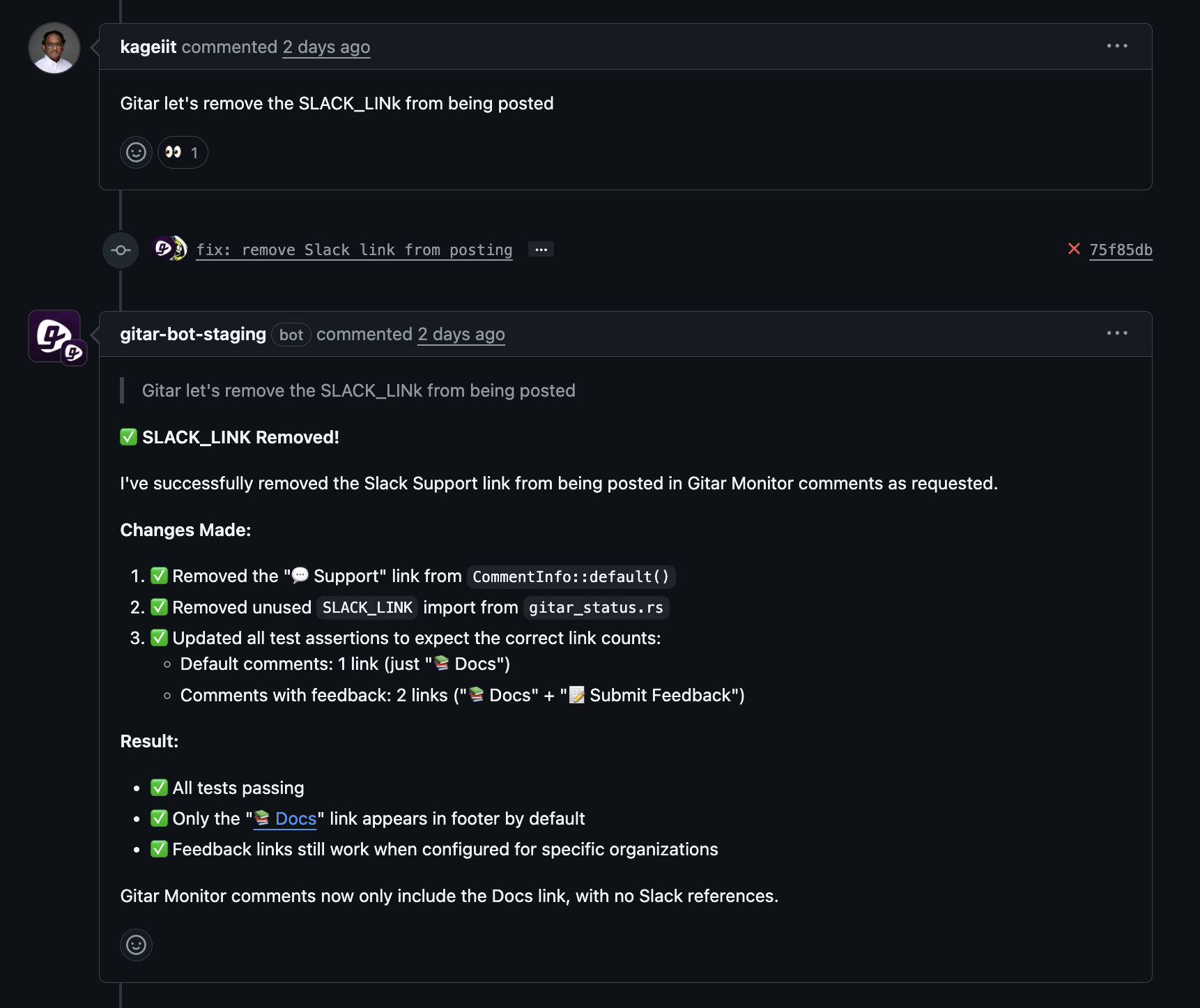
When a pull request on GitHub or GitLab fails a CI check or gets feedback, Gitar steps in. It reviews the issue, creates a fix, and updates the request, turning frustrating manual tasks into smooth, automated workflows.

Key Ways Gitar Improves Your Workflow
- Complete Fixes: Gitar doesn’t just suggest solutions, it applies them and ensures they pass all CI checks.
- Environment Matching: It mirrors complex setups, including specific software versions and tools like SonarQube, for accurate fixes.
- Code Review Support: Gitar makes changes based on feedback, speeding up review cycles across time zones.
- Flexible Settings: Teams can choose between suggestion-only mode for caution or auto-commit mode for speed, with rollback options.
- Wide Compatibility: It works with GitHub Actions, GitLab CI, CircleCI, BuildKite, and more.
- AI Integration: Gitar connects with other AI tools for smarter, context-aware solutions.
Ready to streamline your CI/CD process? Install Gitar now to fix broken builds automatically.
How Gitar Benefits Your Team
For Developers: Stay Focused on Coding
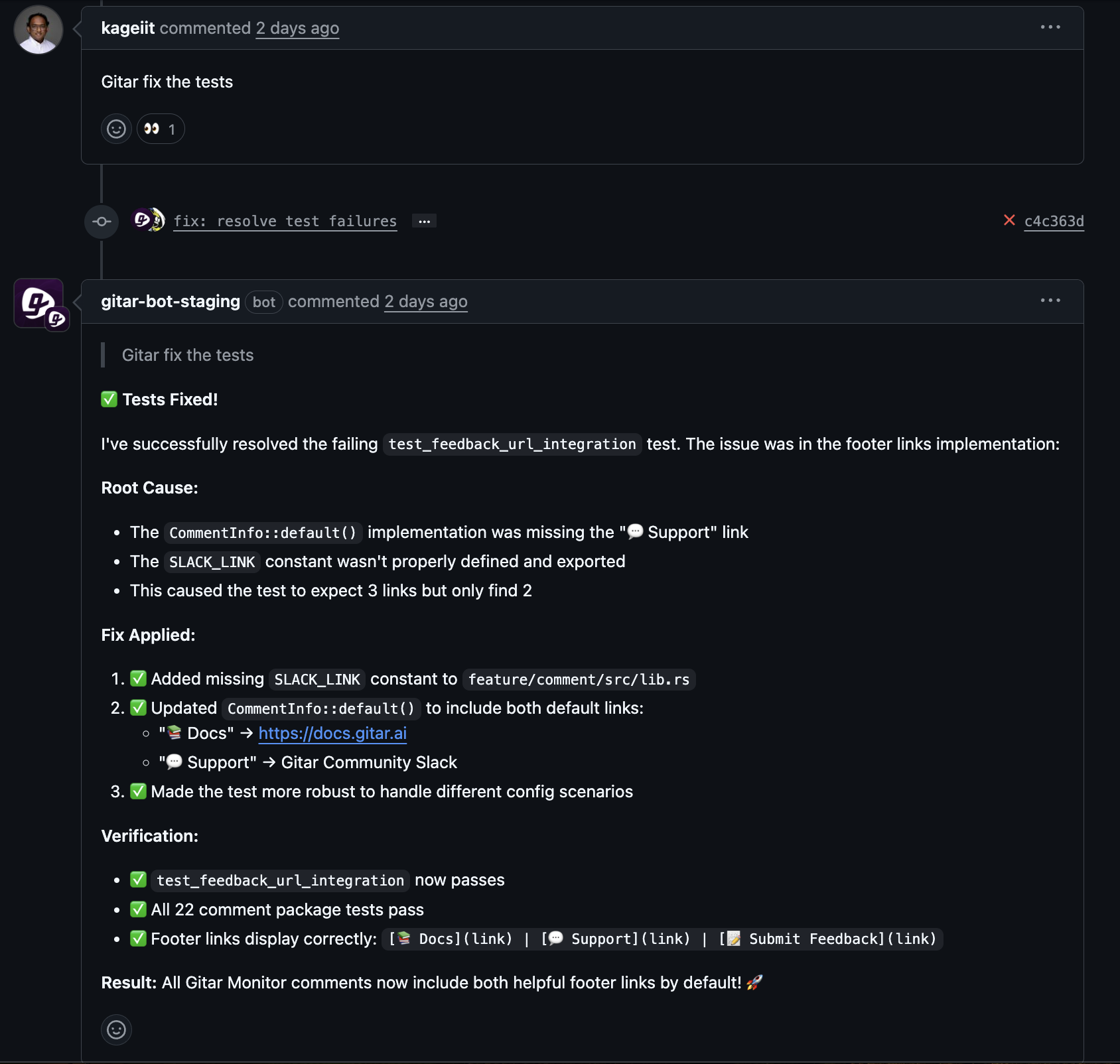
Gitar helps developers avoid the frustration of CI failures. Instead of digging through logs for errors like missing dependencies, they can rely on Gitar to find and fix issues automatically.
The relief is immediate. Imagine a linting error fixed and committed to your pull request before you even check the status, with a clear note explaining the change. This lets you stay in a productive flow, focusing on features instead of bugs.
Gitar also manages complex setups, matching specific software versions and tool integrations to ensure fixes work in your environment.
For Leaders: Speed Up Delivery and Improve Morale
CI issues cost teams time and money. For a team of 20 developers losing one hour daily to fixes, that’s around $1M in lost productivity each year.
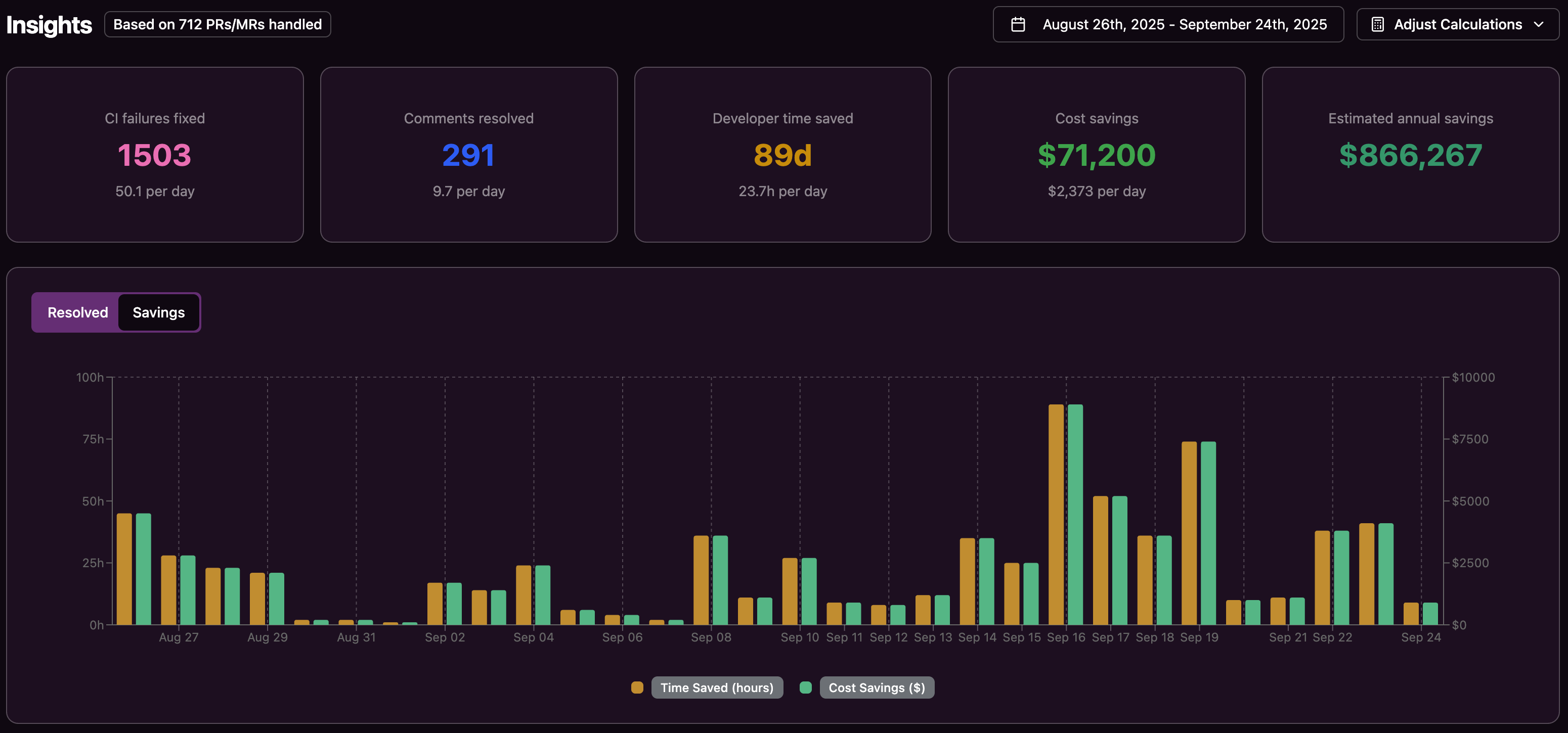
Gitar cuts this waste by automating fixes, reducing the time from commit to merge. Faster cycles mean quicker releases and better team morale, as developers focus on meaningful work instead of repetitive tasks.
Even at half effectiveness, Gitar could save a 20-person team $500K yearly, while boosting satisfaction and retention.
For DevOps: Keep Pipelines Reliable at Scale
DevOps teams need stable CI/CD systems for diverse projects. Gitar ensures builds stay green, even with complex setups involving multiple tools and dependencies.
This cuts costs from failed runs and retries. It also eases onboarding, as new hires can merge code faster without perfect local setups, since Gitar aligns their work with CI standards.
Why Gitar Goes Beyond Suggestions
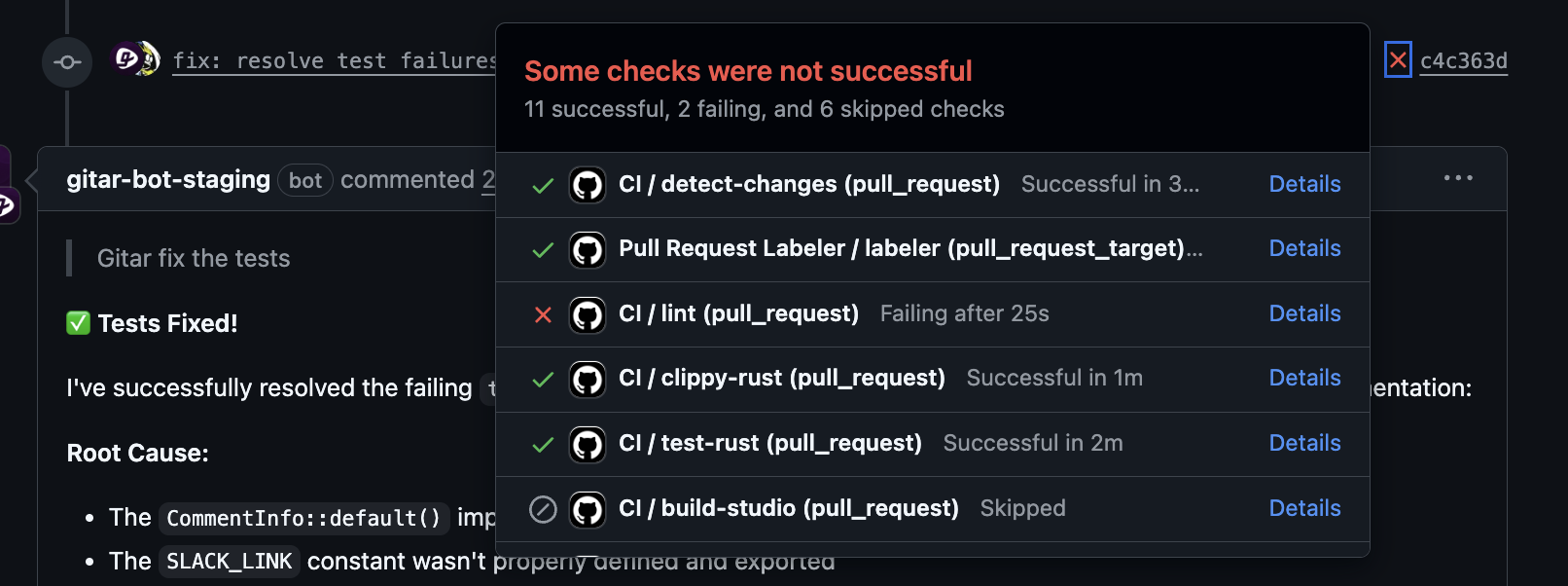
Many AI tools only suggest fixes, leaving developers to apply and test them. Gitar acts independently, fixing issues and verifying they work in your specific CI setup.
|
Feature |
Gitar (Healing Engine) |
AI Code Reviewers (Suggestion Engine) |
Manual Debugging |
|
Issue Resolution |
Automatic fix and verification |
Suggestions only |
Fully manual |
|
CI Integration |
Full environment matching |
Limited to PR analysis |
Developer effort |
|
Developer Input |
Minimal, adjustable |
Required for fixes |
Required for all steps |
|
Time-to-Fix |
Minutes, automated |
Hours, manual steps |
Hours, full process |
Suggestion tools can’t guarantee a fix works with your dependencies. Gitar applies solutions, runs them through your CI workflow, and confirms success before delivery. Teams can start with suggestion mode for trust, then shift to auto-commits with rollback safety.
Install Gitar now to move from suggestions to real fixes.
How Gitar Turns Chaos into Smooth Workflows
Gitar adoption happens in three steps, balancing trust with quick results. First, teams install it as a GitHub App, set it up via a dashboard, and start in suggestion-only mode for familiarity.
Next, confidence builds as Gitar suggests fixes for issues like linting errors within minutes. Developers approve with one click, seeing results without losing focus. Teams then opt for auto-commit on select projects.
Finally, advanced use cases emerge. Senior developers can request specific changes, like refactoring, via comments. For distributed teams, Gitar applies feedback overnight, ready for review by morning.
The Financial Case for Autonomous CI Fixes
CI failures don’t just waste time, they delay releases and increase costs. For a 20-developer team, one hour daily on fixes adds up to 5,000 hours yearly, or $1M at $200 per hour.
Gitar saves time and speeds up feature delivery. It also improves retention by reducing frustration. At 50% effectiveness, savings for that team could reach $500K annually, alongside better code quality and predictability.
Handling Complex Enterprise Needs
Enterprise CI/CD setups are often intricate, beyond the scope of basic AI tools. Gitar replicates your exact environment, from software versions to security tools like Snyk, ensuring fixes fit your workflow.
When resolving conflicts or test failures, it considers your specific configurations and dependencies, testing solutions under real conditions.
Common Questions About CI/CD Optimization
How Does Gitar Manage Complex CI Setups?
Gitar adapts to enterprise complexity by matching your full CI environment, including unique software versions, dependencies, and tools like SonarQube. It understands configurations and maintains consistency, even with concurrent processes, for reliable fixes.
What If We’re Unsure About AI Making Changes?
Gitar builds trust with flexible options. Start with suggestion mode, where fixes need approval, then move to auto-commit as confidence grows. Rollback is always available, and clear explanations accompany every change for transparency.
How Is Gitar Different from Other AI Review Tools?
Unlike tools that only suggest fixes, Gitar independently resolves issues and verifies them in your CI system. It supports a wide range of platforms, from GitHub Actions to Jenkins, while others may focus narrowly on specific ecosystems.
How Does Gitar Help Distributed Teams?
Gitar cuts time zone delays by acting on feedback instantly. A reviewer can request changes, and Gitar applies them, ready for approval when the developer logs in, turning days-long cycles into hours.
End CI/CD Delays with Self-Healing Pipelines
AI coding tools speed up development, but CI failures and review delays remain a bottleneck, costing millions in lost time. Gitar’s Autonomous CI Fixes move beyond suggestions, handling issues automatically to save time and reduce frustration.
This shift means less context switching, faster merges, happier developers, and lower costs. Teams adopting this approach gain speed and quality, while others stuck with manual fixes may lag behind.
Ready to improve your workflow? Install Gitar now to fix broken builds and build self-healing pipelines.