
CI pipeline failures slow down development, waste time, and delay releases. While Jenkins plugins offer tools to manage issues, they often lack the ability to fix errors automatically with full context. This article breaks down the challenges of traditional plugin-based methods and highlights how an AI solution like Gitar delivers a self-healing CI process, helping teams resolve failures quickly and regain focus on coding.
Why CI Failures Hurt More Than You Think
CI pipeline failures cost more than just frustration over a broken build. They sap productivity, lower team morale, and delay critical business goals. Even with countless Jenkins plugins for detecting and addressing errors, the core issue remains: these tools require manual effort to analyze and fix problems, leaving developers stuck in a reactive loop.
Constant Interruptions from Manual Debugging
Every failed CI build forces developers to stop their work and switch to debugging. One minute, you’re coding a new feature; the next, you’re buried in error logs, trying to figure out why code that worked locally fails in CI. Flaky tests and environment differences often cause these disruptions.
This shift from creating to troubleshooting takes a toll. A quick fix can stretch into an hour as you lose your focus, dig into the issue, and struggle to get back on track. Across a team, these interruptions add up, creating a drag on overall progress.
Jenkins plugins can point out errors with alerts or logs, but they still leave the hard part to you. Identifying the problem is only half the battle; figuring out the context and coding a fix remain manual tasks that pull you away from your priorities.
Delayed Merges and Slower Software Releases
CI failures don’t just affect one developer; they stall entire teams. A pull request that fails CI checks sits unmerged, holding up others who depend on those changes. Issues like permission errors or misconfigured settings often stop pipelines cold.
These delays compound. An hour spent fixing a build doesn’t just cost 60 minutes; it can push back an entire release schedule. In environments aiming for daily deployments, such setbacks can mean missing key deadlines or losing ground to competitors.
For teams spread across time zones, the impact worsens. A CI failure pushed by a developer in one region might sit unresolved for hours until a teammate with the right knowledge logs in elsewhere, turning a small fix into a full-day delay.
Why Jenkins Plugins Can’t Solve Everything
Jenkins boasts thousands of plugins, but most focus on spotting issues, not fixing them. They provide detailed reports or integrate with other tools, yet they stop short of taking action on their own.
Common pipeline failures, from syntax errors to unstable plugin versions, still demand hands-on solutions. Even with alerts in place, developers must step in to address the root cause.
This reactive setup keeps teams on the defensive. You get notified of a failure, investigate it, and apply a fix, but the process stays manual. Instead of building new features, you’re stuck putting out fires, with little time to improve workflows proactively.
Navigating the Complexity of Modern CI Systems
Today’s enterprise CI setups are intricate, blending multiple languages, dependencies, and configurations. Manually debugging in this environment feels overwhelming, even for seasoned developers. Mismatched environments and dependency conflicts frequently trigger pipeline issues.
With various SDKs, specific version needs, and third-party tools like SonarQube or Snyk in play, a failure isn’t just about your code. It’s about understanding the entire system where that code runs. Local setups rarely match CI perfectly, so code that passes on your machine can fail in testing, leading to frustrating hunts for the cause.
Jenkins plugins offer logs and environment details, but they don’t bridge the gap to a solution. They show what broke, not how to adjust the code for the specific CI context, leaving you to piece together the fix.
Meet Gitar: Your AI-Powered Fix for CI Failures
Gitar shifts CI error handling from reactive to proactive. Unlike Jenkins plugins that only flag problems, Gitar acts as an AI agent that detects failures, creates fixes, applies them, and confirms the build succeeds, freeing your team from manual intervention.

Gitar’s strength is in acting as a healing system, not just a diagnostic one. When a CI build fails, it analyzes the error, grasps the context, crafts a code fix, and commits it to your pull request. This turns a tedious, hands-on process into an automated, self-correcting workflow.
- Complete Fix Process: Gitar doesn’t stop at suggestions. It applies fixes and tests them against your full CI pipeline to ensure success.
- Environment Matching: It mirrors complex CI setups, including specific SDKs, dependencies, and tool integrations, so fixes fit your exact system.
- Adjustable Control: Teams can ease into using Gitar with a mode where fixes are suggested for review, then move to full automation with rollback options as trust grows.
- Code Review Support: Beyond CI issues, Gitar handles feedback from reviews, making requested changes automatically to speed up cycles, especially for remote teams.
- Wide Compatibility: It supports Jenkins, GitHub Actions, GitLab CI, CircleCI, BuildKite, and more, fitting diverse toolsets.
Speed up releases and save developer hours. Install Gitar today to fix broken builds automatically and deliver quality software faster.
How Gitar Solves Common CI Pain Points
Gitar tackles CI errors with automated, context-aware solutions. By directly addressing frequent issues, it turns frustrating failures into quick resolutions, keeping your workflow smooth.
Fixing Environment and Dependency Issues
CI failures from environment mismatches are tricky since they often don’t show up locally. Your code might run fine on your machine but break in CI due to a version conflict or missing package.
Gitar understands your CI setup, including SDKs and dependencies. If a build fails from an incompatibility, it creates a fix that matches your system’s needs, ensuring harmony with other components.
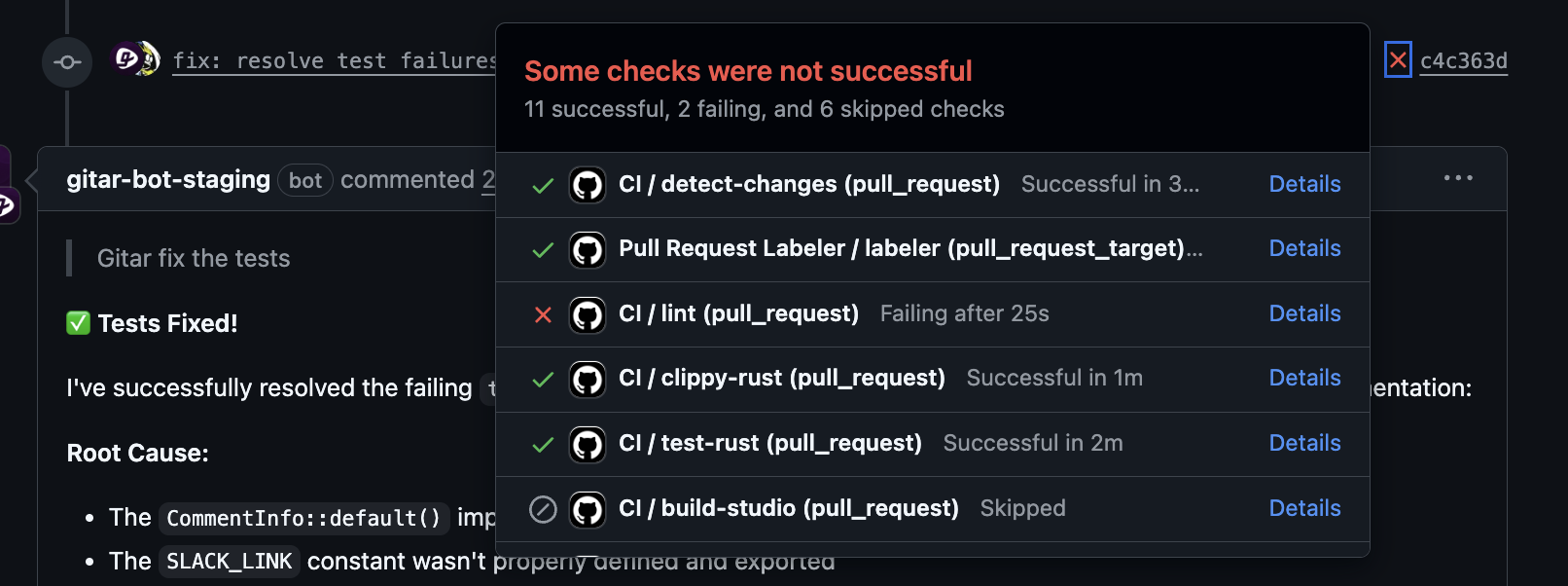
Simplifying Error Log Analysis
Decoding complex CI logs and stack traces eats up valuable time. Jenkins offers detailed steps for error analysis through logs, but this still demands significant effort and skill.
Gitar automates the process. It reviews logs, pinpoints the root issue, and generates precise code changes, whether for a failing test, lint error, or build script problem. It also explains the updates for clarity.
Speeding Up Code Reviews for Distributed Teams
Code review delays hit hard when teams are spread across time zones. Waiting for feedback or changes can stretch into days as schedules misalign.
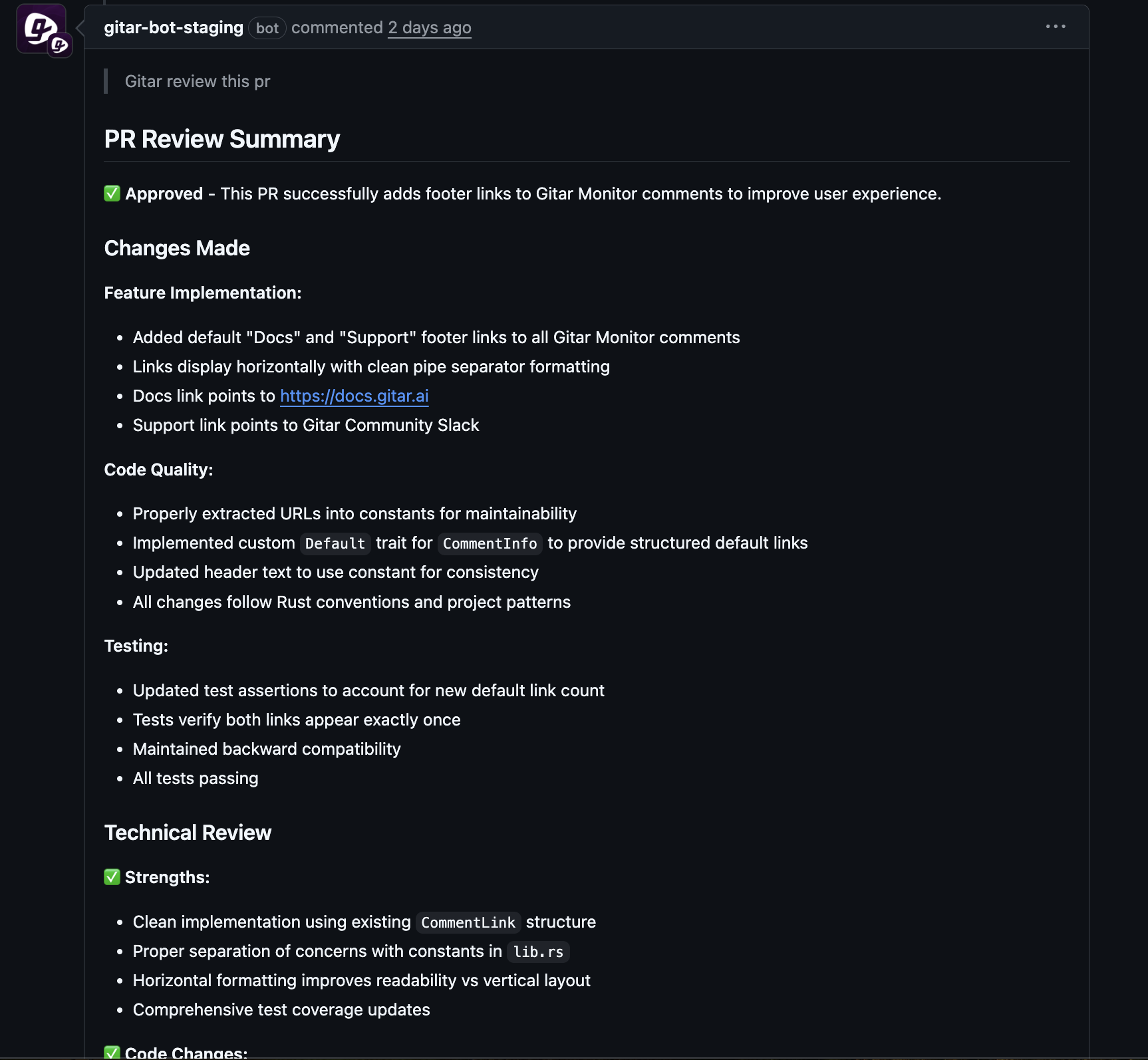
Gitar steps in by acting on review comments directly. If a reviewer requests a feature removal or tweak, Gitar makes the change and commits it with a clear note, so updates are ready for approval without delay, no matter the time difference.
Ensuring Consistency Across Growing Teams
Managing Jenkins plugins gets tougher as teams expand. Configuring tools and maintaining uniform error handling across projects becomes a burden.
Gitar offers a steady, automated fix system for builds across all codebases. Centralized error systems and quick-fail tactics improve pipeline efficiency, and Gitar enhances this with fully automated resolutions.
Stop battling CI issues and focus on delivery. Install Gitar now to automate fixes and ship better software faster.
How Gitar Stands Out from Manual Fixes and Suggestions
CI error tools range from manual debugging to AI suggestions and fully automated systems. Knowing the differences helps teams choose the right approach to streamline their workflow.
Comparison: Gitar Against Other CI Fix Options
|
Feature / Tool |
Gitar (AI Healing System) |
AI Suggestion Tools |
Manual Debugging |
|
Fix Application |
Automatic commit and validation |
Suggestions requiring manual action |
Full manual effort |
|
Environment Context |
Replicates complex CI setups |
Often limited to code analysis |
Relies on local setup |
|
CI Validation |
Confirms build success |
Needs manual CI recheck |
Needs manual CI recheck |
|
Developer Effort |
Greatly reduced |
Partially reduced, still manual steps |
High, frequent interruptions |
|
Platform Support |
Works across Jenkins, GitHub, GitLab, CircleCI |
Depends on specific tool |
Depends on setup |
|
Trust Options |
Flexible, from suggestions to auto-commit |
Usually suggestions only |
Full developer control |
The key distinction is integration. Manual methods and suggestion tools operate separately from CI, requiring extra steps to apply and test fixes. Gitar works within your CI environment, ensuring solutions align with your build process.
Upgrade your CI to self-healing. Install Gitar today to fix builds automatically and ship quality software faster.
Common Questions About Gitar
Can Gitar Work with Our Complex Jenkins Setup?
Yes, Gitar adapts to intricate enterprise systems. It matches your specific dependencies, SDK versions, and third-party tool setups, crafting fixes that fit your unique pipeline.
How Does Gitar Differ from Other AI Code Review Tools?
Many AI tools only suggest fixes, leaving the work to you. Gitar goes further by applying changes and validating them in your CI pipeline, ensuring builds pass with minimal input from your team.
How Can We Trust AI to Edit Our Code?
Gitar provides control through a trust model. Start with suggestions for review in a cautious mode, then shift to automatic commits as you gain confidence, with rollback options always available.
Does Gitar Increase CI Costs?
No, Gitar helps lower costs by fixing failing builds early, cutting down on repeated failed runs and retries, which optimizes your CI resource usage.
Does Gitar Support Our Testing and Build Tools?
Gitar works with many languages and tools, including Python, Go, JavaScript, TypeScript, Java, Rust, Docker, Terraform, and various testing frameworks, fitting into your existing setup.
Wrap-Up: Speed Up Delivery with Automated CI Fixes
Jenkins plugins and manual debugging keep teams stuck in a cycle of reacting to CI failures. The real costs, like lost focus, delayed releases, and slowed progress, hit hard.
Gitar changes the game with automated resolutions. Adding it to your workflow cuts the time spent on CI errors, letting your team prioritize building great software.
Move from constant troubleshooting to seamless fixes. Install Gitar now to automate build fixes and deliver quality software faster.