
Key Takeaways
- CI and code review are now major bottlenecks as AI-assisted coding increases pull requests and failure points.
- Intelligent test maintenance automation platforms reduce manual CI debugging by autonomously identifying and fixing failures.
- Teams see the most value when these tools integrate deeply with existing CI/CD workflows and align with DevOps goals.
- Successful adoption depends on technical readiness, clear guardrails, and gradual expansion of autonomous capabilities.
- Gitar acts as an autonomous CI assistant that fixes failing builds and applies code review changes automatically, which you can try by visiting Gitar.
Why Intelligent Test Maintenance Automation Is Now Critical
Modern engineering teams face a productivity drain from CI failures and code review loops. Developer time often goes into chasing red builds, reading logs, and applying repetitive fixes.
Studies show that developers can spend up to 30 percent of their time on CI pipeline failures and review rework. For a 20-person team, that can approach 1 million dollars per year in lost productivity. AI-assisted coding increases this pressure by generating more pull requests and more potential failure combinations.
Intelligent Test Maintenance Automation Platforms with autonomous healing engines reduce this overhead. These systems not only suggest fixes, but they also apply and validate them, which creates self-healing CI pipelines that keep builds green with limited developer intervention.
The impact appears across the organization. Faster feedback loops support quicker releases, fewer interruptions improve developer focus, and automated CI fixes let teams increase delivery without linear headcount growth. Install Gitar to automatically fix broken builds and ship software faster.
How Test Maintenance Automation Has Evolved
From Scripts to Intelligent, Self-Healing Workflows
Test automation has moved through three main stages. Early tools focused on basic script execution. The next stage introduced modular frameworks and better reuse. The current stage adds intelligence and autonomy to test maintenance.
Earlier frameworks required manual updates when applications changed. Modern intelligent platforms interpret context, update tests or code automatically, and adapt to shifting environments. This change shifts teams from reactive debugging to proactive automation.
Core Capabilities That Reduce Manual CI Work
Effective platforms share several capabilities that directly reduce developer toil:
- Autonomous application of fixes for CI failures, including lint, test, and build issues
- Decision-making that distinguishes flaky tests from real regressions
- Support for diverse tech stacks and complex dependency graphs
- Deep integration with CI/CD tools to trigger, validate, and report fixes
The most advanced systems operate as agents that monitor pipelines, act on failures, and verify results, rather than as passive suggestion engines.
Where These Platforms Fit in Your Strategy
Teams evaluating intelligent test maintenance tools should look at three dimensions.
- Technical readiness: Existing CI/CD maturity, test coverage, and integration capabilities
- Organizational readiness: Comfort with autonomous tools, governance requirements, and security policies
- Business alignment: Clear metrics for time to merge, deployment frequency, and developer satisfaction
High debugging overhead and frequent pipeline breakage usually indicate a strong fit. Many teams start with limited automation modes, then expand as confidence builds.
How Gitar Works as an Autonomous AI Agent for Self-Healing CI
Gitar is an Intelligent Test Maintenance Automation Platform that acts as a healing engine for your CI pipelines. It goes beyond suggestions by applying, validating, and committing fixes so that developers focus on feature work instead of chasing red builds.
Key capabilities that address common engineering pain points include:
- End-to-end autonomous fixing, including analysis of failures, code updates, and commit of validated fixes to the pull request branch
- Full environment replication that mirrors enterprise workflows, such as specific JDK versions, multi-SDK builds, and tools like SonarQube and Snyk
- Code review assistance that implements reviewer feedback on demand, which helps distributed teams working across time zones
- A configurable trust model that supports suggestion only, review required, or auto-commit modes with rollback options
- Compatibility with major CI platforms, including GitHub Actions, GitLab CI, CircleCI, and Buildkite

Gitar uses an action-oriented architecture that handles concurrent pipelines, asynchronous events, and wave-based execution, which matches the realities of modern CI environments.
Why Gitar’s Healing Engine Goes Beyond Suggestion Tools
Autonomous Fixes That Preserve Developer Focus
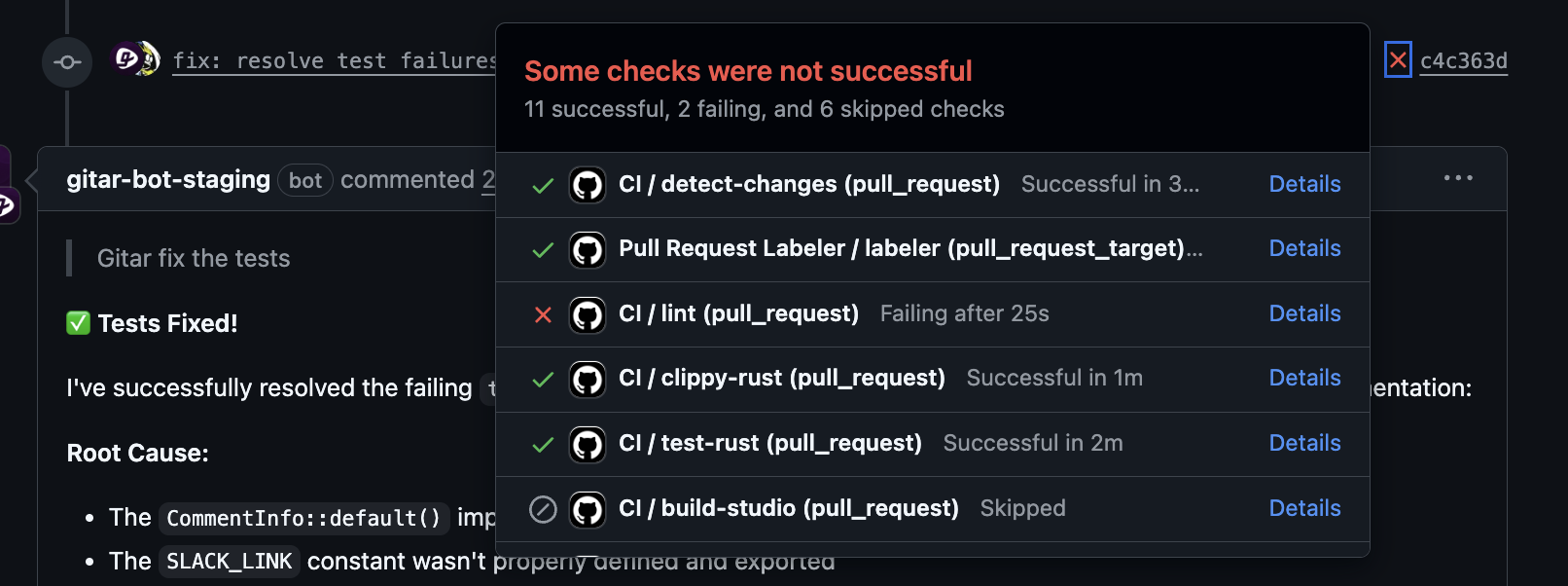
Gitar differs from suggestion-based tools by completing the entire fix lifecycle. When a CI check fails from lint issues, tests, or builds, Gitar reads the logs, identifies likely causes, proposes code changes, applies them, runs the relevant CI steps, and commits the fix if validation passes.
This approach reduces context switching. Traditional tools still require developers to stop, understand the failure, review a suggestion, and apply it manually. Gitar keeps remediation in the background so developers stay in their flow.
Environmental Awareness for Reliable Fixes
Enterprise CI stacks often combine multiple SDKs, language versions, and security or quality tools. General-purpose AI assistants that lack this context can propose fixes that do not pass in real pipelines.
Gitar emulates your CI configuration, including dependency versions and integrations such as SonarQube and Snyk. This context helps ensure that proposed fixes are deployment-ready and compatible with existing policies.
Faster Code Reviews and Shorter Feedback Cycles
Gitar also assists with human code review. When reviewers leave comments such as a request to remove a feature or adjust a pattern, Gitar interprets the request, updates the code, and commits the change along with an explanation.
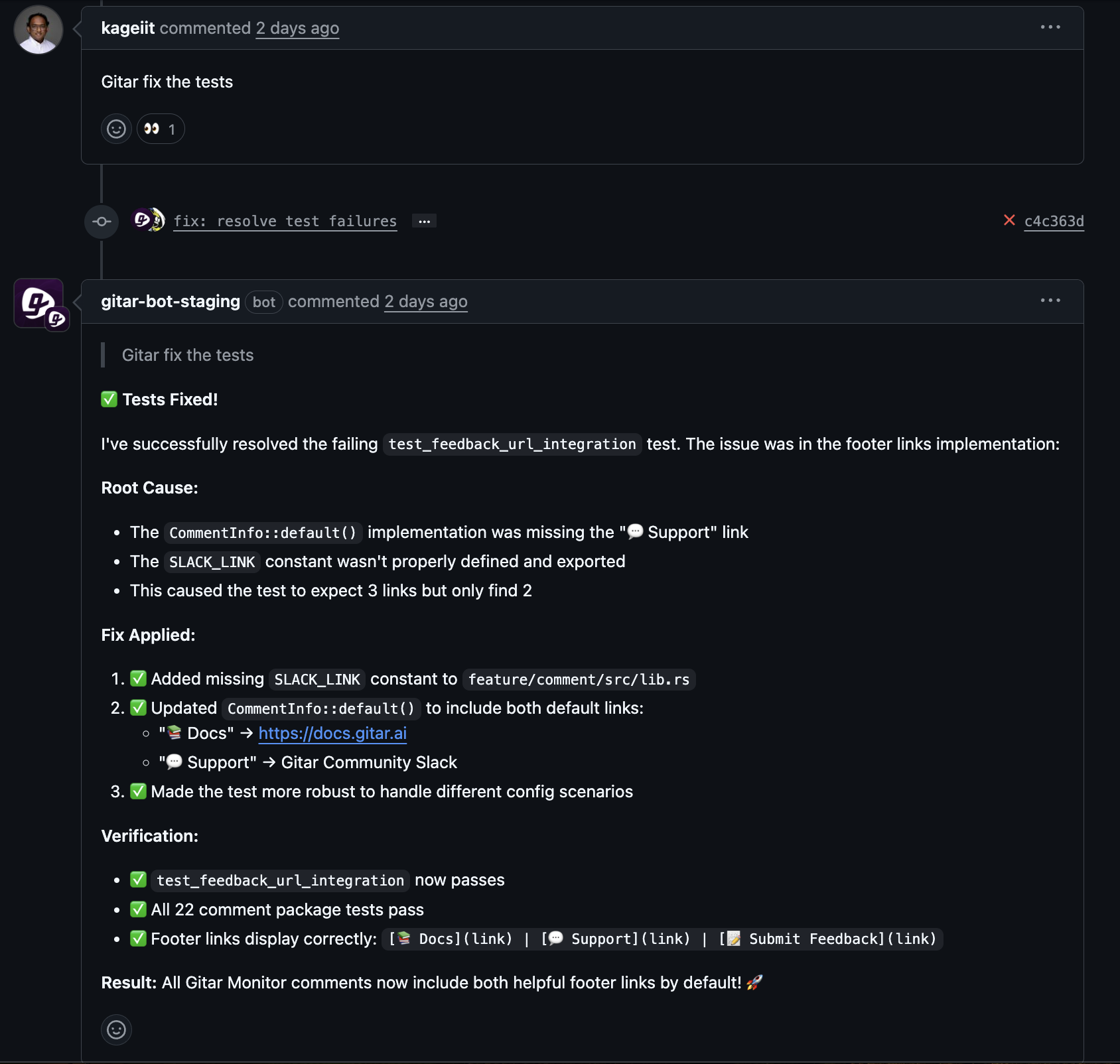
Distributed teams benefit from this model. A reviewer can leave feedback at the end of their day, and Gitar can apply changes so that the author arrives at a ready-for-merge pull request instead of a long back-and-forth.
Preparing Your Organization for Intelligent Test Maintenance
Assessing Readiness Across Technology, Culture, and Strategy
Successful adoption starts with a realistic assessment.
- Technical readiness: Clear CI pipelines, reliable tests, and existing automation around builds and deployments
- Cultural readiness: Openness to automation, defined ownership for CI health, and clear communication about tool behavior
- Strategic alignment: Targets for reducing time to merge, cutting flaky failures, and improving developer experience
Many organizations begin with a pilot on a single repository or service. Teams then refine automation policies before expanding to business-critical systems.
Common Pitfalls and How to Avoid Them
Teams often underestimate the workflow changes that autonomous tools introduce. Processes for code review, incident response, and post-deployment checks may need updates to incorporate automated fixes and audit trails.
Another frequent issue is treating intelligent test maintenance as an isolated tool rather than part of a broader DevOps and platform strategy. The strongest results appear when autonomous CI fixing supports continuous delivery, trunk-based development, and platform engineering goals.
Measuring only technical metrics can hide real impact. Effective programs track deployment frequency, lead time for changes, and reduction in manual debugging hours alongside traditional stability metrics. Install Gitar to automatically fix broken builds and reduce manual CI work.
Frequently Asked Questions (FAQ)
How do Intelligent Test Maintenance Automation Platforms handle complex enterprise CI environments?
Platforms such as Gitar mirror your CI workflows, including dependency chains, SDK versions, and third-party tools. By emulating the same configuration that runs in production pipelines, Gitar can test potential fixes against the full workflow so that changes comply with your standards before they land in the main branch.
How does a healing engine differ from AI reviewers like CodeRabbit?
AI reviewers such as CodeRabbit provide recommendations and sometimes one-click fixes through IDE or CLI integrations. A healing engine like Gitar completes the loop autonomously. Gitar analyzes failures, generates and applies fixes, validates them in CI, and commits updates without requiring manual steps. This model reduces context switching and keeps pipelines green more consistently.
What is a typical ROI for a 20-person team using an autonomous CI fixing platform like Gitar?
A team of 20 developers that spends about one hour per day on CI failures and review rework loses roughly 5,000 hours per year. At an average loaded cost of 200 dollars per hour, that equals about 1 million dollars in lost productivity. If Gitar cuts this time by even 50 percent, the savings can reach 500,000 dollars annually, which often covers the investment within the first quarter.
How does Gitar balance automation with developer trust and oversight?
Gitar provides multiple modes of operation. Conservative mode posts fixes as suggestions for human review. Progressive mode automatically applies common or low-risk fixes while leaving complex changes for review. Aggressive mode commits fixes automatically and supports rollback if needed. Each change includes an explanation and is visible in version control history so teams keep full auditability and can adjust automation levels over time.
Conclusion: Using Intelligent Test Maintenance to Improve Delivery in 2026
Intelligent Test Maintenance Automation Platforms mark a shift from manual CI firefighting to automated, reliable delivery. As AI-generated code accelerates development, manual approaches to pipeline maintenance struggle to keep up.
Healing engines like Gitar turn CI from a source of delay into a supporting system that maintains green builds, reduces context switching, and improves developer experience. Organizations that adopt autonomous CI fixing can ship features faster, maintain quality, and scale output without proportional increases in staffing.
Teams that invest in intelligent test maintenance in 2026 will be better positioned to handle the growing volume and complexity of software changes. Request a Gitar demo to start reducing CI bottlenecks and reclaim developer time.