
Key Takeaways
- Developer teams lose significant time and money when they stop feature work to investigate CI failures and iterate on code review feedback.
- Suggestion tools in the IDE help write code faster but do not fully address the post-commit bottleneck from first commit to final merge.
- Self-healing CI focuses on failed builds and review comments in remote repositories, then applies and validates fixes autonomously.
- Engineering leaders gain measurable ROI, stronger pipeline reliability, and better developer morale from autonomous CI fixing tools.
- Teams that want autonomous CI fixes and faster time-to-merge can start using Gitar by installing it at https://gitar.ai/fix.
The Developer Productivity Crisis: Why Current AI Tools Fall Short
Developer productivity now depends on how quickly teams can move code from commit to merge. Many organizations see up to 30 percent of developer time lost to CI failures and review loops, which can translate to roughly $1 million in annual cost for a 20-person team.
Current AI tools such as GitHub Copilot and Cursor focus on code generation in the IDE. They speed up typing and pattern matching but only partially support pipeline-level and post-commit work. Developers still need to inspect logs, reproduce failures, and push fixes manually for many CI issues.
This gap shifts the bottleneck from writing code to validating and merging it. As AI accelerates creation, the slowest part of the lifecycle has become CI debugging and review turnaround, which creates demand for autonomous post-commit systems.
Self-Healing CI: Moving Beyond Suggestion Engines
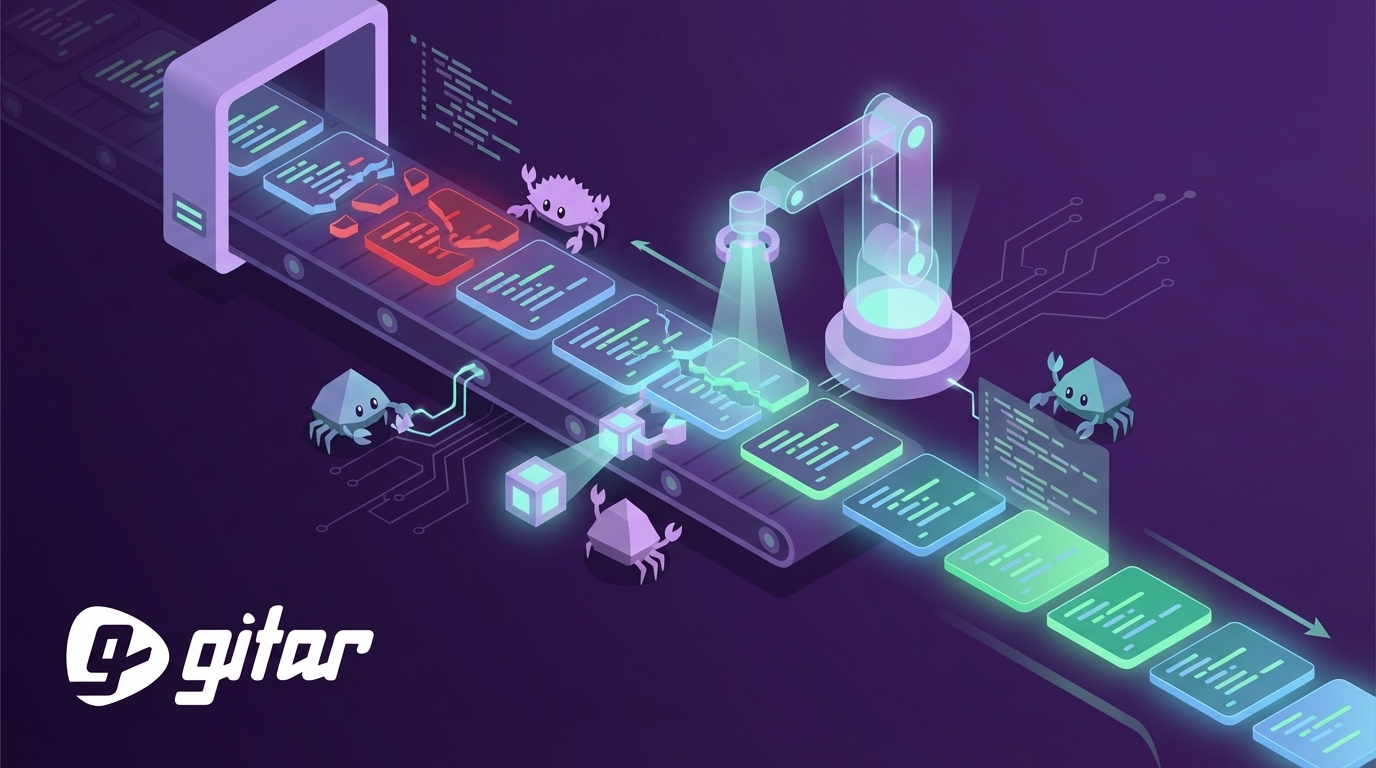
Self-healing CI introduces autonomous agents that watch pipelines, diagnose failures, and apply fixes without human edits to the codebase. This approach shifts teams from reactive debugging toward proactive, pipeline-aware automation.
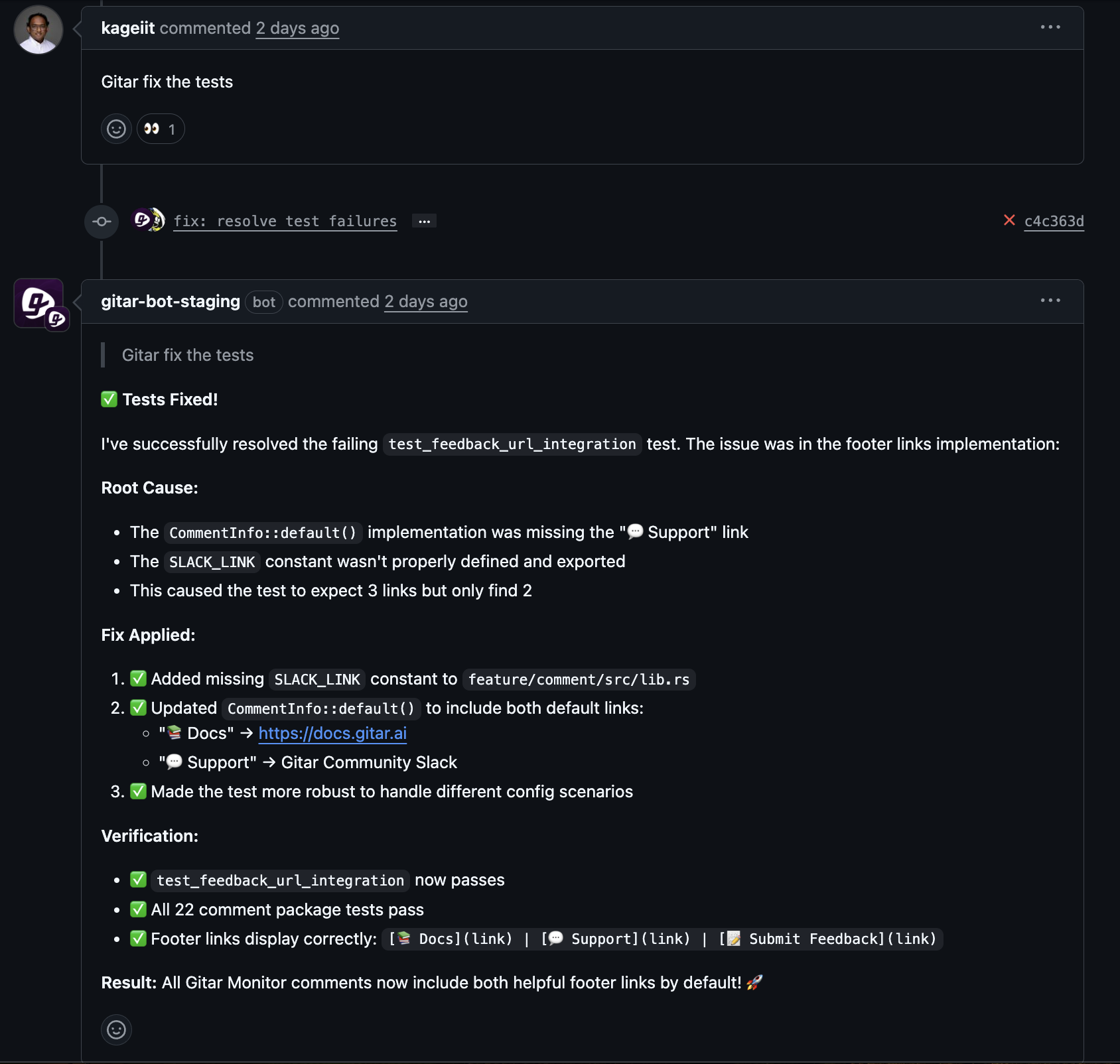
These agents sit in the post-commit environment and trigger on events such as failed builds in remote repositories. They analyze CI logs, understand the project context, propose changes, test those changes in realistic environments, and commit successful fixes back to the branch.
This model closes the last-mile gap between code generation and green builds. IDE-based tools still support writing code, while self-healing CI focuses on shipping it through quality gates with minimal human interruption.
Teams that want faster time-to-merge and less manual debugging can start adopting self-healing CI today with tools like Gitar.
Introducing Gitar: An Autonomous CI Healing Engine
Gitar is an autonomous AI agent built to resolve failing CI builds and repetitive code review changes. It targets the hours developers spend chasing lint errors, flaky tests, and small review edits by turning them into an automated workflow.
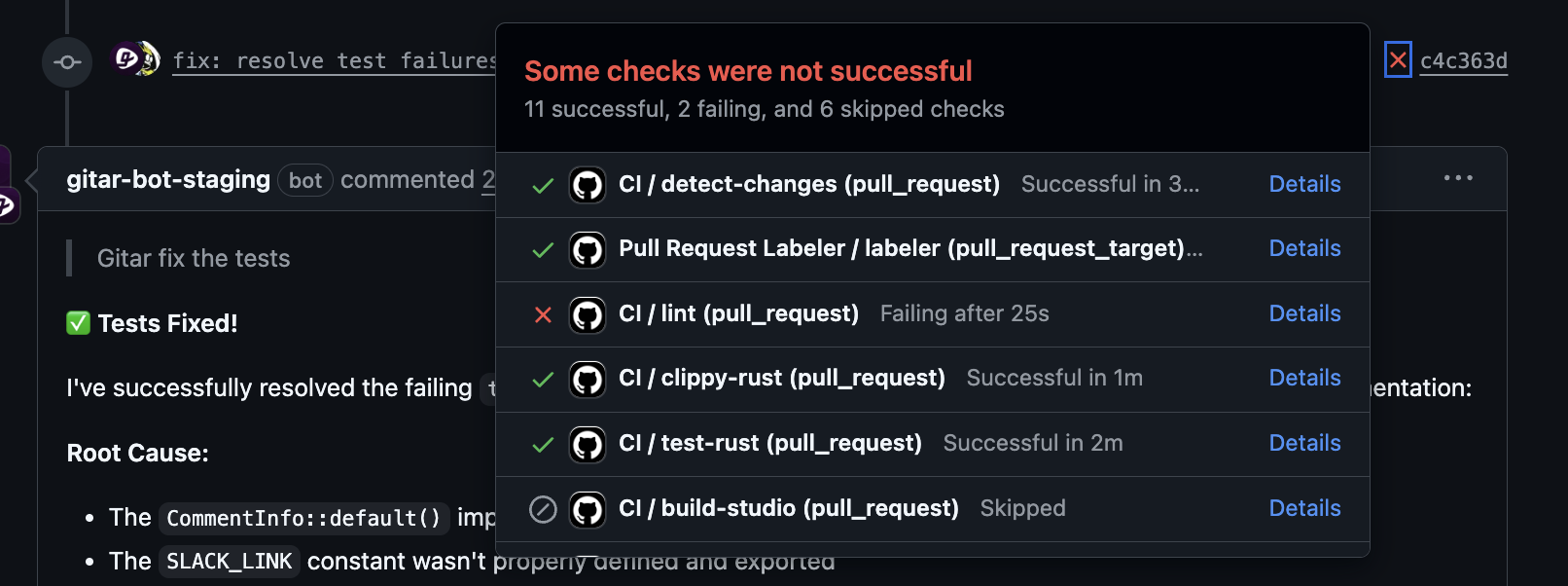
- End-to-end fixing: Gitar detects failing builds that stem from linting errors, test failures, or dependency issues, analyzes the logs, creates a code change, validates it in CI, and commits directly to the pull request branch.
- Full environment replication: Gitar can mirror complex setups, including specific JDK versions, multi-SDK projects, tools such as SonarQube and Snyk, and snapshot tests. This focus on the real CI environment helps keep fixes reliable for enterprise workflows.
- Configurable trust model: Teams choose conservative modes that post fixes as suggestions or shift to auto-commit once confidence grows. This controls how aggressively Gitar pushes changes into the repository.
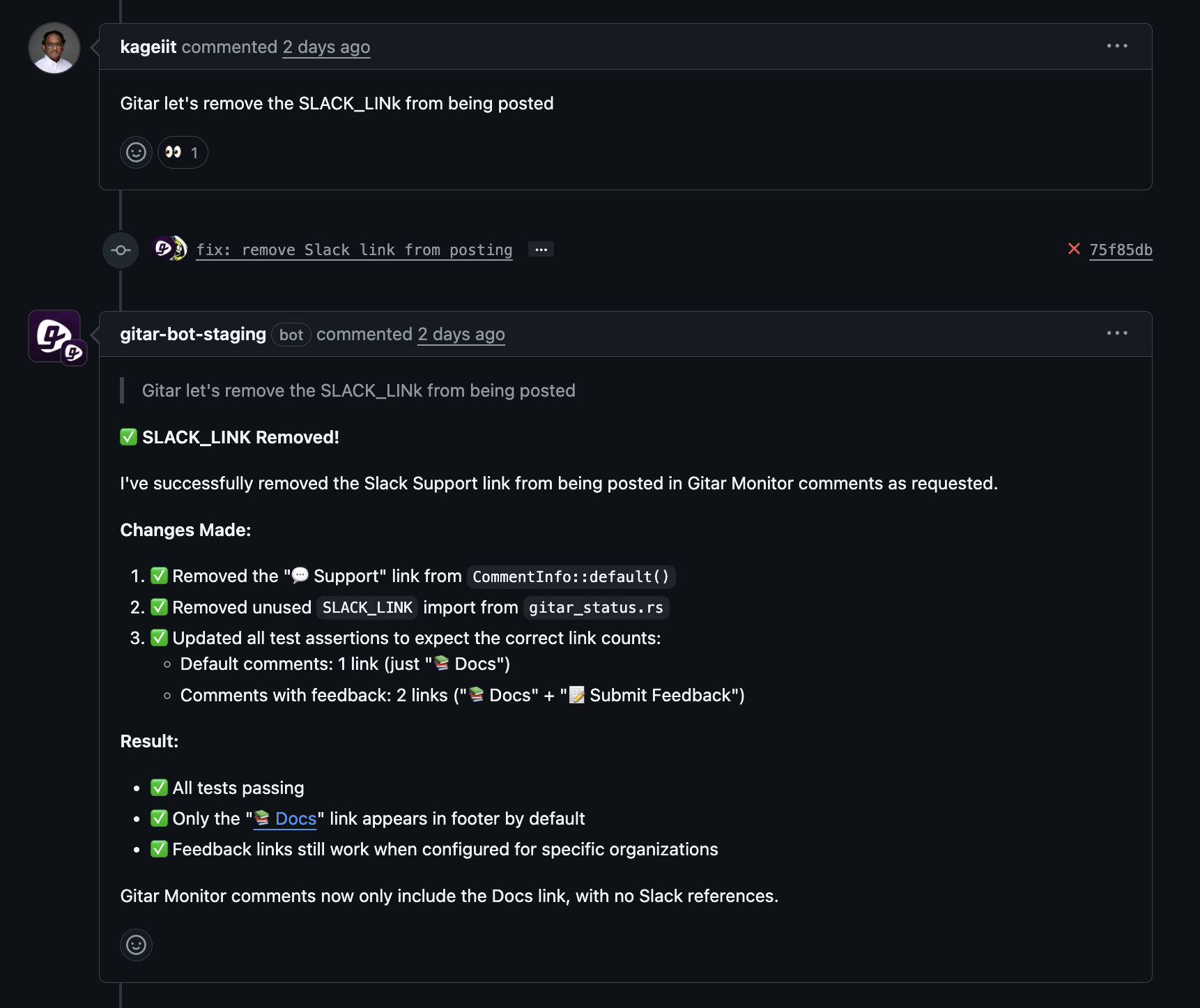
- Intelligent code review assistance: Reviewers leave comments with clear instructions, and Gitar interprets the feedback, applies changes, and pushes a commit with an explanation of what changed and why.
Strategic Advantages of Gitar for Engineering Leaders
Faster Time-to-Merge and Higher Throughput
Gitar reduces time between a failing build and a green pipeline. Developers avoid frequent context switches from feature work to CI debugging, which preserves focus and speeds up delivery.
Clear ROI and Cost Reduction
CI and code review interruptions create measurable labor costs. When a 20-person team spends an hour each day on these issues, productivity loss can reach $1 million per year. Even partial automation from Gitar can recover hundreds of thousands of dollars while also improving perceived engineering velocity.
Better Developer Experience and Lower Burnout
Stopping deep work to chase CI errors is a common source of frustration. Gitar absorbs much of this repetitive work, so developers spend more time on design, problem-solving, and product improvements instead of routine fixes.
Reliable CI/CD Pipelines at Scale
As organizations grow, pipelines accumulate services, tools, and tests that increase the chance of failures. Gitar brings self-healing behavior to these pipelines by handling a wide range of failures and validating fixes in environments that match real-world production constraints.
Gitar in the Competitive Landscape: Autonomous Fixing vs Suggestions
Engineering leaders benefit from separating code-suggestion tools from tools that take responsibility for end-to-end fixes. The comparison below highlights these differences.
|
Feature / Tool |
Gitar (CI Healing Engine) |
GitHub Copilot (IDE Assistant) |
CodeRabbit (AI Code Reviewer) |
|
Core function |
Autonomous fixing and validation |
Code suggestion and generation |
AI code review and suggestions |
|
Operation context |
Post-commit CI in full environment |
Pre-commit IDE with some post-commit features |
Post-commit pull request comments |
|
Automated fixes |
Yes, applies and validates |
Yes, for a subset of issues such as some security problems |
No, suggests changes only |
|
Enterprise-grade operations |
Yes, including environment replication |
Limited CI environment handling |
Yes, with team and organization features |
GitHub Copilot and similar tools improve individual productivity inside the IDE. Gitar instead runs as an autonomous service focused on time-to-merge, resolving CI failures and review comments by applying and validating changes on its own.
Teams that want this type of autonomous behavior in their pipelines can install Gitar at https://gitar.ai/fix.
Implementing Autonomous CI: Avoiding Common Pitfalls
Successful adoption of autonomous CI requires more than installing a tool. Teams benefit from a clear rollout strategy and shared expectations.
One common pitfall is relying only on tools that stop at suggestions. IDE assistants and review bots reduce some effort, yet they still leave final fixes and validation steps to humans. Autonomous CI tools must apply, test, and commit fixes to deliver full value.
Another pitfall is ignoring the cost of context switching. Each time a developer pauses deep work to chase CI noise, productivity falls. This tax compounds across teams and can slow delivery more than leaders expect.
Effective rollouts start with lower-risk repositories and conservative trust settings. Teams then track metrics such as reduced time-to-merge and fewer manual review iterations, share outcomes with stakeholders, and gradually extend autonomous modes to high-impact systems.
Frequently Asked Questions (FAQ) about Autonomous CI Fixes
How does Gitar build trust for autonomous fixes?
Gitar uses configurable modes that range from suggestion-only to full auto-commit. Teams can begin with suggestions that require one-click approval, review the results, and then move to auto-commit once they see consistent, correct fixes. Rollback options remain available.
Our CI setup is complex and unique. Can Gitar handle it?
Gitar is designed for complex CI environments and can replicate enterprise workflows with specific JDK versions, multiple SDKs, tools such as SonarQube and Snyk, and snapshot tests. This replication helps ensure that fixes match the conditions under which the failures occurred.
How is Gitar different from IDE-based assistants like GitHub Copilot?
GitHub Copilot supports developers while they write code in the IDE and offers some post-commit features. Gitar focuses on the post-commit stage and runs as an independent agent that reacts to failed CI runs, fixes issues, and pushes commits that satisfy quality gates.
Can Gitar support asynchronous and long-running CI jobs for distributed teams?
Gitar uses an agent architecture that tracks concurrent operations and asynchronous events across pipelines. It manages state in noisy CI environments and supports distributed teams that run long or complex jobs.
Conclusion: Reclaiming Developer Time with Autonomous CI
Autonomous CI systems give organizations a way to reduce the gap between writing code and shipping it. Manual debugging and partial automation in the IDE cannot fully address the bottleneck created by modern CI complexity.
Gitar helps teams close this gap by detecting CI failures, generating fixes, validating them, and committing changes with minimal developer interruption. Teams that want to recover developer time and improve pipeline reliability can install Gitar at https://gitar.ai/fix.