
Key Takeaways
- Growing use of AI-assisted coding in 2026 increases pull requests and CI load, which turns CI failures and manual debugging into major productivity drains.
- Self-healing CI/CD shifts GitHub workflows from reactive firefighting to proactive, automated fixes that reduce context switching and time-to-merge.
- Gitar acts as an autonomous agent that analyzes CI failures, applies validated fixes, and implements code review feedback while respecting team trust levels.
- Engineering, DevOps, and architecture leaders can use Gitar to cut CI costs, improve code quality, and free senior talent from repetitive maintenance work.
- Teams can start with suggestion-only automation, then scale to full auto-commit workflows by installing Gitar for GitHub repositories.
The Developer Productivity Crisis in Modern CI/CD
Manual CI intervention creates hidden productivity costs
Development teams now ship more code and more pull requests, yet CI remains a frequent blocker. A 20-developer team can lose roughly $1M per year in productive time when recurring CI failures, log reading, and patching consume even one hour per engineer per day.
Monolithic pipelines that run every test and scan on every commit create cascading failures and long feedback cycles. Developers start batching changes to avoid painful runs, which leads to larger pull requests that slow review, increase merge risk, and raise the chance of regressions.
Context switching slows teams and delays merges
The ideal flow of open pull requests, get review, and move forward rarely happens. Developers push code, start deep work on another task, then must drop everything when CI turns red or review comments arrive. A 30-minute fix often consumes an hour or more once context switching overhead is included.
Distributed teams feel this even more. A pull request opened in California that requires input from a teammate in Bangalore can stretch into multi-day cycles as feedback and fixes bounce across time zones.
Time-to-merge is the metric that matters
Teams with pipelines under 10 minutes deploy about twice as frequently as teams with slow pipelines. Short runtimes help, yet they are not enough. Reliability and fast recovery from failure now matter as much as raw speed.
Engineering leaders gain the most leverage by optimizing the full path from first commit to merged pull request. Intelligent automation that shortens this path delivers direct business impact.
Self-Healing CI/CD for Autonomous GitHub Workflows
Intelligent automation for GitHub workflows
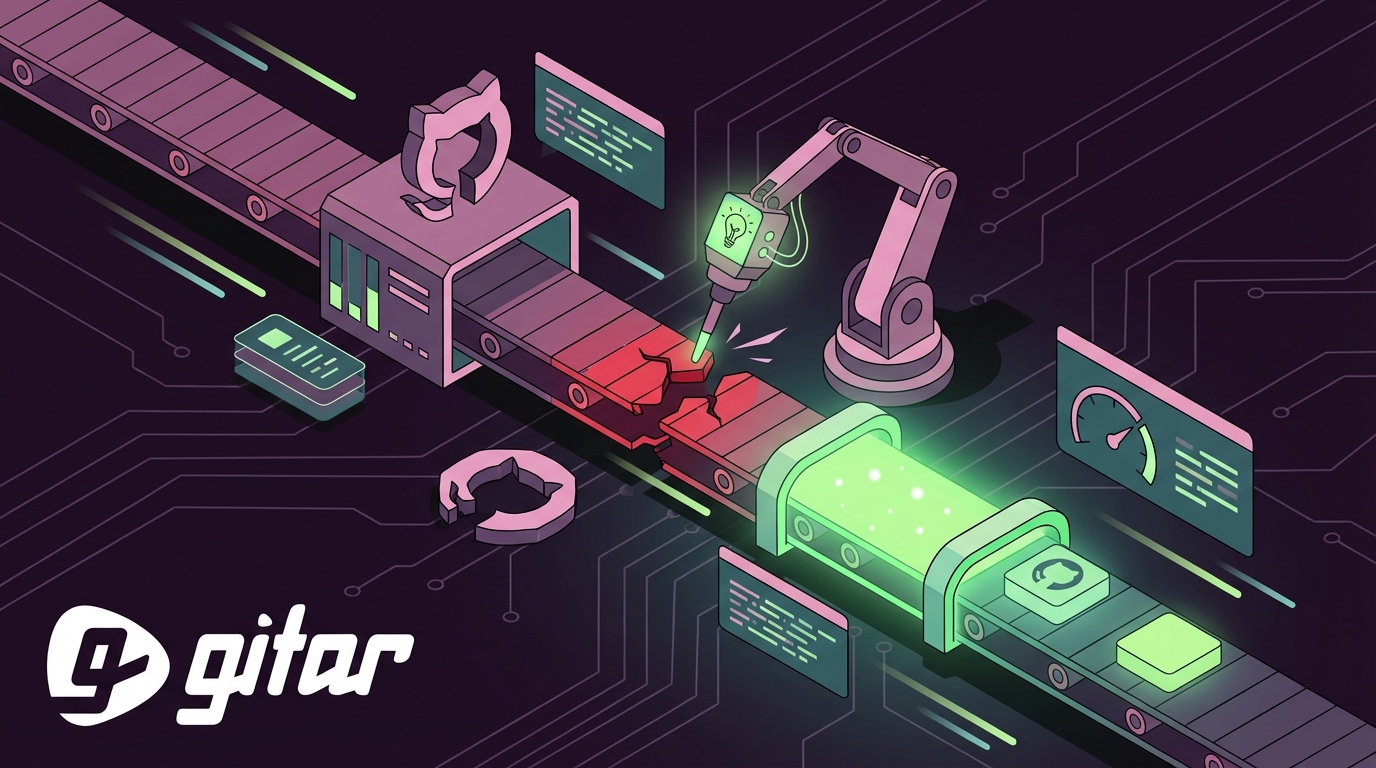
Intelligent automation turns CI/CD from a passive gate into an active participant in development. Instead of only reporting failures, a self-healing system inspects logs, identifies root causes, proposes fixes, validates them in the right environment, and applies changes automatically.
This approach changes CI from a blocker that demands attention into an assistant that protects code quality while reducing interruptions.
How Gitar autonomously fixes CI failures
Gitar runs as an autonomous AI agent connected to your GitHub repositories. When a CI check fails for reasons such as lint errors, test failures, or build issues, Gitar inspects logs, infers the cause, and prepares a code change that addresses the problem.
Gitar then commits that fix back to the pull request branch. The next CI run verifies the result, creating a self-healing loop that removes much of the manual toil from developers.
Trust-aware automation instead of suggestions only
Many AI review tools stop at recommendations that still require manual edits and re-runs. Gitar focuses on execution. Teams configure trust levels that range from suggestion-only to fully autonomous commits for specific failure types.
This model lets organizations adopt automation at their own pace while building confidence in the quality of generated fixes. Teams keep control and expand automation only when data supports it.
Impact on time-to-merge and developer focus
Automated CI fixes and applied review feedback shorten pull request lifecycles and remove a large share of low-value work. Developers dedicate more attention to design and problem-solving instead of scanning logs and fixing style violations.
Code reviews become more about architecture and business logic and less about formatting or minor nits, which improves both code quality and team morale.
Core Capabilities of Gitar for GitHub Automation
Autonomous CI resolution for common failure modes
Gitar can correct lint and formatting violations, analyze and repair failing tests, and address many build issues such as dependency conflicts or misconfigured scripts. Each fix is grounded in the actual CI logs and configuration.
Teams choose when Gitar proposes changes for human approval and when it may commit directly, aligning automation with risk tolerance.
Code review assistance that turns feedback into commits
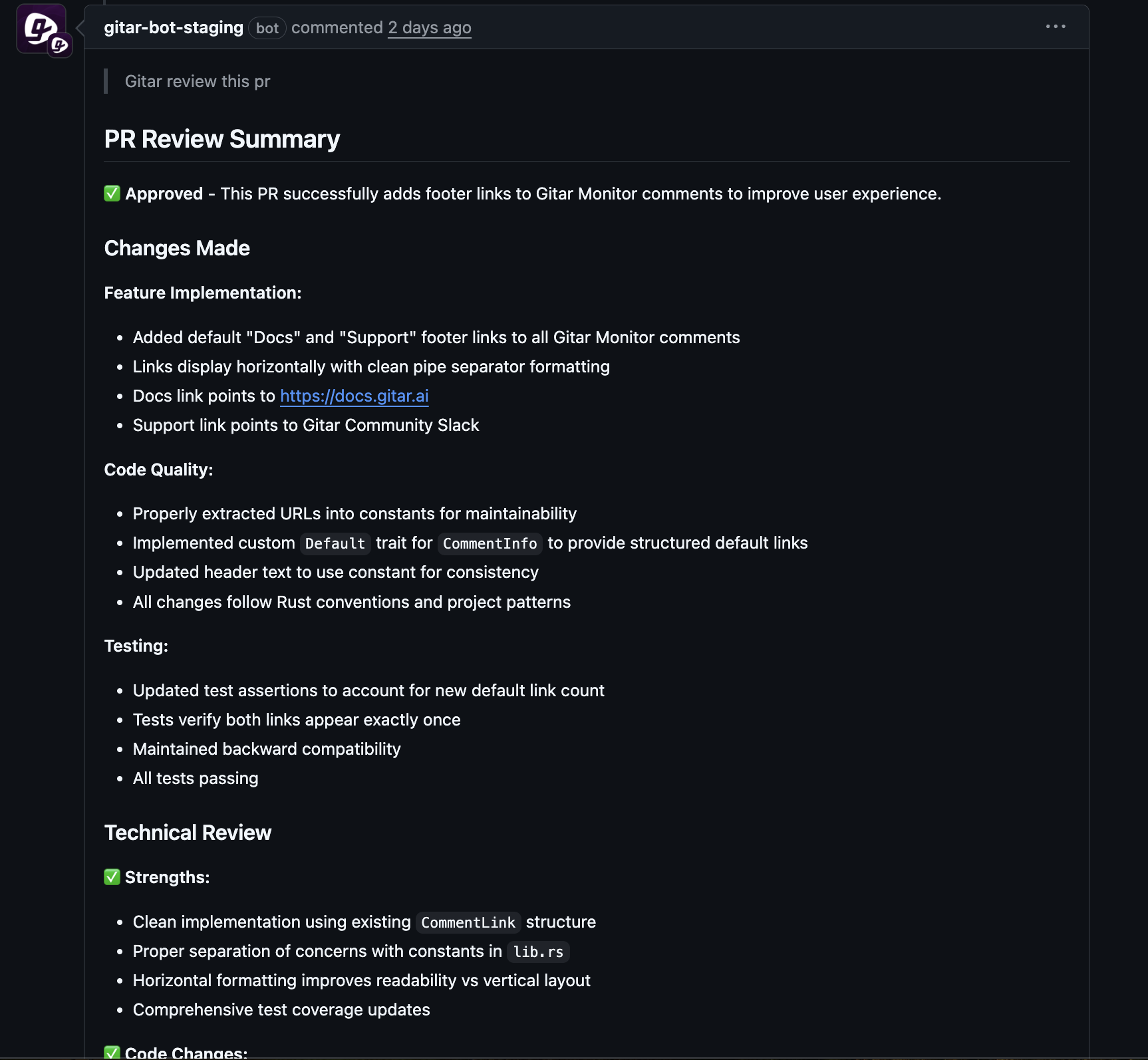
Reviewers can tag Gitar to perform a first-pass review that summarizes the pull request and surfaces likely issues. Review comments can also serve as instructions for Gitar to implement.
For example, a reviewer might write “remove this feature from this pull request,” and Gitar will adjust the code and push a commit with a clear explanation. Distributed teams gain special value from this pattern, since reviewers can leave actionable instructions that Gitar executes while authors are offline.

Environment-aware fixes across CI platforms
Enterprise pipelines combine multiple SDK versions, languages, and third-party scanners. Gitar mirrors the full CI environment so that generated fixes respect real dependencies and tools such as SonarQube and Snyk.
Support for GitHub Actions, GitLab CI, CircleCI, and BuildKite allows Gitar to operate consistently across mixed CI estates.
GitHub-native experience and simple operations
Gitar integrates as a GitHub App and surfaces activity directly in pull request comments. These comments show the current status and describe what Gitar changed, which keeps the workflow familiar for developers.
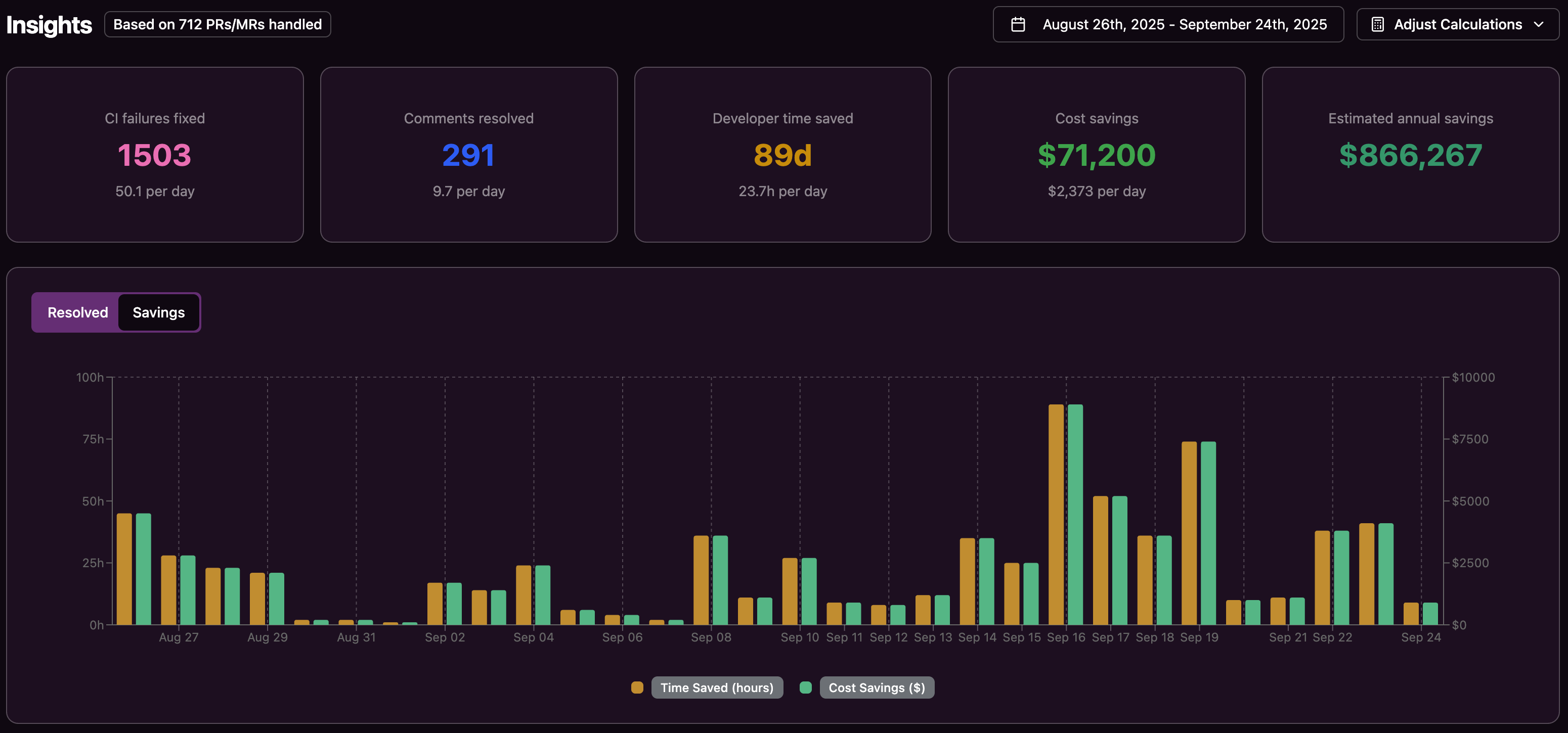
The web dashboard lets teams configure rules, adjust trust levels, and track impact on metrics like failures fixed and time saved.
How Gitar Supports Key Engineering Roles
Benefits for engineering managers and directors
Managers see fewer fire drills around broken builds and stalled reviews. Teams ship features faster, and standups shift from status on CI issues to planning and delivery discussions.
Reduced context switching and clearer expectations improve morale and make it easier to retain and grow talent.
Benefits for staff engineers and architects
Senior technical leaders gain an automated layer that enforces standards without requiring daily oversight. Gitar keeps pipelines healthy and code consistent, which protects reliability.
This frees staff engineers to focus on system design, cross-team decisions, and long-term technical direction.
Benefits for DevOps and platform teams
GitHub’s 2026 pricing changes added platform fees for self-hosted runners, which increased CI spend for many organizations. Gitar lowers the number of re-runs triggered by fixable issues, which reduces those costs.
Teams now pay close attention to CI/CD cost predictability. By preventing cascading failures and removing some manual interventions, Gitar improves both reliability and cost efficiency.
Healing Engines Compared to Suggestion Engines
Manual workflows lock teams into a debugging loop
Without automation, developers must interpret logs, make edits, push patches, and wait for another CI run. Even simple fixes turn into long feedback cycles, and CI knowledge often concentrates in a few specialists who become bottlenecks.
Gitar vs AI code reviewers
Tools like CodeRabbit provide inline comments and highlight potential problems. These insights help, yet developers still own the work of implementing and validating changes.
|
Feature |
Gitar |
AI code reviewers |
|
CI failure handling |
Analyzes logs and applies fixes |
Flags issues, leaves resolution to developers |
|
Code review feedback |
Implements reviewer instructions as commits |
Focuses on commentary |
|
Environment awareness |
Uses full CI configuration |
Often limited context |
|
Primary value |
Faster, more reliable merges |
Better insights during review |
Gitar alongside IDE-based coding assistants
Tools such as GitHub Copilot support developers as they write code and prepare pull requests. Gitar complements these assistants by owning the post-commit stages of validation and remediation.
This combination supports an end-to-end AI-assisted workflow from first draft through merge.
Implementing Gitar in Phases
Phase 1: Install and gather evidence
Teams start by installing the GitHub App on selected repositories and configuring conservative rules. Gitar begins monitoring CI runs and suggesting fixes that require human approval.
This phase produces quick wins and concrete examples that help teams judge accuracy and decide where automation is safe.
Phase 2: Expand automation with clear guardrails
After teams see Gitar autonomously repair issues such as lint errors or simple test failures, they often enable auto-commit for those categories. Higher risk changes still go through manual review.
Trust levels can differ by repository, branch, or failure type so that automation aligns with business and compliance requirements.
Phase 3: Use advanced workflows for distributed teams
Mature teams use Gitar as an execution partner during reviews. Senior engineers leave fine-grained instructions, and Gitar performs the edits and validation before the next workday begins in another time zone.
Pull requests progress while people sleep, which shortens lead time without adding meeting overhead.
Measuring ROI from Intelligent Automation
Quantifying the cost of inefficient CI/CD
For a 20-person engineering team, one hour per day lost to CI issues per developer can approach $1M per year in loaded cost. That estimate excludes delay-driven revenue impact and opportunity cost from features that arrive later than they could.
Extra pipeline runs, manual triage, and complex onboarding for new engineers further increase the total cost of ownership for CI/CD.
Productivity gains with Gitar
Organizations that use Gitar reclaim a portion of those hours by reducing repeated failures and manual fixes. Even modest reductions in time-to-merge compound into more releases, faster feedback, and better use of engineering expertise.
Start Modernizing Your GitHub Workflows with Gitar
Software teams in 2026 need CI/CD systems that not only detect problems but also fix them. Manual-only pipelines and suggestion-only AI leave too much friction in the path from commit to merge.
Gitar introduces self-healing behavior into existing GitHub workflows, helping engineering leaders improve delivery speed, code quality, and developer experience without forcing a full toolchain change.
Teams can begin with a single repository, measure the impact, and then expand to more projects as confidence grows. Install Gitar for your GitHub organization to start reducing CI toil and time-to-merge.
Frequently Asked Questions about Intelligent Automation for GitHub Workflows
How does Gitar handle complex enterprise CI setups?
Gitar mirrors your existing CI configuration, including language versions, multi-language builds, and tools such as SonarQube and Snyk. It supports GitHub Actions, GitLab CI, CircleCI, and BuildKite so that one agent can work across varied pipelines. Enterprise plans can run inside your infrastructure to meet strict security or compliance requirements.
Security and control for sensitive code and repositories
Gitar operates as a scoped GitHub App and accesses only the repositories and data required to analyze CI failures and apply fixes. Enterprises can choose on-premise deployment when data residency or regulatory rules require it. Trust-level settings ensure that sensitive areas can remain suggestion-only or require human approval for all changes.
Control over the level and pace of automation
Teams configure Gitar to match their comfort level. You can start with read-only analysis, move to suggested fixes, and then enable auto-commit for well-understood failure types. These controls apply per repository and can differ between production-critical code and lower-risk services.
Speed to value after installation
Most teams see benefits within the first day, since Gitar immediately starts inspecting failing runs and surfacing proposed fixes. As trust grows and automation expands, dashboards make it easy to track hours saved, failures resolved, and improvements in time-to-merge.