
Failing CI/CD pipelines often slow down engineering teams, draining time and focus. This article looks at how Gitar’s AI-driven agent integrates with your existing setup to handle pipeline issues automatically. You’ll see how it cuts down on context switching, speeds up merge times, and improves productivity, even in complex environments.
Why Manual CI/CD Fixes Hurt Teams and Businesses
CI/CD failures disrupt workflows and cost valuable time. When a pull request fails, developers must dig through logs, switch back to their local setup, apply fixes, and wait for another pipeline run. This repetitive cycle slows progress, delays releases, and impacts overall output for organizations of any size.
How Context Switching Drains Developer Focus
Submitting a pull request rarely means the job is done. Developers often move to the next task, only to be pulled back by CI failures or feedback. This constant shifting between tasks eats up mental energy, making it hard to stay focused and productive during the workday.
Beyond time loss, manual debugging feels tedious. It pulls developers away from meaningful work, causing frustration and lowering job satisfaction. When teams spend more time fixing routine issues than building features, morale and innovation suffer.
Maintaining a focused state, where developers do their best work, becomes nearly impossible with frequent interruptions from failing pipelines. The effort to regain context after each break adds up, slowing down entire development cycles.
How Pipeline Delays Impact Business Goals
The cost of manual CI/CD fixes goes beyond wasted developer hours. For a team of 20 developers spending just one hour daily on pipeline issues, annual productivity losses can reach around $1 million when accounting for full costs. Larger teams or more frequent issues amplify this expense.
Slowed releases create bigger problems. When features take longer to ship, companies miss market windows, lose ground to competitors, and disappoint customers. These delays often lead to reduced satisfaction and missed revenue goals.
Enterprise teams face added challenges. Managing multiple repositories, varied tech stacks, and complex dependencies increases the frequency and difficulty of CI failures. Unclear ownership and scattered debugging efforts further drive up costs.
Why Standard Tools Struggle with CI Challenges
Today’s CI/CD systems are intricate, often outpacing traditional debugging methods. Issues like misconfigured setups, dependency clashes, and mismatched environments between development and production frequently cause failures.
Basic tools that suggest fixes often miss the mark in complex setups. Without full context of your environment, a recommended solution might not work when applied to specific builds or dependency versions.
AI coding tools, while speeding up code creation, add to CI/CD strain. More pull requests and tests mean more failure points. The real challenge has shifted from writing code to validating and integrating it, making automation essential.
Install Gitar now to automatically fix broken builds and ship better software faster.
How Gitar’s AI Creates Self-Fixing CI/CD Pipelines
Gitar brings a new approach to CI/CD by using AI to detect, diagnose, and resolve pipeline issues on its own. Instead of relying on manual fixes, it builds a system that keeps builds passing without pulling developers away from their work.
What Gitar Offers for Automated Pipeline Fixes
Gitar acts as an AI agent that fits into your current CI/CD tools, spotting failures, creating fixes, and applying them to pull requests automatically. Unlike tools that only suggest solutions, Gitar handles the entire process, ensuring issues are resolved without extra effort.
It works by enhancing your existing setup, not replacing it. There’s no need to switch platforms or change how your team operates. Gitar simply adds a layer of automation to make pipelines more dependable.

Key features that support your workflow include:
- Complete Fix Process: Gitar doesn’t just suggest changes. It applies fixes for issues like linting errors, commits them, and confirms the pipeline passes.
- Environment Matching: It mirrors your exact CI setup, including SDK versions and tools like SonarQube, so fixes fit your specific context.
- Platform Compatibility: Gitar works with GitHub Actions, GitLab CI, CircleCI, and more, letting you keep your preferred tools.
- Adjustable Automation: Start with a cautious mode where Gitar suggests fixes for approval, then move to full auto-commit as you see results.
How Gitar Improves Your CI/CD Experience
Gitar changes how teams deal with pipeline issues by cutting down on manual tasks. This lets developers focus on building features and solving problems, rather than getting stuck on repetitive fixes.
Keeping Developers Focused by Reducing Interruptions
Switching between tasks kills productivity. Gitar steps in when CI checks fail, fixing issues automatically so developers aren’t pulled away from their current work. This helps maintain focus and keeps projects moving forward.
With Gitar, developers can submit pull requests and keep working, without worrying about pipeline status. Often, they return to find a passing build with clear notes on any changes made, skipping the usual cycle of failure and rework.
By handling routine tasks, Gitar reduces frustration, letting developers spend more time on creative and impactful work.
Speeding Up Merges for Distributed Teams
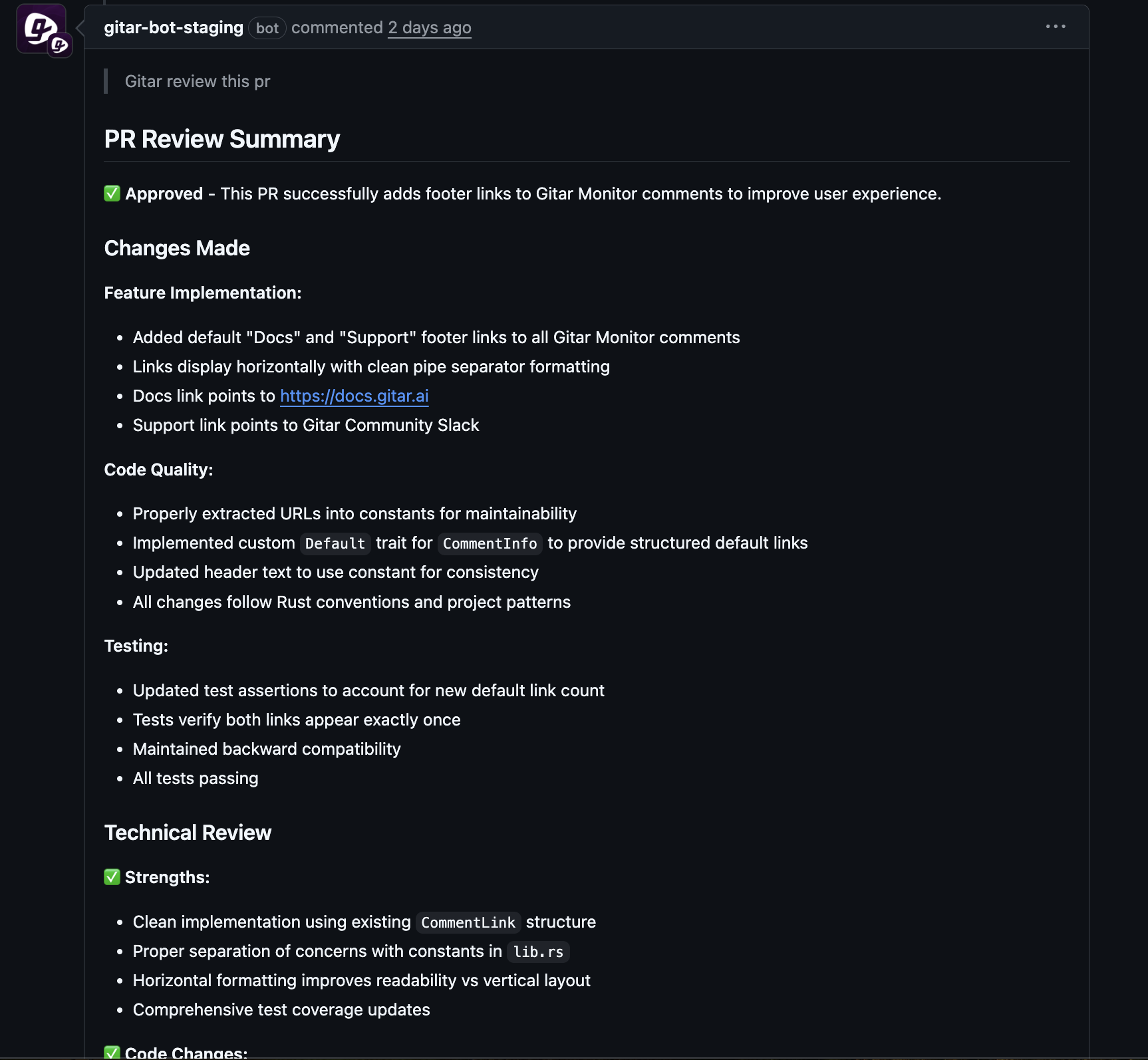
Teams spread across time zones often face delays in fixing and reviewing code. Gitar cuts these delays by handling routine fixes and updates instantly, keeping feedback loops short and merges on track.
For distributed teams, a reviewer in one location can request changes, and Gitar can apply them before the developer in another time zone starts their day. This approach eliminates wait times for simple updates.
Through automated fixes, Gitar keeps developers focused and speeds up code review cycles, helping teams maintain pace no matter where they’re located.
Boosting Pipeline Reliability While Cutting Costs
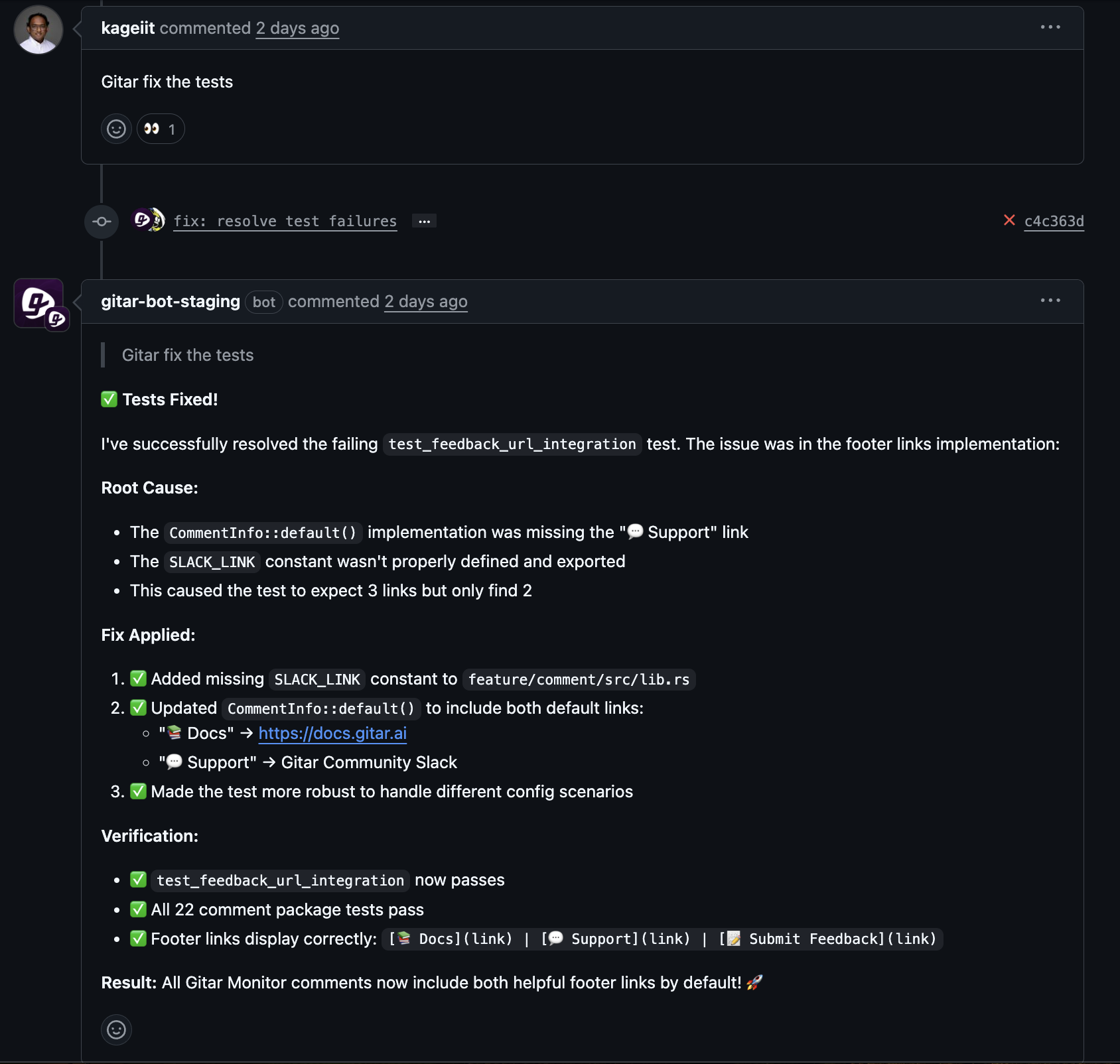
Reliable pipelines save time and reduce expenses. Gitar keeps builds passing by addressing failures early, cutting down on costly re-runs and manual debugging efforts that add up over time.
Saving developer time also lowers operational costs. When builds don’t block multiple team members, the savings grow with team size and project scope, offering measurable value.
Reliable pipelines build confidence. When developers know issues will be fixed automatically, they commit more often and maintain higher code standards, improving overall quality.
Why Gitar Stands Out from Suggestion-Based Tools
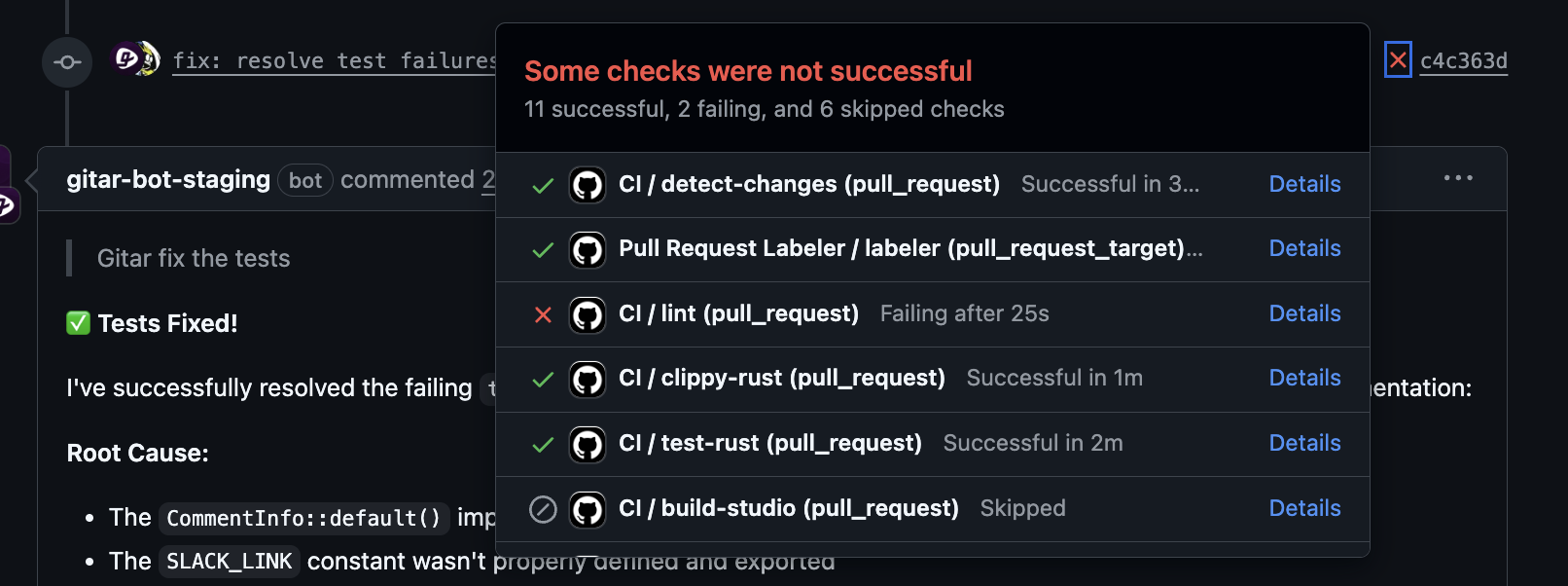
Many tools offer suggestions for CI issues but leave the actual fixing to developers. While helpful for spotting problems, they don’t solve the time-consuming step of applying and testing solutions.
Gitar goes further by automating the entire fix process. This matters most in complex setups where solutions must match specific dependencies and configurations to work correctly.
Comparison of Approaches to CI Fixes:
|
Feature |
Traditional CI Fixes |
AI Suggestions |
Gitar Automation |
|
Main Action |
Manual diagnosis |
Offers suggestions |
Fixes and validates |
|
Integration |
Developer’s setup |
Git hooks |
Full CI/CD stack |
|
Validation |
Manual re-runs |
User checks |
Automated re-runs |
|
Context Switching |
High |
Moderate |
Minimal |
This automated approach closes the gap between finding an issue and applying a working fix, saving significant effort in challenging environments.
Install Gitar now to fix broken builds automatically and ship better software faster.
Common Questions About Gitar for CI/CD Automation
How Does Gitar Fit Into My Current CI/CD Setup?
Gitar connects as a GitHub App or similar integration, working with your existing tools without changing your workflow. After setup, it monitors repositories and pipelines, stepping in to fix issues as they arise.
When a pipeline fails, Gitar reviews logs, creates fixes, and applies them using standard Git operations that match your current processes. Your team continues using familiar platforms while Gitar adds automation in the background.
Can Gitar Handle Complex Enterprise Pipelines?
Gitar is built for enterprise challenges, matching your full CI environment. It accounts for specific SDK versions, tools like SonarQube, and custom setups, ensuring fixes work in your context.
Its ability to emulate your exact environment means solutions are tested and validated against your actual pipeline, addressing unique failure patterns common in large organizations.
Can I Adjust How Much Gitar Automates?
Gitar offers settings to control its level of intervention. Teams can start with a cautious mode where it suggests fixes for approval, building trust over time.
For full automation, switch to a mode where Gitar commits fixes directly. Even then, it provides clear commit messages explaining changes, with options to revert if needed. You can tailor settings based on fix types or team preferences.
How Does Gitar Address Security and Compliance?
Gitar meets enterprise security needs by operating within strict permissions, accessing code only as needed and writing to specific branches via Git controls. All changes are tracked in commit history for audits.
For organizations with unique needs, Gitar offers deployment options within your infrastructure, maintaining automation while respecting security boundaries.
What If Gitar’s Fix Causes a New Issue?
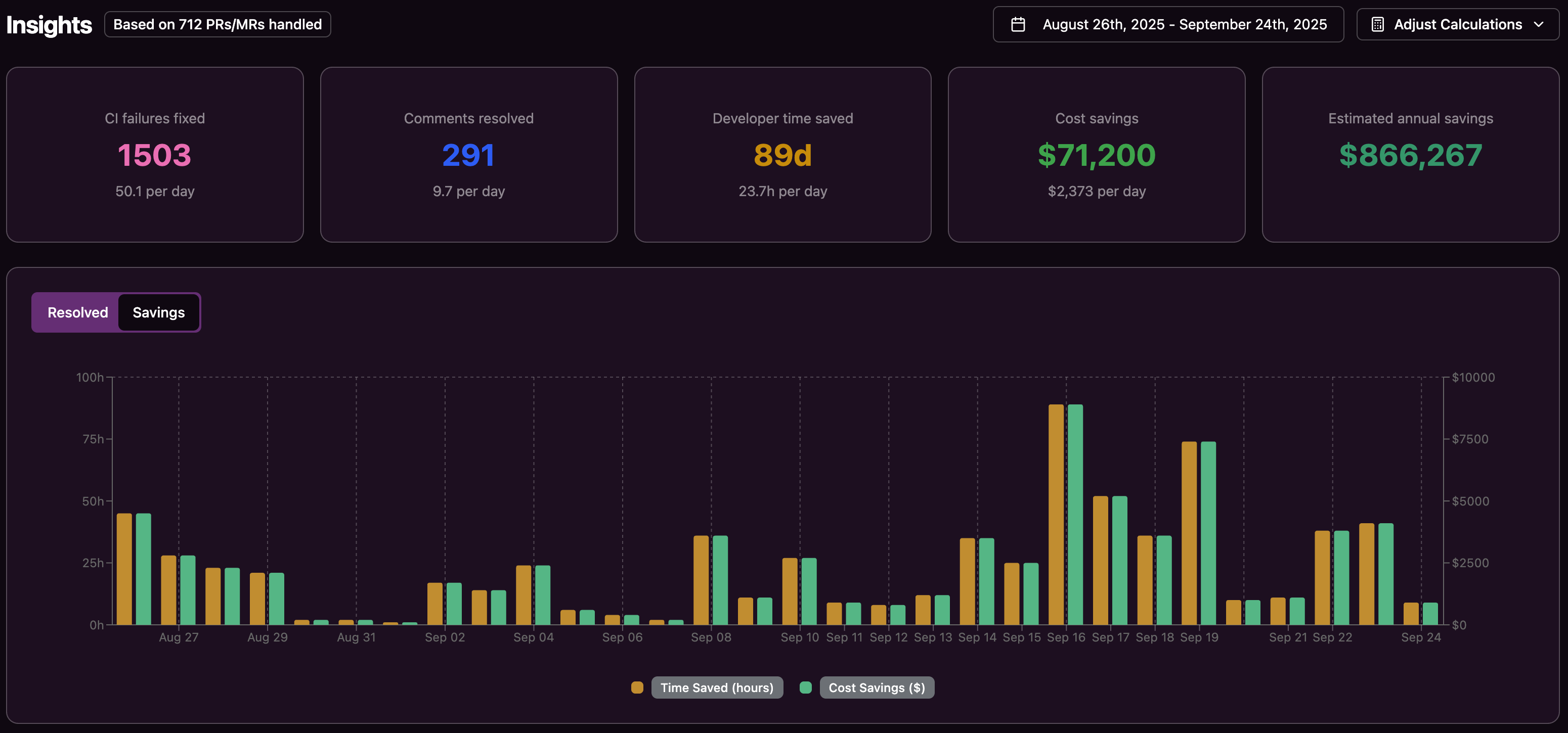
Gitar validates fixes against your full pipeline before marking them successful, reducing the chance of new problems. If an issue arises, it can retry or flag for manual review.
Since fixes are standard Git commits, rollbacks are straightforward. Detailed logs of actions also help pinpoint and avoid similar issues in the future.
Why Choose Gitar for Automated CI/CD Fixes
Modern software development moves fast, and manual pipeline fixes can’t keep up with growing complexity. Gitar shifts the burden from developers to an automated system that resolves issues without breaking focus.
For a team of 20 developers, CI interruptions can cost around $1 million yearly. Redirecting that time to innovation offers real value. Gitar saves effort, boosts satisfaction, and gets features to market quicker.
Adopting automated CI fixes now prepares teams for a future where speed and reliability define success. Start building a pipeline that fixes itself and keeps your focus on what matters.