
Key Takeaways
- Integration testing ROI in 2026 must connect directly to time savings, quality improvements, and business outcomes that executives recognize.
- Clear baselines and before-and-after metrics for CI failures, test time, and release speed create credible ROI stories for leadership.
- Well-defined cost and benefit models help teams compare manual work, traditional automation, and AI-driven approaches on equal financial terms.
- Autonomous tools like Gitar that fix CI failures, not just flag them, can unlock large productivity gains and reduce delivery risk.
- Teams can improve integration testing ROI and reduce broken builds by installing Gitar for autonomous CI fixes and code review help: Install Gitar.
Why Integration Testing ROI Needs a 2026 Perspective
Modern engineering teams ship more code than ever, which increases pull requests, test runs, and CI failures. Integration testing now plays a central role in controlling this complexity, not just catching bugs.
Poor integration testing and slow CI remediation create visible business costs. Developers lose hours each week debugging cryptic logs, projects stall when broken builds block merges, and burnout grows when engineers spend time on toil instead of product work.
For a 20‑developer team that spends one hour per person per workday on CI failures and code review issues, the annual loss reaches roughly 5,000 hours, or about $1 million at a $200 blended hourly rate. Teams that track time, defect, and release metrics alongside new tooling can show cause-and-effect between testing investments and financial outcomes.
Executives expect structured ROI cases that resemble broader enterprise investments. Effective ROI models balance cost reduction with revenue or throughput gains to build compelling business cases.
A Simple Framework for Integration Testing ROI
Integration testing ROI builds on a straightforward formula: ROI equals savings from automation minus the cost of automation, divided by that cost, expressed as a percentage.
Practical ROI models for integration testing typically separate costs and benefits into clear categories.
Key cost components include:
- Tool licenses and subscriptions
- CI infrastructure and test environments
- Team training and onboarding
- Integration with existing CI/CD workflows
- Ongoing maintenance, test creation, and flaky test triage
Well-structured ROI models for test automation explicitly include tools, infrastructure, and training costs.
Key benefit components include:
- Reduced manual testing and debugging time
- Faster defect detection during integration
- Fewer bugs in production and lower fix costs
- Higher release frequency and more predictable cadence
- Improved developer productivity and lower context switching
Direct savings often come from less manual work, fewer human errors, and earlier bug discovery.
Metrics That Connect Integration Testing to Business Value
Well-chosen metrics help executives see how integration testing influences delivery and cost.
Key efficiency metrics:
- Average time spent per CI failure or broken build
- Time per test cycle before and after automation
- Average time-to-merge for pull requests
- Developer hours per week spent on test failures and code review rework
Release frequency and cycle time serve as core KPIs for automated testing impact.
Key quality metrics:
- Defect detection rate during integration testing
- Defect escape rate into staging and production
- Mean Time To Resolution (MTTR) for production issues
- Customer-facing indicators such as production bug volume
Fewer production bugs and better user outcomes directly support testing ROI arguments.
Key business impact metrics:
- Operational cost reduction from fewer CI incidents
- Time-to-market for revenue-generating features
- Developer satisfaction and retention trends
Coverage, time saved per cycle, and defect trends together give a rounded view of testing value.
Establish Baselines and Measure Change
Reliable ROI stories start with baselines before new tools roll out. Teams that measure manual execution time, failure rates, and maintenance effort before automation can quantify later improvements.
Track for several weeks:
- Average CI failures per pull request
- Time spent investigating and fixing failures
- Defects found during integration vs. in production
- Time-to-merge and release frequency
After introducing new automation or AI, capture the same metrics and compare. This before-and-after view gives executives clear deltas in hours, dollars, and release speed.
How Gitar Improves Integration Testing ROI
Gitar operates as an autonomous CI healing engine. Instead of only pointing out failures, it applies and validates fixes inside your CI workflow, which removes a large share of repetitive developer work.
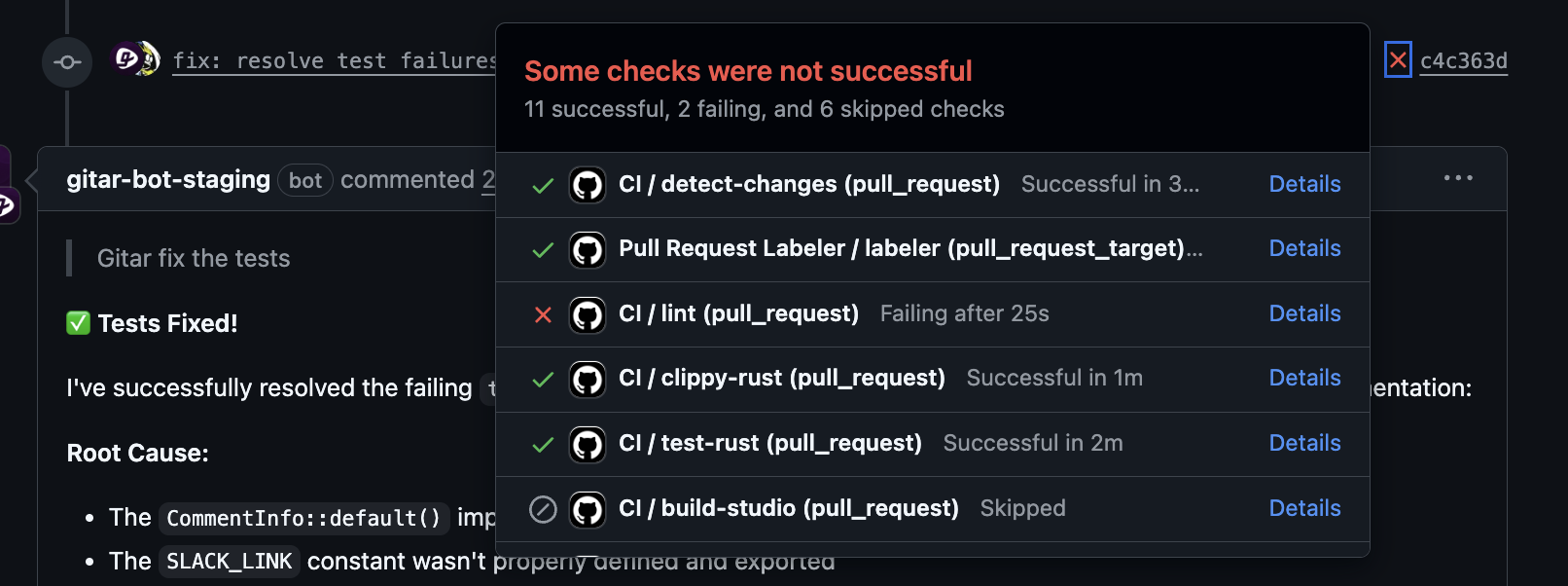
Direct, quantifiable benefits include:
- Automatic fixes for many CI failures without developer intervention
- Faster time-to-merge for blocked pull requests
- Lower operational costs from fewer manual debug cycles
Reducing the number and cost of late-stage defects contributes significantly to testing ROI.
Additional, often undercounted benefits include:
- Fewer context switches, which protects developer focus and morale
- Better throughput for distributed teams that work across time zones
- More time for feature work instead of CI firefighting
Install Gitar to start replacing manual CI fixes with autonomous healing.
Gitar vs. Manual Fixes and Suggestion-Only AI
|
Feature |
Gitar (Autonomous CI Healing) |
Traditional Manual Fixes |
AI Suggestion Engines |
|
Issue resolution |
Applies and validates fixes so builds pass CI |
Engineers diagnose, code, commit, and re-run CI |
Suggests changes that developers still implement and validate |
|
Developer interruption |
Low, fixes run in the background |
High, frequent context switching during feature work |
Moderate, manual edits still required |
|
Validation |
Runs in a replicated CI environment |
Relies on manual reruns and log inspection |
Depends on how carefully developers apply suggestions |
|
Time-to-merge impact |
Clears many blockers autonomously |
Slows merges while engineers debug and retry |
Often still slowed by manual iterations |
Calculating Integration Testing ROI with Gitar
Step 1: Capture Your Current Costs and Time
First, document how much effort integration testing and CI failures currently consume. Track:
- Developer hours per week on CI failures and code review changes
- Average CI failures per pull request
- Average time-to-merge
- Loaded hourly cost for engineers, including salary, benefits, and overhead
Clear, shared assumptions on hourly costs and expected test runs help non-technical stakeholders review ROI models.
Step 2: Estimate Gitar’s Savings
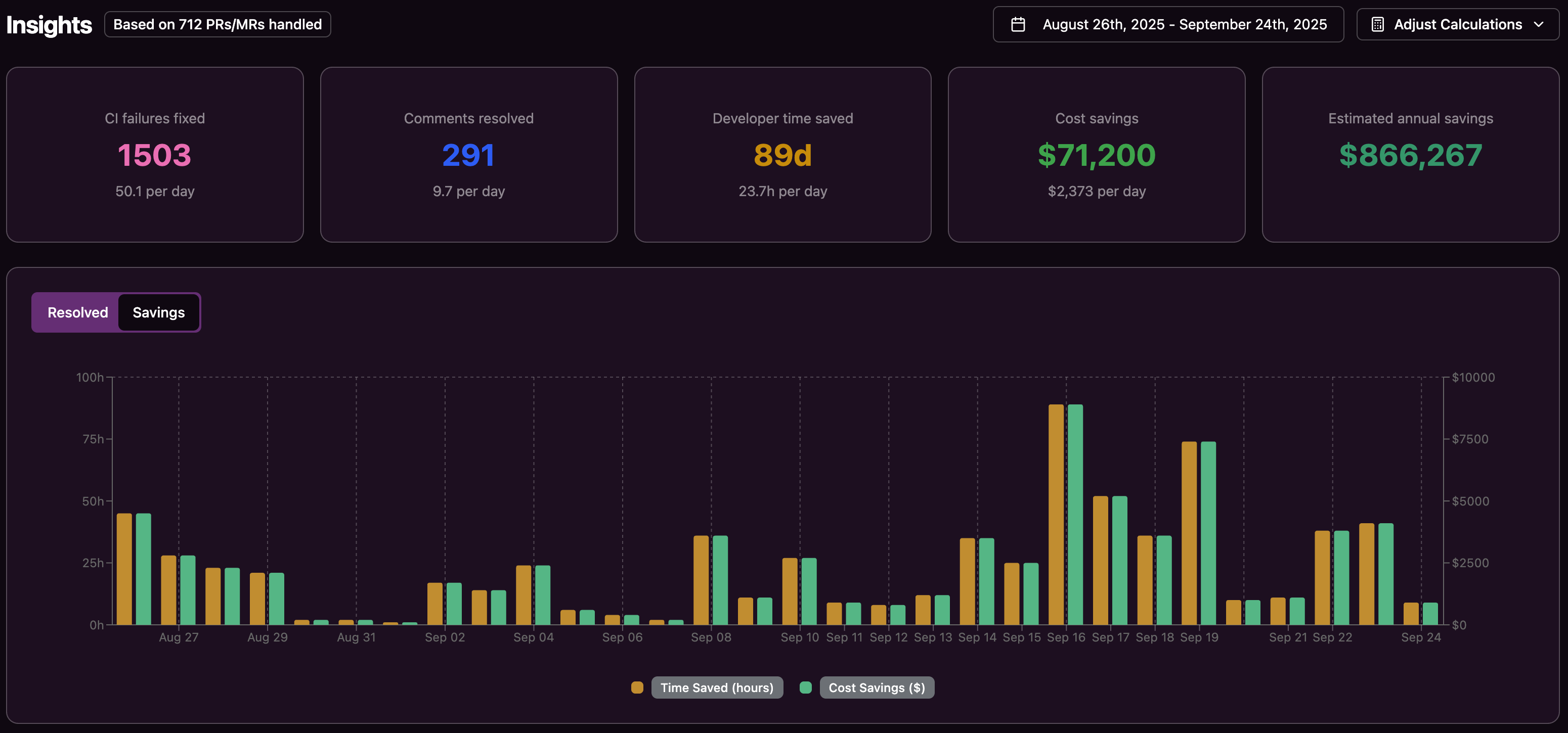
Assume the 20‑developer team mentioned earlier loses 5,000 hours per year to CI and review churn, worth $1 million at $200 per hour. If Gitar cuts this wasted time by 50 percent, direct productivity savings reach $500,000 per year. Additional value comes from faster releases and higher developer satisfaction, which can appear in retention and delivery metrics.
Step 3: Include Implementation and Recurring Costs
Next, outline Gitar-related costs:
- Annual subscription fees
- One-time setup and CI integration effort
- Any incremental infrastructure spend, if needed
AI testing initiatives typically include tool acquisition, setup, integration work, and training in their cost models.
Gitar reduces many ongoing maintenance costs by operating autonomously, which contrasts with DIY AI systems that demand continuous tuning. Teams that underestimate test maintenance often produce overly optimistic ROI projections.
Step 4: Apply the ROI Formula
Consider a simple example. If annual savings from Gitar equal $500,000 and total annual cost equals $50,000, then:
ROI = ($500,000 − $50,000) ÷ $50,000 × 100 = 900 percent annual ROI.
Modeling payback period and multi-year benefits helps align AI investments with broader portfolio planning.
Teams can keep refining these numbers as real post-Gitar data accumulates, updating business cases for expanding usage.
Strategic Implementation and Trust in Automated CI Fixes
Successful rollouts involve platform teams, DevOps, and engineering managers who coordinate policy, security, and developer workflows. Many organizations pilot Gitar on a subset of services before expanding to critical systems.
Build vs. Buy for AI-Driven Testing
Internal AI solutions require significant work for context management, environment replication, and safe validation. Large one-time integration efforts for AI in CI/CD pipelines belong in ROI and total cost of ownership models.
A purchased platform like Gitar concentrates this engineering investment into a product, which lets internal teams focus more on core features than CI plumbing.
Managing Trust and Adoption
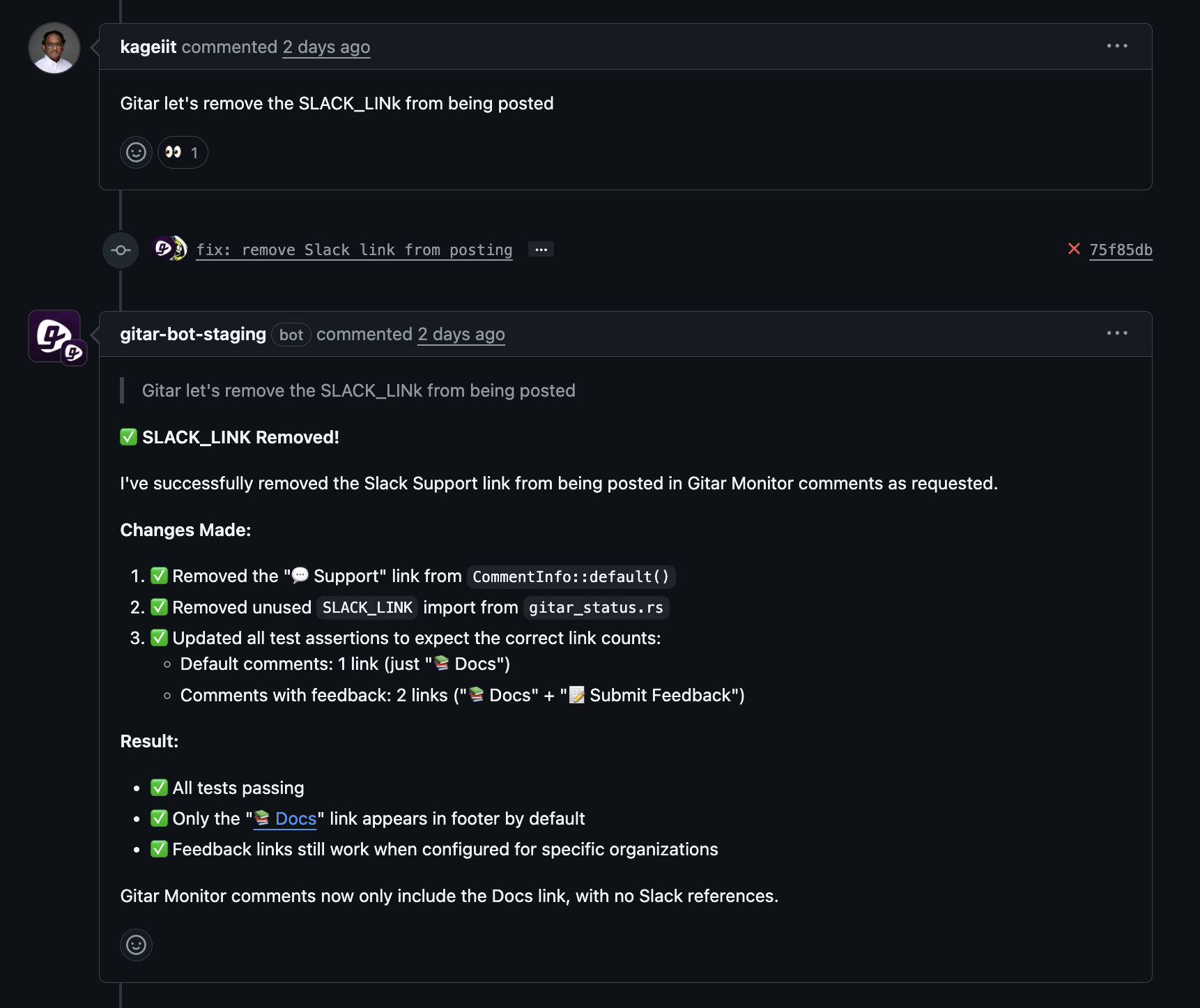
Gitar offers configurable modes that let teams start with suggestion-style behavior, then progress to auto-commit once results prove reliable. This path gives reviewers full visibility into suggested fixes before granting more autonomy.
Avoid Common ROI Pitfalls
Experienced teams often fall into two traps: skipping baseline measurements and ignoring maintenance costs. Using historical defect and test-run data helps translate improvements into dollar savings.
Clear communication about how Gitar complements, rather than replaces, human reviewers also smooths change management.
Frequently Asked Questions
We already use AI reviewers. How is Gitar different for ROI?
Most AI reviewers suggest changes that developers still need to apply and validate. Gitar focuses on autonomous fixing and validation inside your CI pipeline, which reduces hands-on debug time and accelerates merges.
What hidden costs should I consider when evaluating AI testing tools?
Hidden costs usually include custom integration, prompt engineering, and ongoing maintenance. Gitar limits these by providing built-in context management and full-environment replication, which reduces bespoke engineering work after rollout.
How does ROI scale as our team and CI complexity grow?
As teams and repositories grow, the number of CI failures and review cycles usually climbs. Gitar’s ROI tends to increase with this scale, since each autonomous fix replaces a larger pool of manual effort.
Conclusion: Turn Integration Testing into a Clear ROI Story
In 2026, integration testing sits at the center of software delivery speed, reliability, and developer experience. When teams track baselines, choose clear metrics, and model both costs and benefits, integration testing shifts from a perceived expense to a measurable driver of business value.
Gitar strengthens this story by converting CI failures and review churn into automated workflows, which frees engineers to focus on shipping product improvements instead of repairing pipelines.
Teams that want faster, more predictable delivery and a clear ROI narrative can start by introducing autonomous CI healing where it matters most. Install Gitar to begin automatically fixing broken builds and improving integration testing ROI.