
CI/CD promises fast, dependable deployments, but frequent failures and manual feedback loops often create delays. These issues disrupt focus, slow down merges, and reduce productivity. This article explains how Gitar, an autonomous AI platform, works with your current CI/CD tools to fix problems automatically, creating a smoother development process and helping your team work more efficiently.
Why CI/CD Bottlenecks Hurt Your Team
The Real Cost of Fixing CI/CD Issues Manually
Most developers know the frustration of submitting a pull request, only to face a failed build. A missing dependency, an unstable test, or a minor formatting error can send you into a loop of reading logs, switching tasks, making small changes, and waiting for the pipeline to rerun.
This process wastes time and energy. Unreliable CI/CD pipelines delay builds, disrupt feedback, and require constant manual effort. Developers can spend up to 30% of their day addressing CI issues or review comments, breaking their focus and adding stress.
These interruptions don’t just slow you down; they break your concentration. After submitting a PR, you might start another task, only to be pulled back by a failure or feedback. This constant back-and-forth kills productivity and deep focus.
The financial impact hits hard. For a team of 20 developers, inefficiencies can cost up to $1 million each year in delayed releases and extra overhead. Manual fixes and slow feedback also lower team morale and increase burnout risks.
DevOps and platform engineers face extra challenges with growing pipeline complexity. Common problems like monolithic builds, hardcoded secrets, or excessive testing create delays in CI/CD workflows. Tools that speed up coding can also increase PRs, tests, and potential failures, adding to the bottleneck.
Ready to stop these delays? Install Gitar to fix broken builds automatically and deliver better software faster.
How Gitar Solves CI/CD Pain Points
Gitar tackles the biggest hurdles in development: failing CI builds and repetitive code review cycles. When a pull or merge request gets a comment or fails a CI check, Gitar’s AI agent steps in. It reviews the issue, creates a fix, and updates the request directly.
This builds a self-correcting CI process. Instead of spending hours on manual fixes and losing focus, developers experience an automated solution that keeps their workflow uninterrupted. Gitar helps teams save time and merge code faster.

Here’s what Gitar offers as a solution:
- Complete fix automation: Applies and tests fixes through full CI workflows to ensure builds pass.
- Accurate environment setup: Mirrors complex setups with multiple SDKs or tools like SonarQube and Snyk for reliable fixes.
- Feedback implementation: Lets reviewers direct Gitar to make changes, cutting out manual steps.
- Wide platform support: Connects with GitHub Actions, GitLab CI, CircleCI, BuildKite, and more.
- Customizable automation: Adjusts from suggested fixes to automatic commits based on your comfort level.
Easy Integration with Your CI/CD Tools
Gitar works as a GitHub or GitLab app, tracking PRs and connecting to your CI pipelines to spot and fix issues without changing your setup. Integration is simple and direct.
When you open a PR or MR, Gitar posts a comment to confirm it’s ready to assist. It keeps this comment updated as it resolves issues. You can request help by adding comments starting with “Gitar,” like asking it to review code or make specific updates.
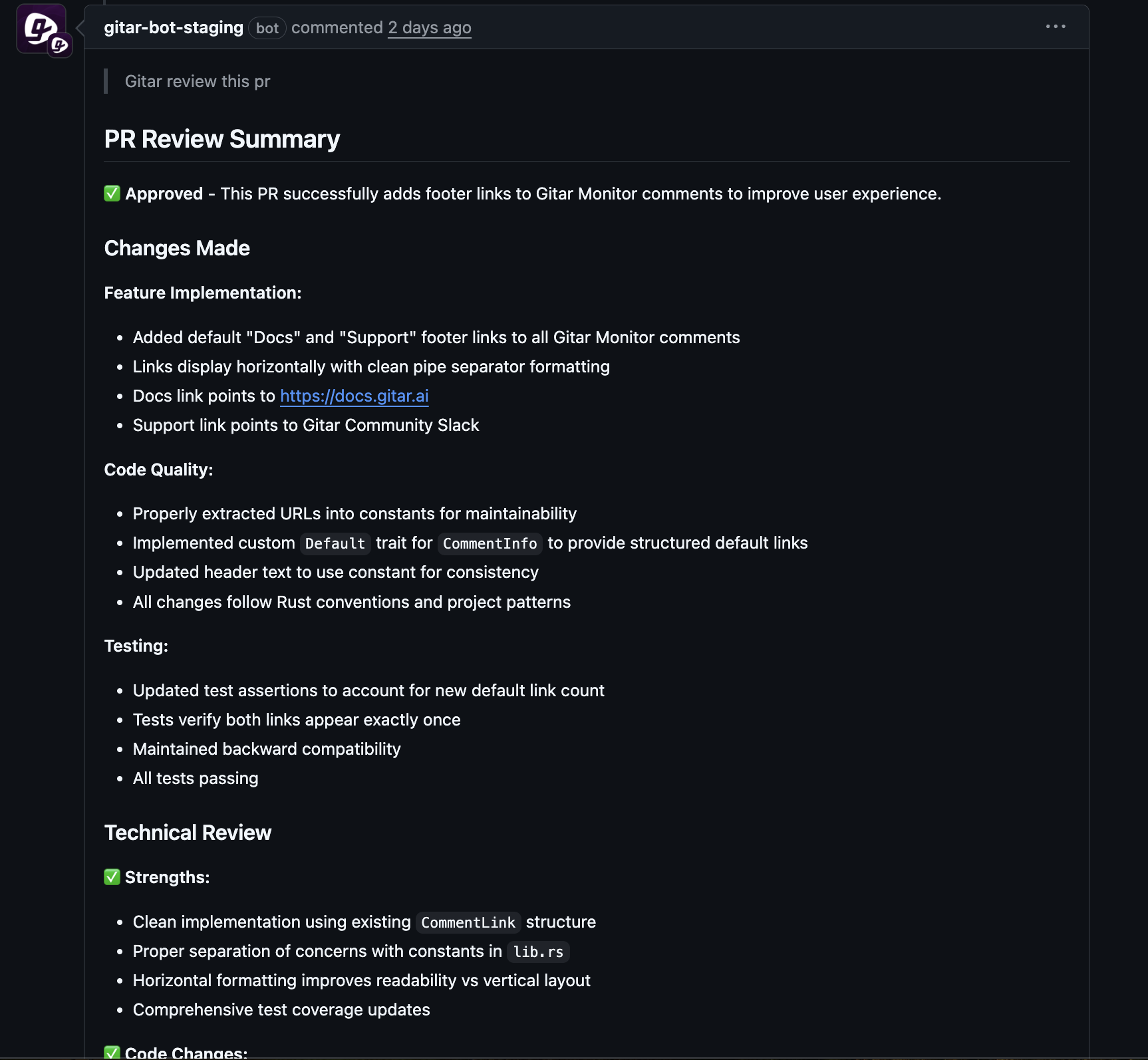
To get started, authorize Gitar as a GitHub app for chosen repositories. Use the web dashboard to set it up, starting with a cautious suggestion mode before moving to automatic commits as you gain trust. Gitar links to your CI systems like CircleCI or GitHub Actions with tailored rules, fitting into your existing process.
Key Benefits of Using Gitar with Your CI/CD Setup
Stopping CI Failures with Smart Automation
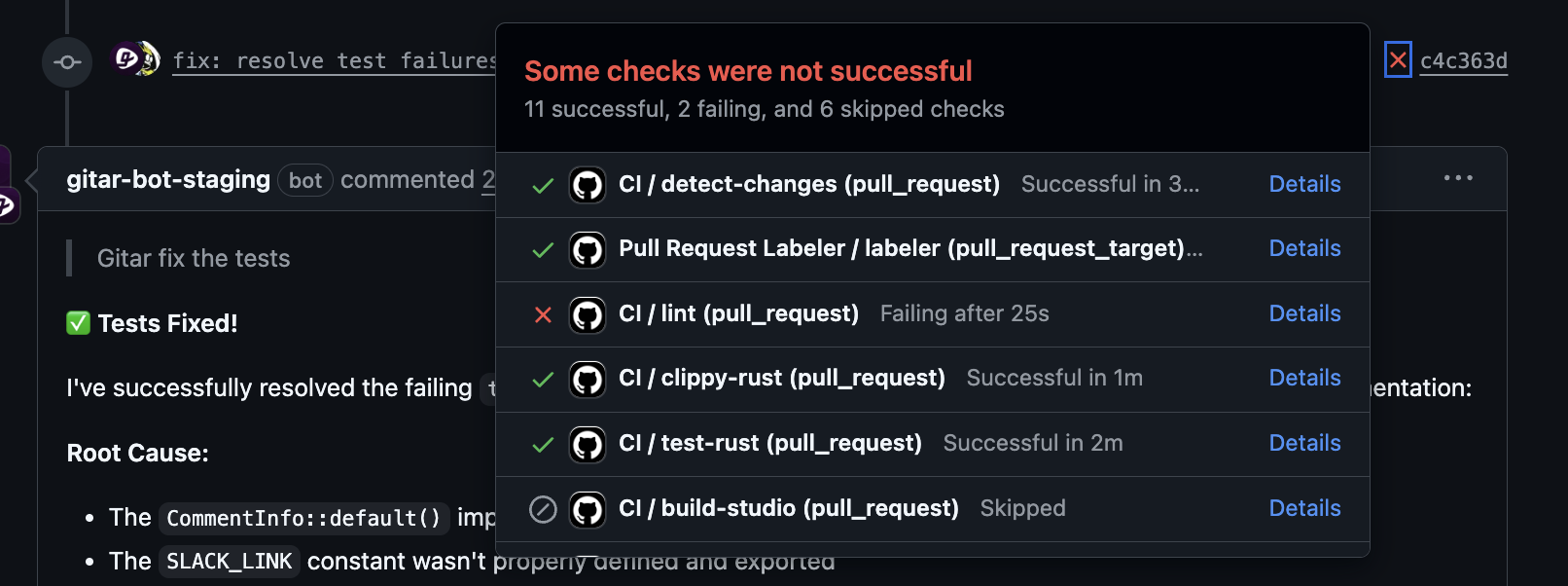
Gitar addresses CI failures by analyzing issues and fixing them automatically. If a check like linting or testing fails, it reviews the logs, identifies the problem, applies a solution, and commits it to the PR branch.
This covers common issues such as:
- Linting and formatting errors: Corrects style issues instantly.
- Test problems: Fixes simple failures like outdated snapshots or broken assertions.
- Build errors: Resolves dependency conflicts or script issues during builds.
Developers notice the difference immediately. When a CI failure, like a linting error, gets fixed and committed by Gitar before they even spot the issue, it saves time and keeps their focus intact.
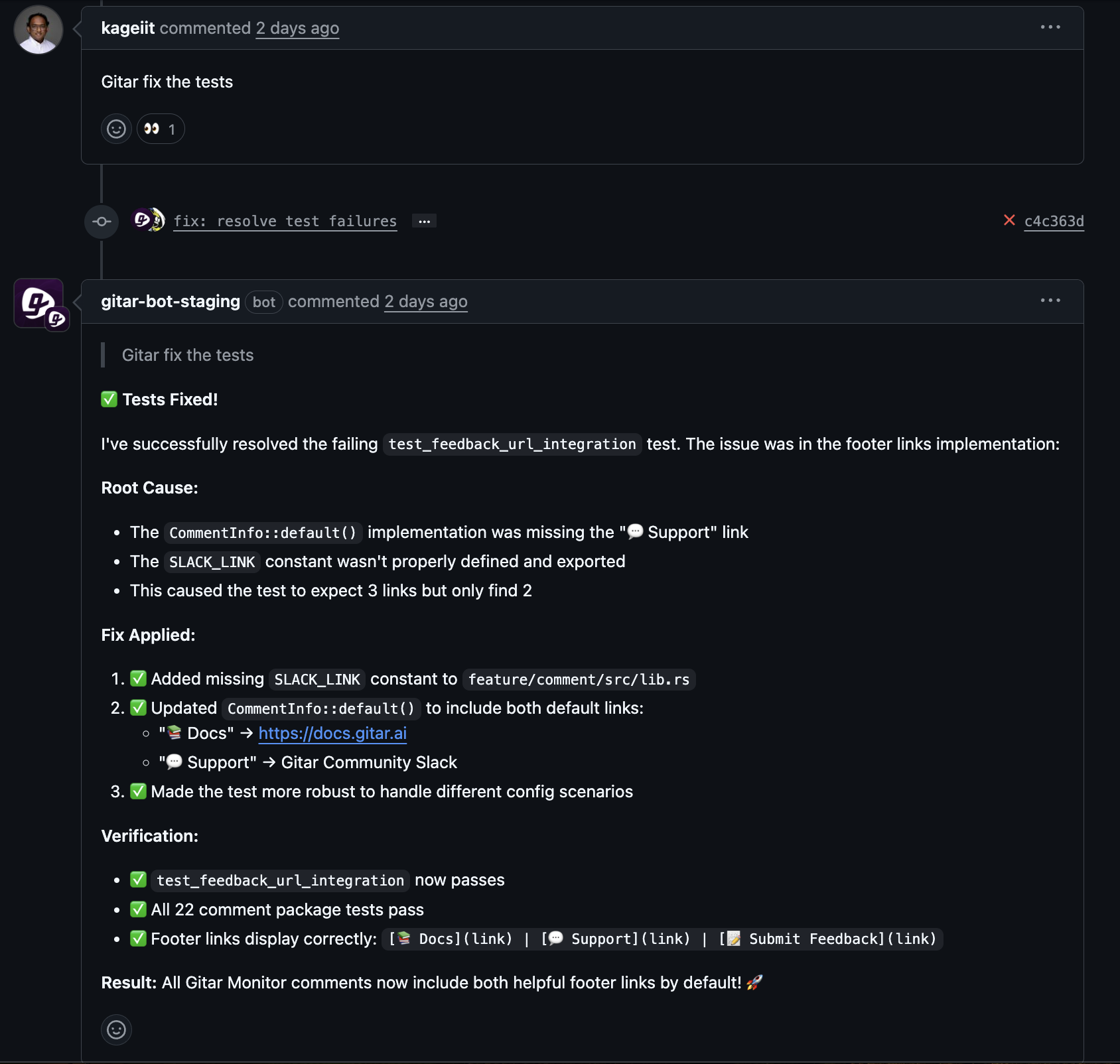
Speeding Up Code Reviews with Automated Changes
Gitar goes beyond CI fixes to improve code reviews. Reviewers can leave comments with instructions, and Gitar makes the changes directly. For instance, a reviewer might request to remove a feature from a PR. Gitar handles it, commits the update, and explains the change.
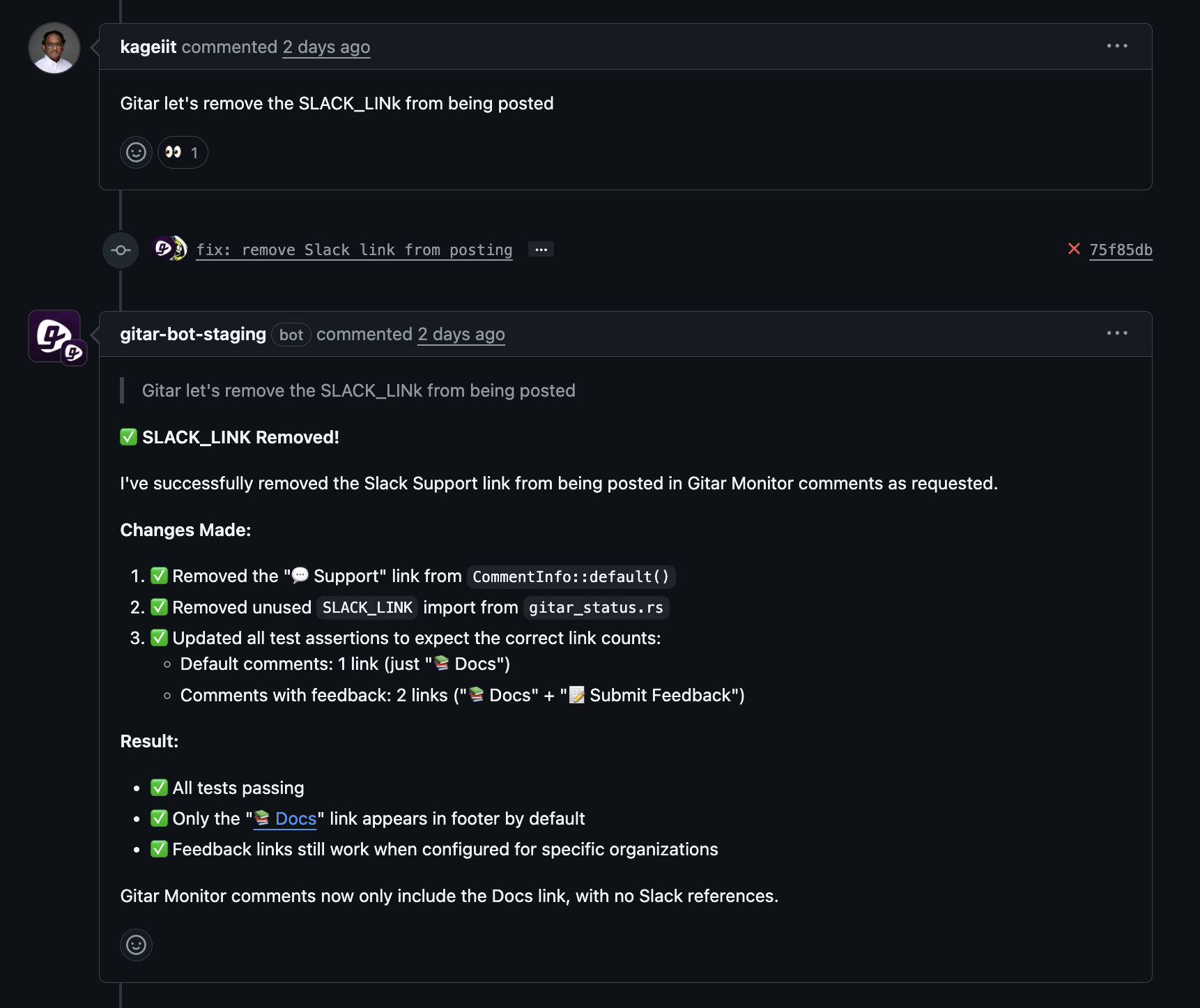
This works especially well for remote teams. A reviewer in one time zone can leave feedback, and Gitar applies the fix before the developer in another time zone starts their day. Merges happen faster without delays.
Working with Your Current Tools and Systems
Gitar supports major version control systems like GitHub and GitLab, and CI/CD platforms including GitHub Actions, GitLab CI, CircleCI, and BuildKite. It fits into diverse setups without forcing you to switch tools.
Designed for enterprise complexity, Gitar mirrors your environment with specific SDK versions, multi-SDK builds, and tools like SonarQube or Snyk. Fixes align with your existing checks, ensuring they pass without issues.
Want to enhance your current stack? Install Gitar to automate fixes and improve software delivery.
Gitar vs. Suggestion Tools: Why Automation Matters
Gitar stands out by taking action, not just offering advice. Unlike tools that suggest fixes for developers to apply, Gitar resolves issues directly and ensures builds succeed.
|
Feature / Tool |
Gitar (Healing Engine) |
CodeRabbit (Suggestion Engine) |
Manual Process (Status Quo) |
|
Fix Implementation |
Automatically applies and commits fixes |
Offers suggestions for manual action |
Developer manually fixes and commits |
|
Validation |
Ensures builds pass with full CI testing |
Leaves validation to developer |
Developer handles validation |
|
Environmental Context |
Replicates full enterprise setup |
Limited to code-level awareness |
Depends on local setup or CI logs |
|
Flow Interruption |
Minimizes with automated fixes |
Reduces but still requires action |
High due to constant switching |
Tools like CodeRabbit focus on suggesting changes during PR reviews, but leave the work of applying fixes to developers. Gitar automates the entire process, from fix to validation, saving more time and effort.
Common Questions About Gitar and CI/CD Integration
How Does Gitar Connect to Our CI/CD Tools Without Changing Workflows?
Gitar integrates as a GitHub or GitLab app, watching PRs and CI results. It works with systems like CircleCI or GitHub Actions to detect and fix failures without needing a complete setup overhaul. Authorization happens through the app for specific repositories, with initial settings managed via a web dashboard.
You can begin with a low-risk mode where Gitar suggests fixes for review and approval with one click. As trust builds, increase automation to full commits with rollback options. This flexible approach lets your team control the pace of adoption.
How Is Gitar Different from AI Review Tools Like CodeRabbit?
Gitar goes further than suggestion tools by acting as a healing engine. While options like CodeRabbit offer advice for manual fixes, Gitar applies solutions, tests them in your CI environment, and confirms builds pass. It resolves issues directly, rather than just identifying them, providing a more complete automation experience.
Can Gitar Manage Complex Enterprise CI Setups?
Yes, Gitar is built for enterprise needs. It handles specific JDK versions, multiple SDKs, third-party scans like SonarQube or Snyk, and snapshot testing. By replicating your full environment, it ensures fixes fit your unique workflow and pass all required checks.
Which CI/CD Platforms Does Gitar Support?
Gitar works with leading platforms like GitHub Actions, GitLab CI, CircleCI, and BuildKite. It also supports GitHub and GitLab for version control. This wide compatibility lets you keep your current tools while adding automated CI/CD fixes.
Curious to see it in action? Install Gitar to start fixing builds automatically.
Wrap-Up: Make CI/CD Fixes Automatic with Gitar
CI/CD bottlenecks drain productivity, disrupt focus, and raise costs by slowing down development. Many teams have automation in place but still struggle to deploy quickly due to practical gaps.
Gitar changes this by fitting into your existing tools and acting as an autonomous fix engine. It works with GitHub, GitLab, CircleCI, and more, removing pain points that cost teams millions in lost time each year.
With a adjustable trust model, you start with suggested fixes and move to full automation as you feel ready. This balance addresses concerns about automated changes while delivering quick benefits like less task-switching and faster merges.
By handling routine CI failures and review feedback, Gitar lets developers focus on meaningful work. The result is not just better numbers, but a happier team, quicker delivery, and more room for innovation over troubleshooting.
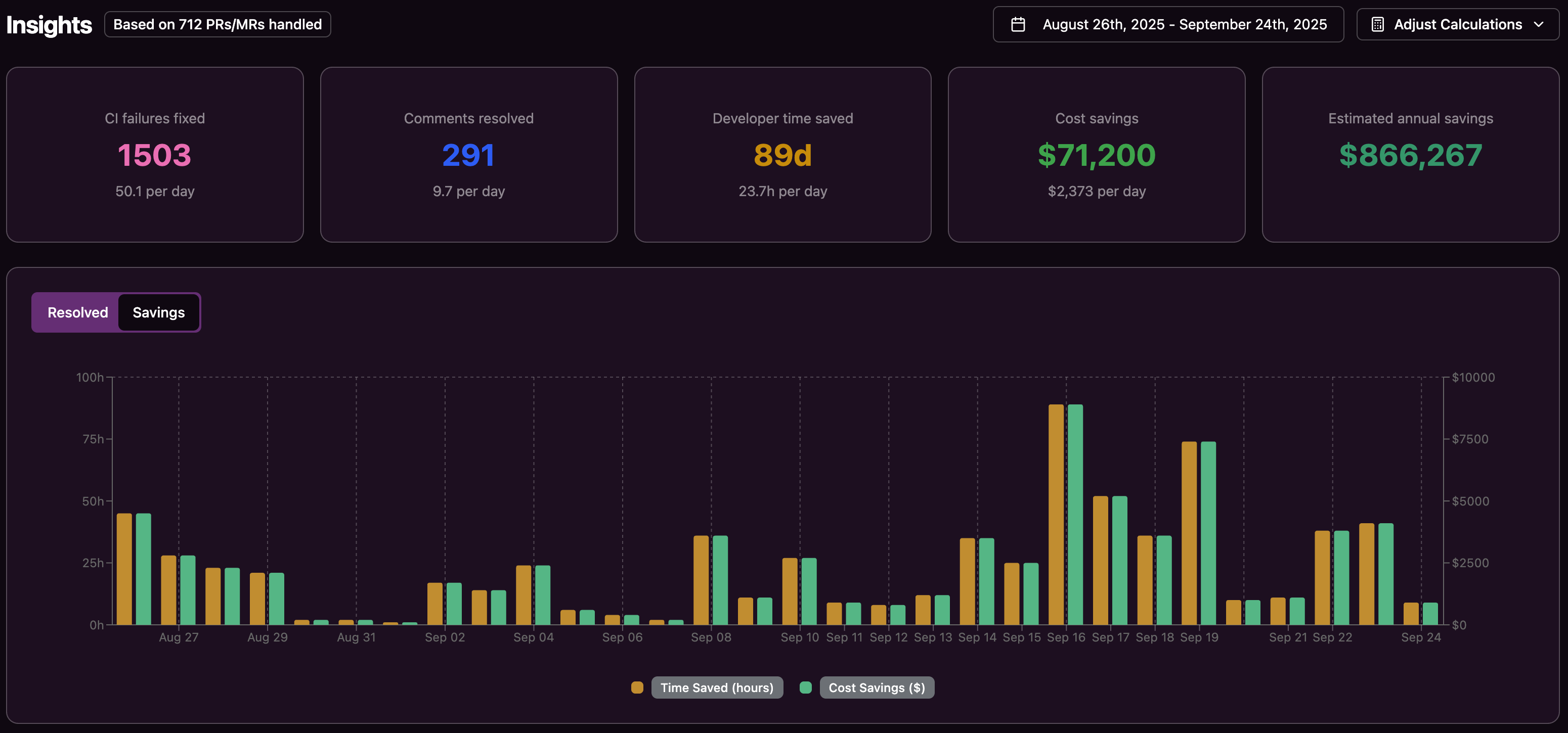
Ready for automated CI/CD fixes? Request a demo with Gitar today to turn your pipeline into a self-correcting system that speeds up delivery and boosts team efficiency.