
Key Takeaways
- Manual CI troubleshooting and code reviews create costly bottlenecks, context switching, and burnout, especially as teams scale.
- Autonomous “healing engines” improve on suggestion-only tools by diagnosing issues, applying fixes, and validating them in your real CI environment.
- Hybrid workflows that combine automation for routine issues with human oversight for complex logic help teams maintain quality and velocity.
- Gradual rollout, clear controls, and environment replication are essential for building trust in automated code review tools.
- Gitar gives engineering teams practical self-healing CI by autonomously fixing failed checks and implementing review feedback. Install Gitar to start automating CI fixes in your own pipeline.
The Productivity Bottleneck: Why Traditional CI/CD And Manual Code Review Strain Teams
Many engineering teams now ship with sophisticated CI/CD, yet still lose large amounts of time to broken builds and slow reviews. 52% of developers report feeling blocked and slowed by inefficient code reviews, which directly reduces throughput and delays releases.
The Human Cost: Burnout And Context Switching
Developers often push a pull request, see red checks, and must stop current work to decode logs, patch code locally, push, and wait again. A small lint, test, or dependency fix may take 30 minutes on paper but can consume an hour or more of productive time once context switching and re-orientation are included.
This repeated loop erodes focus and morale. The “fire and forget” PR ideal rarely occurs; developers instead move between feature work, CI repairs, and review feedback, which fragments attention throughout the day.
The Business Impact: Delays, Costs, And Quality Risk
Manual reviews force developers to split time between new feature work and reviewing existing code, extending cycle times. For a 20-person team spending just one hour per day on CI and review rework, the cost can approach $1M per year in lost productivity.
Slow reviews and repeated CI failures also push releases back, which weakens competitive position and can reduce customer satisfaction.
Beyond Suggestions: How Autonomous Code Review Tools Enable Self-Healing CI
Traditional automated code review tools focus on suggestions. They flag problems and propose changes, but developers still implement and validate fixes, so context switching remains.
The Shift From Basic AI To Healing Engines
Most current tools behave as “suggestion engines” that work well for obvious patterns but struggle with environment-specific logic. Many existing approaches handle only trivial changes reliably, which limits impact on real-world CI failures.
This gap has created demand for “healing engines” that detect failures, understand the environment, apply code changes, and re-run checks until the pipeline is green.
Why Hybrid Automation Beats Manual-Only Review
Teams that combine automated and manual reviews tend to ship higher quality code and fix security issues faster. Automation can handle repetitive checks, formatting, and straightforward bugs, while human reviewers focus on architecture, product impact, and edge cases.
Nearly half of teams now use AI-driven reviews to accelerate delivery while maintaining defect detection, which shows a broad move toward this hybrid model.
Gitar: Practical Autonomous CI Fixes And Streamlined Feedback
Gitar treats broken builds and simple review feedback as work the system should resolve, not developers. It functions as a CI healing engine that fixes many failures end to end and updates the pull request automatically.
End-To-End Problem Resolution, Not Just Suggestions
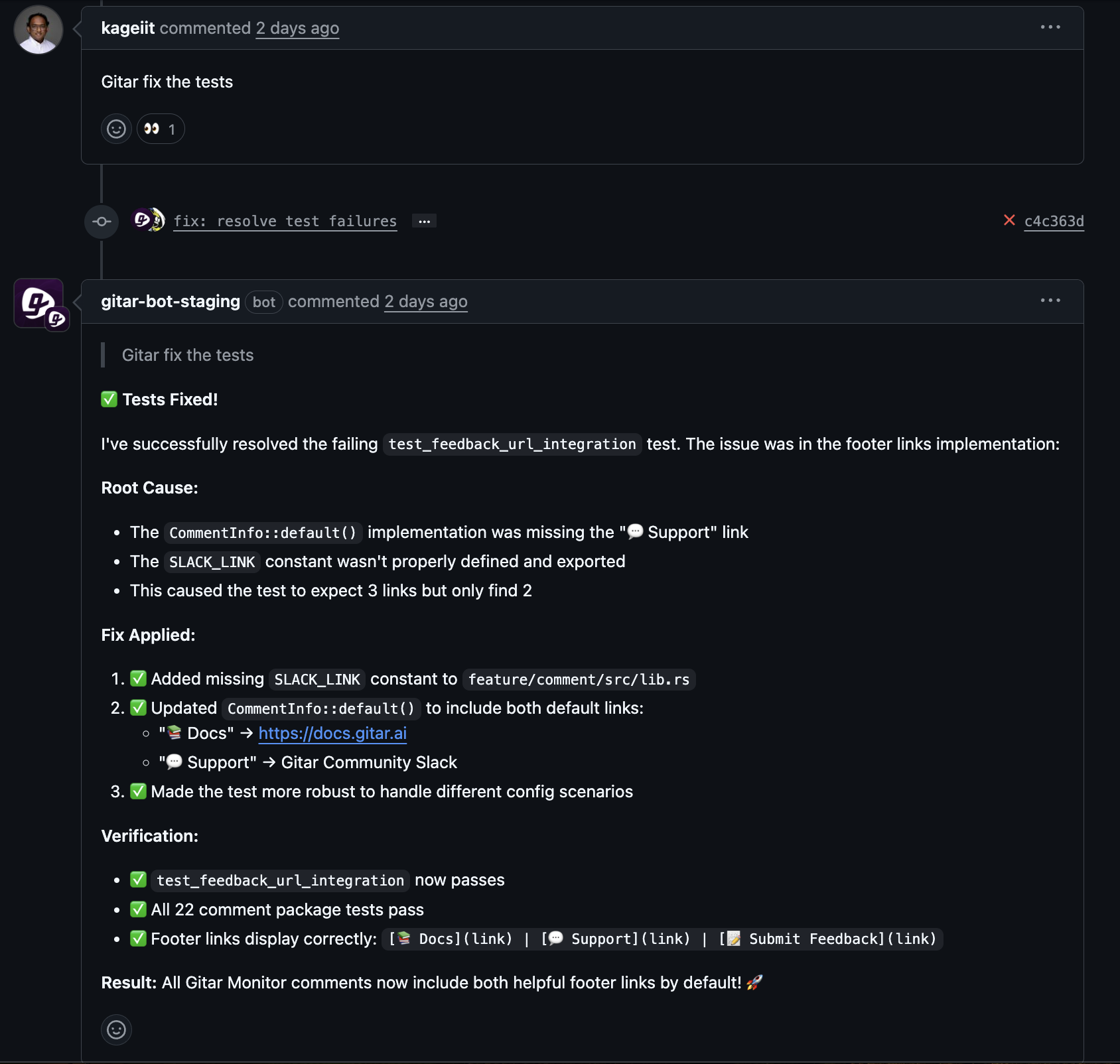
When a CI job fails, Gitar reads the logs, locates the root cause, updates the code, and commits the fix back to the branch. Typical issues include:
- Lint and formatting violations
- Failing or flaky unit tests
- Dependency and build configuration errors
Gitar then validates changes against the full CI workflow. Only when all jobs pass does the pull request appear green, which removes guesswork about whether a suggested fix will succeed in your specific environment.
Environment-Aware Execution For Enterprise CI
Enterprise CI often involves multiple SDKs, specific JDK versions, security scanners, and snapshot tests. Gitar replicates these workflows so that proposed fixes reflect the same environment as your real pipeline, not a generic sandbox.
This environment awareness helps ensure that changes are not only syntactically valid but also operationally correct for your stack.
Smarter Reviews And Support For Distributed Teams
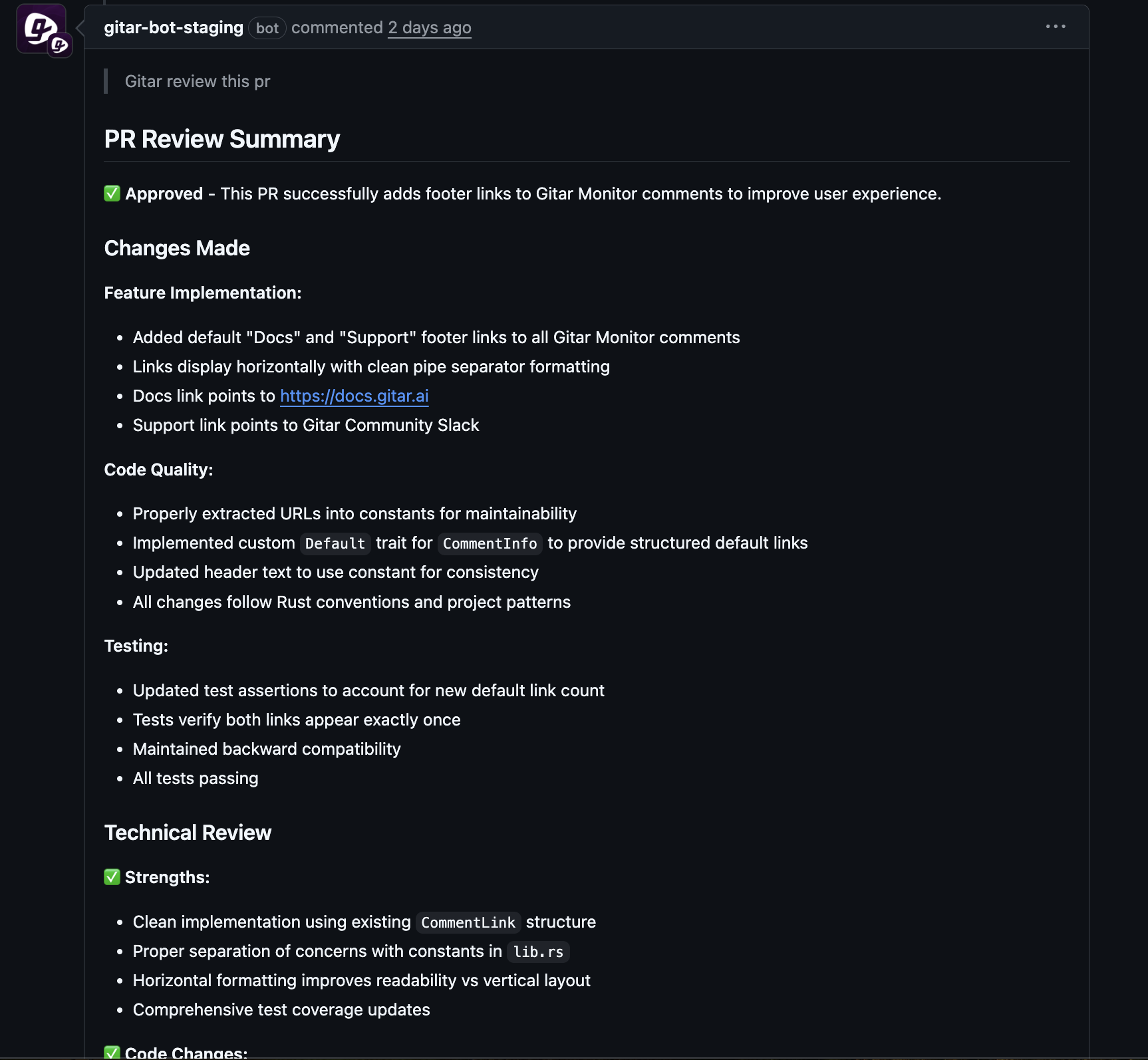
Reviewers can mention Gitar on a pull request to receive a concise AI-generated review that summarizes changes, flags risks, and checks for obvious UX or integration issues. Review comments can also instruct Gitar to apply specific changes directly.
Distributed teams gain particular benefit. A reviewer in one region can leave instructions for Gitar at the end of their day, and the updated pull request is ready when colleagues in another time zone sign in.
Trust And Control Through Configurable Automation
Teams can start Gitar in conservative mode, where it posts suggested changes that require one-click developer approval. After trust grows, more aggressive modes allow direct commits with clear audit logs and rollback options.
Install Gitar to introduce autonomous CI fixes in a controlled, low-risk way.
Implementing Autonomous Code Review Tools: A Practical Roadmap
Successful adoption of self-healing CI works best in phases that show quick wins while keeping human control.
Phase 1: Integrate And Build Initial Confidence
Teams typically authorize Gitar as a GitHub App on selected repositories and connect it to existing CI providers such as GitHub Actions or CircleCI. Configuration in the dashboard defines which checks Gitar can fix and whether changes appear as suggestions or commits.
Repositories with frequent lint or formatting failures make strong starting points because they are predictable and low risk.
Phase 2: Turn Early Wins Into Routine Autonomy
Early success often looks like a failed lint job that Gitar fixes automatically, leaving only a suggestion for the developer to accept. The pull request updates and the build passes without a full context switch back to the local environment.
As similar events repeat, teams extend Gitar to more repositories and allow it to commit directly for well-understood classes of issues.
Phase 3: Scale Automation And Advanced Workflows
Mature teams use Gitar to apply review feedback, handle repetitive refactors, and support complex pipelines with many concurrent runs. Senior reviewers can leave detailed comments that Gitar converts into concrete code changes across files or services.

Quantifiable Benefits: Measuring ROI From Automated Code Review Feedback
Developer Time And Cost Savings
For a 20-developer team spending one hour per day on CI failures and review-driven rework, the annual cost is about 5,000 hours. At $200 per hour, that equals $1M in lost productivity. If automation removes even half of that work, the savings reach roughly $500K per year, in addition to improvements in focus and morale.
Teams that adopt AI-based review have reported large drops in unplanned work within a few months, which supports these estimates.
Faster Cycle Times And Time-To-Market
Average code review latency from pull request opening to merge can approach 18 hours. Moving repetitive fixes from people to automation shortens this window and helps releases move on schedule.
Improved Developer Experience And Code Quality
Developers can focus on design and problem solving instead of clearing lint errors or restaging flaky tests. Consistent automated enforcement of style and basic correctness also reduces drift across repositories and mitigates reviewer fatigue.
|
Feature |
Manual Work |
Suggestion Engines |
Gitar (Healing Engine) |
|
Resolution Method |
Human detects and fixes |
AI suggests, human implements |
AI detects, fixes, and validates |
|
CI Pipeline Impact |
Frequent interruptions |
Manual follow-up required |
Self-healing for many failures |
|
Complexity Handling |
Depends on reviewer expertise |
Limited environment awareness |
Full CI environment replication |
|
Time To Merge |
Slow and bottlenecked |
Faster but still human-gated |
Often significantly shorter |
Strategic Considerations And Common Pitfalls
Building Trust In Autonomous Fixes
Initial hesitation about AI-committed code is natural. Teams address this by starting with suggestion-only mode, limiting scope to low-risk fixes, and reviewing change logs. Clear explanations and easy rollback options further increase trust.
Supporting Complex And Unique CI Setups
Many enterprises assume their CI pipelines are too customized for automation. Purpose-built tools like Gitar focus on full environment replication so that fixes respect your SDK versions, third-party scanners, and custom build steps.
Distinguishing AI-Assisted From AI-Autonomous Workflows
AI-assisted tools help with suggestions but still depend on developers to apply and validate changes. AI-autonomous tools handle detection, updates, and verification on their own for routine issues, which removes much of the context switching that slows teams down.
Install Gitar to move from AI-assisted suggestions to AI-autonomous CI healing.
Frequently Asked Questions (FAQ) About Integrating Automated Code Review Tools
How can we integrate automated code review tools into our CI pipeline without disruption?
Most teams begin by connecting an automated code review tool to a few non-critical repositories in suggestion-only mode. This setup lets the tool comment on pull requests without changing code. Configuration can restrict scope to lint, formatting, or basic test failures, which keeps risk low while the team reviews early results.
How is Gitar different from AI reviewers like CodeRabbit or Claude?
Many AI reviewers analyze diffs and suggest edits but leave implementation, CI validation, and commits to developers. Gitar instead acts as a healing engine that applies fixes, re-runs checks in your real CI environment, and updates the branch. This end-to-end flow reduces manual effort and cuts the time from detection to a green build.
How can teams stay comfortable with an AI that commits code?
Teams maintain control by starting with suggestion mode, defining which issue types Gitar may handle, and requiring human review for complex or risky changes. As the tool delivers consistent results on simple issues, teams often permit automatic commits for those categories while retaining manual review for others.
Can Gitar handle intricate, highly customized CI environments?
Gitar is designed to mirror real CI pipelines that use multiple SDKs, specific runtime versions, custom scripts, security scans, and snapshot tests. This replication allows Gitar to generate fixes that match your environment and that pass the same checks your developers run today.
What ROI can an engineering team expect from adopting Gitar?
Teams commonly estimate ROI by time saved on CI triage and review-driven rework. A team of 20 developers saving only 30 minutes per day per person still recovers more than 2,500 hours per year. At standard loaded rates, that reduction usually exceeds the cost of the tool by a wide margin, while also improving developer satisfaction and release speed.
Conclusion: Moving Toward Autonomous CI/CD And Code Review
Modern engineering organizations now face scaling challenges that manual CI debugging and traditional code review cannot efficiently solve. Suggestion-only tools help, but they do not fully address the context-switching and latency that slow teams down.
Gitar advances this model with AI-autonomous problem resolution, turning many CI failures and straightforward review comments into background tasks that the system handles. Teams gain faster merges, fewer interruptions, and a clearer focus on high-impact work.