
Key Takeaways
- Failed CI pipelines consume significant engineering time, create context switching, and reduce throughput across entire teams.
- Autonomous CI shifts work from manual debugging to automatic repair, which shortens feedback loops and improves pipeline success rates.
- Gitar operates as a self-healing CI agent that fixes lint errors, test failures, and other CI issues, then validates and commits changes.
- A phased rollout of autonomous CI, from conservative suggestions to full auto-commit, builds organizational trust while showing clear ROI.
- Teams that want faster build and test execution with fewer interruptions can start using Gitar today by visiting https://gitar.ai/fix.
The Critical Need: Faster Build and Test Execution as a Strategic Imperative
Pipeline success rates directly correlate with developer productivity and resource efficiency. Each failed build delays delivery, increases unplanned work, and reduces capacity for feature development.
Pipeline downtime affects entire teams, not just the person who pushed the change. Developers lose flow when they jump from focused work into debugging CI issues, and incoherent CI/CD strategies often create inefficient development cycles and costly delays.
For a 20-developer team, interruptions from failing builds can easily cost around $1M per year in lost productivity. Context switching turns small fixes into long interruptions, and longer pipeline run times directly reduce available productive time.
Extra compute power or more parallel jobs help only to a point. The main bottleneck is still human attention when CI fails. Every failure requires a developer to investigate logs, reproduce issues, and rerun jobs, which consumes far more resources than the original error.
The Autonomous CI Solution: Eliminating Interruptions
Autonomous CI shifts pipelines from failure notification to automatic repair. Instead of stopping at detection, the system identifies the root cause, applies a fix, validates it, and only then notifies developers when builds are green.
Modern AI-powered CI/CD platforms already include self-healing and automatic analysis capabilities. The real gain comes from moving beyond suggestions toward systems that execute and verify fixes without waiting on manual action.
True autonomous CI must handle concurrent pipelines, asynchronous events, retries, and shared state across many jobs. This requires context-aware orchestration, durable memory, and event processing that traditional CI systems do not provide on their own.
Autonomous CI systems such as Gitar turn pipelines into self-healing workflows. When a lint error or simple test failure appears, Gitar fixes the code, commits the change, and re-runs CI. Developers stay focused on building features instead of chasing red builds.
Install Gitar to start automatically fixing broken builds and accelerating build and test execution.
Gitar: Autonomous CI That Accelerates Build and Test Execution
Gitar acts as an autonomous CI agent that removes manual intervention from most build and test failures. Rather than offering suggestions that still require manual edits, Gitar operates as a healing engine that applies and validates fixes.
Key capabilities that speed up build and test execution include:
- End-to-end fixing, where Gitar applies changes, runs CI, and presents green pull requests instead of raw suggestions.
- Full environment replication for complex stacks, including specific JDK or SDK versions, third-party scanners such as SonarQube or Snyk, and snapshot testing flows.
- Intelligent code review assistance, where reviewers leave comments and Gitar implements the requested changes directly.
- A configurable trust model, which allows teams to start with suggestions and gradually move to autonomous commits as confidence grows.
- Support for common CI platforms such as GitHub Actions, GitLab CI, CircleCI, and BuildKite, rather than a single ecosystem.
Gitar tracks events across pipelines and users, manages retries, and avoids duplicate work. This context awareness ensures that fixes are valid for the specific environment, not just syntactically correct code snippets.
Distributed teams gain extra value. A reviewer in one time zone can leave feedback at the end of the day, and Gitar applies changes so the original author in another region sees a ready-to-merge pull request the next morning.
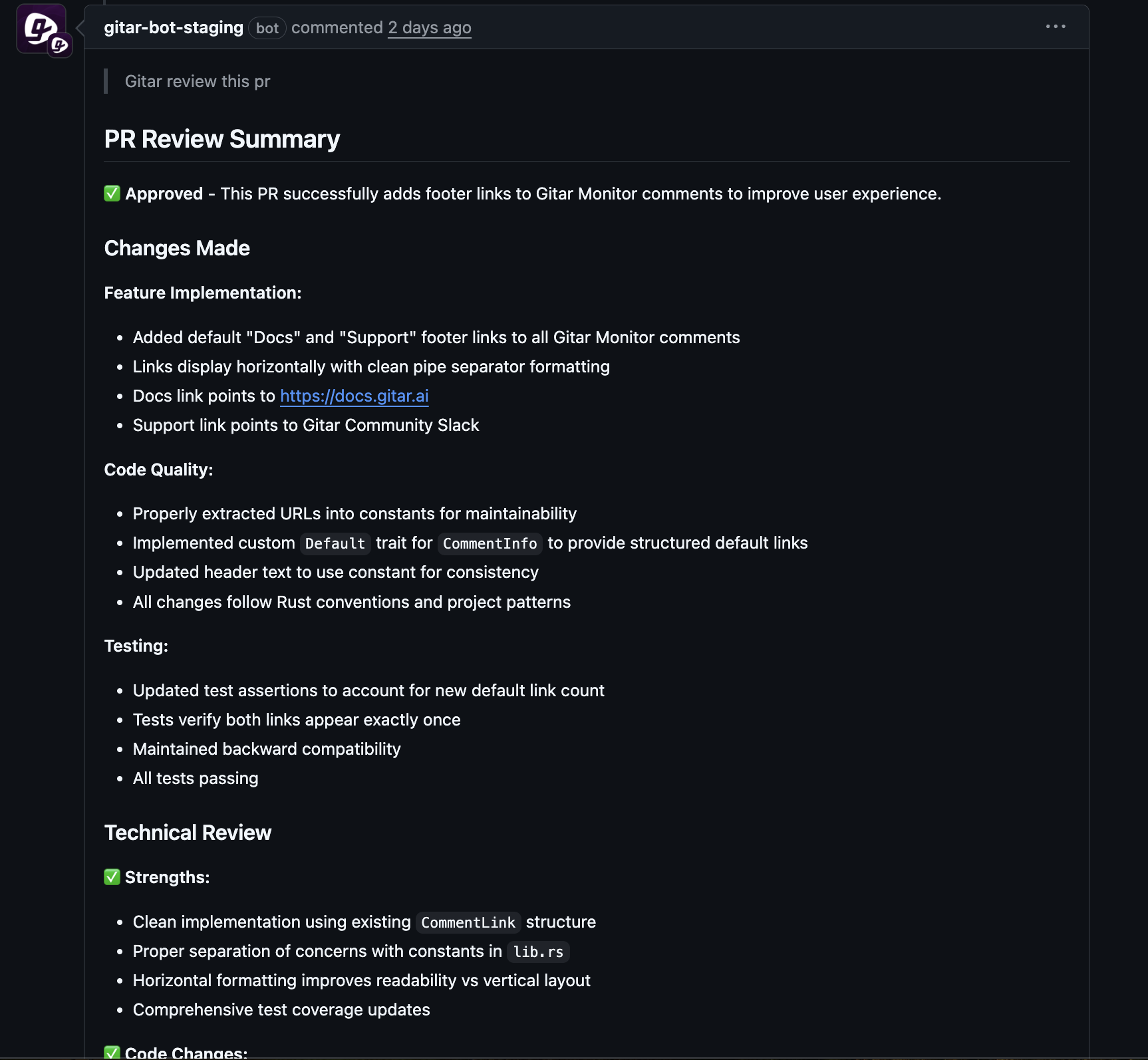
See how Gitar improves build and test execution by removing manual CI fixes.
Strategic Implementation: Bringing Autonomous CI Into Your Workflow
Phase 1: Installation and Trust Building
Teams usually start with Gitar in a conservative mode. The agent proposes fixes, and developers accept or edit them before merge. This approach demonstrates value while keeping full human control.
Setup uses a GitHub App installation on selected repositories and connection to your existing CI. A web dashboard lets you choose which failures Gitar may address automatically and which ones still require review.
Phase 2: Scaling Automation
After observing many correct fixes, teams expand Gitar’s scope and increase its level of autonomy. The system begins to auto-commit changes for routine lint errors, flaky tests, or straightforward configuration issues.
At this stage, developers spend less time on repetitive issues and more time on architecture, features, and deeper testing. Gitar also starts to handle more review feedback, such as simple refactors or minor behavior changes.
Phase 3: Advanced Workflows and Policies
Mature teams use Gitar as an execution layer for complex workflows. Reviewers can write comments like “Gitar, refactor this function to use a map for better performance,” and Gitar performs and validates the refactor.
Organizations can encode policies and patterns as prompts at the repository level. Gitar then enforces these rules during CI, which reduces the need for complex YAML logic and manual checklists.
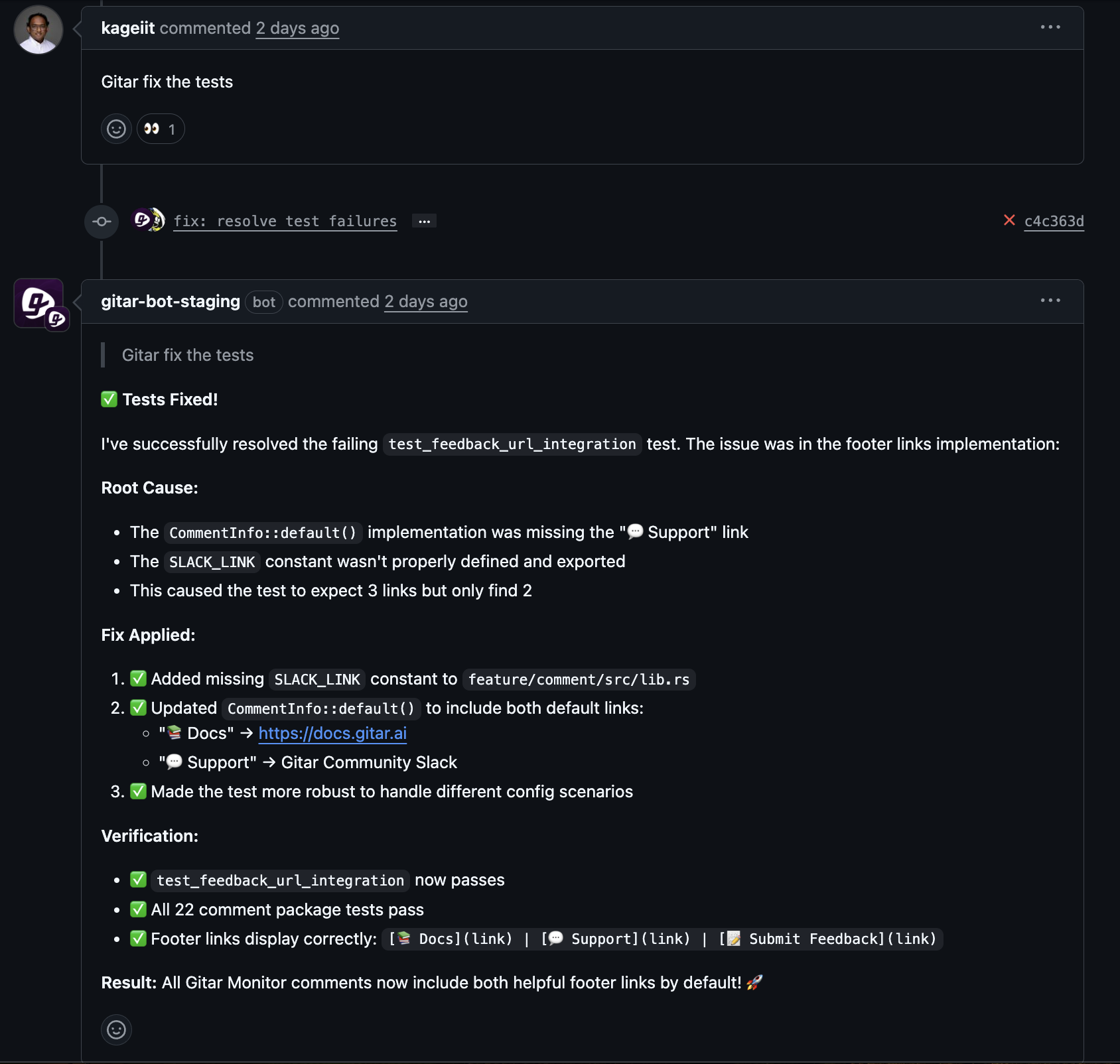
Measuring Impact: ROI From Faster Build and Test Execution
Build duration and feedback speed closely track developer productivity. Shorter feedback loops reduce idle time and unblock work faster.
Consider a 20-developer team that spends one hour per day on CI and review-related issues. That total of 5,000 hours per year at a $200 loaded hourly rate represents $1M in potential productivity loss. If autonomous CI recovers even half of that time, the effect is a $500K annual gain.
Useful metrics for autonomous CI include:
- Reduced pipeline downtime and fewer red builds.
- Shorter time from merge to deploy, as tracked in pipeline performance reports.
- Lower average time to fix broken builds.
- Fewer manual restarts and retries for the same pull request.
Gitar vs. Traditional Approaches
|
Feature |
Gitar |
Manual Fixes |
Suggestion Engines |
|
CI Error Resolution |
Autonomous repair with validated green builds |
Manual investigation and fix |
Suggestions that still need manual validation |
|
Developer Interruption |
Minimal |
High |
Moderate |
|
Environment Handling |
Full replication of real workflows |
Manual setup and debugging |
Limited context |
|
Time to Merge |
Accelerated |
Slow |
Delayed |
Overcoming Concerns About Autonomous CI
Many teams worry about loss of control or incorrect fixes. Gitar addresses these concerns with transparent logs, a configurable trust model, and easy rollback of any automated commit.
Some teams already use AI-based reviewers. Those tools usually propose changes and rely on humans to apply them. Gitar instead applies and validates fixes in the full CI environment, treating self-healing as a core responsibility rather than an optional helper.
Gitar is designed for complex environments with multiple SDKs, large dependency graphs, and security or quality gates. Replicating these conditions inside the agent lets it produce fixes that respect enterprise rules and pass all checks.
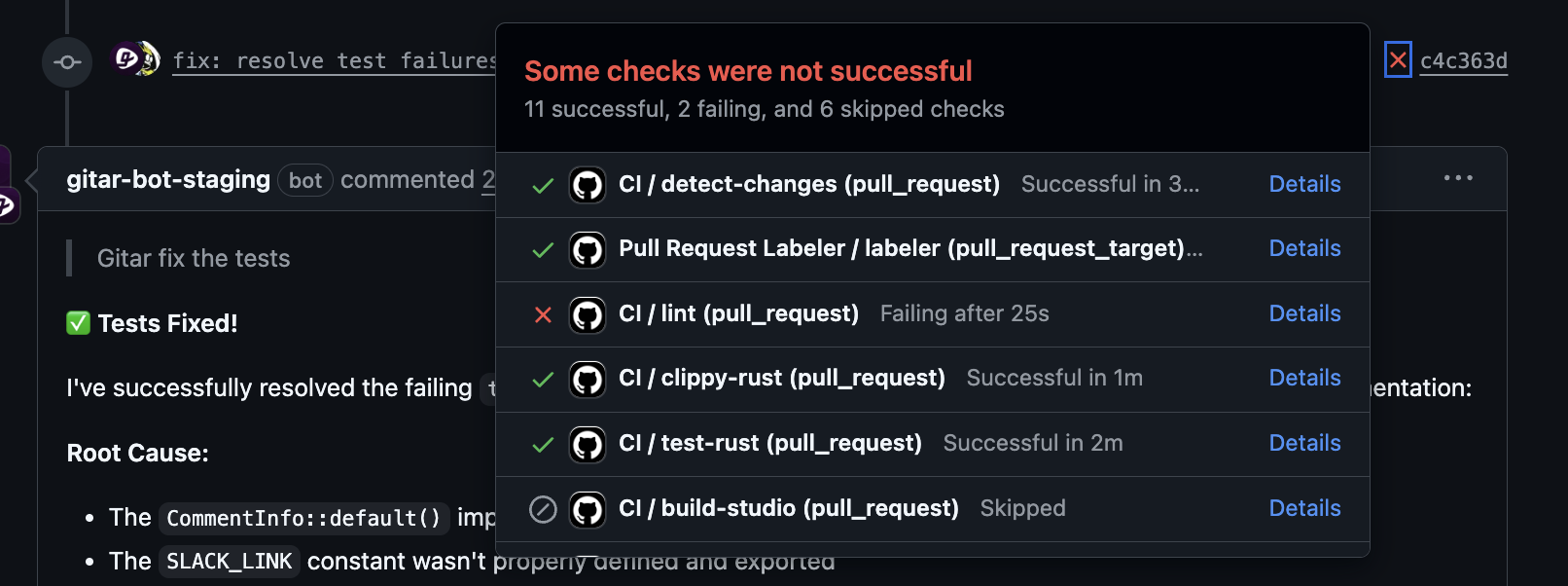
Install Gitar to reduce interruptions from pull request build failures.
Frequently Asked Questions
How autonomous CI increases resources for faster build and test execution
Autonomous CI increases effective resources by returning time that developers previously spent debugging pipelines. The same team and hardware can ship more code because less attention goes to failed builds, log reading, and repeated reruns.
How Gitar compares to building an in-house CI-fixing solution
Large language models provide building blocks, but a DIY solution requires custom integrations, prompt design, context stitching, and state management. Gitar already includes this infrastructure, from event handling to environment replication, so teams can adopt self-healing CI without a long internal project.
What happens when Gitar makes an incorrect fix
Teams can run Gitar in conservative mode and require approval before merge. In more autonomous modes, each automated commit comes with full context and can be reverted quickly. Because Gitar validates changes in the full CI workflow, incorrect fixes are rare and still faster to resolve than manual debugging from scratch.
Conclusion: A Practical Path to Faster Build and Test Execution
AI-driven CI/CD pipelines are becoming a standard for high-performing software teams. Autonomous CI converts build failures into background tasks instead of urgent interruptions.
Gitar gives engineering teams a practical way to adopt self-healing CI. By fixing common failures automatically, reducing context switching, and keeping pipelines green, Gitar helps organizations deliver features faster with the same people and infrastructure.