
Developers often lose valuable time dealing with manual CI/CD feedback loops and code reviews, slowing down projects and increasing costs. This article explores how an AI-driven, autonomous solution like Gitar can address these challenges. By automating CI fixes and feedback implementation, Gitar helps reduce developer burnout, speeds up code delivery, and improves engineering efficiency with self-healing CI workflows.
Manual CI/CD Feedback: A Hidden Cost Impacting Your Bottom Line
Manual CI/CD feedback and code review cycles create a significant productivity drain for software engineering teams, costing companies millions in delays and lost efficiency. This issue stems from the constant interruptions developers face while addressing pipeline failures and review comments.
Developers can spend up to 30% of their workday on CI issues and code reviews. For a team of 20 developers, this equates to roughly $1 million in annual productivity loss, a figure that grows with team size and project complexity.
CI/CD pipeline failures delay projects for 60% of companies, disrupting sprints, release timelines, and customer deadlines. Each failed build requires manual fixes, turning a straightforward process into a time-consuming ordeal.
AI coding tools like GitHub Copilot have improved code generation speed. However, validating and merging code remains a bottleneck, as these tools often rely on manual intervention for full integration into the CI/CD pipeline.
Context switching adds another layer of inefficiency. When a developer must pause their work to fix a CI failure or address feedback, a quick task can stretch into an hour of lost productivity due to mental overhead.
Distributed teams face even greater delays. A developer in one time zone might wait days for feedback from a colleague halfway across the world, with each round of changes requiring manual updates and validations.
Ready to cut these hidden costs and boost your team’s output? Install Gitar now to automate CI fixes and ship quality software faster.
Automate CI Fixes with Gitar’s AI-Driven Solution
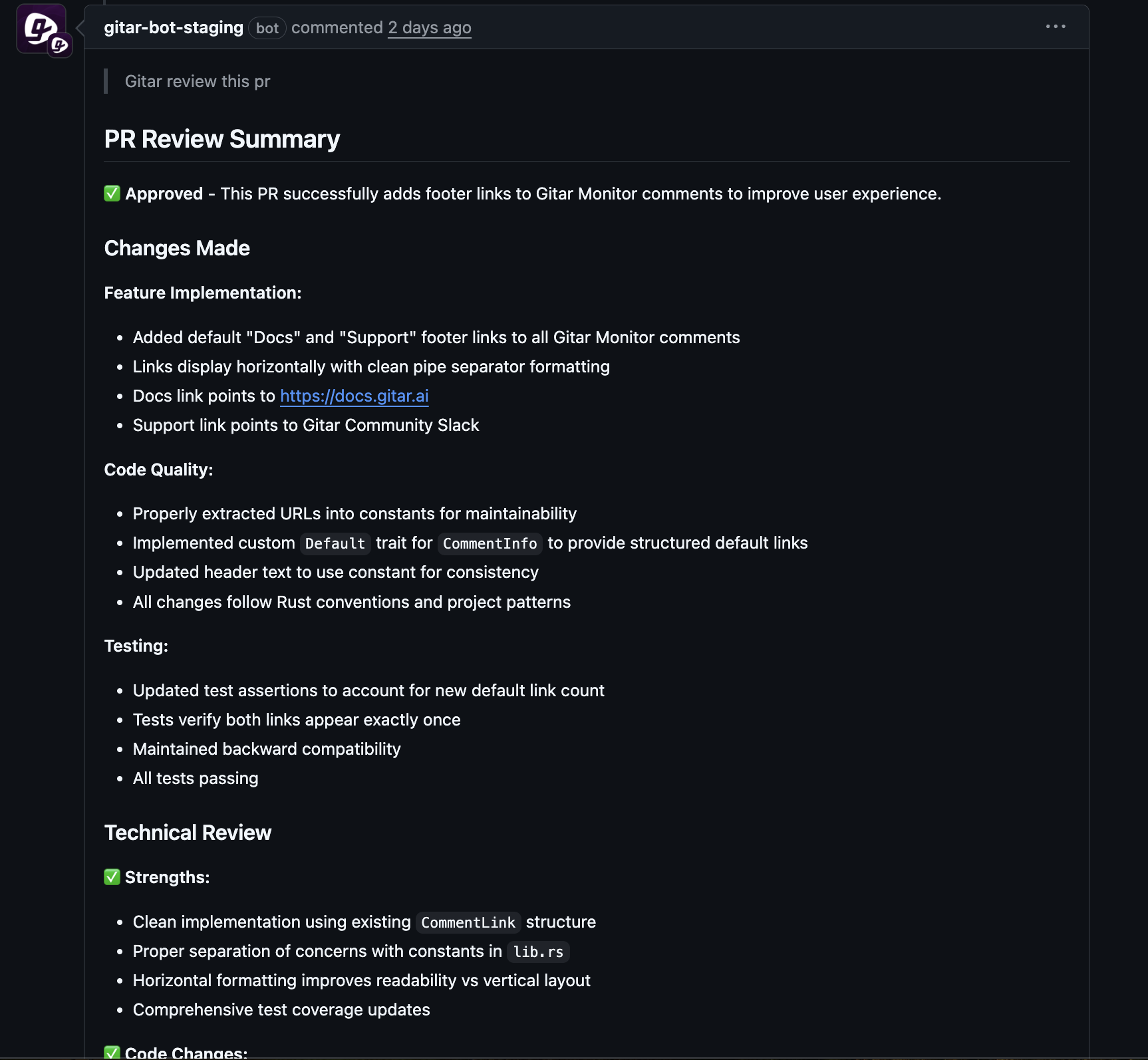
Gitar changes the game by autonomously resolving CI/CD failures, unlike traditional tools that depend on human input. This AI agent doesn’t just flag issues, it fixes them, turning failing pipelines into self-healing systems that save time and enhance productivity.

Gitar moves beyond suggestion-based AI tools by taking action. While many assistants offer recommendations for manual implementation, Gitar analyzes issues, applies fixes, validates them, and commits changes without needing developer involvement.
Here’s what makes Gitar stand out:
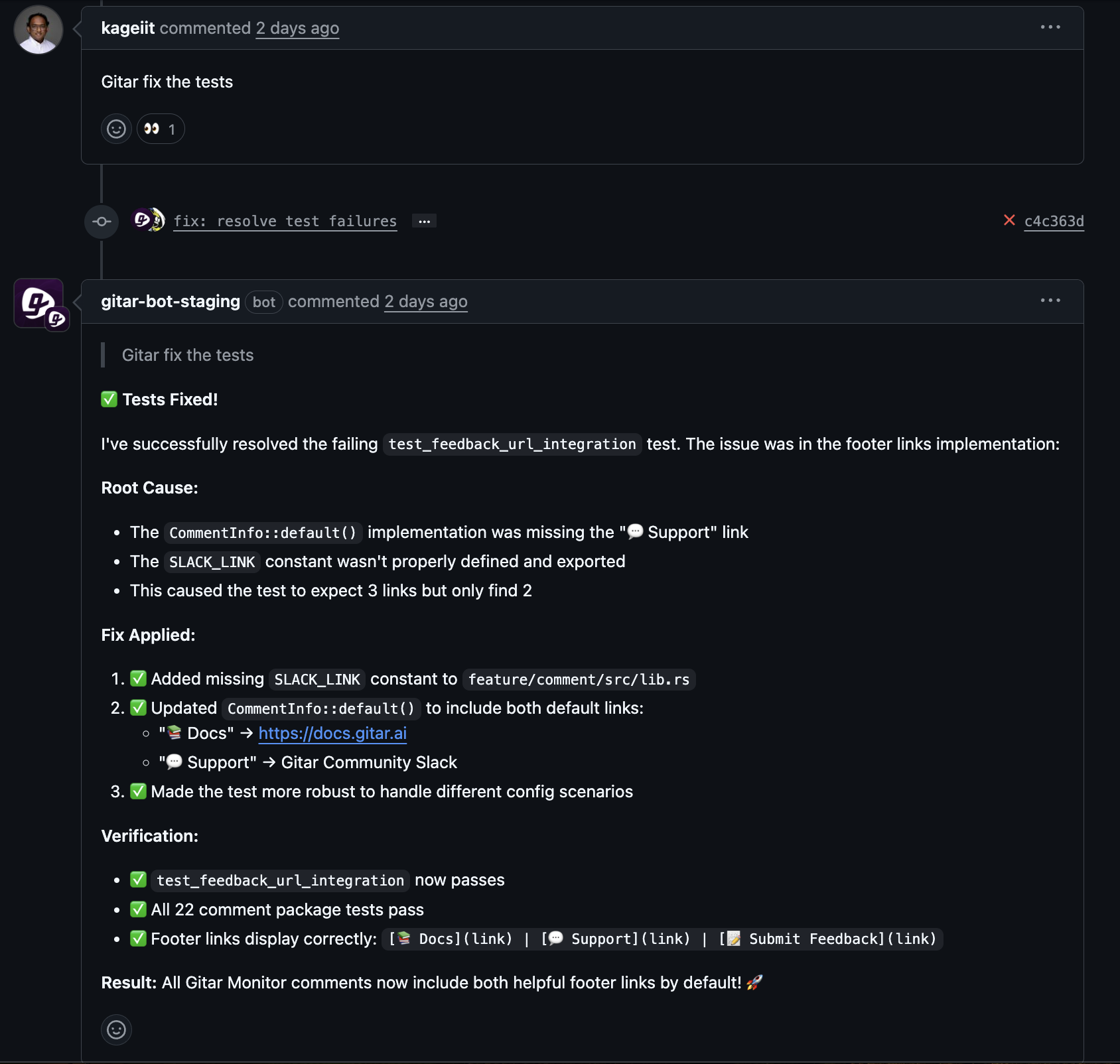
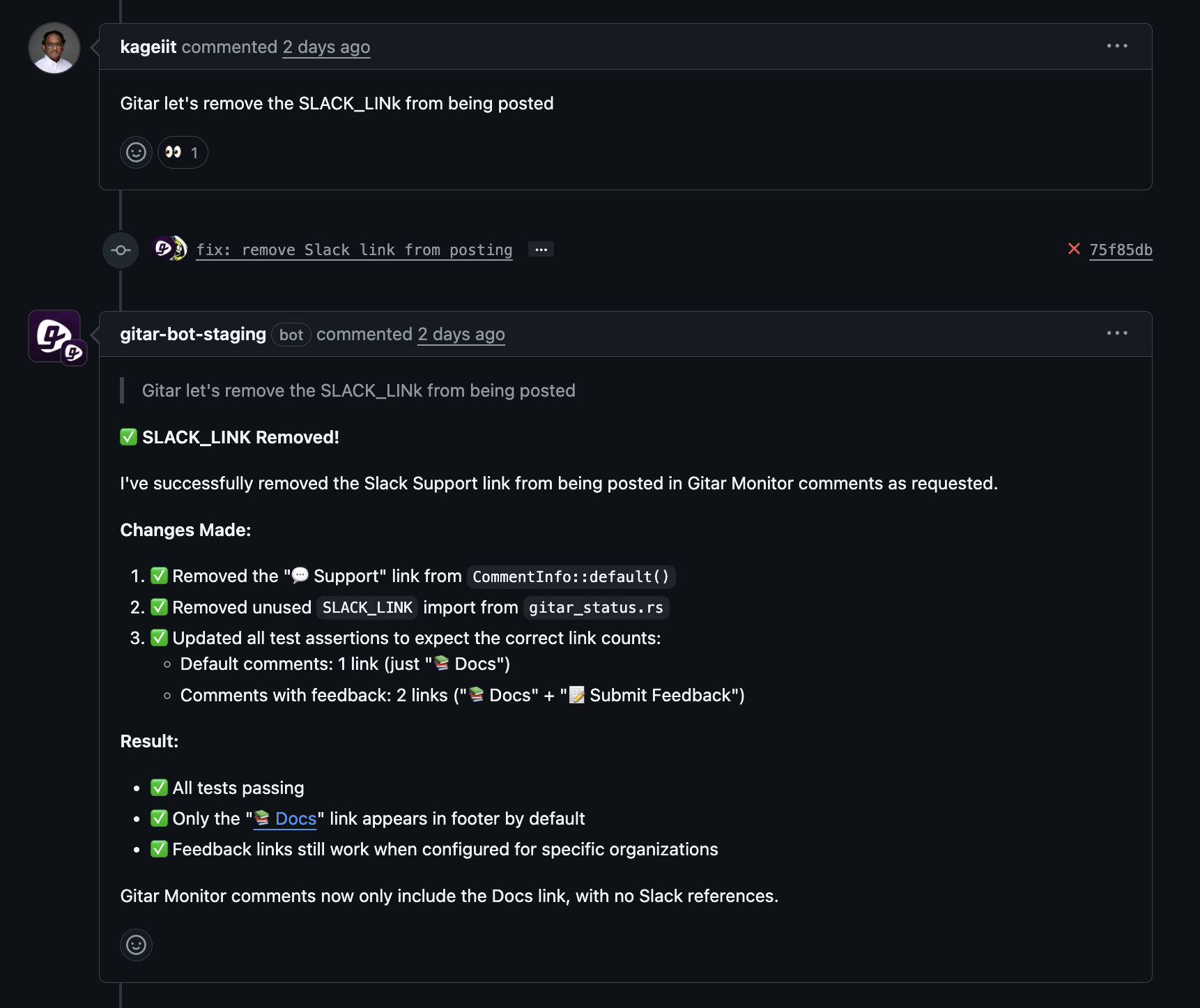
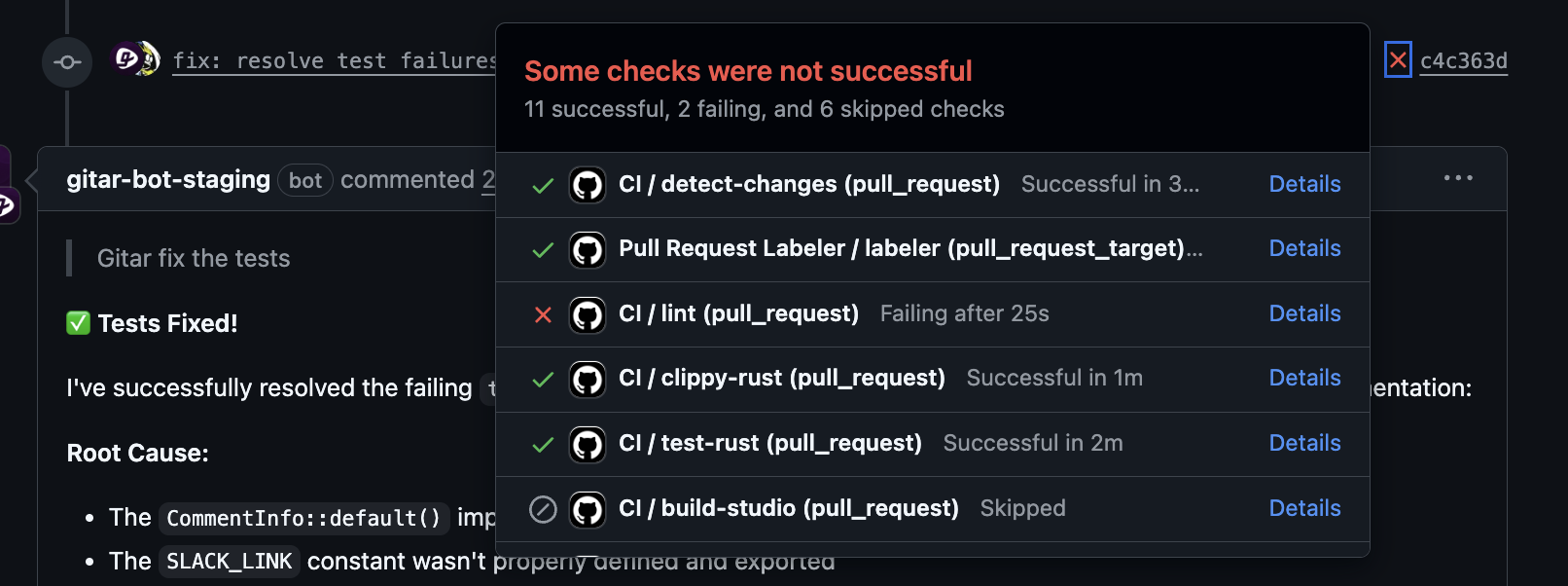
- Autonomous CI Repairs: Gitar detects and resolves common failures like linting errors, build issues, and test failures by analyzing logs, generating fixes, validating them in the CI environment, and committing solutions to the pull request.
- Feedback Implementation: Gitar interprets and applies reviewer comments, cutting out repetitive back-and-forth, especially for distributed teams.
- Accurate Environment Matching: Gitar replicates complex CI setups, including dependencies and integrations like SonarQube, ensuring fixes work in production.
- Customizable Automation Levels: Teams can choose between suggestion-only mode for manual approval or full auto-commit mode with rollback options, building trust over time.
- Wide Compatibility: Gitar supports multiple CI platforms like GitHub Actions, GitLab CI, and CircleCI, as well as languages including Python, Go, and JavaScript.
Want to streamline CI fixes and speed up delivery? Book a demo with Gitar today.
How Gitar’s Healing Engine Improves Development Workflows
End Context Switching with Automated Solutions
Gitar’s automation eliminates the mental burden of context switching. Developers stay focused on creative tasks while Gitar handles CI failures, notifying them only when a pull request is fixed and ready to merge.
Removing these interruptions adds up. Instead of losing up to an hour per failure, developers maintain their workflow, leading to faster feature delivery and better code quality.
Speed Up Time-to-Merge for Distributed Teams
Gitar cuts down time-to-merge by automating feedback implementation and ensuring CI checks pass. This shortens review cycles from days to hours, a critical advantage for teams spread across time zones.
For global teams, a reviewer in one region can leave feedback, and Gitar will apply changes by the time the developer in another region logs in, eliminating delays from manual updates.
Improve Developer Morale by Reducing Repetitive Tasks
Automating mundane CI fixes lifts a significant burden off developers, letting them focus on problem-solving. This shift boosts job satisfaction and reduces frustration from repetitive debugging.
Many developers feel a sense of relief when Gitar resolves an issue like a linting error before they even notice it, complete with a clear commit message. This hands-off approach changes how they engage with CI/CD systems.
Teams also benefit as a whole. When CI issues no longer derail progress, sprints stay on track, fostering better collaboration and project outcomes.
Navigate Enterprise CI Complexity with Precision
Enterprise CI environments often involve intricate setups with multiple SDKs, security scans, and dependencies. Gitar handles these by fully replicating the environment, ensuring fixes align with specific configurations and production needs.
This attention to detail prevents new issues or vulnerabilities, making Gitar a reliable choice for large-scale, complex systems.
Move from Suggestions to Solutions with Gitar
Gitar shifts from merely suggesting fixes to autonomously applying and validating them. Unlike other AI tools that leave implementation to developers, Gitar acts as a true healing engine.
|
Feature |
Gitar (Healing Engine) |
Suggestion Engines |
Manual Work |
|
Action Type |
Autonomous Fix & Validate |
Suggest & Manual Apply |
Manual Investigation & Fix |
|
Environmental Context |
Full Replication |
Limited/Manual |
Developer Local Setup |
|
Impact on Workflow |
Uninterrupted Flow |
Context Switching |
Major Context Switching |
|
Trust Model |
Configurable Automation |
Developer Discretion |
Manual Validation |
Suggestion tools reduce some workload but still demand manual steps. Gitar, by contrast, minimizes interruptions, saving time at scale.
See the impact of automated solutions. Install Gitar now to fix broken builds and deliver quality software faster.
Key Questions About Gitar’s Autonomous CI Fixes
How Does Gitar Differ from Other AI Code Review Tools?
Gitar stands out by autonomously fixing issues, not just suggesting solutions. While many AI tools identify problems for developers to address, Gitar applies fixes, validates them in the CI environment, and commits working changes to the pull request.
Gitar also integrates with a wide range of CI systems like GitHub Actions and Jenkins, offering flexible automation levels from suggestions to full commits with rollback options for team control.
How Does Gitar Build Trust for Automated Fixes?
Gitar offers a customizable trust model to ease teams into automation. In a cautious mode, it suggests fixes for review and approval, letting teams build confidence in its accuracy.
As trust grows, teams can enable automatic commits for simpler issues like linting errors while keeping complex changes under manual review. Full rollback options and detailed logs of every action further ensure control and transparency.
Can Gitar Manage Complex Enterprise CI/CD Setups?
Enterprise CI/CD systems often have intricate requirements that Gitar handles through full environment replication. It mirrors specific configurations, dependencies, and integrations, ensuring fixes are production-ready.
Gitar supports diverse platforms like GitLab CI and Jenkins, with on-premise options for security and compliance, making it a fit for large organizations with unique needs.
What Return on Investment Can Teams Expect from Gitar?
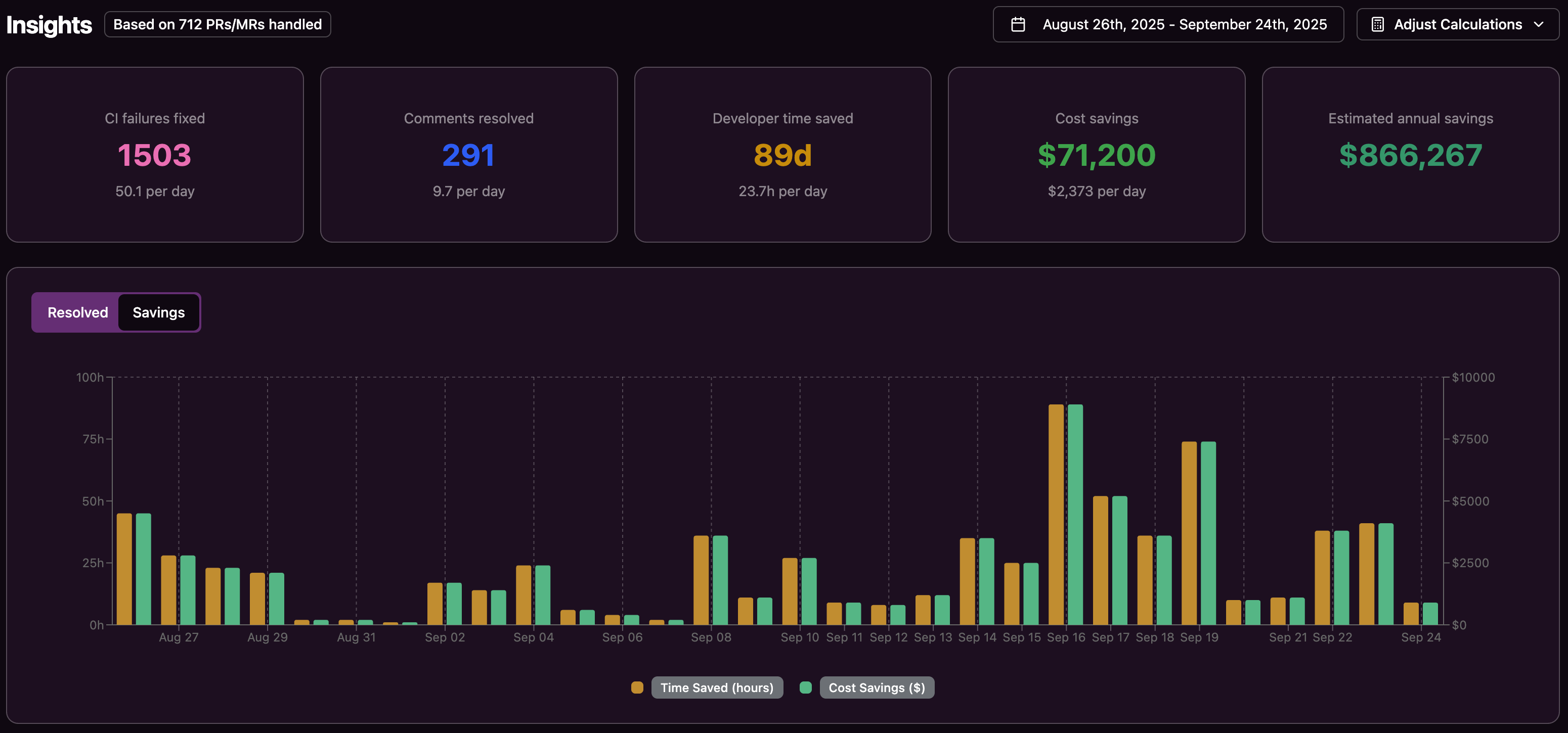
Gitar delivers measurable cost savings by reducing time spent on CI issues. For a 20-developer team losing 5,000 hours yearly to these tasks, at $200 per hour, that’s $1 million in productivity loss. Gitar can cut at least 50% of this, saving $500,000 annually while improving delivery speed and developer morale.
How Does Gitar Fit into Existing Development Tools?
Gitar integrates easily into current workflows, often setting up in under 30 minutes. It connects with GitHub and GitLab, respecting permissions and security settings for selective or full deployment.
It adapts to CI platforms like GitHub Actions and CircleCI without needing pipeline changes. Developers interact with Gitar via pull request comments, receiving updates and using simple commands or automated actions based on trust settings.
Conclusion: Reclaim Productivity with Gitar’s Autonomous CI Solutions
Developer productivity suffers from manual CI/CD feedback and validation bottlenecks. While AI coding tools speed up code creation, merging and validating remain slow without automation.
Gitar’s healing engine automates CI fixes and feedback implementation, ensuring green builds with minimal human effort. This approach saves time, boosts morale, speeds delivery, and improves code quality.
For enterprises, Gitar’s ability to replicate complex environments ensures reliable fixes while meeting security needs. A 20-developer team can recover significant productivity losses, gaining both financial and operational benefits.
Move from manual fixes to automated efficiency. Discover how Gitar can enhance your CI/CD pipelines by booking a demo today.