
Software development often faces delays due to CI build failures and manual code review feedback. These issues steal valuable time from developers, slowing down projects and increasing costs. This article looks at the impact of such bottlenecks and explains how autonomous CI fixes can help teams work faster and more efficiently.
Why CI/CD Issues Slow Down Development
Failing Builds and Feedback Cost Time and Money
CI failures drain productivity. Developers push code expecting a smooth merge, but instead face errors like test flakiness, build issues, or dependency conflicts. What should be a quick process turns into hours of debugging, breaking focus.
The financial hit is real. Developers may lose up to 30% of their time on CI and review tasks, leading to millions in lost revenue for companies. For a 20-person team, this could mean $1 million yearly in wasted productivity, delaying projects for many organizations.
Context switching adds to the problem. When developers move to a new task only to be pulled back by a failure, a short fix can stretch into a major time sink. This constant disruption makes deep, focused work nearly impossible.
Debugging failed tests and builds also takes a toll on teams, especially distributed ones. These tasks slow down progress significantly, and time zone differences can turn quick feedback into days of waiting.
Limitations of Current CI/CD Solutions
Most tools and manual methods can’t keep up with today’s CI/CD challenges. Developers must dig through error logs, switch back to local setups, apply fixes, and hope the pipeline passes. This cycle creates delays instead of solving them.
AI coding tools have increased code output, but this means more pull requests to review and more chances for CI issues. The focus has shifted from writing code to validating and merging it effectively.
Slow, monolithic pipelines with sequential tests often lead to cascading failures and discourage frequent commits. Teams with pipelines under 10 minutes deploy twice as often, showing how CI speed directly affects delivery pace.
How Autonomous CI Solves Development Delays
Why Self-Healing CI Saves Time
Traditional CI tools and AI reviewers only suggest fixes, leaving the work to developers. This still interrupts focus and requires manual effort to apply and test solutions.
Self-healing CI changes the game. These systems detect issues, create fixes, test them across the full pipeline, and apply solutions without developer input. CI becomes a background process, not a constant hurdle.
By handling routine errors automatically, autonomous systems let developers focus on creative tasks. Broken builds no longer disrupt workflows, saving hours of frustration.
Ready to streamline your CI process? Install Gitar to automate fixes today.
Meet Gitar: Your AI Agent for Faster Development
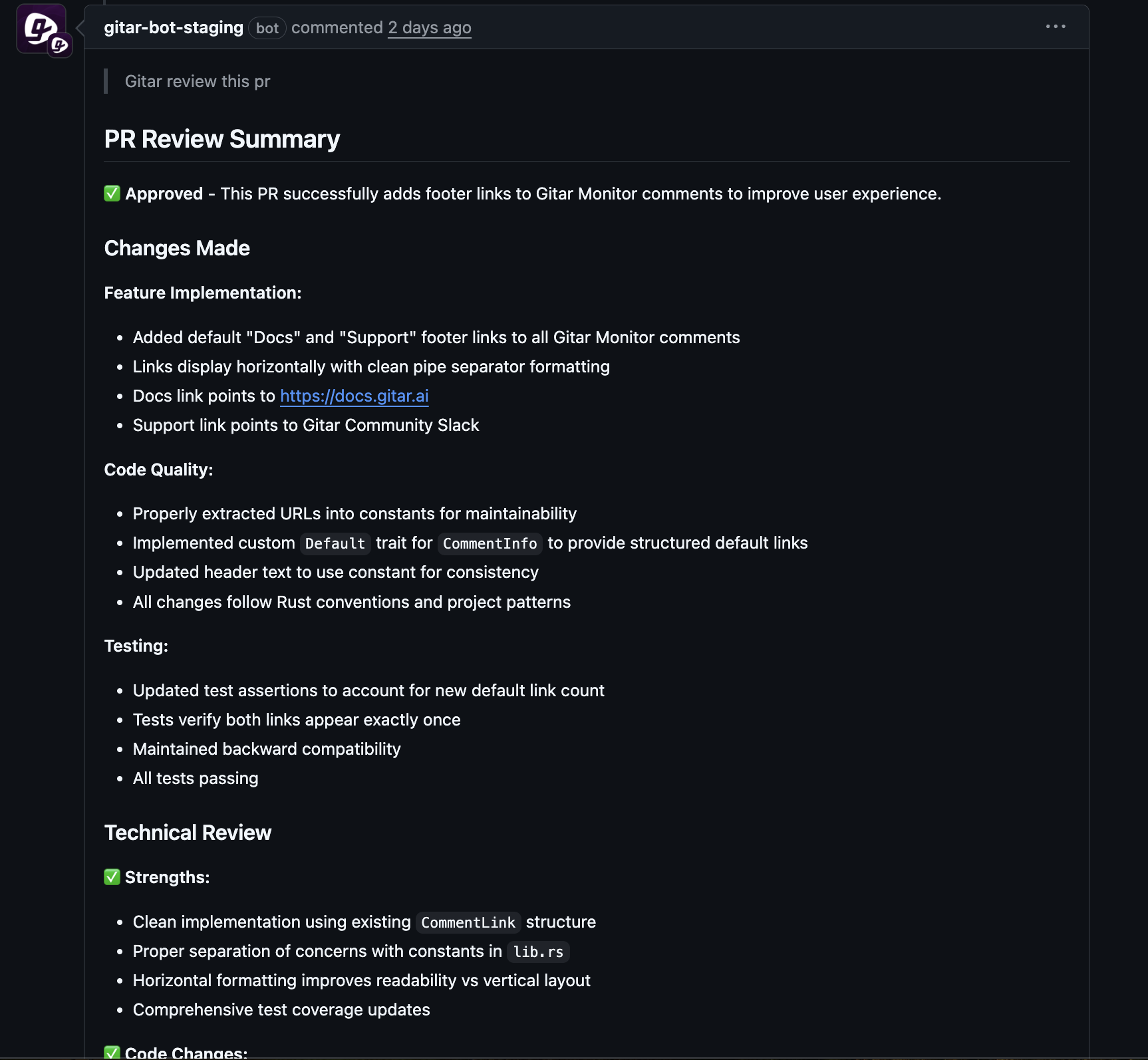
Gitar is an AI tool that automatically resolves CI pipeline failures and code review feedback. It turns hours of manual debugging into a hands-off process, freeing developers from repetitive tasks.

Key Benefits of Gitar for Your Team
Gitar offers practical features to cut development delays:
- Complete Fixes: Gitar applies solutions and tests them across CI workflows, ensuring pull requests pass without guesswork.
- Environment Matching: It handles complex setups, like specific JDK versions or multi-SDK dependencies, for accurate fixes.
- Review Automation: Gitar acts on reviewer feedback, making changes and committing them with clear notes, ideal for distributed teams.
- Trust Options: Start with a cautious mode where fixes need approval, then move to full automation as trust grows.
- Wide Compatibility: Gitar works with GitHub Actions, GitLab CI, CircleCI, and more, fitting diverse tech stacks.
Measuring the Value: Savings and Speed with Gitar
Cutting Costs and Boosting Output
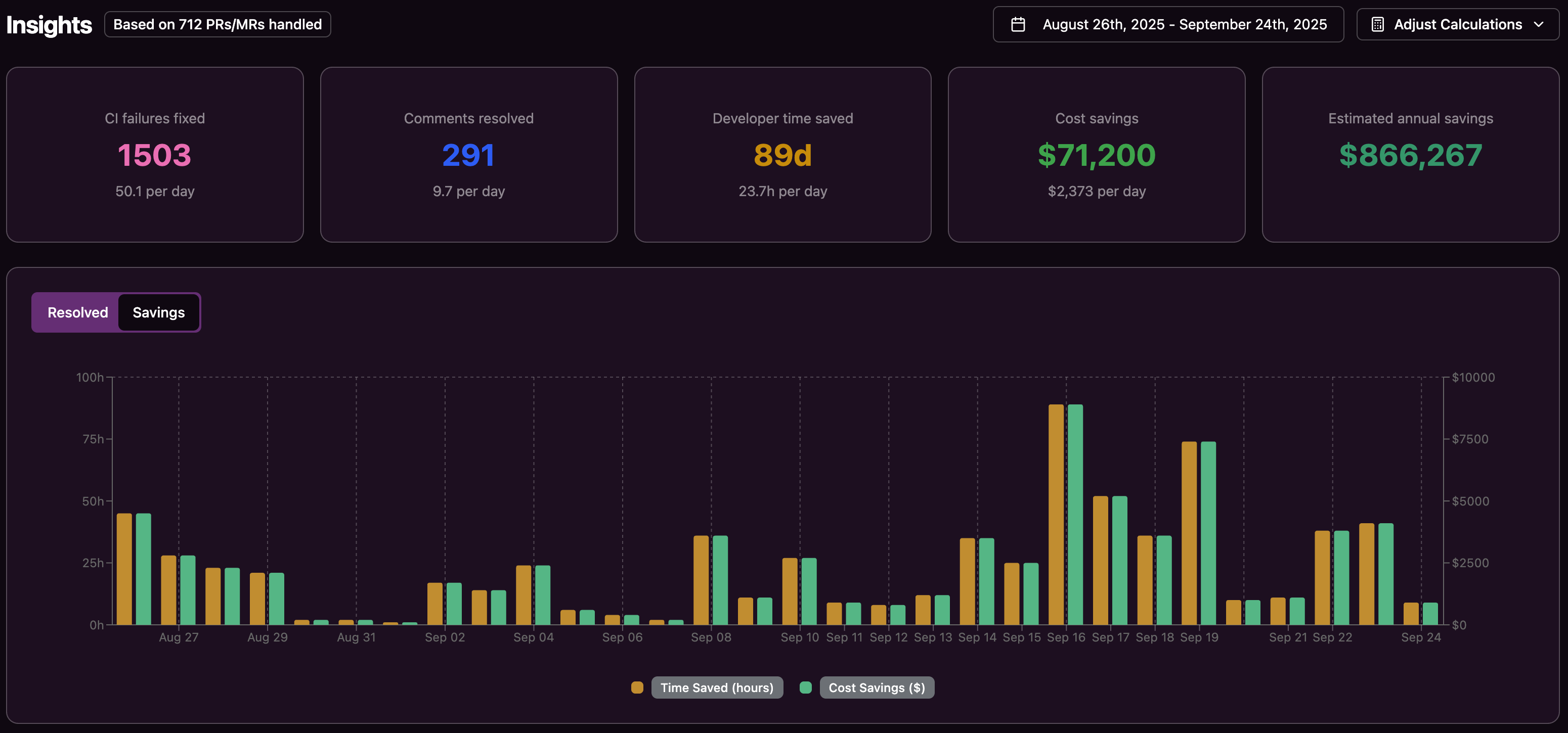
For a 20-developer team, spending just one hour daily on CI and review issues adds up to 5,000 hours lost yearly, costing around $1 million. Gitar automates these tasks, potentially saving hundreds of thousands of dollars even at half effectiveness.
Pipeline reliability matters. Teams with high CI success rates deliver faster and waste less time on flaky builds. Automated fixes improve these metrics, speeding up releases and lowering costs.
Improving Developer Focus and Satisfaction
Eliminating repetitive debugging does more than save time. It reduces frustration, helping developers stay engaged. This can lead to better job satisfaction and lower turnover.
Uninterrupted focus is vital for coding. By handling CI failures automatically, Gitar helps developers stay in the zone, working on features instead of fixes.
How Gitar Fits Into Your Workflow
Automatic Fixes for Hassle-Free CI
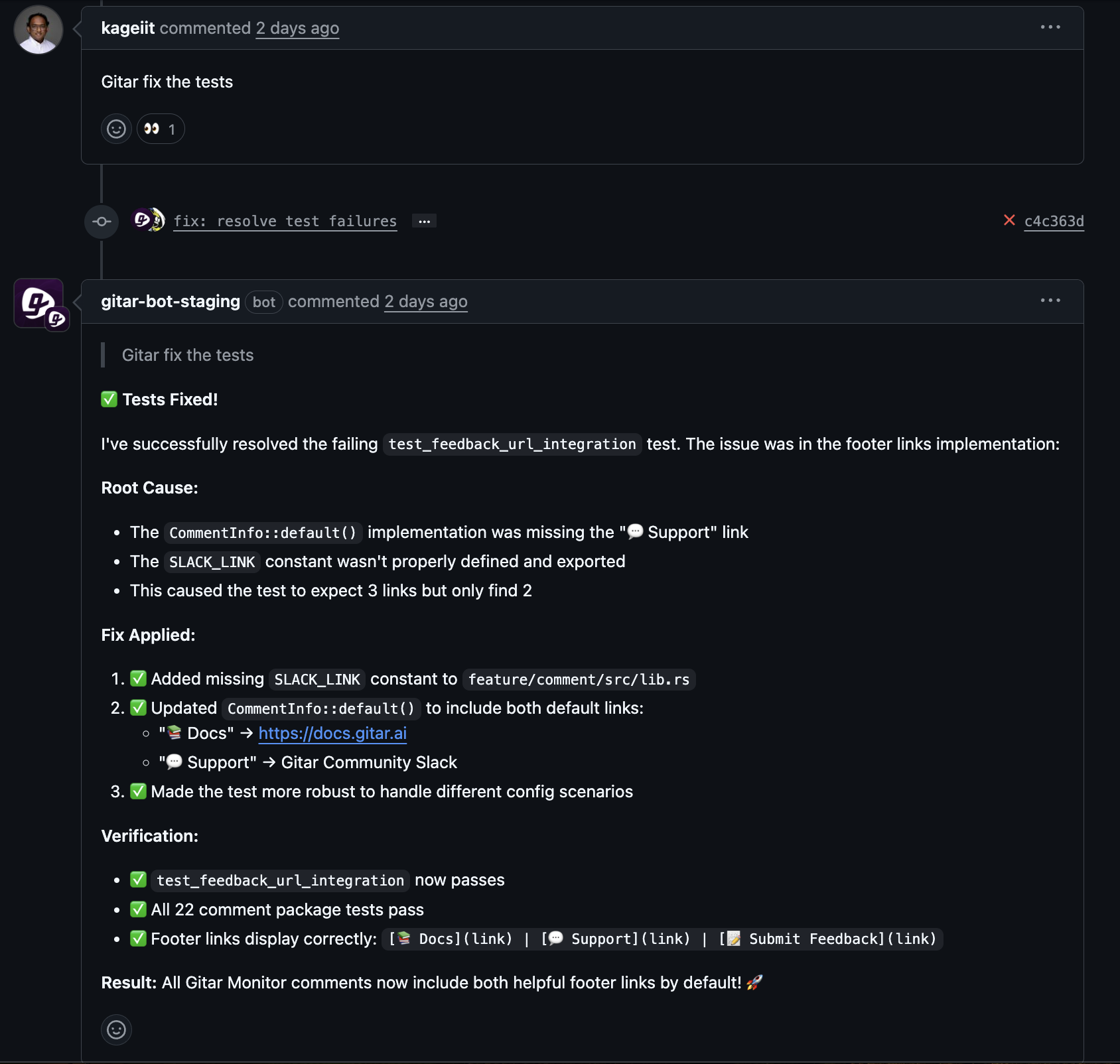
Gitar works quietly to keep pipelines running. If a lint error or test failure pops up, it analyzes the issue, applies a fix, and commits the change, often before anyone notices.
Developers experience a moment of relief seeing failures resolved with a new commit in their pull request, complete with a clear explanation. This builds confidence in the tool.
Gitar handles common issues like style errors, outdated test snapshots, and build script problems, all without manual effort.
Faster Reviews for Distributed Teams
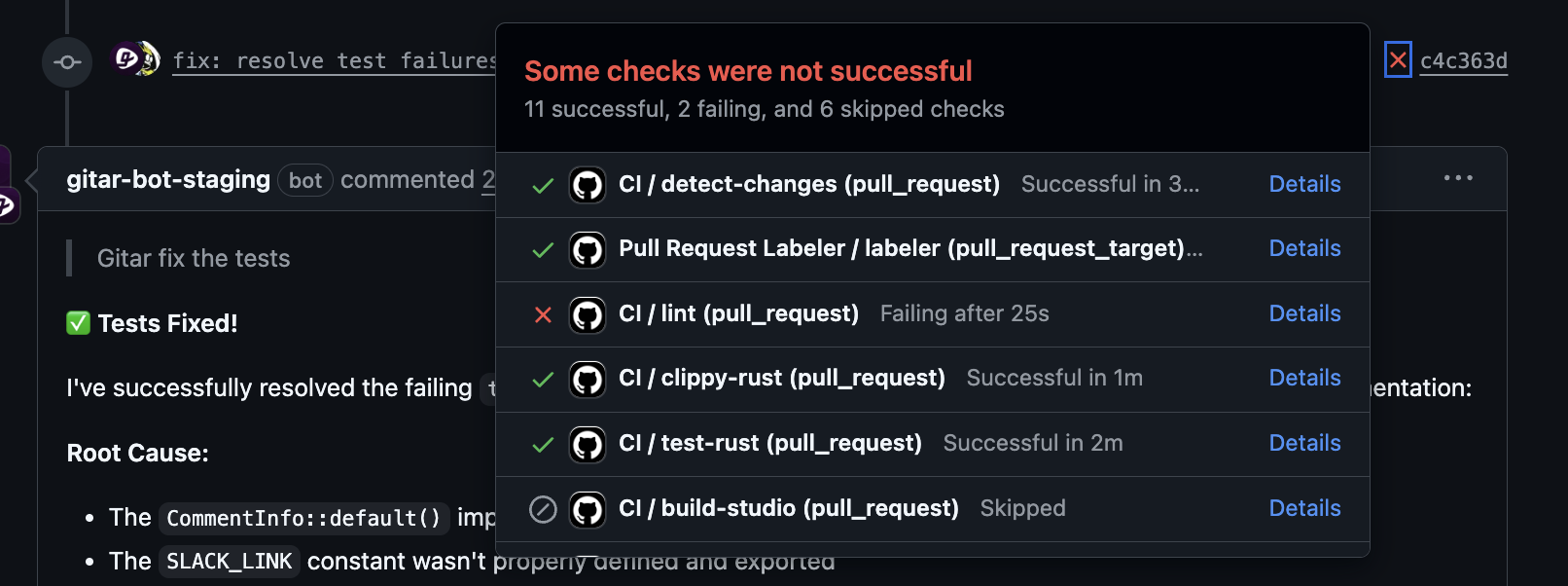
Gitar speeds up feedback cycles, especially for teams across time zones. When a reviewer leaves a comment, Gitar can apply the change instantly, avoiding delays.
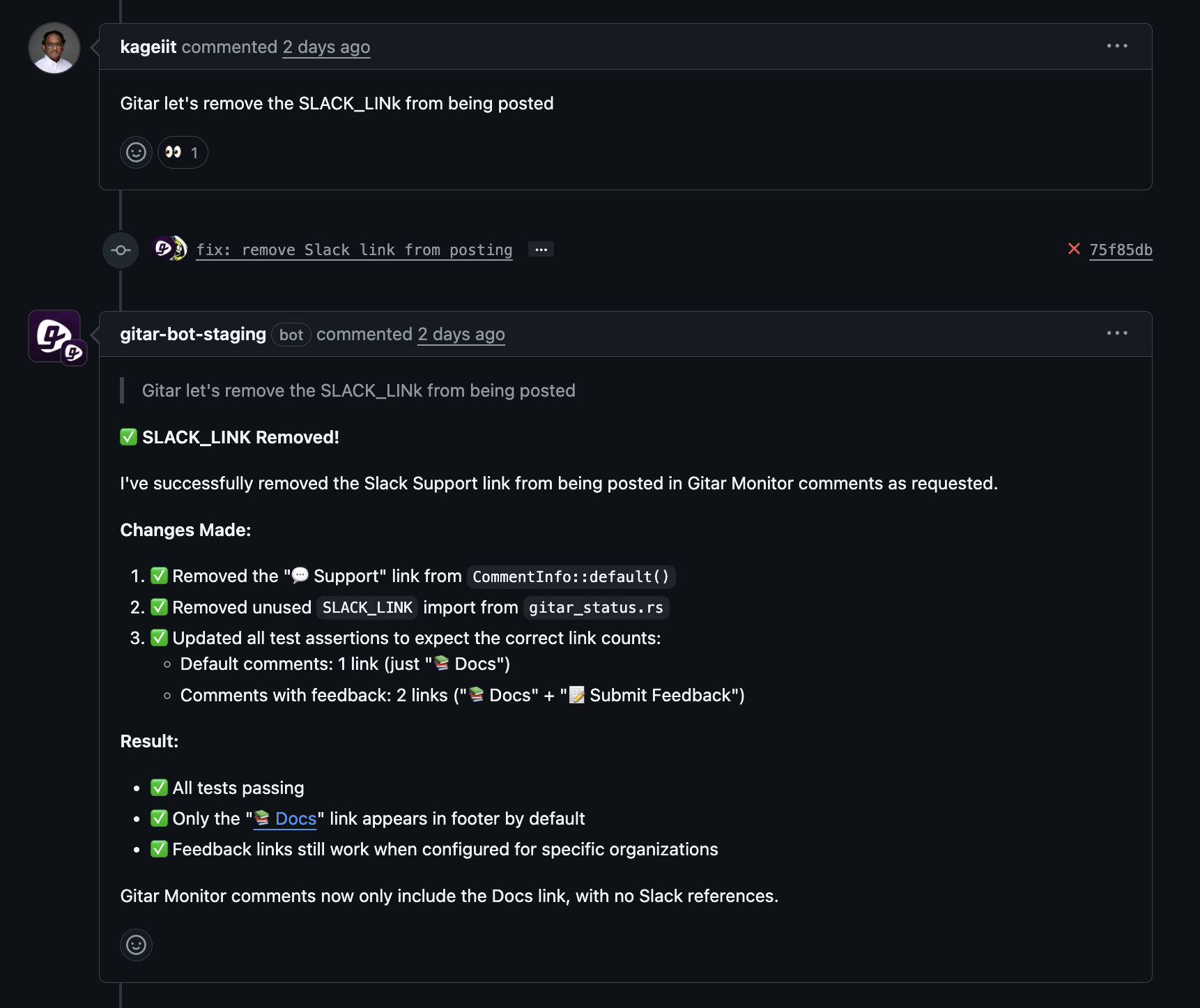
For instance, a reviewer once asked to remove a feature from a pull request. Gitar made the update and committed it with a note, so the developer saw a ready-to-approve request the next day. This turns reviews into a smooth, ongoing process.
Ready to improve your review workflow? Install Gitar to automate fixes now.
Gitar vs. Traditional Methods: Why Automation Wins
Comparing Development Speed Across Approaches
|
Feature |
Manual Work |
AI Review Tools |
Gitar (Autonomous CI) |
|
Core Functionality |
Manual debugging |
Suggestions only |
Automatic detection and fixes |
|
CI Failures Handled |
All, manually |
Some, with suggestions |
Common failures, automatically |
|
Code Review Feedback |
Manual changes |
Suggestions only |
Automatic implementation |
|
Validation Process |
Local environment |
Manual by developer |
Full CI workflow |
|
Context Switching |
Frequent |
Frequent |
Minimal |
|
Developer Focus |
Interrupted |
Interrupted |
Sustained |
|
Environment Setup |
Local only |
Not supported |
Full enterprise match |
|
Time to Merge |
Slow |
Slow, manual steps |
Faster with automation |
This table highlights the edge of autonomous tools. Manual methods and basic AI reviewers demand developer effort, while Gitar automates from issue detection to resolution, cutting delays.
Older approaches keep developers stuck in cycles of switching tasks and manual checks. Gitar breaks this pattern, letting teams focus on meaningful work.
Ready to cut CI delays? Install Gitar to automate fixes today.
Common Questions About Speeding Up Development
How Does Gitar Differ From Other AI Review Tools?
Many AI tools suggest fixes but don’t ensure they work. Gitar applies solutions, tests them across your CI pipeline, and delivers passing builds without extra steps.
Can Gitar Handle Our Complex CI Setup?
Gitar is built for complex environments. It mirrors your specific dependencies and SDK versions, creating fixes that fit your unique workflow.
How Does Gitar Reduce Context Switching?
Gitar tackles context switching by handling CI fixes and review feedback automatically. Developers stay focused on their current tasks without interruptions from pipeline issues.
What Kind of Savings Can We Expect?
For a 20-developer team, CI and review issues can cost $1 million yearly in lost time. Gitar can cut these losses significantly, often saving hundreds of thousands annually.
How Can We Trust Automated Fixes?
Gitar offers a flexible trust model. Start with a mode where fixes need approval, then shift to full automation as you see reliable results. Each fix comes with a clear explanation, and rollbacks are always an option.
Wrap-Up: Boost Efficiency with Gitar
CI failures and manual code reviews eat up to 30% of developer time, creating costly delays for software teams. These inefficiencies slow down releases and drain resources.
Gitar changes this by automating fixes and feedback handling. It detects problems, applies solutions, and validates them, freeing up developer time for core tasks.
Beyond saving hours, Gitar helps maintain focus and cuts repetitive work, fostering a better work environment for engineers.
Teams adopting tools like Gitar can improve delivery speed and overall development efficiency.
Ready to enhance your process? Install Gitar to automate CI fixes now.