
CI/CD pipelines are becoming more complex, and AI-assisted coding has introduced new challenges in software delivery. This article dives into how custom configurations in autonomous CI systems can significantly improve reliability. You’ll see how adjustable trust settings help engineering teams reduce friction, speed up delivery, and create self-healing pipelines while staying in control.
Why Unreliable CI/CD and Manual Fixes Hurt Teams
CI Failures Slow Down Developers
CI failures disrupt developers’ focus and waste valuable time. With AI tools speeding up code writing, the real challenge now is moving that code through pipelines and reviews without constant delays or manual fixes.
Picture this: you submit a pull request, expecting smooth progress, only to face a wall of errors. A missing dependency breaks the build, a test behaves unpredictably, or a linter flags a minor style issue. Each error forces you to dig through logs, switch back to your local setup, apply a fix, commit, push, and wait for the pipeline to rerun.
This cycle takes more than just the few minutes to fix an issue. Overly complex CI/CD pipelines create slow feedback loops that drain productivity. When developers shift from focused work to troubleshooting routine failures, they lose the mental clarity needed for creative problem-solving.
AI coding tools like GitHub Copilot have increased the volume of code and pull requests, adding pressure to pipelines. Performance and scalability of CI/CD tools are now more important than ever as teams work to manage higher output without losing reliability.
These interruptions change how developers operate. Instead of building features, they spend hours fixing pipeline issues, often losing up to 30% of their time on CI and review obstacles.
Project Delays and Rising Costs for Leaders
CI/CD inefficiencies create widespread problems for engineering leaders, affecting every part of software delivery. Small pipeline delays add up, causing significant costs and disruptions beyond the tech team.
Inefficient pipelines lead to hidden costs, slower time-to-market, and frustrated developers. For a team of 20 developers, around 5,000 hours are lost yearly to debugging CI issues and handling review feedback. At standard rates, that’s about $1 million in wasted productivity.
Delivery timelines suffer too. When CI failures are frequent, projects that should take days stretch into weeks. Developers get stuck maintaining pipelines instead of coding features, making timelines unpredictable and planning difficult for product teams.
Key metrics like change failure rate and recovery time reveal struggles in continuous delivery. Teams with unreliable systems often see low deployment frequency, long lead times, high failure rates, and slow recovery from issues.
The impact on people is just as serious. Developers grow frustrated with repetitive tasks, leading to burnout, higher turnover, increased hiring costs, and lost expertise that delays projects further.
Install Gitar to fix broken builds automatically and ship quality software faster
Why Full AI Automation in CI/CD Feels Risky
Even with a clear need for automation in CI/CD, many teams hesitate to adopt fully autonomous systems. This caution makes sense since pipelines are vital to production, customer experience, and business operations.
The issue lies in the complexity of modern CI/CD setups. Overly large pipelines often become difficult to manage, making it hard even for experienced engineers to anticipate every failure or solution.
Many AI tools act more like advisors than problem-solvers. They spot issues and suggest fixes but can’t confirm if those fixes work in intricate enterprise settings. A proposed fix for a linting error might seem fine alone but fail when paired with specific dependencies or custom security scans.
Enterprise systems add extra layers of difficulty. Multiple SDK versions, third-party scans from tools like SonarQube, custom test setups, and unique deployment steps create a maze of requirements that demand deep context to handle well.
This complexity builds a trust gap. Teams want automation but worry about errors from automated actions, sticking to slow manual processes despite the inefficiencies.
Meet Gitar: Self-Healing CI with Adjustable Trust Settings
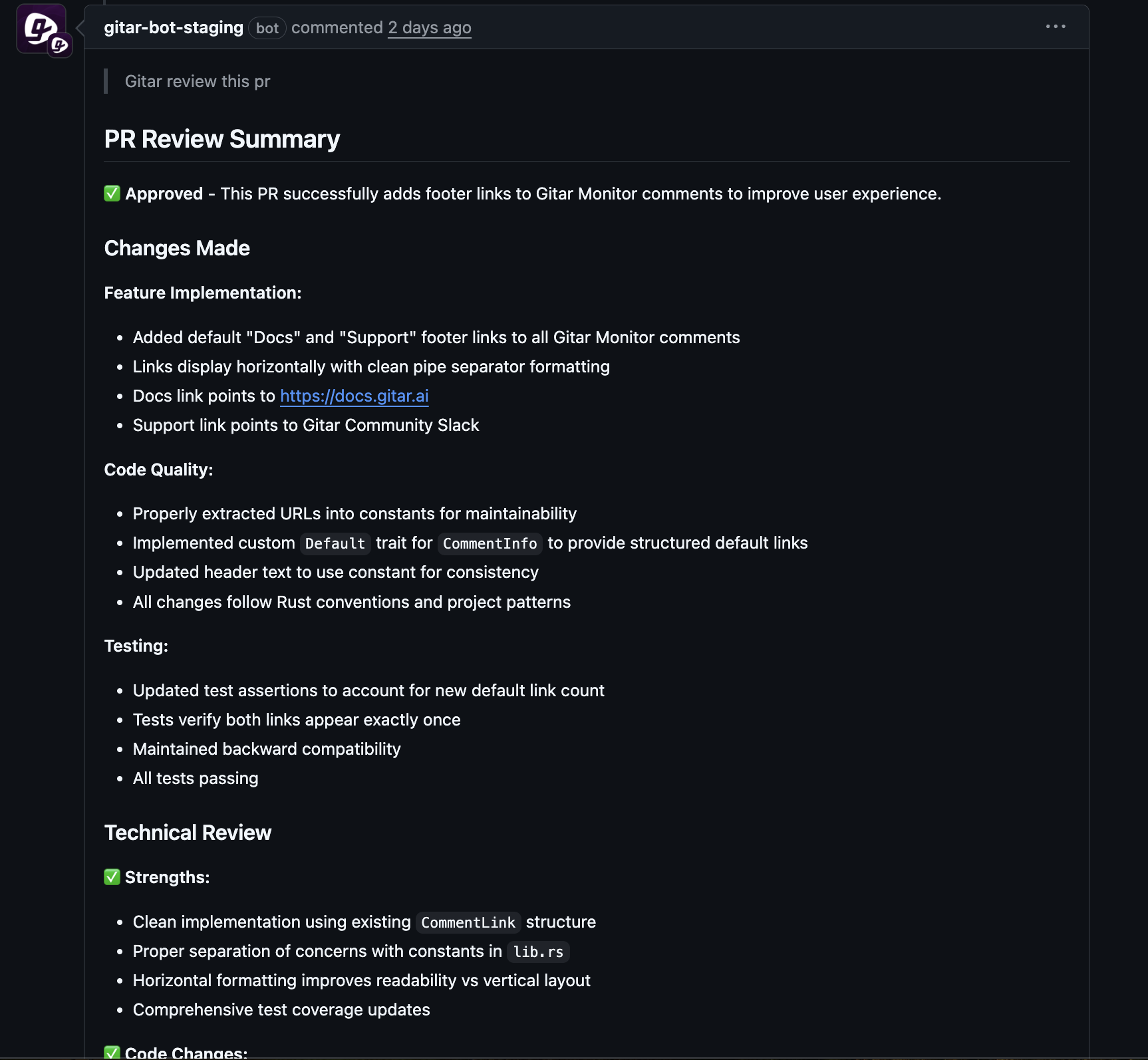
Gitar shifts the game from AI tools that only suggest fixes to a system that actively resolves CI issues and review feedback on its own. Unlike advisors, Gitar analyzes problems, applies fixes, validates them, and commits changes directly to your code.
What makes Gitar different is its ability to mirror your full CI environment, ensuring fixes work under the same conditions as the failure. This builds confidence by delivering tested solutions instead of unproven ideas.
Here’s what Gitar brings to the table:
- Complete fix automation: Applies, validates, and commits changes for CI failures, delivering green builds without manual effort.
- Environment matching: Handles complex enterprise setups with specific JDK versions, multi-SDK dependencies, and scans from tools like SonarQube.
- adjustable trust settings: Start with suggestions only, then scale to full automation as your needs evolve, balancing flexibility and control.
- Smart review support: Addresses review feedback independently, cutting delays for distributed teams across time zones.
- Wide platform compatibility: Works with GitHub Actions, GitLab CI, CircleCI, BuildKite, and more, fitting into your existing stack.
Adoption happens in steps to build trust. Teams often begin in a suggestion mode, reviewing and approving fixes with one click. As successful automation builds confidence, they can move to full autonomy with rollback options for safety.
Request a Gitar demo to see it in action

How Custom Configurations Boost Engineering Teams with Gitar
Build Trust Gradually with Flexible Settings
Adopting autonomous CI/CD starts with small, trust-building steps using Gitar’s adjustable automation levels. Instead of jumping straight to full automation, teams can increase it over time as they gain confidence.
In suggestion mode, Gitar identifies CI failures, finds root causes, and offers tested fixes for developers to review. This keeps human oversight while saving time on figuring out and applying solutions. A single click approves the fix, blending control with ease.
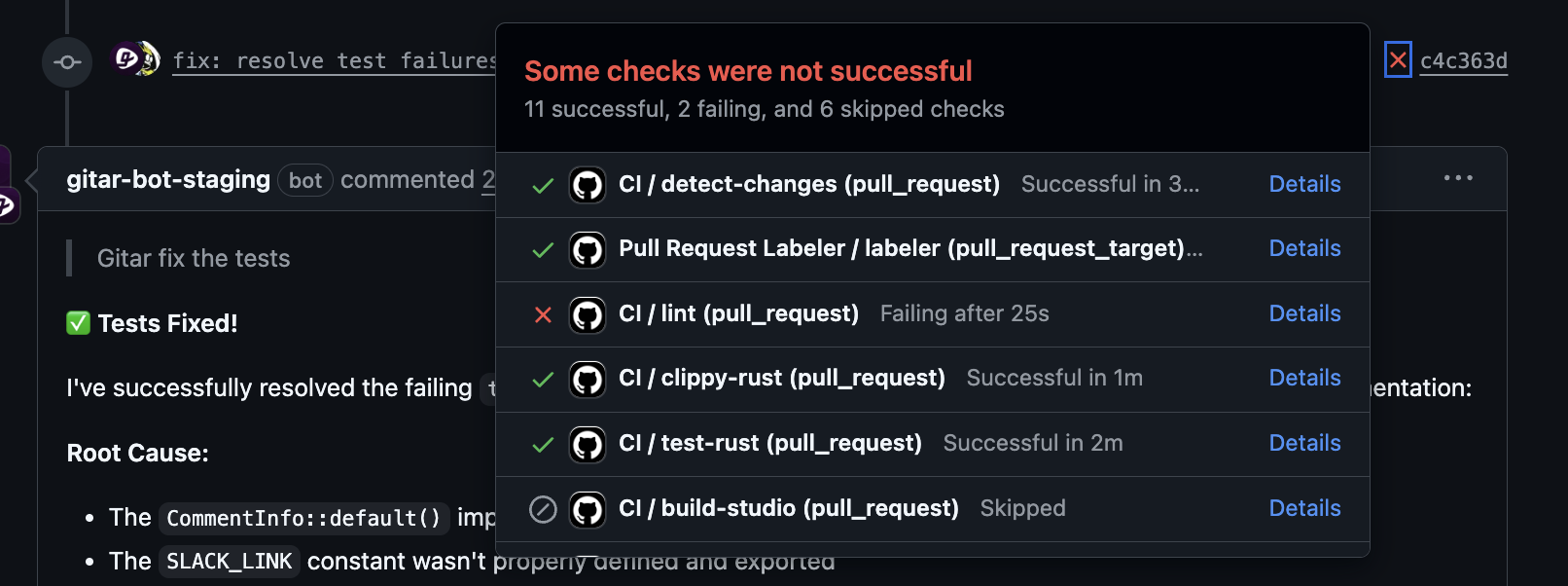
Within days, teams often notice the value. A developer submits a pull request, a linting error pops up, and before they check notifications, Gitar comments with a ready-to-approve fix. This turns doubt into relief as workflow interruptions vanish.
After seeing consistent success with fixes like linting or dependency issues, confidence grows. Teams can then adjust automation for specific failure types, starting with low-risk ones like formatting before tackling complex challenges.
This step-by-step method eases the shift to autonomous systems. Custom configurations let teams experience benefits while maintaining control, making full automation a natural next move.
Speed Up Delivery by Cutting Developer Workload
Once teams switch to full automation mode, productivity gains become clear. Gitar removes common frustrations like linting errors, formatting issues, basic test failures, and dependency conflicts. Pull requests that once needed several commits now pass CI on the first try.
Lead times for changes shrink noticeably. Pipeline bottlenecks that used to need manual fixes get resolved without intervention, cutting the gap between commit and merge.
For ongoing tasks like dependency updates or test maintenance, Gitar handles them in the background. This frees developers to focus on building features instead of fixing routine issues, boosting focus and innovation.
These small time savings add up, improving delivery speed. Teams meet sprint goals more reliably, with fewer delays from technical debt or maintenance tasks.
Reduce Risk with Control and Auto Rollbacks
Autonomous tools need strong safeguards to keep teams confident and systems stable. Gitar combines thorough validation with rollback options to ensure automation supports reliability.
Every fix is tested against the complete CI setup before application, including relevant tests and policy checks. Only fixes that pass are committed, with clear explanations for transparency.
A workflow dashboard offers full visibility into automated actions. Leaders can monitor success rates, spot failure patterns, and tweak settings based on performance data.
If a fix leads to unexpected problems, rollback features restore the prior state while saving insights for future improvements. This safety net lets teams embrace automation without fear of rare issues.
Improve Collaboration Across Distributed Teams
Distributed teams often struggle with CI/CD cycles, especially reviews across time zones. A developer in one region might wait hours for feedback from another, stretching simple fixes over days.
Gitar changes this by acting as a responsive go-between. If a reviewer requests a change, Gitar can apply the fix and commit it before the original developer logs back in. This cuts out the usual back-and-forth delays.
For remote teams, this means faster workflows. Reviews become a nonstop, independent process where human input guides direction and AI manages execution, shortening cycle times regardless of location.
Install Gitar to fix builds automatically and deliver quality software faster
Gitar’s Healing Engine Compared to Suggestion Tools
|
Feature Category |
Gitar (Healing Engine) |
AI Code Reviewers (e.g., CodeRabbit) |
Big Model Integrations (e.g., Claude for CI) |
Manual Work (Status Quo) |
|
Issue Resolution |
Autonomous fix and validate |
Suggests fixes, manual validation |
DIY AI toolkit, manual fix and validate |
Manual detect, debug, fix, validate |
|
CI/CD Integration |
Full environment replication, cross-platform |
Git provider level, some CI integration |
Requires custom integration |
None |
|
Trust Model |
Configurable (Suggestion to Full Automation) |
Suggestion-based, limited automation |
Fully custom, user-managed |
Full human oversight |
|
Developer Toil |
Greatly reduced |
Partially reduced (still needs action) |
High (requires building setup) |
Very High |
Gitar stands out by fully automating the fix-validate-commit process. While other tools offer suggestions that still need manual effort, Gitar handles everything independently, ensuring fixes match your specific environment before application.
Common Questions About Autonomous CI Fixes
How Does Gitar Earn Trust for Automated Fixes?
Gitar builds trust with a flexible approach, letting teams gain confidence step by step. It starts in a suggestion mode, presenting fixes for review and one-click approval, keeping humans in the loop while cutting down effort.
Over time, as teams see reliable fixes for issues like formatting or minor tests, trust grows. They can then shift to full automation for certain fixes or projects where confidence is high.
Validation is key to this trust. Gitar mirrors your CI setup to confirm fixes work in your context. Rollback features also act as a safety net if rare issues appear later.
Can Gitar Handle Complex Enterprise CI Setups?
Yes, Gitar is built for the challenges of enterprise CI environments. It replicates workflows with specific JDK versions, multi-SDK dependencies, custom builds, and scans from tools like SonarQube or Snyk.
Unlike basic AI tools that work in isolation, Gitar grasps the connected nature of enterprise systems. It manages fixes across dependency versions and meets coding standards, ensuring they fit your exact pipeline conditions.
How Is Gitar Different from Other AI Review Tools?
Gitar operates at a unique stage of development compared to other tools. IDE assistants help with code writing before commits, and review tools analyze pull requests. Gitar works after commits as a healing system, fixing issues autonomously once code is submitted.
While suggestion tools require manual steps to apply and test fixes, Gitar handles the entire process from analysis to commit. It addresses CI failures like linting or dependencies directly in your infrastructure, unlike tools focused on individual coding or review stages.
What Returns Can Teams Expect from Gitar?
Gitar offers measurable cost and time savings. For a 20-developer team, about 5,000 hours are lost yearly to CI issues and reviews, costing around $1 million at $200 per hour.
If Gitar resolves just half of these problems automatically, teams could save about $500,000 annually in productivity. Additional gains include better morale, quicker delivery, reliable sprints, and faster onboarding for new team members.
Does Gitar Fit with Existing CI/CD Tools?
Gitar integrates easily with platforms like GitHub Actions, GitLab CI, CircleCI, and BuildKite. Setup requires minimal changes, delivering value quickly without disrupting workflows.
It connects at the repository level using standard APIs and webhooks, stepping in only for failures while leaving successful builds alone. Teams can test it on one project before scaling up.
For complex setups with custom images or deployments, Gitar adapts to your patterns. It learns your environment to ensure fixes align with your processes.
Conclusion: Gain Back Developer Time with Automated Reliability
Software delivery is moving toward smart automation that solves routine issues independently. Custom configurations are the bridge to this future, letting teams adopt AI tools with control and oversight.
Gitar leads this shift, turning CI/CD from a hurdle into a self-healing process that speeds up delivery and boosts reliability. With adjustable trust settings, detailed environment matching, and automated fixes, teams can scale automation at their own pace while seeing real gains.
Teams adopting this now will benefit from quicker market delivery, happier developers, stronger system stability, and savings from regained productivity.