
Key Takeaways for 2026 Code Review Automation
- AI coding tools now accelerate development 3 to 5 times, yet they overwhelm traditional code reviews. PR volumes are up 29% year over year, and review times have surged 91%.
- Most automated code review tools only suggest changes and still require manual fixes. True automation needs healing engines that apply fixes and validate them against CI.
- Gitar stands out with free unlimited code reviews, auto-fix capabilities with a 14-day trial, and full integrations across GitHub, GitLab, CircleCI, and more.
- Follow this 7-step guide: assess pipelines, add linters, install Gitar, configure settings, enable auto-fix, add rules, and integrate workflows for self-healing CI.
- Advance through the maturity model from manual reviews to self-healing CI with Gitar to guarantee green builds and ship higher quality software faster.
Where Automated Code Review Tools Stand in 2026
The automated code review ecosystem now falls into clear categories. Tools like ESLint and Pylint provide static analysis but lack the AI-driven contextual understanding of modern platforms. Paid AI tools like CodeRabbit and Greptile charge $15-30 per seat for suggestion-only features, while open-source options like pre-commit hooks offer limited automation.
The core limitation across most tools is their suggestion-only approach. Average time to merge was 3 days 4 hours before automated tools, with 60% of companies citing CI pipeline failures as the primary cause of delayed projects. Even with AI suggestions, developers still implement fixes manually, validate them against CI, and repeat review cycles.
Integration capabilities also vary widely. GitHub Actions and GitLab CI support is common, but true cross-platform coverage including CircleCI and Buildkite remains rare. Many tools focus on a single platform, which creates vendor lock-in and reduces team flexibility.
Gitar vs. Competitors: Concrete Capability Comparison
| Capability | CodeRabbit/Greptile | DIY LLMs | Gitar |
|---|---|---|---|
| PR Summaries | Yes (paid) | Partial | Yes (free) |
| Inline Suggestions | Yes | Yes | Yes (free) |
| Auto-Apply Fixes | No | No | Yes (14-day free trial) |
| CI Failure Auto-Fix | No | No | Yes (14-day free trial) |
| Pricing | $15-30/seat | Infra costs | $0 unlimited (code review free; autofix 14-day trial) |
| Integrations | Limited | Custom | Full (GitHub/GitLab/etc.) |
The critical differentiator is Gitar’s healing engine approach compared with competitors’ suggestion engines. Other tools identify problems and leave comments. Gitar analyzes failures, generates fixes, validates them against CI, and commits working solutions automatically.
7 Steps to Automate Code Reviews with Gitar
Step 1: Assess Your Current Pipeline
Start by identifying your CI/CD platform such as GitHub Actions, GitLab CI, CircleCI, or Buildkite. Document existing linting, testing, and build processes. Map current failure points and review bottlenecks so you know where automation will help most.
Step 2: Add Foundational Linters
Set up basic static analysis tools in your CI pipeline. For Python projects, use this GitHub Actions workflow:
name: Code Quality on: [pull_request] jobs: lint: runs-on: ubuntu-latest steps: - uses: actions/checkout@v3 - uses: actions/setup-python@v4 with: python-version: '3.11' - run: pip install flake8 black - run: flake8 . --max-line-length=88 - run: black --check . Step 3: Install the Gitar App
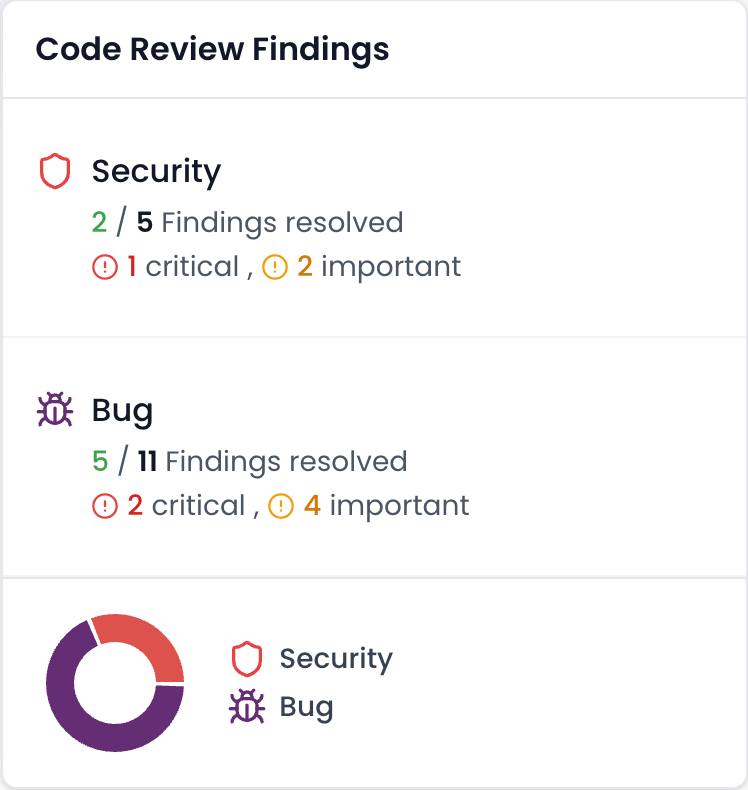
Add the Gitar GitHub App or GitLab integration to your repositories. Installation takes about 30 seconds and does not require a credit card. After installation, Gitar begins posting dashboard comments on new PRs.
Step 4: Tune Gitar Review Settings
Enable PR summaries and single-comment consolidation to cut notification noise. Configure review depth and focus areas based on your team’s priorities, such as security, performance, or style consistency.
Step 5: Turn On the Auto-Fix Trial
Activate Gitar’s 14-day auto-fix trial for CI failures and review feedback implementation. Start with low-risk fixes such as linting errors and formatting issues. This approach builds trust before you expand to more complex fixes.
Step 6: Add Natural Language Rules
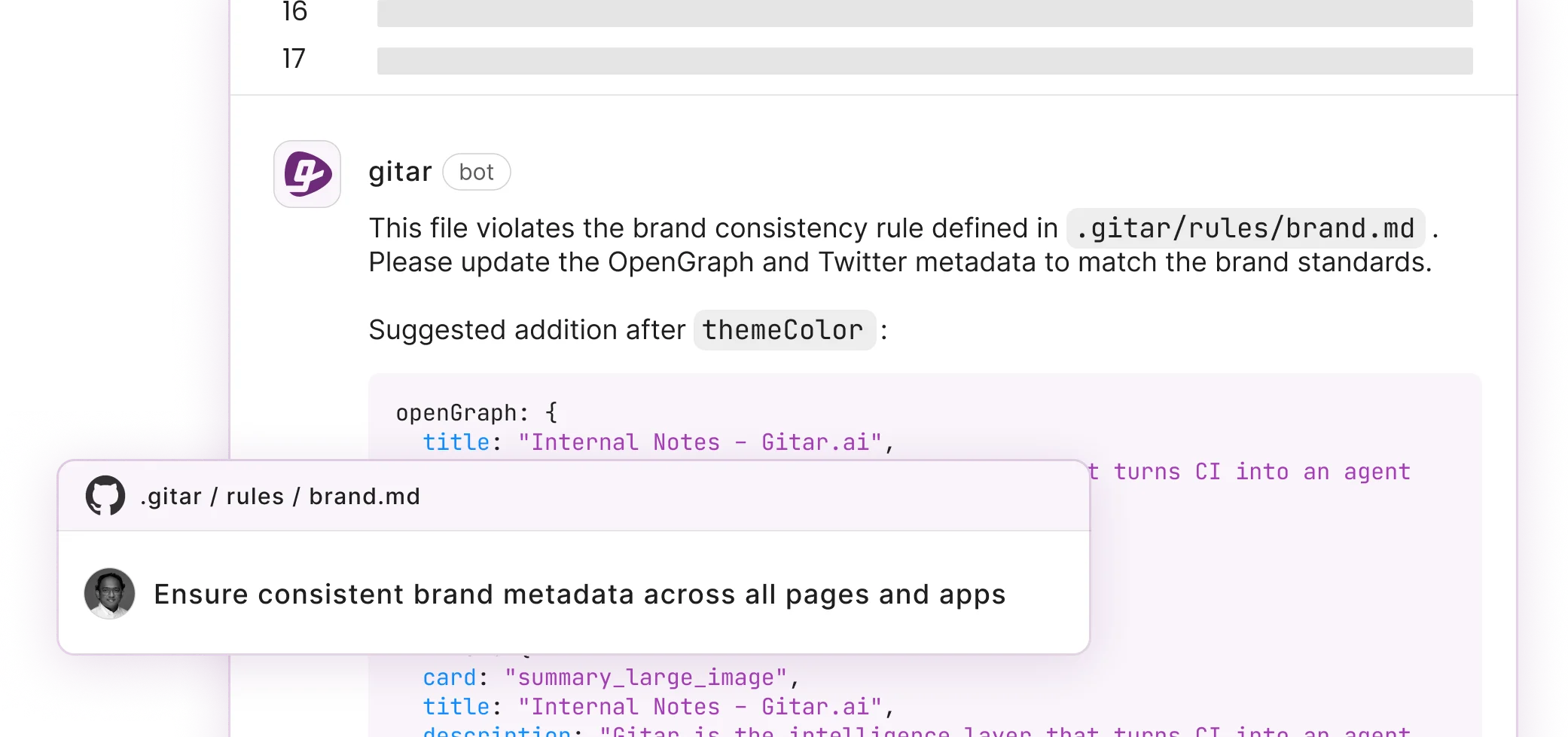
Create repository-specific rules using natural language in .gitar/rules/*.md files:
--- title: "Security Review" when: "PRs modifying authentication or encryption code" actions: "Assign security team and add label" --- These rules align reviews with your internal policies without custom scripting.
Step 7: Connect Workflow and Analytics Tools
Connect Jira, Slack, and Linear integrations for cross-platform context and notifications. Configure analytics dashboards to track CI failure patterns, resolution times, and auto-fix coverage.
Python Projects: Sample GitHub Actions with Gitar
Python teams can combine Gitar with comprehensive CI checks using this workflow:
name: Python CI with Gitar on: [pull_request] jobs: test: runs-on: ubuntu-latest steps: - uses: actions/checkout@v3 - uses: actions/setup-python@v4 with: python-version: '3.11' - run: pip install -r requirements.txt - run: pytest tests/ - run: mypy src/ # Gitar automatically analyzes failures and posts fixes Inside Gitar: How the Healing Engine Delivers Self-Healing CI
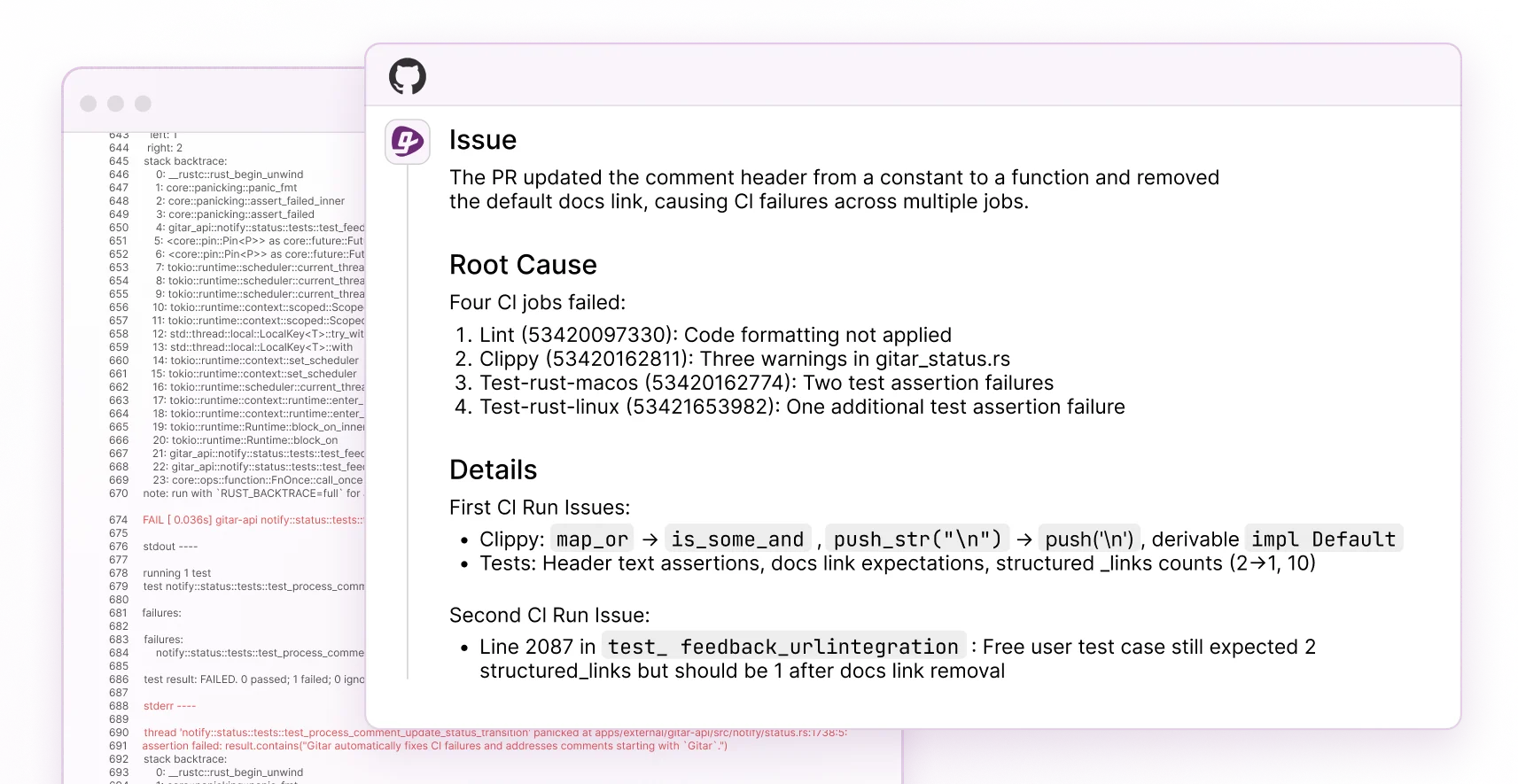
Gitar’s architecture focuses on healing instead of suggestions. When CI fails, the healing engine analyzes failure logs, interprets root causes with full codebase context, generates validated fixes, and commits working solutions. This flow runs without human intervention and keeps builds green.
The platform supports enterprise scale and handles more than 50 million lines of code and thousands of daily PRs while remaining free for core features. Cross-platform support covers Python, JavaScript, Go, Java, and Rust across GitHub, GitLab, CircleCI, and Buildkite environments.
Trust-building controls let teams start in suggestion mode, review and approve fixes, then gradually enable auto-commit for specific failure types. Teams adjust automation levels while they build confidence in the system.
Five-Stage Automation Maturity Model for Code Reviews
| Level | Description | Tools |
|---|---|---|
| 1 | Manual reviews | Humans |
| 2 | Basic linting | ESLint, Pylint |
| 3 | AI suggestions | CodeRabbit, Greptile |
| 4 | Auto-fixes | Gitar trial |
| 5 | Self-healing CI | Gitar full |
Teams usually move through these phases over 2 to 4 weeks. Initial installation and observation build familiarity. Next, teams approve suggestions, then enable selective auto-commit, and finally adopt comprehensive rule-based automation.
Strategic ROI, Trade-Offs, and Common Pitfalls
A 20-developer team can save about $1M annually by cutting CI and review friction from 1 hour to 15 minutes per developer per day. Build-versus-buy analysis often favors zero-setup platforms like Gitar over custom LLM integrations that demand ongoing engineering effort and infrastructure maintenance.
Common pitfalls include over-reliance on paid suggestion tools that add incremental value but never solve core automation gaps. Tools without CI context cannot separate code bugs from infrastructure flakiness, which wastes developer time on failures they cannot fix in code.
FAQ: Automating Code Reviews with Gitar
How do I set up Gitar on GitLab?
GitLab integration uses the same 30-second installation flow as GitHub. Open your GitLab project settings, add the Gitar integration from the marketplace, and grant repository access permissions. Gitar then analyzes merge requests and posts consolidated dashboard comments. GitLab CI pipeline integration works automatically with existing .gitlab-ci.yml files.
Is Gitar secure for enterprise environments?
Gitar supports multiple deployment models for strict enterprise security needs. The free plan runs agents in a secure managed cloud with zero data retention. Enterprise plans deploy agents inside your CI pipeline infrastructure so code never leaves your environment. The platform maintains SOC 2 Type II and ISO 27001 certifications and provides full audit trails and access controls.
How does Gitar compare to CodeRabbit?
CodeRabbit charges $15-30 per developer for suggestion-only features that still require manual implementation. Gitar offers free code review with auto-fix capabilities that validate fixes against CI before committing. While CodeRabbit leaves many inline comments across diffs, Gitar consolidates findings in a single updating dashboard comment, which reduces notification noise and cognitive load.
Are there limits on Gitar’s free plan?
Gitar’s free plan includes unlimited repositories, unlimited users, comprehensive code review, and PR summaries with no seat limits or credit card requirements. The 14-day auto-fix trial unlocks full healing engine capabilities. After the trial, teams can keep using free review features or upgrade for ongoing auto-fix and advanced workflow automation.
Does Gitar handle custom CI environments and complex builds?
Gitar supports complex CI environments by emulating your full build context, including specific SDK versions, multi-dependency builds, and third-party security scans. Enterprise deployments run agents inside your CI with access to secrets and caches, which ensures fixes work in production environments instead of isolated test conditions. The platform supports GitHub Actions, GitLab CI, CircleCI, Buildkite, and custom pipeline configurations.
Conclusion: Ship Faster with Guaranteed Green Builds
The AI coding wave has shifted bottlenecks from code generation to review and validation. Median PR size increased 33% in 2025, and AI-generated code leads to 154% larger PRs on average. Traditional suggestion-only tools cannot keep up with this scale.
Automated code reviews now require healing engines that deliver working fixes, not just comments. Gitar’s free platform provides comprehensive code review, auto-fix capabilities, and cross-platform integrations without the $15-30 per seat costs of competitors.