
Key Takeaways
- Faster AI-assisted coding shifts the main bottleneck from writing code to maintaining and merging it safely.
- Manual CI fixes, lint cleanup, and review-driven rework consume significant developer time and disrupt deep focus.
- Autonomous maintenance tools like Gitar work alongside GitHub Copilot to fix CI issues and apply review feedback with less manual effort.
- Phased rollout and clear trust controls help teams adopt hands-off maintenance without losing visibility or control.
- Teams can use Gitar to automatically fix broken builds and reduce CI bottlenecks by getting started at https://gitar.ai/fix.
Why faster AI coding makes hands-off maintenance essential
GitHub Copilot changes how teams create code. Copilot automates repetitive coding tasks such as utility functions and database entities, saving developer time and effort, while also improving consistency across projects.
Faster generation exposes a new bottleneck on the right side of the workflow. More code means more pull requests, more CI runs, and more opportunities for tests, linters, and builds to fail. Organizations add automated tests, linting, code scanning, and IP scanning around Copilot-generated code, yet humans usually remain responsible for diagnosing and fixing the resulting failures.
Autonomous, hands-off maintenance targets this bottleneck directly. Instead of jumping between writing new code and chasing CI errors, developers can let an AI-driven system validate changes, apply targeted fixes, and keep pipelines green. This approach preserves flow state and reduces the hidden tax of constant context switching.
How Gitar extends GitHub Copilot after code is written
GitHub Copilot helps developers write code quickly. Gitar focuses on what happens next, automating CI recovery and follow-up changes that would otherwise slow merges.
Key Gitar capabilities that support this workflow include:
- Autonomous CI fixes, resolving lint, test, and build failures without manual edits
- Intelligent code review actioning, turning reviewer feedback into concrete, validated changes
- Environment-aware execution that replicates complex enterprise setups, SDK versions, and third-party tools
- A configurable trust model, ranging from suggestion-only to auto-commit modes
- Cross-platform support for GitHub Actions, GitLab CI, CircleCI, BuildKite, and other CI systems
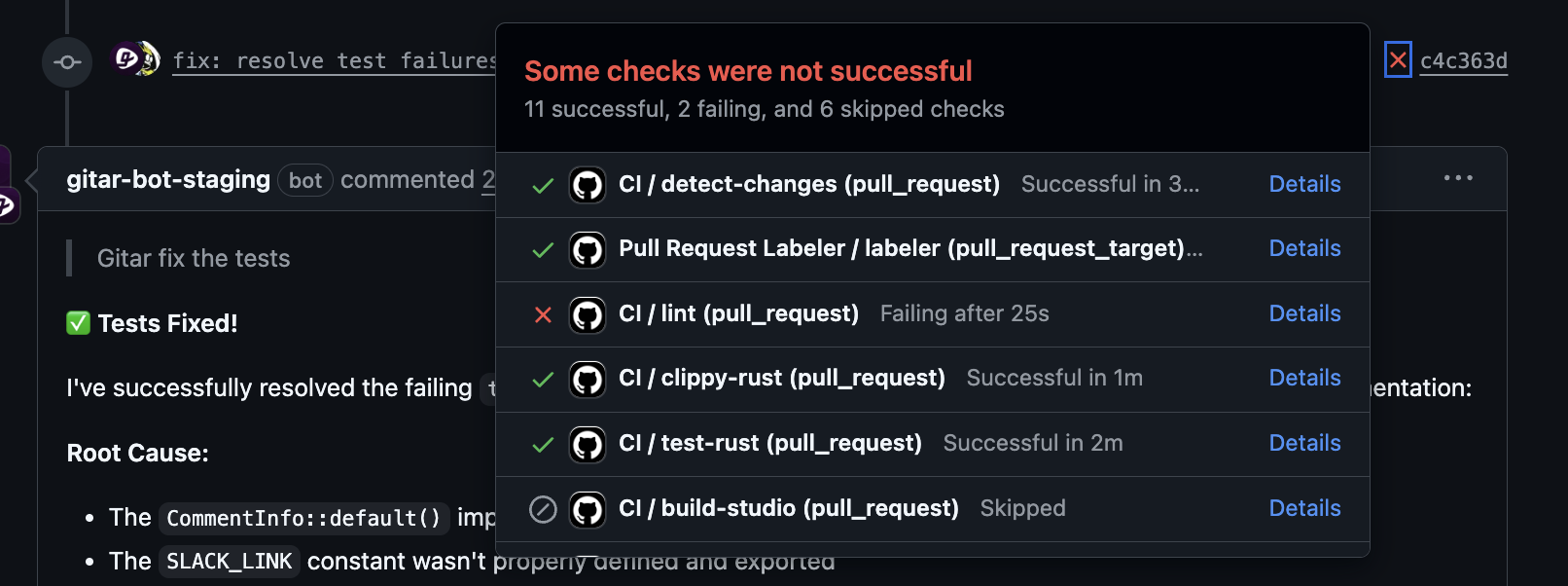
These capabilities make Gitar a natural partner to Copilot. Developers continue using Copilot to create code and open pull requests, while Gitar focuses on keeping those pull requests moving toward a clean, merge-ready state.
Adopting autonomous maintenance safely and gradually
Aligning GitHub Copilot and autonomous fixers in one workflow
Development leaders can design a workflow where Copilot accelerates creation and Gitar accelerates stabilization. Copilot helps draft code, tests, and configuration. Gitar then monitors pull requests, addresses CI failures, and applies review feedback so that fewer changes wait in review queues or red pipeline states.
Understanding the cost of manual maintenance work
Manual CI maintenance adds up quickly. A 20-developer team that spends one hour per person each workday on CI failures and review-related fixes loses roughly 5,000 hours per year. At a loaded cost of 200 dollars per hour, that time equals about 1 million dollars of annual productivity that could shift from rework to new feature delivery.
Teams also feel the impact in slower releases, increased burnout, and less room for strategic engineering initiatives.
Using a phased rollout to build trust
Structured rollout helps organizations adopt autonomous maintenance with confidence:
- Phase 1: Install Gitar in suggestion-only mode on a small set of repositories and review every proposed fix.
- Phase 2: Expand usage, track success rates, and allow Gitar to auto-apply low-risk changes such as lint or formatting fixes.
- Phase 3: Enable broader autonomous fixing, including selected test and configuration changes, while keeping human review for complex logic updates.
Maintaining control with transparent automation
Trust depends on visibility and reversibility. Gitar supports configurable aggression levels, detailed commit logs, and rollback options so teams can see what changed and revert when needed. This combination lets organizations benefit from automation without giving up control of their codebase.
Why autonomous maintenance goes beyond suggestion-only tools
From generative assistance to agentic action
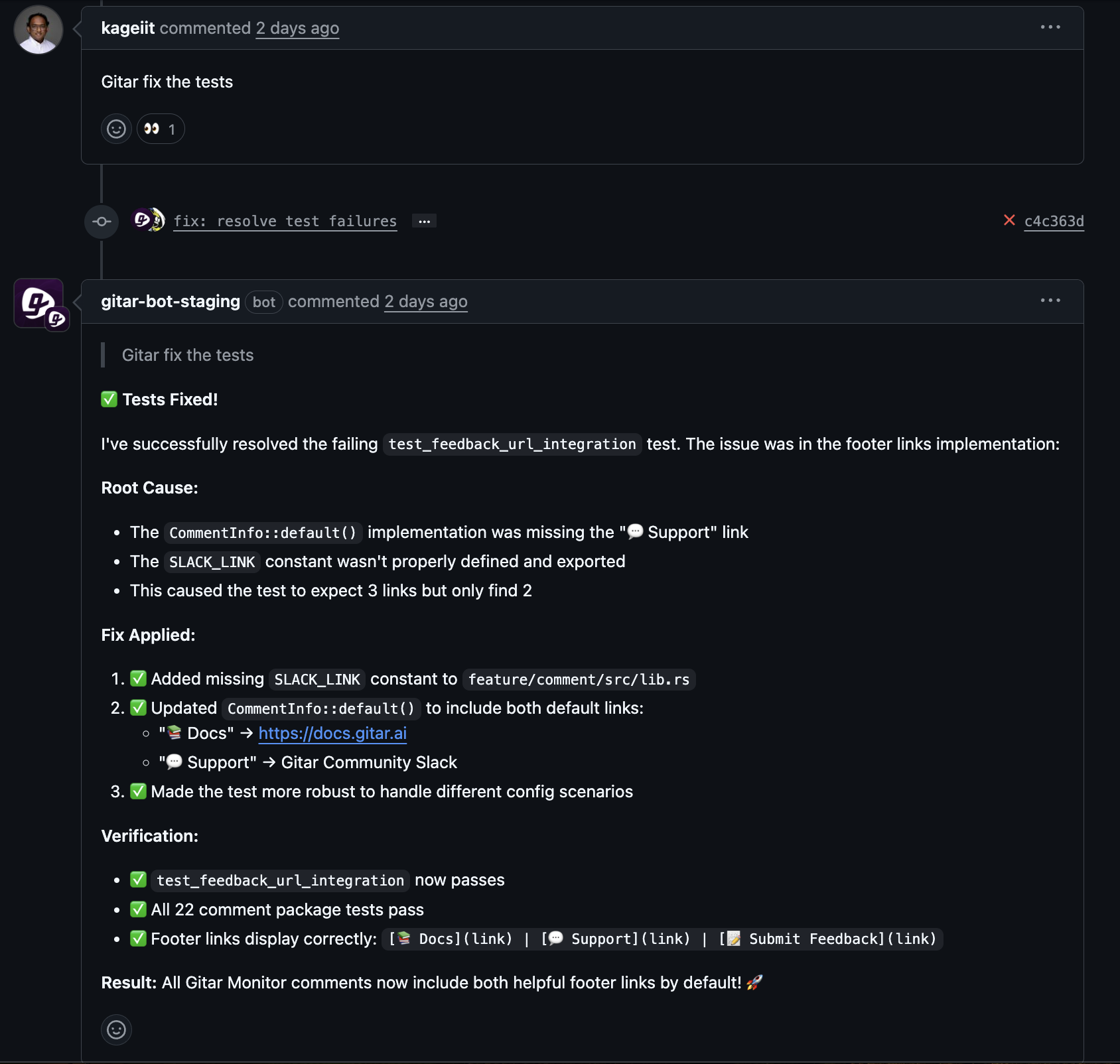
GitHub Copilot represents generative AI. It suggests code, but a human still decides what to accept and how to validate it. Gitar represents agentic AI focused on maintenance. It detects CI issues, proposes fixes, runs the pipeline, and commits successful changes so that developers do not need to coordinate each step manually.
Comparing Gitar with manual and suggestion-based approaches
Different approaches carry different maintenance burdens for developers.
|
Feature or capability |
Manual workflow |
AI code reviewers |
Gitar |
|
Autonomous fixing |
No, requires manual edits and reruns |
No, suggestions only |
Yes, detects, fixes, validates, and commits |
|
Environmental awareness |
Depends on each developer’s local setup |
Limited to code context |
Replicates full CI and enterprise environments |
|
Cross-platform support |
Not applicable |
Often limited to specific git providers |
Supports GitHub, GitLab, CircleCI, BuildKite, and more |
|
Impact on developer focus |
Frequent context switching and interruptions |
Requires time to review and apply suggestions |
Reduces interruptions by closing the loop autonomously |
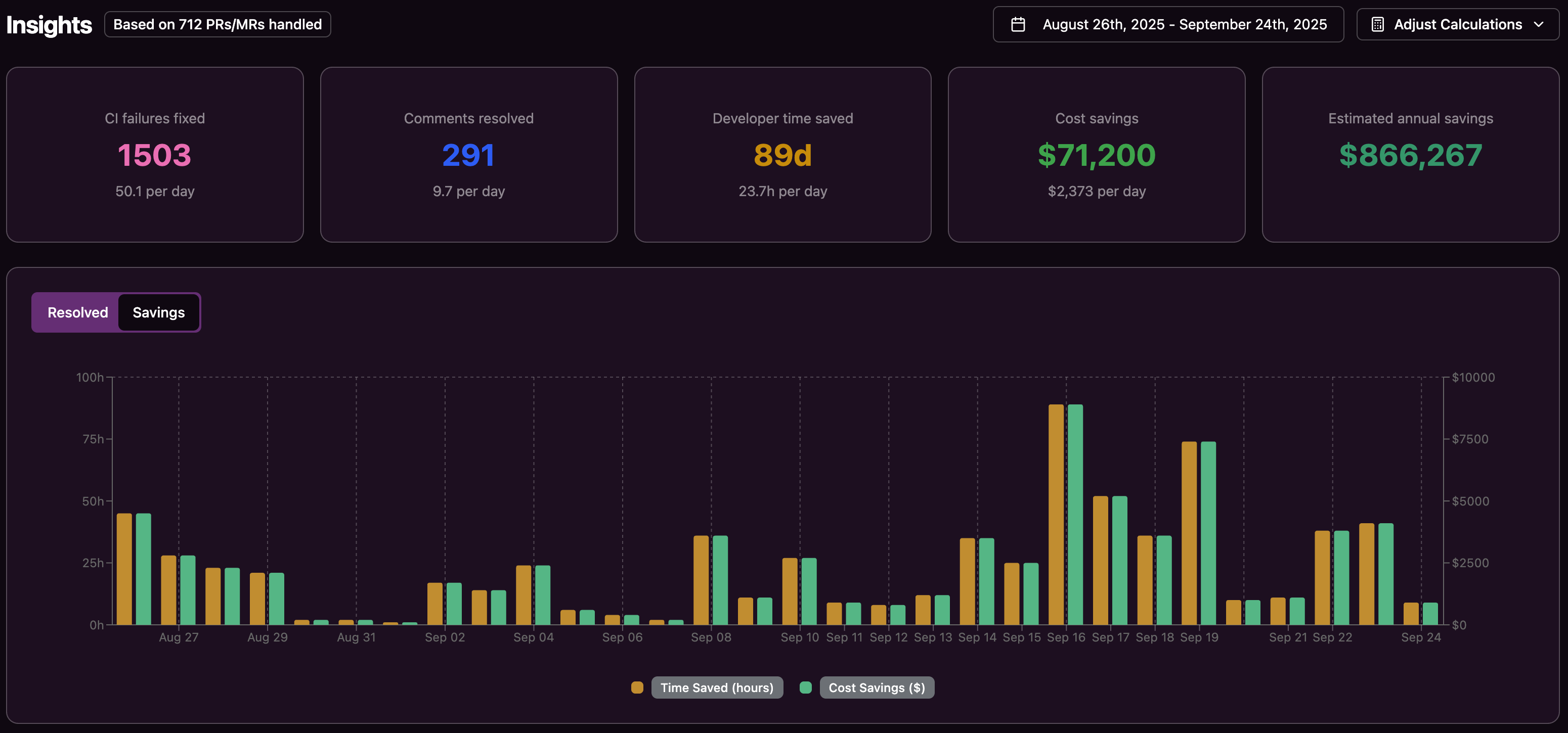
This end-to-end autonomy helps convert CI and review stages from active developer work into background automation that runs reliably and predictably.
Avoiding common pitfalls in AI-powered maintenance
Teams can reduce risk by watching for these common mistakes:
- Assuming suggestion-only tools are enough, even though they still require manual edits, validation, and re-runs.
- Skipping a trust-building phase and moving directly to full autonomy without clear guardrails or metrics.
- Focusing only on faster code generation while leaving validation and merging as slow, manual steps.
- Underinvesting in change management, training, and clear owner responsibilities for automated systems.
- Deploying tools that do not integrate fully with CI or pull request workflows, creating new process gaps.
Frequently asked topics
How Gitar enhances the value of GitHub Copilot in your organization
GitHub Copilot speeds up code creation, while Gitar helps ensure that code reaches a green, mergeable state more quickly. Gitar focuses on fixing CI issues and acting on review feedback so developers can spend more time on design and problem-solving rather than repetitive rework.
How Gitar differs from existing AI code review tools
Typical AI review tools highlight problems and offer suggestions but still depend on developers to edit files and rerun pipelines. Gitar instead acts as a healing engine that applies fixes, validates them in your CI environment, and commits successful changes with minimal additional effort from the team.
Conclusion: Moving toward self-healing development pipelines
Modern engineering teams in 2026 face growing pressure to ship features quickly without sacrificing quality or security. GitHub Copilot accelerates creation, and Gitar complements it by automating the maintenance work that slows delivery after code is written.
Organizations that adopt autonomous maintenance can reduce manual CI toil, shorten feedback loops, and create a development environment where more energy goes into building value rather than fixing broken builds. Teams can explore this approach by starting a phased rollout of Gitar at https://gitar.ai/fix.