
Written by: Ali-Reza Adl-Tabatabai, Founder and CEO, Gitar
Key Takeaways
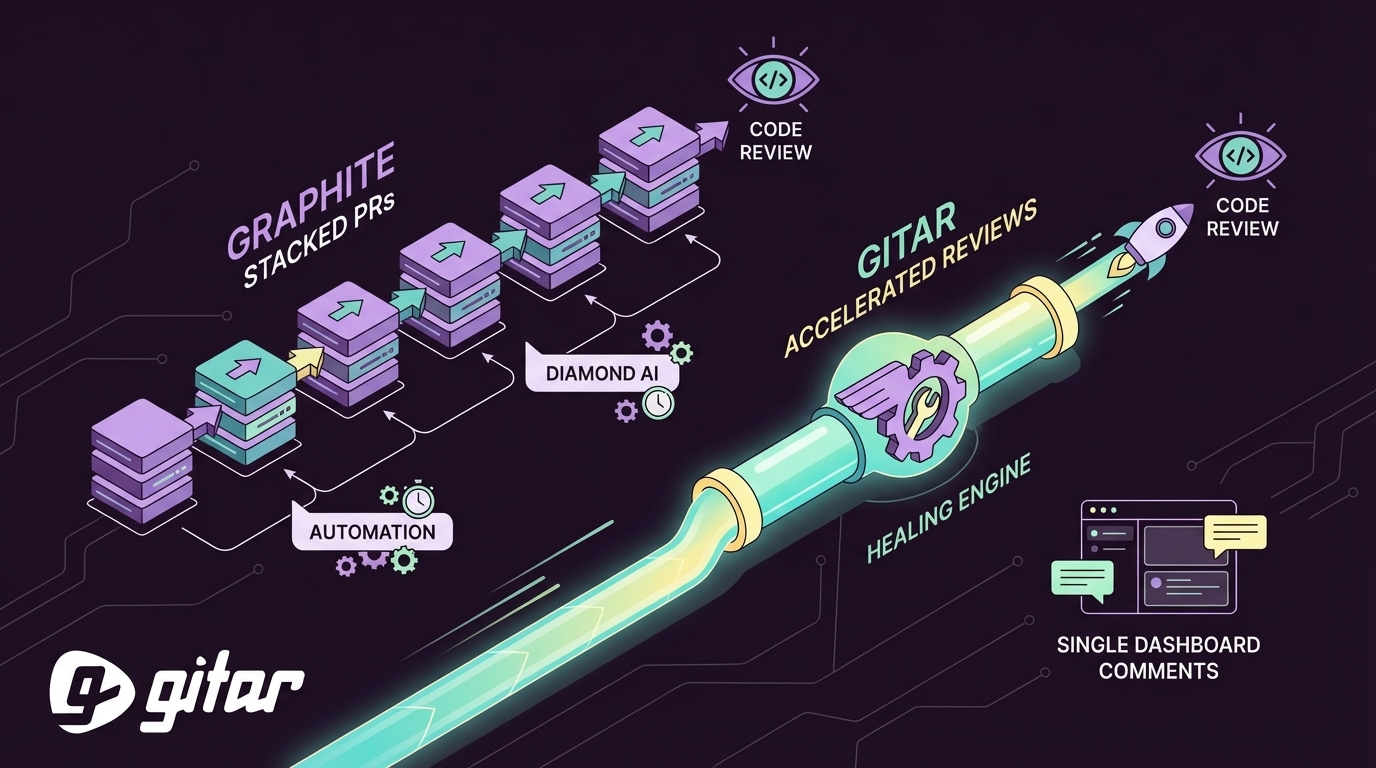
- Graphite reduces code review time 30–50% with stacked PRs, Diamond AI feedback, and automated rebasing, cutting median merge times from 24 hours to 90 minutes.
- Graphite’s suggestion-only model still requires developers to implement fixes manually, which creates re-review cycles and ongoing CI friction.
- Gitar’s Healing Engine autonomously fixes CI failures, applies review feedback, and keeps builds green across GitHub, GitLab, and CircleCI.
- Gitar replaces noisy inline comment threads with a single updating dashboard comment per PR, reducing notification overload compared to Graphite.
- Teams that switch to Gitar complete the full automation cycle that Graphite starts, unlocking up to $750K in annual productivity savings.
How Graphite Reduces Code Review Time: 5 Key Mechanisms
Graphite accelerates code review cycles through five specific mechanisms that reshape how teams create and review pull requests.
1. Stacked PRs Enable Parallel Development: Graphite manages large pull requests by breaking them into stacked PRs, smaller linked changes that are reviewed and merged in sequence. This approach speeds reviews because focused changesets are easier to understand and approve quickly, which keeps development momentum high. Teams adopting Graphite’s stacked PRs saw median PR merge time drop from 24 hours to 90 minutes, a 93.75% reduction.
2. Diamond AI Provides Instant Feedback: Graphite Agent completes code reviews in under 90 seconds while maintaining a sub-5% negative feedback rate. It flags type errors, race conditions, and security vulnerabilities early, so human reviewers focus on design and architecture instead of basic correctness.
3. AI Prioritization Surfaces High-Impact Issues First: Graphite’s Agent provides AI-driven feedback that emphasizes substantive bugs and issues early in the review cycle rather than superficial comments. This prioritization shortens back-and-forth review cycles because teams address the most critical problems in the first pass.
4. Automated Rebasing Limits Merge Conflicts: Graphite automates rebases when parent branches change, visualizing dependencies between PRs and smoothing merge sequencing. Automated rebasing reduces manual conflict resolution work and keeps stacked branches aligned with the main development line.
5. Workflow Automation Increases Throughput: Asana engineers saved 7 hours weekly, shipped 21% more code, and cut median PR size by 11% using Graphite. These gains come from consistent use of stacked workflows and automated review support that keeps work moving without constant human coordination.
Setting Up Graphite Stacked PRs and Diamond AI in Your Workflow
Teams adopt Graphite by installing its CLI and adjusting their branching habits. Install the Graphite CLI with npm install -g @withgraphite/graphite-cli, then initialize stacking in your repository with gt stack init. Create feature branches using gt branch create feature-name, and submit stacks with gt stack submit.
This workflow creates dependent PRs where each change builds on the previous one. Engineers at Vercel, Snowflake, and The Browser Company maintain stacks of 5–10 PRs, each under roughly 200 lines, reviewed independently while work continues unblocked. Reviewers can approve or request changes on each slice without freezing the entire feature.
Tradeoffs appear as stacks grow. Graphite’s stacked PRs increase CI costs because each PR in the stack triggers its own CI run, so a stack of 7 changes runs 7 full pipelines in parallel instead of 1 for a single branch. Teams also encounter workflow bottlenecks such as branch drift, which forces multiple rebases when an upstream PR in a stack changes.
Graphite’s AI Code Review in Practice: Power and Limits
Graphite’s Diamond AI, now called Graphite Agent, delivers automated code review with full repository awareness. Graphite Agent automatically reviews open PRs using full codebase context, leaves comments, suggests changes, and can provide fixes as commits. Developers change the code in response to Graphite Agent–flagged issues 55% of the time, compared to 49% for human reviewers, which shows that its feedback often feels actionable.
Significant limitations still shape the day-to-day experience. Graphite’s suggestion-only approach means developers manually implement fixes, push new commits, and wait through re-review cycles before merging.
Developer reports highlight additional friction beyond this manual work. AI-generated code has 1.7x more issues, 1.75x more logic errors, and 1.57x more security vulnerabilities than human-written code, with 61% of developers saying it “appears correct but isn’t reliable”. This reliability gap compounds Graphite’s limitation, because developers must both implement suggested fixes by hand and validate that AI-generated changes are actually correct before committing them.
How Gitar’s Healing Engine Accelerates Reviews Beyond Graphite
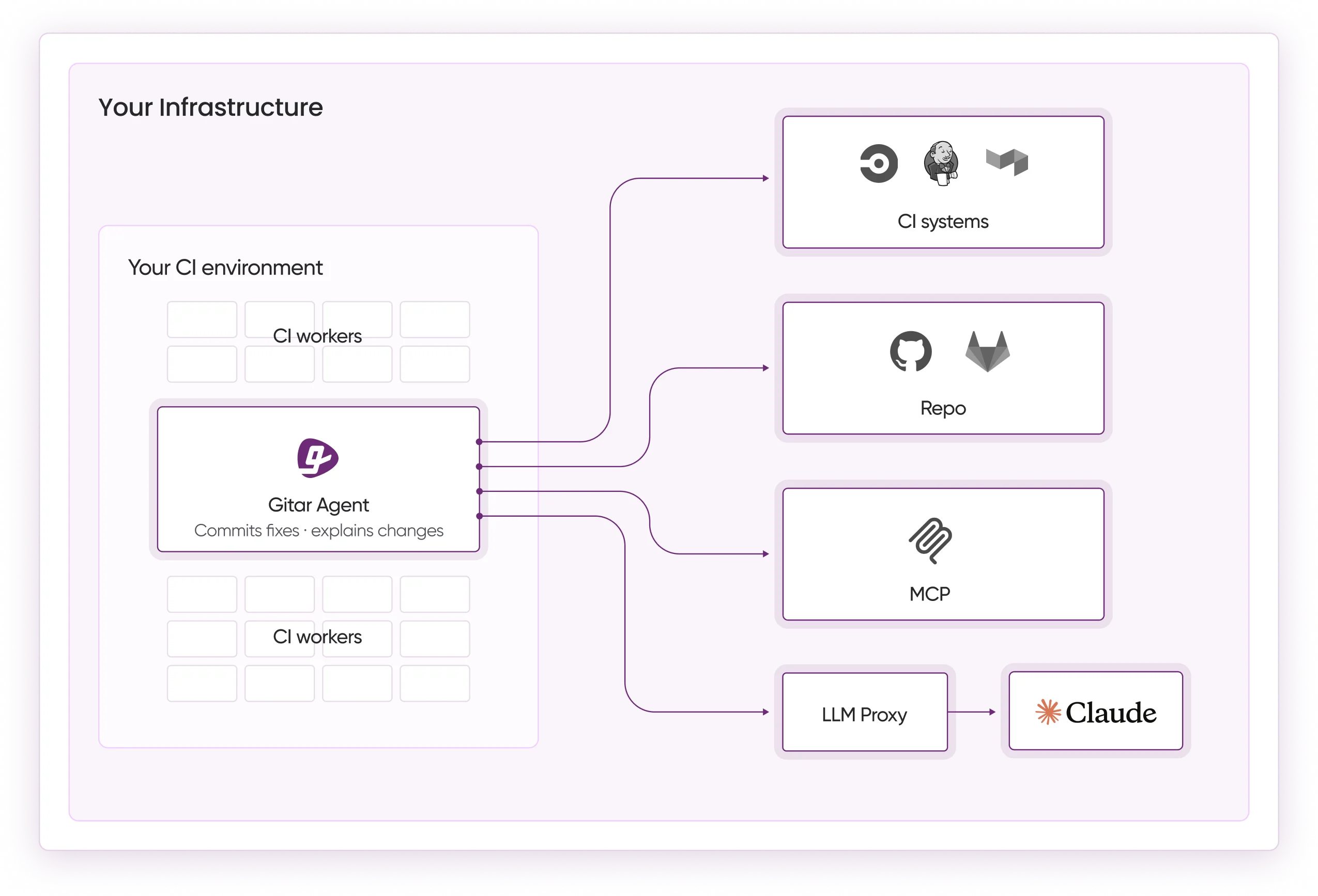
Gitar closes the loop that Graphite leaves open by implementing fixes automatically instead of only suggesting them. Gitar’s CI agent maintains full context from the moment a pull request opens until it merges, works continuously in the background to keep CI green, finds root causes of failures, fixes them, and verifies results inside the team’s own CI environment. The Gitar documentation explains this Healing Engine in detail.
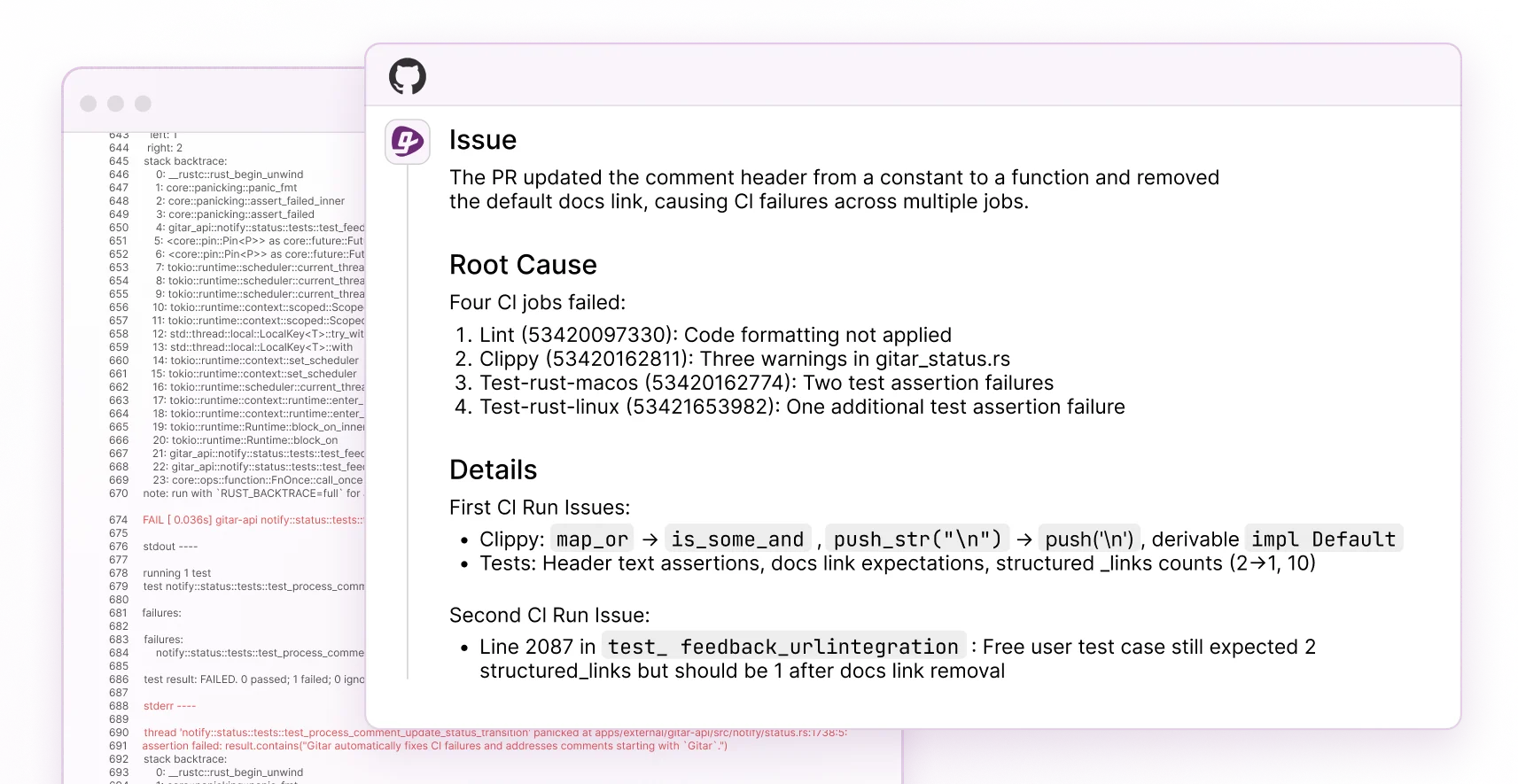
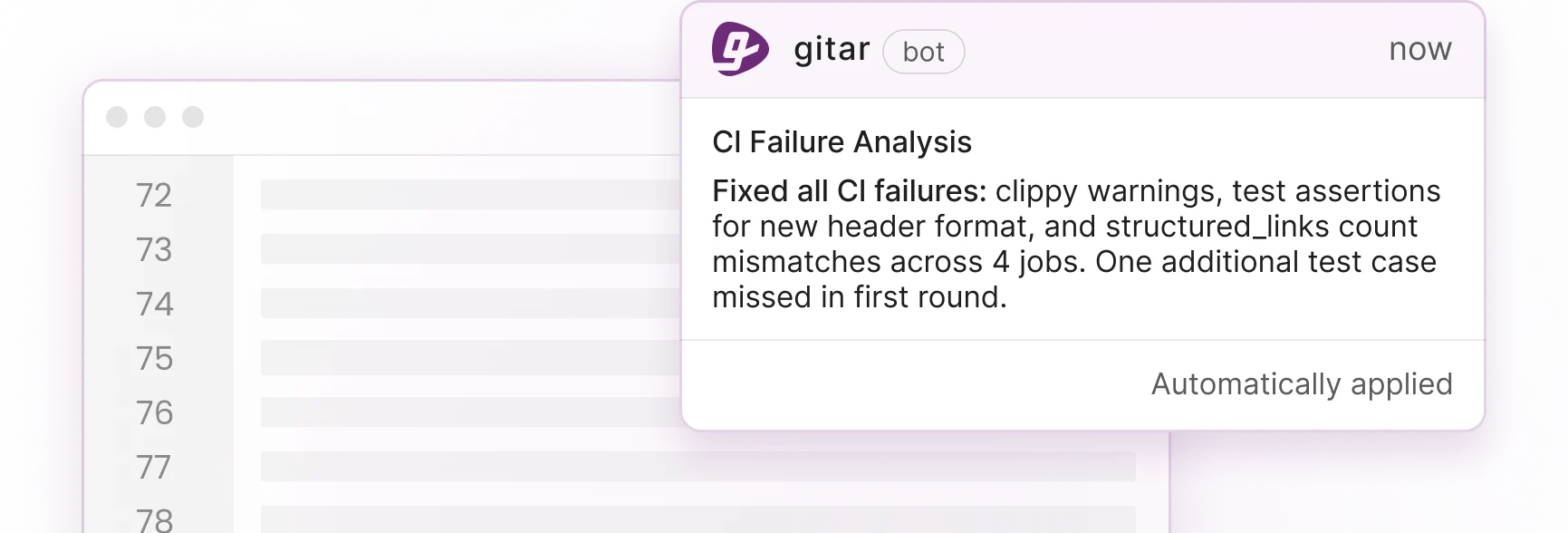
The Healing Engine delivers autonomous code review by resolving CI failures, applying review feedback, and keeping builds green without human intervention. When lint errors, test failures, or build breaks appear, Gitar analyzes failure logs, generates validated fixes, and commits them directly to the PR. Gitar automatically resolves its comments as issues are addressed and can remove its dashboard comment entirely when everything passes, if configured. You can explore more workflows in the Gitar documentation.
Gitar also fits into more environments than Graphite. Unlike Graphite’s GitHub-only model, Gitar supports GitHub, GitLab, CircleCI, and Buildkite, so teams standardize on one autonomous fixing layer across their toolchain. Learn more about these capabilities at docs.gitar.ai.
Install Gitar now to experience autonomous CI healing in your own environment.
Graphite vs Gitar: Feature Comparison for Automation and Noise
The table below highlights how Graphite and Gitar differ on automation depth, CI healing, platform coverage, and comment management, so you can see where Gitar completes the workflow that Graphite begins.
|
Feature |
Graphite |
Gitar |
Winner |
|
PR Summaries |
Yes (Diamond AI) |
Yes |
Tie |
|
Auto-Apply Fixes |
No |
Yes (Healing Engine) |
Gitar |
|
CI Auto-Fix |
No |
Yes |
Gitar |
|
Cross-Platform |
GitHub-only |
GitHub/GitLab/CircleCI |
Gitar |
|
Comment Management |
Multiple inline |
Single dashboard |
Gitar |
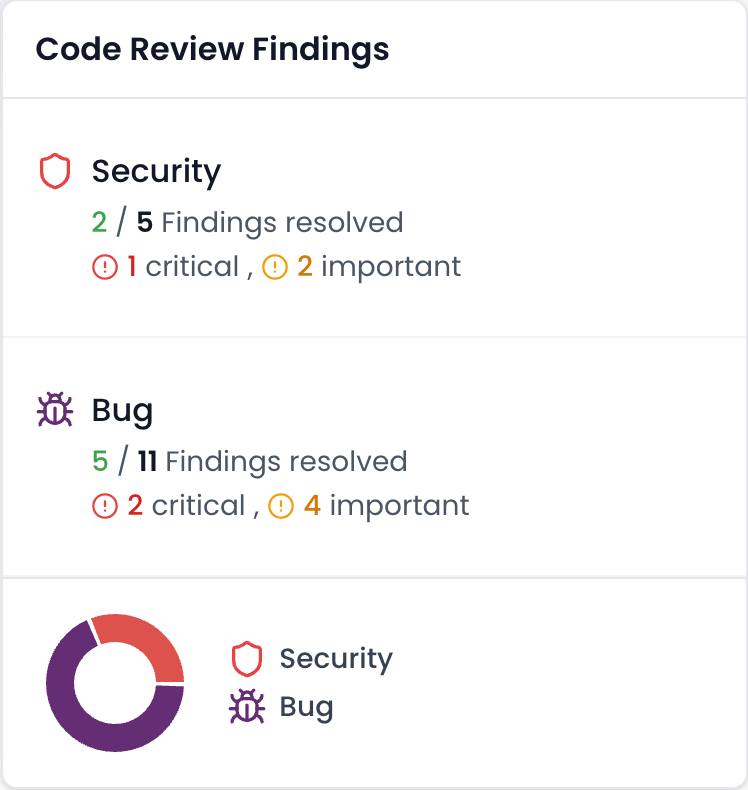
As noted in the comparison above, Gitar can be configured to add only a single comment per PR with no inline comments, a capability no other tool on the market has. This single-comment approach maintains comprehensive review coverage while eliminating the notification overload that traditional inline comment systems create.
ROI and Who Benefits Most from Gitar
For a 20-developer team, Gitar delivers $750K in annual savings through autonomous fixes and guaranteed green builds, compared to Graphite’s partial automation that still needs manual intervention. This ROI compounds across organizational levels, as engineering managers gain measurable velocity improvements that justify tooling investments, developers avoid context-switching costs from manual CI fixes, and DevOps teams run self-healing pipelines that reduce operational overhead and free capacity for strategic work.
Teams already using AI coding tools see especially strong returns. Median PR size increased 33% from March to November 2025, rising from 57 to 76 lines changed per PR. Larger changesets strain traditional review processes, and autonomous tools like Gitar handle this load by fixing failures and applying feedback without adding more work for reviewers.
Conclusion
Graphite improves code review speed with stacked PRs and Diamond AI, often delivering 30–50% faster cycles for teams that adopt parallel review workflows. Its suggestion-only approach still leaves manual implementation gaps, which slow overall development velocity and keep CI friction in the loop.
Gitar’s Healing Engine completes the automation cycle by catching issues, implementing fixes, and guaranteeing green builds autonomously. The decision framework is straightforward: choose Graphite for manual stacking workflows with AI suggestions, or choose Gitar for end-to-end autonomous review and fixing. Graphite provides the suggestions, but Gitar completes the entire automation cycle from detection through implementation.
Install Gitar now to automatically fix broken builds and start shipping higher quality software, faster.
Frequently Asked Questions
How much faster is Gitar compared to Graphite for code review time reduction?
Gitar’s Healing Engine automatically fixes CI failures and applies review feedback without manual intervention. Graphite improves speed through stacked PRs and Diamond AI suggestions, yet developers still implement fixes manually, push new commits, and wait for re-review cycles. The key difference is autonomy, because Gitar completes the entire fix–validate–commit cycle automatically while Graphite stops at suggestions that require human follow-through.
Can Gitar work with existing Graphite stacked PR workflows?
Gitar works alongside existing stacked PR workflows, whether stacks come from Graphite or standard Git branching. Gitar’s Healing Engine operates at the CI and review feedback layer, automatically fixing failures and implementing suggestions across any PR structure. Teams keep their preferred branching strategy while gaining autonomous fixing capabilities that Graphite’s suggestion-only model does not provide.
What platforms does Gitar support compared to Graphite’s GitHub-only approach?
Gitar supports GitHub, GitLab, CircleCI, and Buildkite, which gives teams cross-platform autonomous fixing capabilities. Graphite operates exclusively on GitHub with its stacked PR tooling and Diamond AI reviews. This platform limitation prevents teams on GitLab, Bitbucket, or other systems from using Graphite, while Gitar’s Healing Engine works across the broader development toolchain regardless of platform choice.
How does Gitar’s single dashboard comment approach compare to traditional AI code review tools?
Gitar consolidates CI analysis, review feedback, and rule evaluations into one updating dashboard comment per PR, which removes the notification spam that traditional tools create. Most AI code review tools, including Graphite, scatter inline comments across diffs and generate dozens of notifications per push. Gitar’s single source of truth updates in real time as issues are resolved, reducing cognitive load while still covering every relevant finding.
What ROI can teams expect when switching from Graphite to Gitar?
Teams can expect the annual productivity savings detailed in the ROI section above, driven by Gitar’s autonomous fixing capabilities that remove the manual implementation cycles Graphite requires. These gains come from automatic CI fixes, automated review feedback implementation, and consistently green builds that keep developers focused on shipping features instead of repairing pipelines.