
Written by: Ali-Reza Adl-Tabatabai, Founder and CEO, Gitar
Key Takeaways
- Graphite and Diamond are not competitors. Diamond is Graphite’s integrated AI code reviewer for stacked PR workflows.
- CodeRabbit and Greptile provide useful PR summaries and suggestions but do not auto-fix code or resolve CI failures.
- Gitar delivers automatic CI analysis, code fixes, and green build guarantees, saving teams up to $750K annually for 20 developers.
- Competitors focus on suggestions that still require manual work, while Gitar implements fixes directly in your CI environment.
- Upgrade your code review workflow with Gitar’s Team Plan trial and experience full automation.
How This Comparison Was Built
Our evaluation criteria focus on automation capabilities that matter in 2026. We assess PR summaries and inline comments, auto-fix implementation, CI failure analysis and resolution, build validation, pricing and ROI, platform integrations (GitHub, GitLab, CircleCI, Buildkite), setup complexity, and real-world developer feedback.
Sources include Gitar’s release notes documenting CI analysis features, official Gitar platform documentation, official documentation for other tools, developer community discussions, and hands-on trial evaluations. We prioritize 2026 benchmarks and recent user experiences over legacy comparisons.
Overview of Compared Solutions
Graphite/Diamond combines stacked pull requests with AI code review for GitHub-focused teams that want faster merge cycles through dependent PR workflows and automated feedback.
CodeRabbit provides AI-powered PR summaries and inline suggestions at $15-30 per seat. It focuses on diff-based analysis across multiple version control platforms with linter integration.
Greptile offers deep codebase context analysis at $30 per developer monthly. It builds comprehensive code graphs to detect cross-file issues and provide contextual suggestions.
Gitar delivers auto-fixing CI analysis that identifies the root cause of failures, then implements the necessary code changes automatically. By validating these fixes against your actual CI environment before committing them, Gitar guarantees green builds and removes the manual work that suggestion-based tools require.
Each platform targets different workflow priorities, from stacked development to comprehensive automation. If your priority is eliminating manual fix implementation entirely, see how Gitar’s auto-fixing approach compares in your environment.
Graphite/Diamond in 2026
Graphite’s platform centers on stacked pull requests, which create dependent PRs that merge sequentially rather than branching from main. Diamond (now called Graphite Agent) automatically reviews PRs using full codebase context, leaves comments, suggests changes, and provides one-click fixes that developers can apply directly.
Key capabilities include PR summaries with contextual analysis, inline suggestions with under 3% unhelpful comment rates, one-click fix application, and merge queue coordination. Teams using Graphite’s stacked workflows achieve median PR merge times of 90 minutes, down from 24 hours.
Pricing starts at $40 per user monthly for the Team plan with unlimited reviews. Shopify reported 33% more PRs merged per developer after adoption, and Asana engineers saved 7 hours weekly and shipped 21% more code.
Limitations include GitHub-only support, no CI failure auto-resolution, and a strong focus on GitHub-centric workflows.
CodeRabbit for Multi-Platform Reviews
CodeRabbit combines large language models with linters and security scanners to generate comprehensive PR feedback, including summaries, sequence diagrams, and fix suggestions. The platform has processed over 13 million PRs across 2 million repositories.
The Pro plan costs $24-30 per user monthly with multi-platform support for GitHub, GitLab, Bitbucket, and Azure DevOps. However, CodeRabbit has a medium-high noise level and performs surface diff-based analysis, often requiring configuration tuning to reduce irrelevant suggestions.
Key limitations include suggestion-only functionality without auto-implementation, medium false-positive rates, and no CI failure analysis or automated resolution capabilities. Compare how Gitar’s auto-implementation addresses these gaps.
Greptile Breakdown
Greptile builds comprehensive codebase graphs to understand function connections, usage patterns, and historical context. Version 3, launched in late 2025, uses the Anthropic Claude Agent SDK for autonomous investigation and provides evidence for every flagged issue.
At $30 per developer monthly, Greptile offers deep full-codebase analysis that can catch cross-file issues missed by diff-based tools. In 2025 bug detection benchmarks, Greptile achieved 82-85% detection rates.
However, independent evaluations show Greptile has the highest false positive rate, supports only GitHub and GitLab, requires extensive setup, and provides suggestions without automated implementation or CI integration.
All three competitors share a fundamental limitation. They identify issues but leave implementation and CI validation to developers. This is where Gitar’s approach diverges.
Why Gitar Leads as the Best Auto-Fixing Alternative
Gitar turns AI code review into a healing engine instead of a suggestion engine. When CI fails or reviewers leave feedback, Gitar’s agent maintains full context from PR opening to merge, works continuously to keep CI green, finds root causes, fixes them, and verifies results within your own CI environment. See Gitar documentation for details.
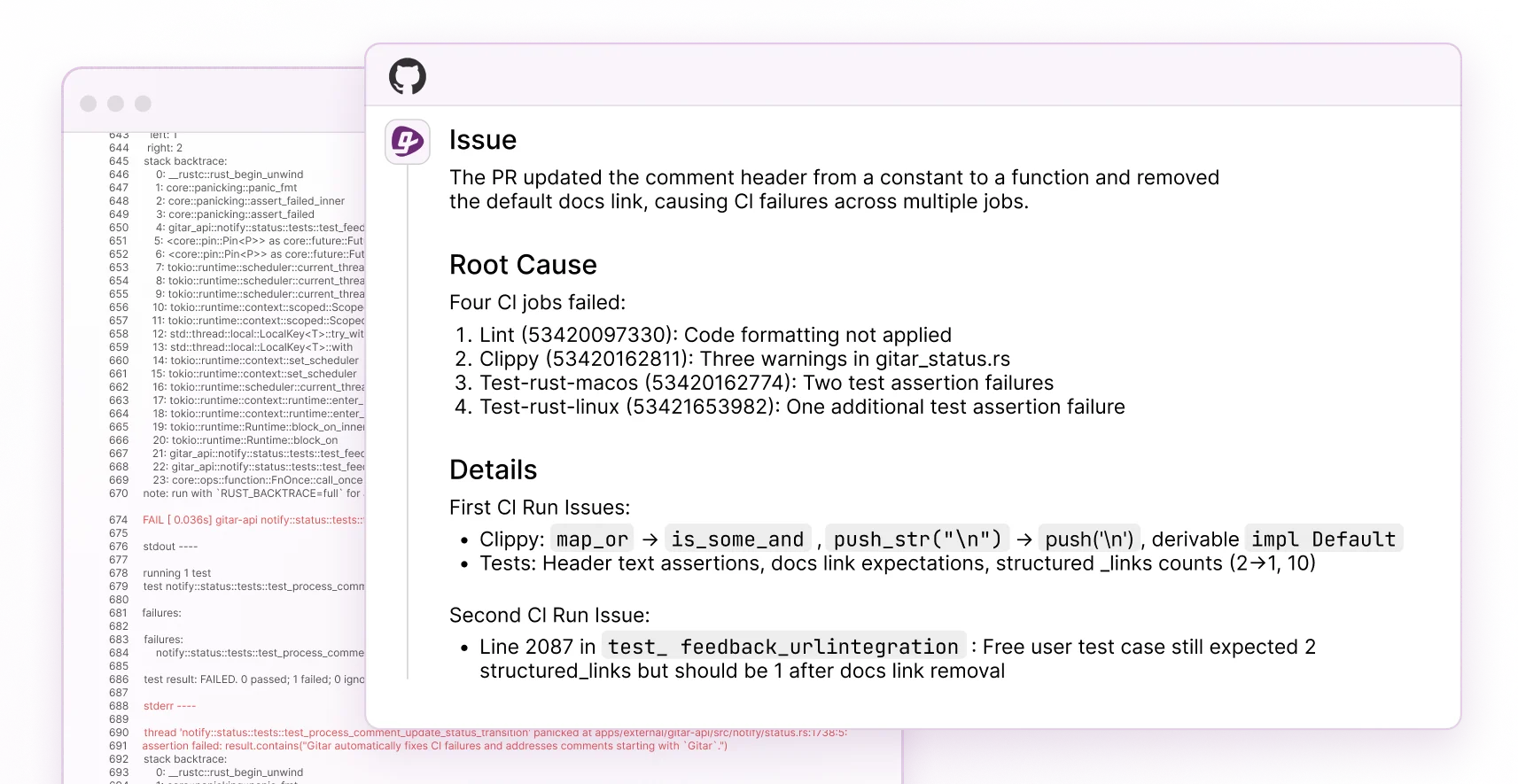
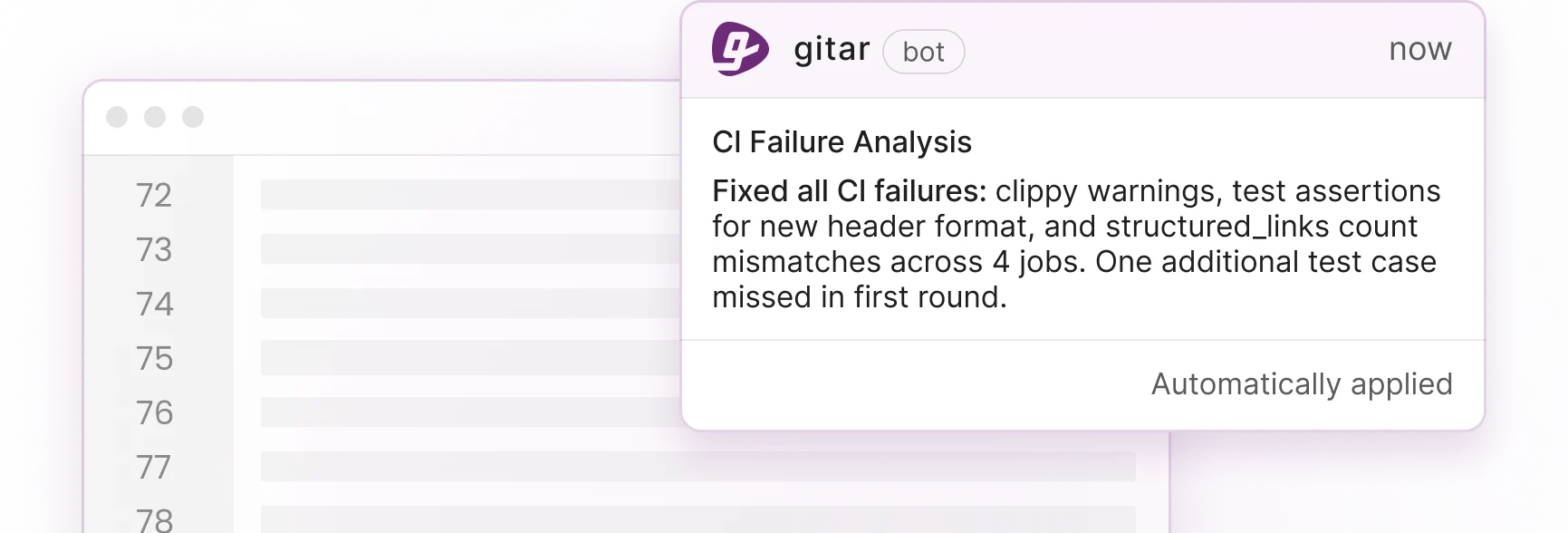
Core capabilities include automatic CI failure analysis and resolution, which works because Gitar maintains full context across the entire PR lifecycle. This context enables it to trace failures back to their root causes. The same awareness powers review feedback implementation and natural language repository rules, while single dashboard comments consolidate insights without notification spam.
The Team Plan trial runs for 14 days and includes full access with no seat limits across unlimited repositories. For a 20-developer team, Gitar achieves the earlier savings by cutting CI issue time from about 1 hour daily to roughly 15 minutes per developer.
Gitar supports GitHub, GitLab, GitHub Actions, GitLab Pipelines, CircleCI, Buildkite, and Bitrise, with integrations for Jira, Slack, and Linear. Installation takes about 30 seconds through a GitHub App or GitLab integration. Unlike competitors that charge premium prices for basic commentary, try Gitar’s full automation free for 14 days to see the difference firsthand. See Gitar documentation for setup and integrations.
Head-to-Head Automation Comparison
The following table highlights the critical automation gaps between platforms. Focus on CI failure analysis, guaranteed green builds, and auto-applied fixes, where only Gitar delivers end-to-end implementation instead of suggestions.
|
Capability |
Graphite/Diamond |
CodeRabbit |
Greptile |
Gitar |
|
PR Summaries |
Yes |
Yes |
Yes |
Yes |
|
Inline Suggestions |
Yes |
Yes |
Yes |
Yes |
|
Auto-Apply Fixes |
One-Click |
No |
No |
Yes |
|
CI Failure Analysis |
No |
No |
No |
Yes |
|
Guarantee Green Builds |
No |
No |
No |
Yes |
|
Platform Support |
GitHub only |
Multi-platform |
GitHub/GitLab |
GitHub, GitLab, GitHub Actions, GitLab CI, CircleCI, Buildkite |
|
Pricing |
$40/user/month |
$24-30/user/month |
$30/user/month |
14-day full trial |
|
ROI for 20 devs |
Velocity gains |
Review efficiency |
Bug detection |
$750K savings |
Gitar uniquely delivers automated fixes with CI validation, while competitors require manual implementation of suggestions. The single comment approach reduces cognitive load compared to scattered inline feedback from other platforms.
These technical differences have distinct implications depending on your role in the development process. The next section explains how each stakeholder should evaluate these tradeoffs.
Key Considerations and Tradeoffs by Role
For Software Engineers
Gitar removes context switching between review feedback and implementation. Engineers stop reading long suggestion threads and start receiving working code changes that already pass CI validation. That shift directly improves the velocity metrics that leaders track.
For Engineering Leaders
ROI calculations favor platforms that reduce manual work instead of just adding commentary. With the ROI demonstrated earlier, Gitar’s automation delivers measurable velocity improvements beyond suggestion-only tools. Those gains make it easier to justify investment in supporting infrastructure and process changes.
For DevOps Teams
Self-healing CI reduces rerun costs and maintenance overhead by fixing failures automatically instead of requiring manual intervention. This automation extends beyond CI failures through natural language rules that replace complex YAML configurations. That shift lowers the technical barriers that often turn workflow automation into a DevOps bottleneck instead of a team-wide capability.
The 2026 shift toward context-aware AI agents delivering auto-fixes with contextual explanations makes suggestion engines feel dated. See this agentic approach in action with Gitar’s two-week trial period.
Real-World Frustrations With Suggestion Engines
Developer discussions, including Graphite versus Diamond Reddit threads, reveal common frustrations with suggestion-based tools. Teams report false positives that require manual filtering, lack of CI context that leads to fixes which still fail, and notification spam from scattered inline comments.
Gitar addresses these pain points through concise single comments and automatic failure detection that separates infrastructure issues from code bugs. This approach keeps attention on the changes that actually move a PR toward a green build.
2026 Platform Vision: Why Gitar Goes Further
Gitar builds a complete development intelligence platform instead of a single-feature tool. Beyond code review, the platform provides workflow automation, deep analytics, integration layers, and CI as an agent platform. Repository rules enable natural language workflow automation without complex YAML configurations. Refer to Gitar documentation for full details on these features.
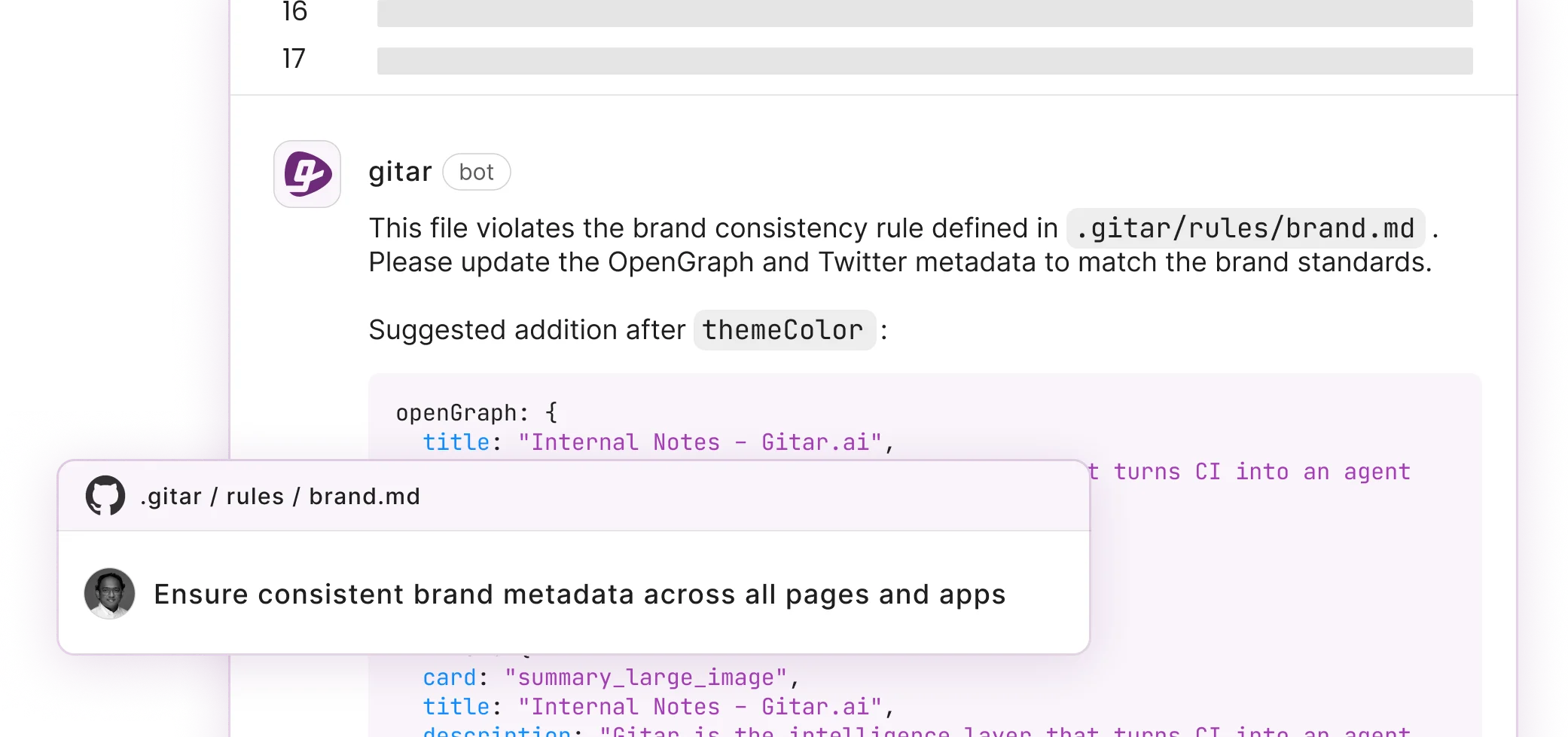
This comprehensive approach positions Gitar as a platform beyond review. It addresses the full outer loop of modern development workflows instead of offering isolated point solutions.
Frequently Asked Questions
Is Diamond different from Graphite?
No. Diamond is now called Graphite Agent and is integrated into Graphite’s platform. They form the same system combining stacked PRs with AI code review, not competing tools.
What do Graphite vs Diamond Reddit discussions reveal?
Since they describe the same platform, discussions focus on Graphite’s limitations, such as no CI failure auto-resolution and GitHub-only support.
What’s the best AI code review tool in 2026?
Gitar leads through auto-fixing capabilities that guarantee green builds, unlike suggestion-only tools that require manual implementation and do not validate fixes against CI.
How does Greptile compare to Graphite?
Greptile provides deeper codebase context analysis, while Graphite focuses on stacked PR workflows. Both offer suggestions without automated implementation, while Gitar delivers working fixes.
Do these platforms offer free trials?
Gitar provides a comprehensive Team Plan trial for about two weeks with full access and no seat limits. Competitors offer limited free tiers or require immediate payment for full features.
Conclusion and Next Steps
The Graphite versus Diamond myth is settled. They are integrated tools, not rivals. The real comparison happens between suggestion engines that leave manual work and auto-fixing platforms that guarantee results. 2026’s shift toward agentic code review automates quality assurance similar to how CI/CD automated builds.
For teams committed to stacked workflows, Graphite offers strong velocity improvements. For teams seeking comprehensive automation that removes manual fixes, Gitar sets the 2026 standard. Try the AI that ships working code—start your 14-day trial to see auto-fixing in your own environment.