
Written by: Ali-Reza Adl-Tabatabai, Founder and CEO, Gitar
Key Takeaways for GitLab Engineering Leaders
- AI coding tools have increased GitLab review times by 91%, so Graphite’s GitHub-only focus creates a gap for GitLab teams that need native options.
- Gitar leads with true auto-fixing of CI failures and code issues, not just suggestions, and delivers guaranteed green builds through its Healing Engine.
- Alternatives like CodeRabbit, Greptile, and Qodo provide varying GitLab support but lack Gitar’s autonomous remediation, with comparisons showing Gitar’s stronger native integration and lower PR noise.
- Teams can save about $750K per year through reduced context switching and faster CI resolution when they adopt auto-fixing platforms instead of manual suggestion tools.
- Start your 14-day Gitar Team Plan trial for full GitLab auto-fixes and transform your PR workflows today.
How We Tested These Graphite Alternatives for GitLab
Our Q1 2026 evaluation covered seven leading alternatives in real GitLab environments. We deployed each tool on Python, JavaScript, and Go repositories. We measured PR processing speed, CI failure resolution rates, and notification noise reduction. Our criteria focused on GitLab integration depth, auto-fix capabilities beyond suggestions, pricing clarity, and enterprise scalability.
Our testing methodology centered on practical GitLab workflows such as merge request automation, pipeline failure handling, and team collaboration patterns. We validated claims against vendor documentation, including Gitar’s release notes and broader Gitar docs, along with competitor feature matrices from recent product updates. The comparison table below summarizes how each alternative performed across these key criteria.
Top Graphite Alternatives for GitLab: Side-by-Side Comparison
|
Tool |
GitLab Integration |
Auto-Fix CI/Review |
Pricing (Trial/Monthly) |
PR Noise Level |
|
Gitar |
Native/10 |
Yes/Validated |
14-day full/Competitive |
Single updating comment |
|
CodeRabbit |
Native/8 |
One-click/Partial |
Free basic/$15-30 |
Inline comments |
|
Greptile |
Native/7 |
Suggest-only/No |
None/$30 |
Inline comments |
|
Qodo |
Webhook/6 |
Tests/No |
Free/$19-30 |
Inline comments |
The Top 7 Graphite Code Review Alternatives for GitLab Teams
1. Gitar: GitLab-Native Auto-Fixing With Guaranteed Green Builds
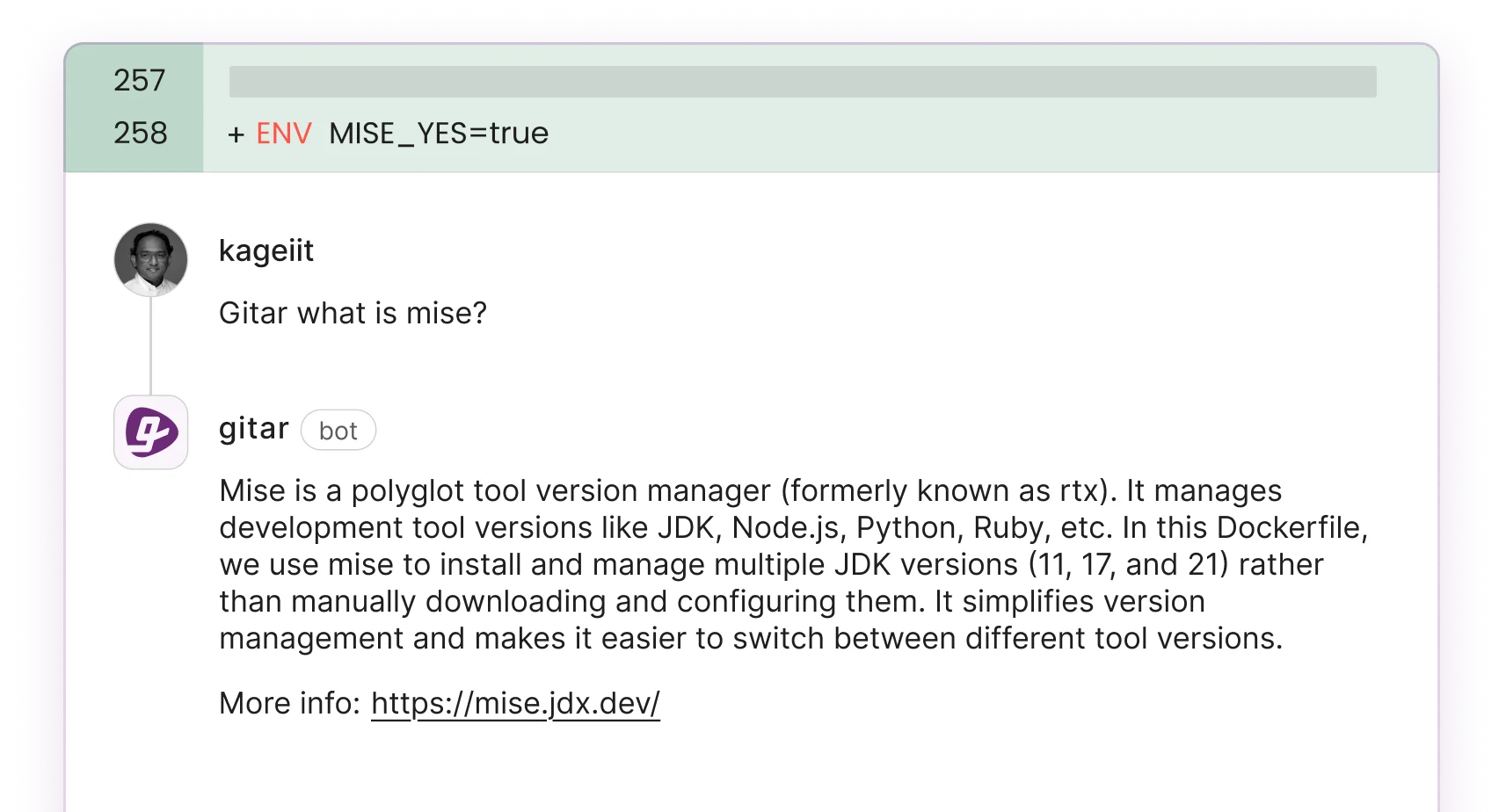
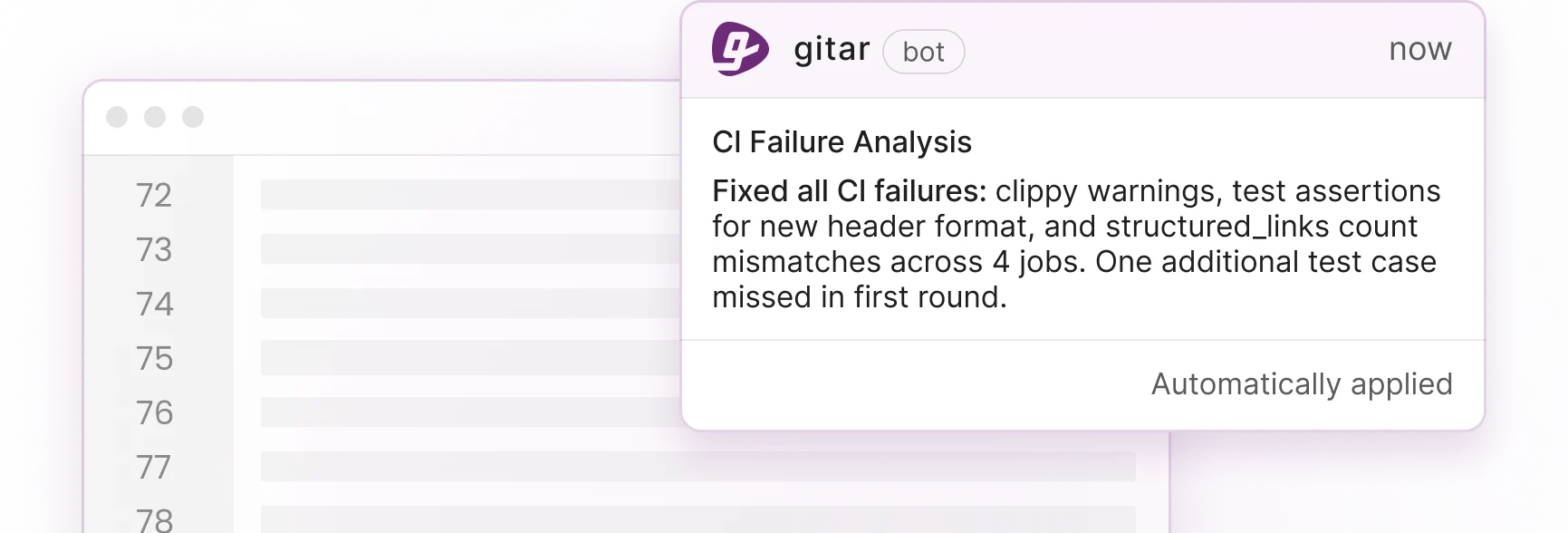
Gitar stands apart as the only platform in this list that fixes code instead of only suggesting changes. Gitar’s CI agent maintains full context from pull request creation to merge and works continuously to keep CI green by finding root causes and implementing verified fixes. The Healing Engine automatically resolves lint errors, test failures, and build breaks. It keeps noise low by maintaining a single dashboard comment that updates in real time. For deeper technical details, see the Gitar documentation.
GitLab integration includes native pipeline support, merge request automation, and natural language repository rules that shape behavior. These features enable the productivity gains teams report from automated CI healing and reduced context switching. The 14-day Team Plan trial provides full access to auto-fix capabilities, Jira and Slack integrations, and unlimited repositories so teams can validate impact on real workloads.
Ideal for: GitLab teams that want guaranteed green builds and measurable ROI from automation instead of suggestion-only tools.
2. CodeRabbit: Detailed AI Reviews With Assisted Fixes
CodeRabbit integrates with GitHub, GitLab, and Bitbucket to provide AI-powered code reviews through detailed pull request comments and an interactive chat interface. The platform offers line-by-line analysis and configurable rules that match team-specific coding standards. CodeRabbit v1.4 adds one-click fixes for incorporating review comments and a “Fix with AI” feature. It includes committable suggestions that apply changes directly with a click, although complex fixes still need developer oversight.
GitLab support covers merge request summaries and incremental reviews that focus on new changes. Pricing ranges from a free basic tier to $15–30 per developer each month. CodeRabbit excels at generating comprehensive review feedback and uses AI-assisted fixing to reduce some manual editing.
Ideal for: Teams that want rich review analysis with AI-assisted fixes that cut down on repetitive changes.
3. Greptile: Deep Repository Understanding Without Auto-Fixing
Greptile builds a full-repository knowledge graph that understands every function, dependency, and historical change across the codebase. This capability enables cross-module dependency analysis and architectural impact assessment. Greptile offers native GitLab integration with repository-wide dependency and impact analysis.
The platform charges $30 per developer each month with unlimited reviews and discounts for annual commitments. Greptile focuses on analysis instead of automated remediation. Developers still implement suggested changes manually, which limits time savings compared with auto-fixing tools.
Ideal for: Large or complex codebases that need deep architectural analysis and dependency mapping more than automated fixes.
See how Gitar’s auto-fixing compares to Greptile’s analysis-only approach and start a free trial when you are ready to test autonomous healing.
4. Qodo (formerly CodiumAI): Test Generation and Security for GitLab
Qodo automatically generates comprehensive unit tests based on code changes, including edge cases and boundary conditions. Qodo Merge integrates with GitLab through CI/CD pipelines or webhooks as an open-source, self-managed AI code review agent.
The platform offers a free tier for up to 75 PRs each month, with team plans at $19–30 per user. Qodo shines in test generation and security analysis. It relies on webhook-based GitLab integration instead of a fully native experience, which adds some setup overhead.
Ideal for: Teams that prioritize automated test generation and security-focused code analysis over direct auto-fixing.
5. Ellipsis: Automated Change Implementation With Strict Approval
Ellipsis reads reviewer comments, implements requested changes, generates fixes, and creates commits after running tests to verify stability. The platform supports GitLab integration with automated bug detection and intelligent responses to merge request comments.
Ellipsis requires explicit developer approval for every change and uses custom enterprise pricing. This design provides control and auditability but keeps significant manual overhead in the workflow. Development velocity improves less than with fully autonomous systems.
Ideal for: Teams that want automated change implementation while maintaining strict human approval on every commit.
6. GitLab Duo: First-Party AI Suggestions Inside GitLab
GitLab Duo has evolved into an agentic AI suite, including Duo Code Review in beta, with growing automation and automatic reviews that are now production ready. Native integration provides AI code suggestions, vulnerability scanning, and merge request automation at $29 per user each month.
As a first-party solution, GitLab Duo fits seamlessly into existing GitLab workflows. It focuses on suggestions rather than autonomous fixes, so teams still handle most remediation work. Duo works well for basic AI assistance when teams prefer to stay entirely within the GitLab ecosystem.
Ideal for: Teams that want first-party AI capabilities with native GitLab integration and are comfortable with suggestion-based workflows.
7. Bito: Cross-Platform AI Review for Budget-Conscious Teams
Bito offers multi-platform AI code review with GitLab support through webhooks, integrations, and automatic triggers on merge requests. The platform includes a free basic tier and paid plans starting at $15 per user each month. Bito supports branch filtering, repository toggles, and agent configuration so teams can tune automation behavior.
The tool serves as a flexible option for teams exploring AI code review across several platforms. Its automation features support modern workflows but stop short of full autonomous healing.
Ideal for: Small teams that want to experiment with AI code review on a limited budget.
Ready to move beyond basic AI review? Experience Gitar’s autonomous healing with a 14-day trial.
Key Factors for GitLab Teams Choosing a Graphite Alternative
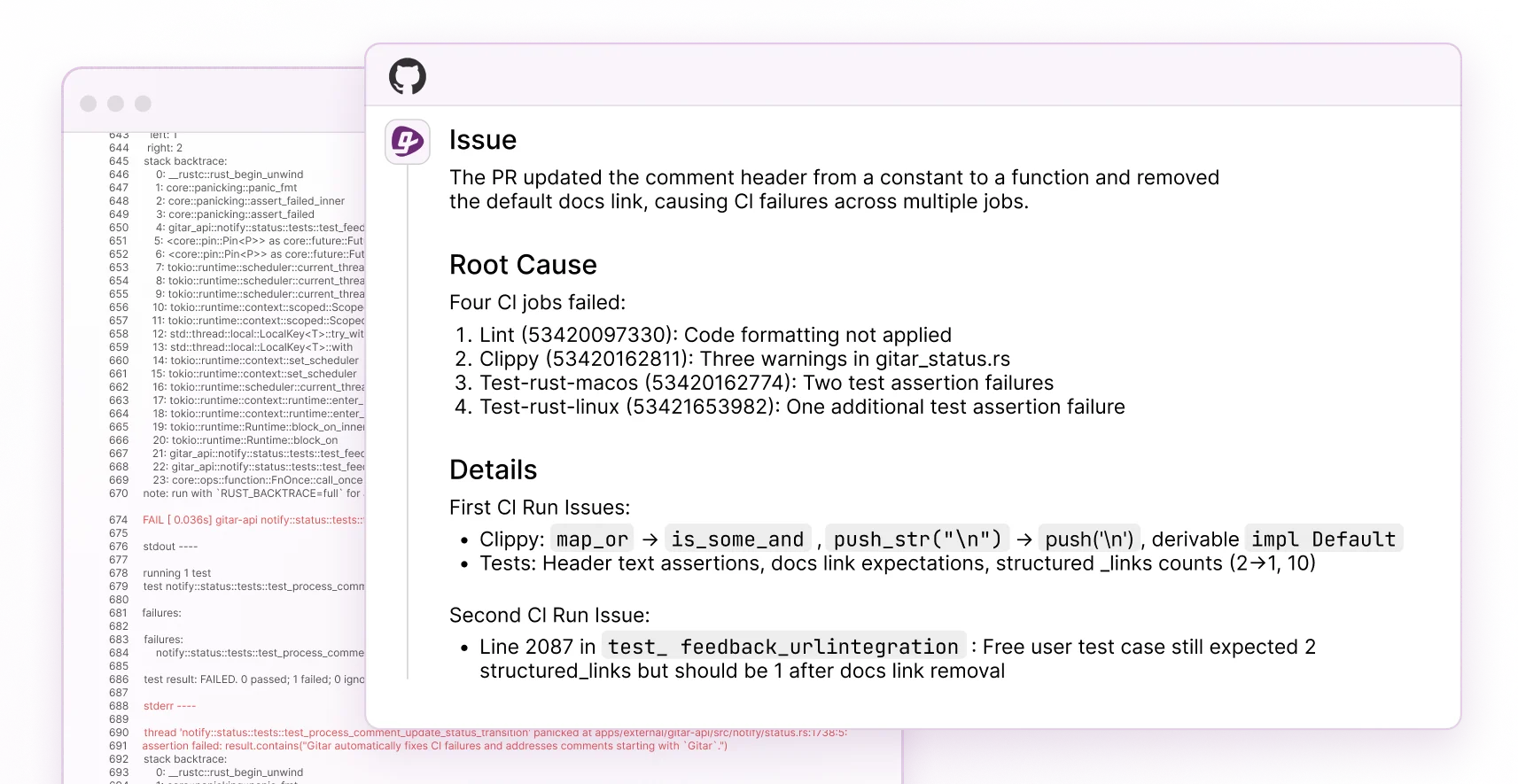
GitLab teams should balance developer experience, engineering velocity, and total cost of ownership when selecting a Graphite alternative. Gitar’s CI Failure Analysis deduplicates failures across multiple jobs or pipelines and surfaces root causes without log digging. This approach reflects a broader shift from suggestion-only tools toward healing-focused platforms.
Teams also need to weigh migration complexity, workflow changes after AI adoption, and how they will measure ROI. Moving from suggestion-based tools to auto-fixing platforms usually produces immediate gains through less context switching and faster CI resolution. For teams that feel cautious about automated commits, most platforms support suggestion modes so confidence can grow before enabling full automation.
As mentioned earlier, the $750K savings for a 20-developer team stems from three compounding factors. Eliminating manual CI fixes drives about 40% of the gain. Reducing review cycles contributes roughly 35%. Minimizing deployment delays adds the remaining 25%. Evaluate tools based on their ability to deliver these velocity improvements, not just surface more analysis.
Pick the Best Graphite Alternative for Your GitLab Team
Gitar leads this field by fixing code instead of only suggesting edits and by offering GitLab-native integration with guaranteed green builds through its Healing Engine. This two-week evaluation period provides risk-free access to auto-fix capabilities that many competitors only approximate with suggestion features.
Transform your GitLab PRs with guaranteed green builds and start your free Gitar trial today.
Graphite Alternatives for GitLab: FAQs
What’s the best free Graphite alternative for GitLab teams?
Gitar offers the most comprehensive free trial, with 14 days of full Team Plan access that includes auto-fixes, CI healing, and unlimited repositories. CodeRabbit and Qodo provide free tiers, but they focus on basic suggestions and partial automation. Gitar’s trial exposes the complete platform so teams can measure real productivity impact before committing.
How does CodeRabbit compare to Gitar for GitLab integration?
CodeRabbit provides native GitLab integration with detailed review comments and an interactive chat experience. Its AI-assisted features help apply fixes, but they still require more oversight than autonomous systems. Gitar extends beyond this model with autonomous CI failure fixes and guaranteed green builds. The core difference lies in automation scope, since CodeRabbit assists while Gitar heals.
Does Greptile offer full GitLab integration?
Greptile supports GitLab with native integration for dependency analysis and architectural impact assessment. It focuses on repository knowledge graphs and cross-module analysis instead of automated fixing. Teams gain strong insight into their codebase but still implement every change manually, which limits productivity gains compared with auto-fixing alternatives.
How do teams measure ROI from AI code review tools?
Teams track time saved on CI failures, shorter review cycles, and fewer context switches. A 20-developer team often saves about $750K each year through automated CI healing and faster merge cycles. Metrics such as mean time to green builds, PR cycle time, and developer interruptions provide clear signals. Auto-fixing tools like Gitar make ROI measurement easier because they directly reduce failure resolution time.
What’s involved in setting up Gitar on GitLab CI?
Gitar provides native GitLab integration with a straightforward setup. Teams install the GitLab app, configure repository access, and start the trial. The platform then analyzes CI pipelines, merge requests, and repository patterns without complex configuration. Natural language rules in repository files enable custom workflows without YAML expertise, which keeps onboarding accessible for entire teams. For complete setup instructions, review the setup guide in the Gitar documentation.