
Written by: Ali-Reza Adl-Tabatabai, Founder and CEO, Gitar
Key Takeaways
- AI-generated code speeds up development 3-5x but introduces merge conflicts in 27.67% of PRs, which adds hours of manual work.
- Gitar stands out by auto-fixing CI failures with validation, delivering green builds instead of suggestions that still need manual edits.
- Evaluate tools by auto-resolve rate (aim for 90%+), CI integration depth, setup time under 5 minutes, and performance on real PR conflicts.
- Traditional GUI tools require 15-30 minutes of manual effort per conflict, while AI tools like Gitar cut this to under 5 minutes with automation.
- Teams using Gitar save significant time and costs, so start your 14-day Gitar Team Plan trial to see validated fixes and higher quality software delivery in your own repos.
How To Evaluate Free AI Tools for Git Merge Conflict Resolution
Developers should evaluate AI merge conflict tools by auto-resolve success rate, CI and PR integration, setup speed, and platform coverage. Aim for at least 90% successful resolutions in production, setup in under 5 minutes, and support for GitHub, GitLab, and major CI systems.
Testing should use real pull requests with actual conflicts, measure time saved versus manual mergetool workflows, and confirm that AI-generated fixes pass CI checks. AgenticFlict dataset benchmarks and Reddit community feedback give you baseline expectations for 2026 tools. With these criteria in place, you can compare tools based on how reliably they keep your builds green in real-world conditions.
Top Free AI Tools to Automatically Resolve Git Merge Conflicts
1. Gitar: AI Code Review Platform with Auto-Fix and CI Validation
Gitar leads the market as an AI code review platform that keeps builds green through validated AI fixes for CI failures. It analyzes CI failure logs, uses full repository context to generate code fixes, validates those fixes in your actual CI environment, and then commits working patches automatically.
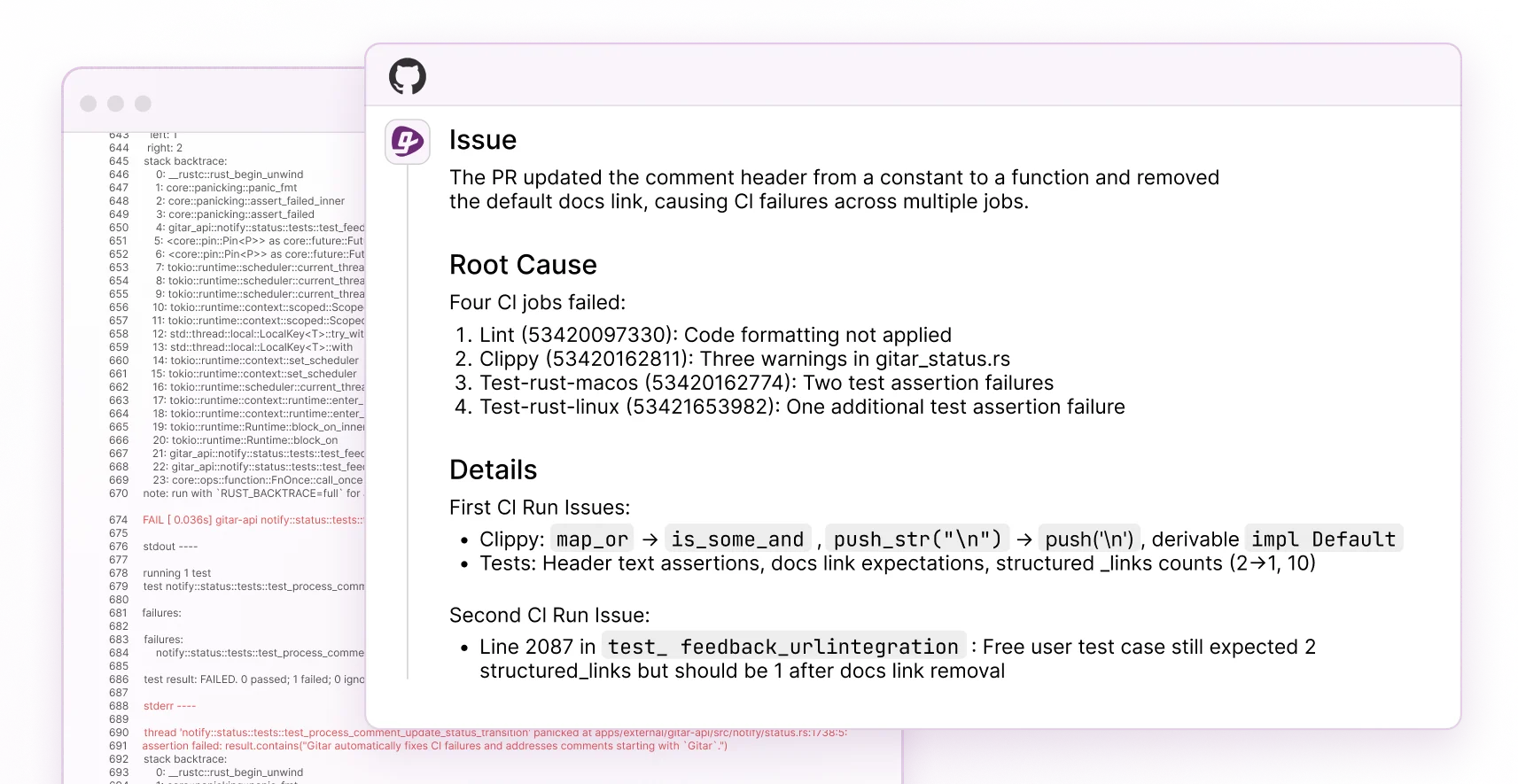
Key features: PR auto-fix with CI validation for lint errors, test failures, and build breaks, natural language repository rules in .gitar/rules, GitHub App installation, a 14-day Team Plan trial with no seat limits, plus GitLab and multi-CI support.
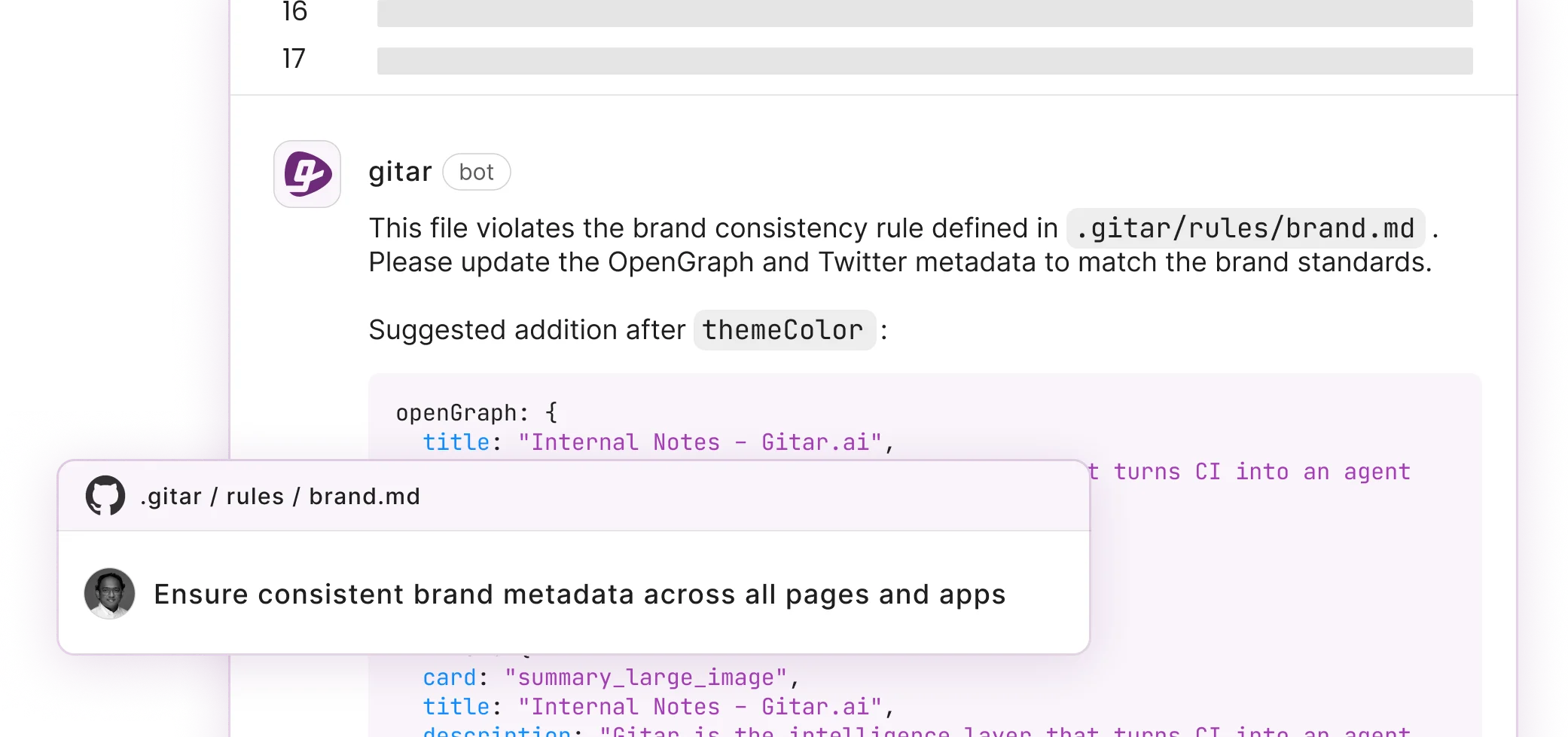
Setup: Install the GitHub App at gitar.ai, enable your trial, and Gitar immediately begins analyzing PRs with a single dashboard comment that updates in place.
Performance: Gitar handles complex CI failure scenarios that break other tools. Recent updates include configurable PR merge blocking and deeper CI failure analysis for noisy test suites.
Why Gitar wins: Gitar validates every fix before committing, so teams avoid the guesswork that comes with suggestion-only engines. Gitar’s CI agent maintains full context from PR open to merge and keeps working in the background to maintain green builds.
See how validated fixes behave in your codebase. Install the Gitar GitHub App and activate your 14-day trial to watch CI failures resolve automatically.
2. Merge Resolver (Git Merger AI)
Roshan Acharya’s Merge Resolver uses GitHub Copilot CLI to process conflict blocks automatically. This open-source tool adds AI-powered resolution with automatic backups and preview modes.
Setup: Clone from github.com/roshan-acharya/Merge-Resolver, run pip install -r requirements.txt, then pip install -e . to complete installation.
Usage: Run git-merger --p for preview mode or git-merger to resolve active conflicts. You need GitHub Copilot CLI access for it to work.
Limitations: Regex parsing can miss edge cases, Copilot CLI requires manual setup, and there is no CI integration or validation layer.
3. Cursor AI (Free Tier)
Cursor’s AI assistant offers merge conflict resolution inside its free tier, including agent mode for autonomous codebase exploration, terminal commands, and automatic file edits.
Features: Inline conflict suggestions, codebase awareness, integration with Claude and GPT models, and background agents that complete tasks independently.
Limitations: Cursor does not validate fixes in CI and free usage comes with strict quotas.
4. Anthropic Claude Code
Claude Code works as an agentic coding tool that includes Git merge conflict resolution in its terminal-based workflow, along with test execution and commit creation.
Capabilities: Terminal integration, git history search, and automated testing and linting fixes.
Limitations: Claude Code requires API access, lacks dedicated CI integration, and focuses mainly on command-line usage.
5. VS Code AI Extensions for Merge Assistance
Several VS Code extensions provide AI-powered merge conflict help, usually through suggestions and guided resolution inside the editor.
Popular options: GitLens with AI features, GitHub Copilot integration, and Cline AI for autonomous assistance.
Limitations: These tools stay bound to the editor, require manual implementation of suggestions, and offer inconsistent CI integration.
6. Traditional Git GUI Clients with AI Wrappers
Traditional tools like SmartGit, Fork, and TortoiseGitMerge provide visual conflict resolution with side-by-side views but no true AI-powered automatic resolution.
Note: These clients excel at visualization and manual control, yet every conflict still needs full manual resolution.
7. Git Rerere with AI Enhancement
Git’s built-in rerere (reuse recorded resolution) feature can pair with AI wrappers to reapply previous conflict resolutions to similar future scenarios.
Limitations: Rerere only helps with conflicts you have already solved and still needs manual setup and training.
Ready to move beyond manual CI failure resolution? Start your Gitar trial and let validated AI fixes handle CI while you focus on features.
Comparison Table: AI Merge Conflict Tools
| Tool | CI Fix Success | CI Integration | Free Tier Limits |
|---|---|---|---|
| Gitar | High for CI failures | Full validation | 14-day Team Plan trial with no seat limits |
| Merge Resolver | ~70% | None | Fully open source |
| Cursor AI | ~60% | Limited | Usage quotas |
| Traditional Tools | 0% (manual) | None | Varies by tool |
Gitar Deep Dive: How Auto-Fix Works in Pull Requests
Gitar takes a different path from suggestion engines by owning the full CI failure lifecycle. When CI fails, Gitar reads the failure logs with full repository context, generates patches, validates them in your CI, and commits working solutions automatically. The .gitar/rules system lets you define behavior in natural language instead of maintaining complex YAML files.
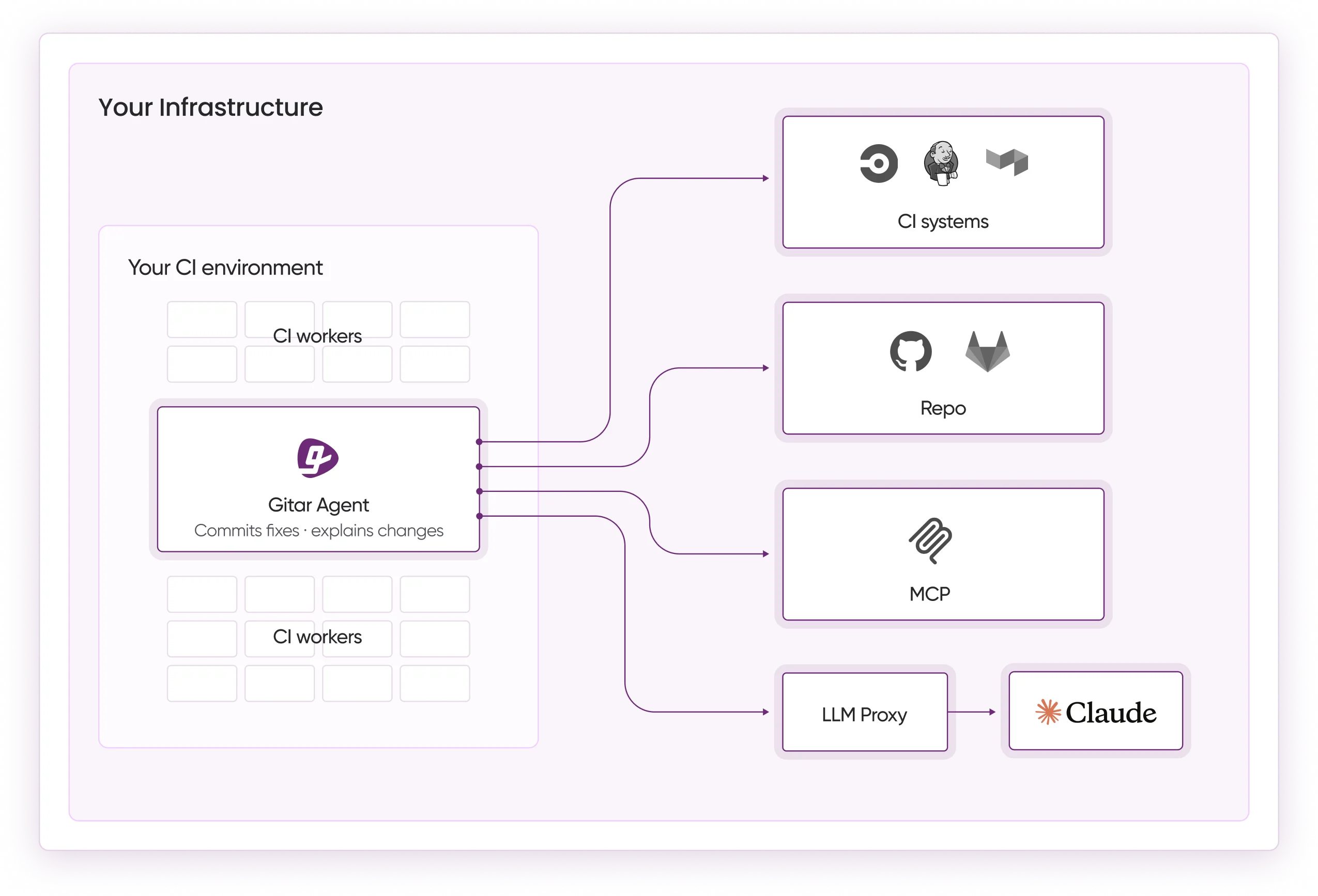
Example workflow: When a Copilot-generated PR causes a CI failure, Gitar immediately detects the broken build and inspects the failure logs to find the root cause. It then generates a fix that preserves the PR’s intent while addressing the specific failure. After that, Gitar runs the fix against your CI environment to confirm it passes. Once validation succeeds, Gitar commits the resolution so you can stay focused on feature development instead of context-switching into debugging.
ROI impact: Teams save large blocks of time on CI issues. Gitar’s intelligence layer keeps context across the development lifecycle, learns team patterns, and improves its decisions over time. To understand why this approach matters, you can compare Gitar’s automation with the traditional merge resolution methods many teams still rely on.
AI vs Traditional Merge Tools: 2026 Performance Analysis
Traditional tools like Meld, KDiff3, and visual merge editors rely on manual conflict resolution. The manual approach mentioned earlier usually takes 15-30 minutes per conflict, with complexity deciding whether you land closer to 15 minutes or 30. AI-powered alternatives reach sub-5-minute resolution times by automating the analysis and implementation steps that consume most of that manual effort.
The 27.67% average conflict rate mentioned earlier hides significant variation across AI coding agents. Benchmarks for 2026 show GitHub Copilot near the low end at 15.24% and OpenAI Codex near the high end at 32.31%, while Cursor at 19.75% and Devin at 22.85% sit in the middle. Gitar focuses on fixing CI failures that arise from these AI-generated changes, regardless of which agent produced the code.
| Approach | Resolution Speed | Automation Level | CI Fix Success |
|---|---|---|---|
| Gitar AI | <5 minutes | Fully automated | High |
| Traditional GUI | 15-30 minutes | Manual only | Variable |
| Suggestion Tools | 10-15 minutes | Semi-automated | 60-70% |
When AI Fails: Troubleshooting Complex Conflicts
Even advanced AI tools struggle with conflicts that involve deep architectural shifts, dependency upgrades, or clashing business rules. When automatic resolution fails, Gitar falls back to detailed analysis and suggestion mode so developers can review and approve fixes manually.
A practical adoption path starts with Gitar’s suggestion mode to build trust, since developers can inspect every change before it lands. After the team gains confidence, you can enable auto-commit for low-risk failure types such as linting errors, which have predictable fixes and limited impact on business logic. Throughout this rollout, CI validation should remain the guardrail that confirms every fix works in your real production environment. Gitar’s configurable aggression levels support this gradual approach, letting teams increase automation as comfort and requirements grow.
Stop paying for suggestions that still need manual work. Install Gitar and experience true automation during your trial period.
Frequently Asked Questions
Best AI Option for Resolving Cursor-Generated Conflicts
Gitar provides a complete solution for CI failures in Cursor-generated PRs through its 14-day Team Plan trial. Unlike suggestion-only tools, Gitar validates fixes in your actual CI environment and aims for consistently green builds. During the trial, you get full auto-fix capabilities, custom repository rules, and unlimited team members.
Seat Limits During the Gitar Trial
Gitar’s 14-day Team Plan trial supports unlimited team members and full feature access, including auto-fix, CI validation, custom rules, and integrations with Jira, Slack, and Linear. This setup lets entire teams measure productivity gains before they commit to a paid plan.
Using Gitar with GitLab Repositories
Gitar supports both GitHub and GitLab repositories and works with multiple CI systems, including GitHub Actions, GitLab CI, CircleCI, and Buildkite. Teams get consistent auto-fix behavior across all supported version control and CI platforms.
How To Measure ROI from AI Merge Conflict Tools
Teams should track time saved per PR, fewer context switches, and improved sprint velocity to measure ROI. Gitar’s auto-fix capabilities for CI failures reduce manual debugging time, and a 20-developer team can see roughly $750K in annual productivity gains compared to manual resolution workflows.
Switching from CodeRabbit to Gitar
CodeRabbit and similar tools focus on suggestions that still require manual implementation and do not guarantee working fixes. Gitar’s healing engine fixes CI failures directly and validates solutions against CI, which removes the guesswork from the process. The trial period lets you compare both approaches on your own codebase before you decide.
Conclusion: Choose Automation Over Suggestions
Modern AI coding workflows need tools that match their speed and reliability. Suggestion engines that cost $15-30 per developer while leaving most work manual deliver only incremental gains that rarely justify their price. The leading free AI tools for Git merge conflict resolution in 2026 focus on real automation, and Gitar leads this group with validated fixes and deep CI integration.
Start with trials and benchmarks that use your own repositories and conflict patterns. Measure time saved, resolution success rates, and team productivity changes so you can select the tool that fits your development workflow.
Install Gitar and let validated AI fixes handle broken builds during your trial access, so your team can ship higher quality software faster.