
Key Takeaways
- AI code generation tools like Copilot increased PR review time by 91% in 2026, so teams now face new review bottlenecks.
- Gitar’s 14-day Team Plan trial includes unlimited auto-fix for CI failures and PR feedback, while many competitors only provide suggestions.
- Top free tools include CodeRabbit (limited tier, line-by-line suggestions), Greptile (public repos, context analysis), and SonarQube (static analysis).
- Gitar’s auto-fix capabilities validate changes in real CI environments and cut review friction from 1 hour to 15 minutes per developer each day.
- Teams save about $750K per year in productivity, so start your free Gitar trial to ship higher quality software faster.
How We Evaluated Bitbucket AI Code Review Tools
We evaluated AI code review tools using 2026 criteria focused on real team outcomes. We checked native Bitbucket Pipelines integration, depth of free offerings, and whether tools provide auto-fix or only suggestions. We also reviewed setup complexity, CI failure analysis depth, and measurable ROI. Our sources include developer community feedback and benchmark data that highlight Gitar’s validation advantages over competitors that charge $15-30 per developer for basic commentary.
Top Free AI Code Review Tools for Bitbucket PRs
| Tool | Free Offering | Key Features | Bitbucket Setup |
|---|---|---|---|
| Gitar | 14-day unlimited Team Plan trial | Auto-fix CI failures, PR summaries, single comment interface | Check Gitar docs for supported integrations |
| CodeRabbit OSS | Limited free tier | Line-by-line suggestions, 40+ linters | Webhook configuration |
| Greptile Free | Free for public repositories | Deep context analysis, repository graph | Manual setup required |
| SonarQube Community | Free basic plan | Static analysis, quality gates | Pipeline integration |
Detailed Reviews of Each Bitbucket AI Code Tool
1. Gitar: Strongest Free Trial for Auto-Fixes
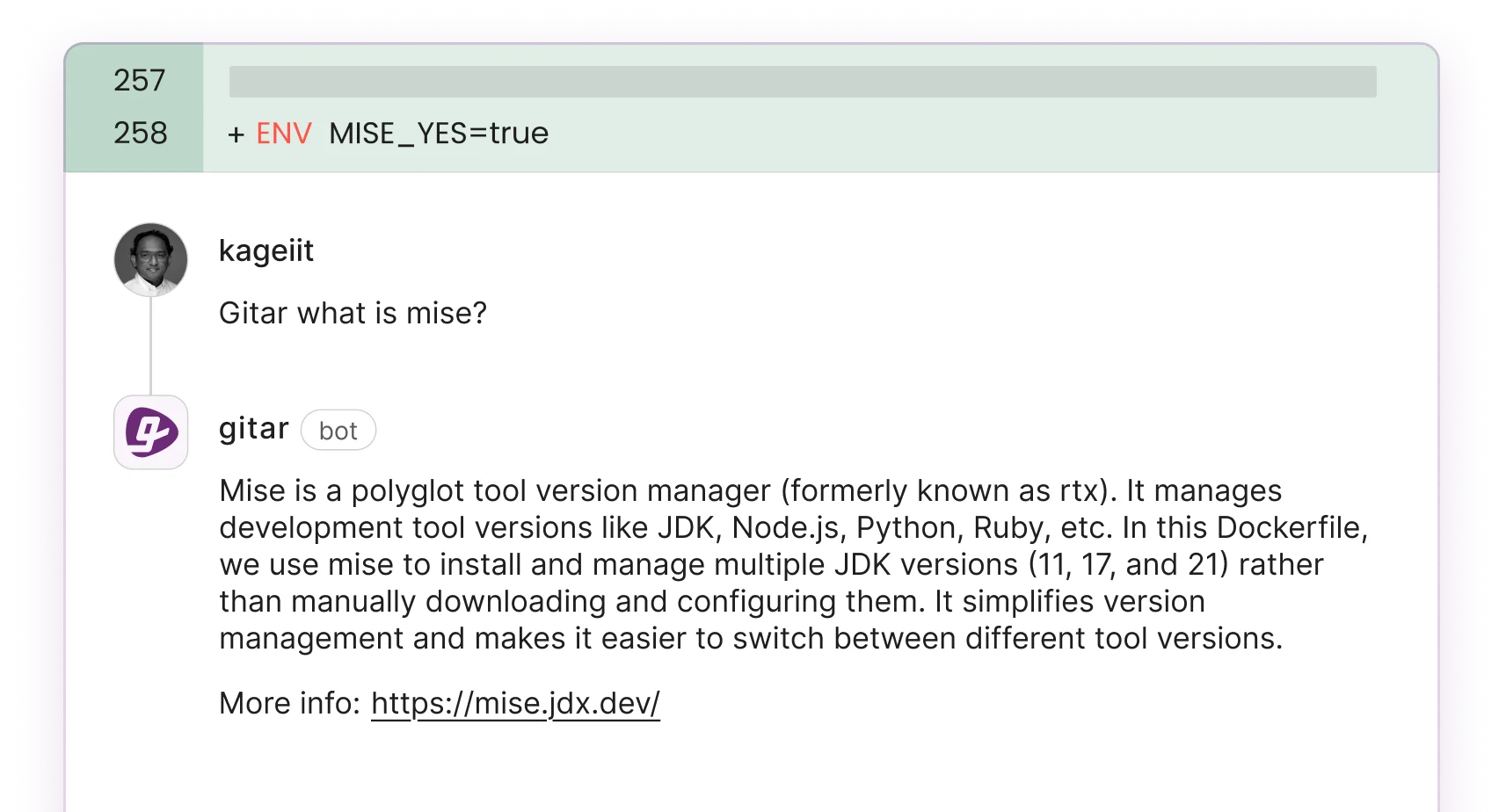
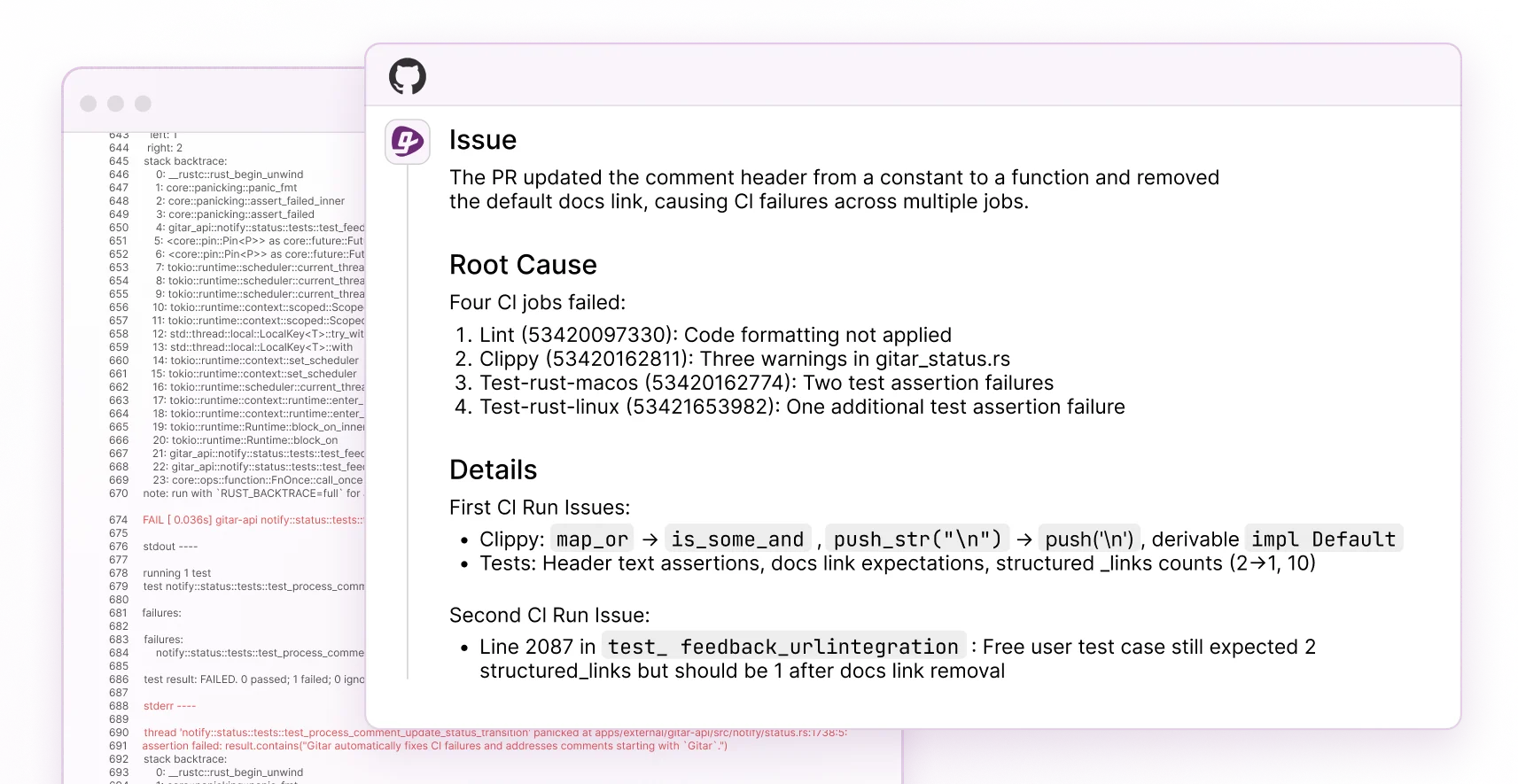
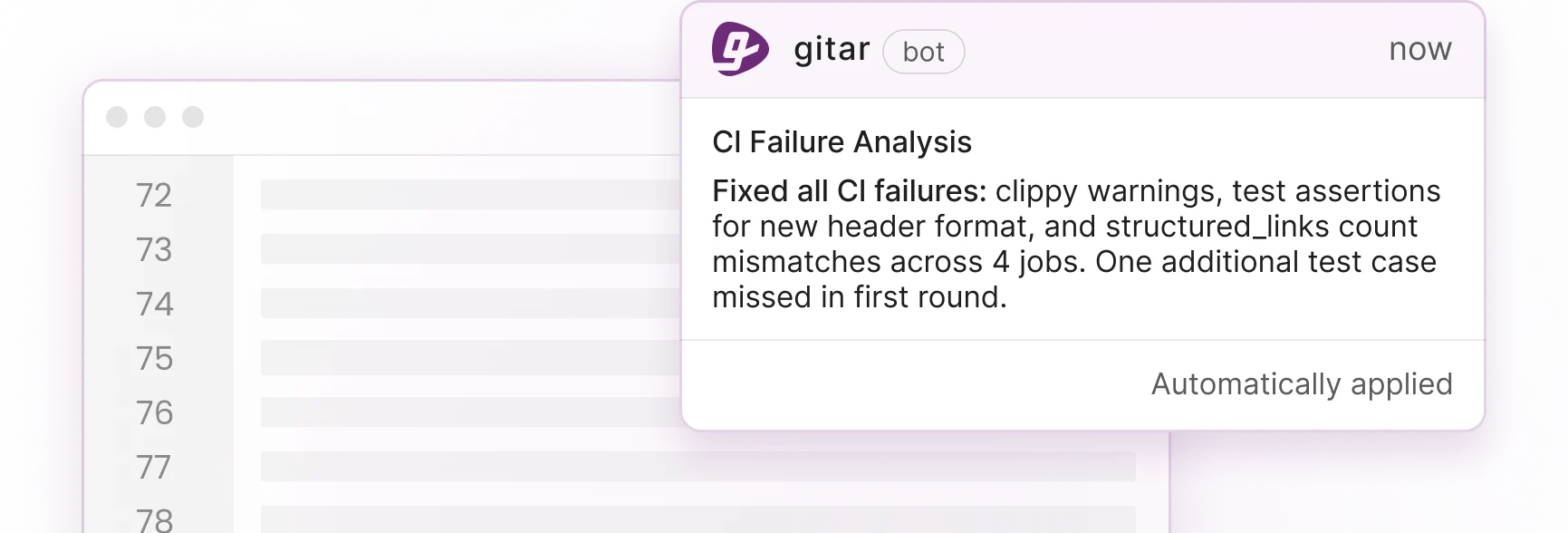
Gitar offers a comprehensive 14-day free trial of its Team Plan with unlimited access to auto-fix capabilities that competitors usually price at $15-30 per developer. Gitar’s healing engine automatically resolves CI failures, addresses review feedback, and commits working fixes directly to your pull requests. This approach turns AI from a suggestion engine into a hands-on teammate.
Key Features:
- Automatic CI failure analysis and resolution
- Single dashboard comment that updates in place
- Validation of fixes against your actual CI environment
- Natural language workflow rules in .gitar/rules.md
- Integrations with GitHub, GitLab, CircleCI, and Buildkite
Setup Steps for Gitar:
- Sign up at gitar.ai for the 14-day Team Plan trial.
- Install using docs.gitar.ai/bitbucket.
- Configure repository rules in .gitar/rules.md using plain language.
- Enable auto-fix for trusted failure types that match your risk tolerance.
Pros: Genuine auto-fixes, full-featured trial, CI context awareness, and a single clean interface that avoids comment noise.
2. CodeRabbit OSS: Line-by-Line Suggestion Reviews
CodeRabbit supports Bitbucket pull requests with more than 2 million repositories connected and over 13 million PRs processed. The free tier focuses on basic line-by-line comments and integrates with more than 40 linters. Teams still need to implement each suggested fix manually, which keeps developers in the loop but adds extra work.
Key Features:
- Line-by-line code analysis
- Integration with multiple linters
- PR summaries and diagrams
- Self-hosted deployment option
Cons: Suggestion-only model, seat limits on the free tier, and notification overload from many inline comments.
3. Greptile Free: Repository-Wide Context Analysis
Greptile provides free access for public repositories and focuses on deep codebase analysis using full repository graph context. Greptile provides deep codebase analysis with full repository graph context awareness, which helps surface architectural issues that diff-based tools often miss. This approach suits teams that care about long-term design quality.
Key Features:
- Repository-wide context understanding
- Architectural issue detection
- Cross-file dependency analysis
Cons: Limited to public repositories on the free tier, higher false positive rates, and no auto-fix capabilities.
Start your 14-day Gitar Team Plan trial at https://gitar.ai/ for full auto-fix power.
4. DIY OpenAI or Groq Integration for Bitbucket
Building an AI-powered code reviewer for Bitbucket using Groq Pipelines outlines a step-by-step approach that teams can adapt. You trigger a Bitbucket Pipeline on PR creation, extract the git diff using “git diff origin/main…HEAD,” send the diff to a Groq LLM for analysis, and then generate structured checklist-based reviews. This pattern gives full control over prompts and behavior.
Key Features:
- Custom prompts and logic control
- Zero licensing costs when using Groq
- Automatic PR reviews in minutes
- Downloadable review artifacts
Cons: Requires engineering effort to build and maintain, offers no auto-fix capabilities, and can be fragile when APIs or schemas change.
5. SonarQube Community Edition: Static Analysis for Bitbucket
SonarQube Community Edition delivers static analysis for code quality, security, and maintainability. It offers seamless Bitbucket Cloud integration where results appear directly in PRs for review and prioritization. Many teams already rely on SonarQube as a baseline quality gate.
Key Features:
- Static code analysis
- Security vulnerability detection
- Quality gate enforcement
- PR decoration with analysis results
Cons: Rule-based rather than AI-powered, no deep contextual understanding, and suggestion-only feedback.
Step-by-Step: Setting Up Free AI Code Review in Bitbucket
Gitar offers the fastest path to a comprehensive auto-fix solution for Bitbucket teams. You can start with a trial and keep your existing CI in place.
- Sign up for the 14-day Team Plan trial at gitar.ai.
- Review official documentation for supported integrations.
- Create a .gitar/rules.md file with natural language workflow rules that match your team’s process.
- Enable auto-fix for trusted CI failure types such as flaky tests or formatting issues.
- Test with a sample pull request to confirm that comments, fixes, and CI checks behave as expected.
For a DIY OpenAI-style integration, you can add this Bitbucket Pipelines YAML as a starting point.
pipelines: pull-requests: '**': - step: name: AI Code Review script: - git diff origin/main...HEAD > diff.txt - python ai_review.py diff.txt artifacts: - ai-review.md
Side-by-Side Comparison and 2026 Benchmarks
| Capability | Gitar | CodeRabbit | Greptile | DIY Solutions |
|---|---|---|---|---|
| Auto-apply fixes | Yes | No | No | No |
| CI failure analysis | Yes | No | No | Limited |
| Free duration | 14-day unlimited | Limited tier | Public repos only | Unlimited |
| Bitbucket support | See docs | Yes | Manual | Custom |
ROI analysis shows that a 20-developer team saves about $750,000 per year in productivity costs by cutting CI and review friction from 1 hour per day per developer to 15 minutes. Auto-fix capabilities drive this gain compared with $15-30 per seat suggestion tools that still require manual work.
Key Tradeoffs When Choosing a Bitbucket AI Reviewer
Most free tools focus on suggestion-only models with seat limits, while Gitar’s full trial delivers zero-setup auto-fix capabilities. Developers distrust AI code review tools due to incorrect suggestions requiring rework, so validation and auto-fix matter more than raw comment volume. Many teams start in suggestion mode to build trust, then enable automated commits once they see consistent, correct fixes.
Frequently Asked Questions
Is there truly free AI code review for Bitbucket?
Gitar provides a 14-day free trial of its Team Plan with unlimited access to auto-fix capabilities, PR analysis, and CI integration. Other options include limited free tiers from CodeRabbit, free access for public repositories through Greptile, and DIY solutions that use OpenAI or Groq APIs with your own prompts and scripts.
How do I set up AI code review for Bitbucket pull requests?
The fastest setup uses Gitar’s integration through its supported platforms and Bitbucket documentation. Alternative approaches include webhook configurations for CodeRabbit, custom Bitbucket Pipelines YAML for DIY solutions, or SonarQube Cloud integration for static analysis and quality gates.
What is the difference between Gitar and CodeRabbit for Bitbucket?
Gitar provides auto-fix capabilities that resolve CI failures and implement review feedback directly in your pull requests. CodeRabbit focuses on suggestion-only comments that require manual implementation by developers. Gitar’s 14-day trial includes unlimited access, while CodeRabbit’s free tier uses seat limits and feature constraints.
Can AI code review tools automatically fix broken builds?
Only Gitar among the reviewed tools provides automatic CI failure resolution. Gitar analyzes failure logs, generates validated fixes, and commits working solutions directly to pull requests. Other tools identify issues but still require manual implementation of suggested fixes.
Which AI code review tool offers the strongest ROI for teams?
Gitar’s auto-fix capabilities deliver the strongest ROI by removing most of the manual work required with suggestion-only tools. Teams save about 45 minutes per developer per day on CI and review issues, which translates to roughly $750,000 in annual productivity gains for 20-developer teams compared with paying $15-30 per seat for basic commentary tools.
Conclusion: Turn Bitbucket PR Reviews into a Faster Feedback Loop
The 2026 landscape of free AI code review tools for Bitbucket shows a clear gap between suggestion engines and healing platforms. Tools like CodeRabbit and Greptile provide valuable analysis and context, but they stop at comments and alerts. Gitar’s 14-day Team Plan trial delivers auto-fix capabilities that resolve CI failures and implement review feedback so teams can move faster with fewer interruptions. Install Gitar now, automatically fix broken builds, and start shipping higher quality software faster. For full setup guidance, visit docs.gitar.ai and shift your Bitbucket workflow from reactive suggestions to proactive, validated solutions.