
Last updated: March 10, 2026
Key Takeaways
- Developers now generate code 3-5x faster, but code review capacity hasn’t scaled. Teams still face review and CI bottlenecks and need true autofix, not just suggestions.
- Gitar.ai leads with full CI integration across GitHub, GitLab, CircleCI, and auto-commits validated fixes once builds turn green.
- Free tiers like GitHub Copilot (2,000 completions per month) and Cursor help in the editor but do not automate pipelines.
- Tools focus on different niches, such as Sourcery for Python and CodeWhisperer for AWS, but most still rely on manual fixes.
- Teams save time each day with Gitar’s autonomous fixing, so start your free 14-day Gitar Team Plan trial today to see real ROI.
Top 7 Free AI Code Fixers at a Glance
Here are the leading automated code fixing tools for 2026.
- Gitar.ai – Auto-fixes and commits CI failures with green-build guarantees.
- GitHub Copilot – Free tier offers 2,000 completions monthly with basic autocomplete.
- Cursor – AI-native editor with instant refactoring and multi-file bug fixes.
- Tabnine – Context-aware completions across 80+ languages with performance suggestions.
- Sourcery – Python-focused refactoring with anti-pattern detection.
- Codeium – Broad code generation and debugging across 70+ languages.
- Amazon CodeWhisperer – Security-focused fixes for AWS-centric workflows.
Start your free automated AI code fix trial with Gitar.ai to feel the difference between suggestions and actual implemented fixes.
1. Gitar.ai: CI-Aware Autofix for Real-World Teams
Gitar.ai moves beyond suggestion-only tools and ships a healing engine that resolves CI failures and applies review feedback automatically. Competing tools often charge $15 to $30 per developer for comments, while Gitar includes full autofix in its 14-day Team Plan trial. You can explore the full feature set in the Gitar documentation.
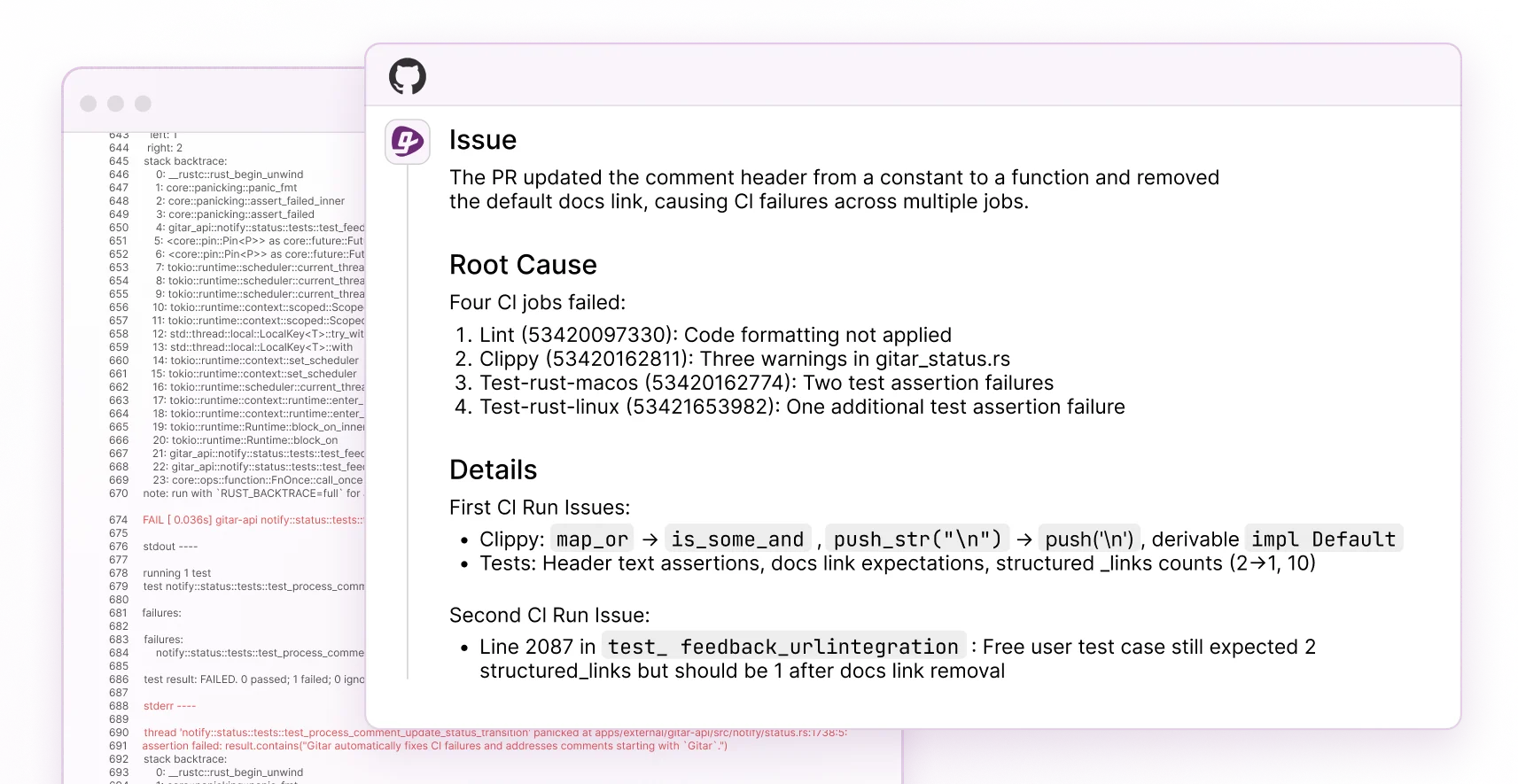
Key Features: Automatic CI failure analysis and resolution, review feedback implementation, natural language workflow rules, single dashboard comment to reduce noise, hierarchical context memory, Jira and Slack integration.
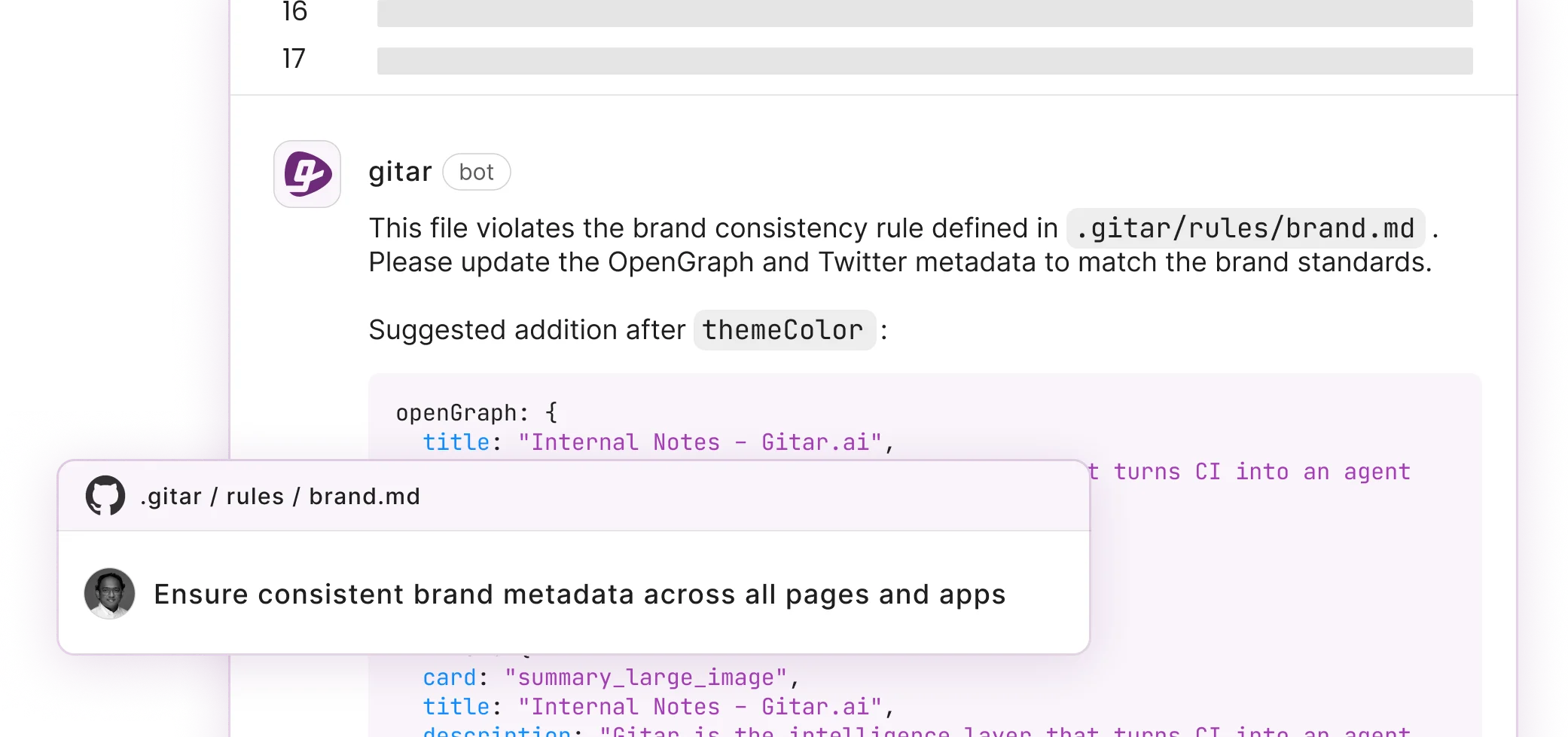
Platforms: GitHub, GitLab, CircleCI, Buildkite, GitHub Actions, GitLab CI with unlimited public and private repositories during the trial.
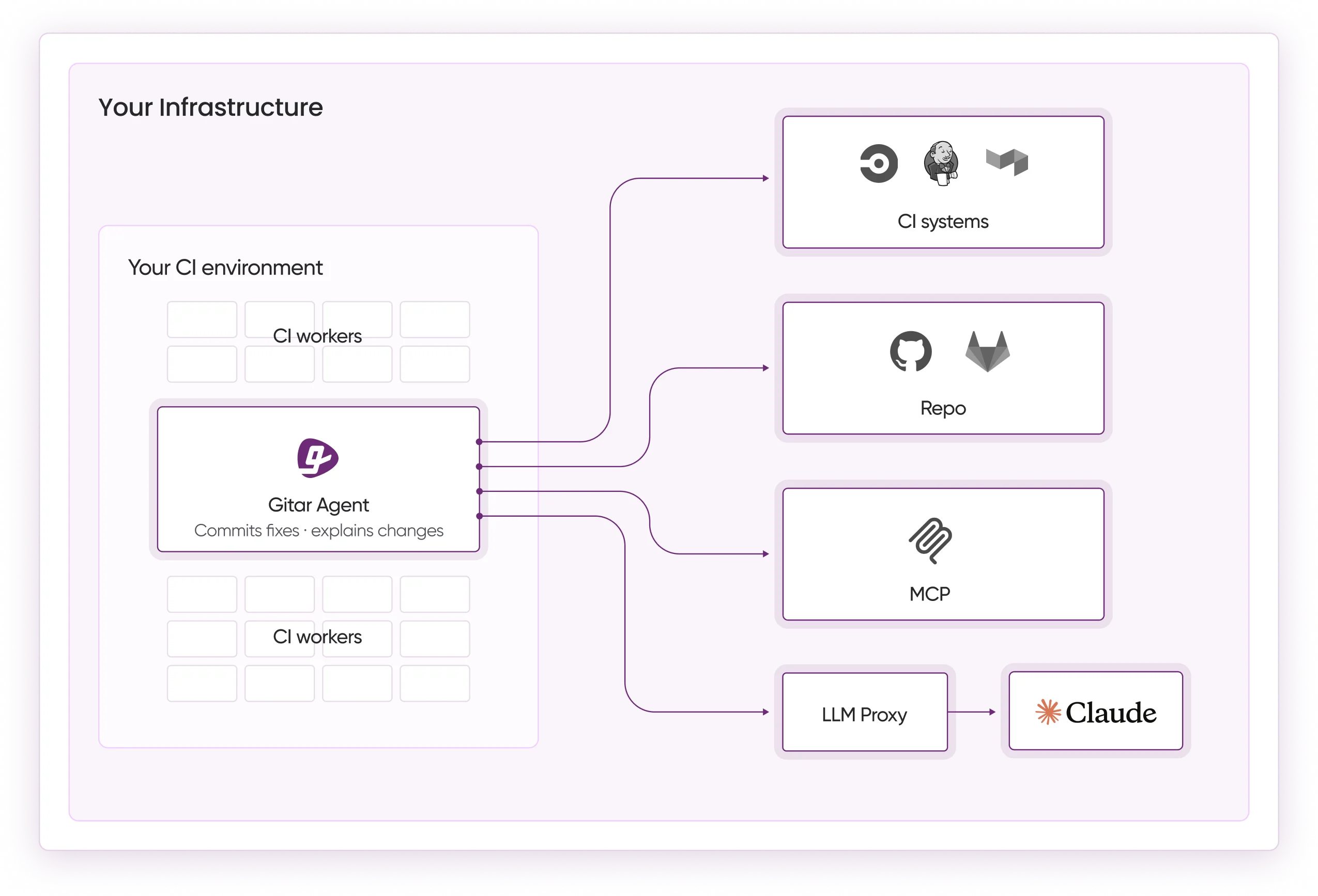
Setup Process:
- Install the Gitar GitHub App or GitLab integration.
- Start the 14-day Team Plan trial.
- Configure auto-commit preferences or begin in suggestion mode.
- Add repository rules using natural language in .gitar/rules/*.md.
- Connect Jira, Linear, or Slack for shared context.
Strengths: Green-build guarantees through fix validation, context retention across pull requests, reduced manual toil with autonomous commits, and CI coverage that extends beyond GitHub alone.
Ideal Users: Engineering teams with CI bottlenecks, developers tired of repetitive fix work, and platform teams that want workflow automation without complex YAML pipelines.
2. GitHub Copilot: Familiar Autocomplete Inside GitHub
GitHub Copilot’s free tier delivers basic autocomplete with 2,000 code completions and 50 chat messages per month. The 2026 release adds an agent mode for multi-file tasks and expands support for C, C++, Kotlin, and Swift.
Key Features: Fast autocomplete in VS Code, basic chat, GitHub Actions integration, and pull request refinement through Copilot workspace.
Platforms: VS Code, JetBrains IDEs, and native GitHub integration with Actions workflows.
Setup Process:
- Install the GitHub Copilot extension in VS Code.
- Authenticate with your GitHub account.
- Enable the free tier for individual use.
- Adjust completion and suggestion preferences.
Limitations: Monthly caps, suggestion-only workflow, limited CI awareness, and a focus on autocomplete rather than autonomous fixing.
Ideal Users: Individual developers who want quick code completion, teams already deep in the GitHub ecosystem, and users comfortable applying suggestions manually.
3. Cursor: AI-First Editor for Multi-File Refactors
Cursor functions as an AI-native code editor with unlimited slow requests and 50 fast requests in its free tier. Its Tab feature supports instant refactoring, while Composer coordinates multi-file edits for complex bug fixes.
Key Features: AI completion with multiline predictions, smart rewrites for errors, full codebase analysis, and multi-file understanding for semi-autonomous bug fixing.
Platforms: Standalone editor that fits VS Code workflows and supports major languages with Git-aware context.
Setup Process:
- Download the Cursor editor.
- Import existing VS Code settings and extensions.
- Choose AI models such as GPT-4 or Claude.
- Enable Tab and Composer features.
Strengths: Deeper automation than simple suggestions, context-aware multi-file edits, built-in debugging, and strong VS Code compatibility.
Limitations: Requires switching editors, free tier request limits, no direct CI integration, and a focus on IDE workflows instead of pipelines.
Ideal Users: Developers open to a new editor, teams that need powerful refactoring, and users who value multi-file context.
Install Gitar now, automatically fix broken builds, and ship higher quality software faster when you want CI-integrated automation beyond editor tools.
4. Tabnine: Language-Heavy Autocomplete Across IDEs
Tabnine delivers context-aware suggestions across many languages with VS Code and JetBrains integration. The free version supports intelligent completion and basic performance improvements across more than 80 languages.
Key Features: Smart autocomplete, performance-focused suggestions, wide language coverage including Python, Rust, and Go, plus a privacy-friendly local processing option.
Platforms: VS Code, JetBrains IDEs such as IntelliJ and PyCharm, Vim, Emacs, and Sublime Text.
Setup Process:
- Install the Tabnine extension in your preferred IDE.
- Create a free Tabnine account.
- Set suggestion and completion preferences.
- Choose local or cloud processing.
Strengths: Broad language support, privacy controls, mature IDE integrations, and consistent behavior across environments.
Limitations: IDE-focused experience, no CI pipeline automation, limited free tier features, and manual work for complex fixes.
Ideal Users: Polyglot developers, privacy-conscious teams, and users who want consistent autocomplete in several IDEs.
5. Sourcery: Python-First Refactoring and Style
Sourcery focuses on Python refactoring with anti-pattern detection and improvement suggestions in VS Code, PyCharm, and GitHub. The free tier runs continuous analysis and offers personalized recommendations.
Key Features: Python-specific refactoring, anti-pattern detection, continuous analysis, personalized style guidance, and GitHub pull request reviews.
Platforms: VS Code, PyCharm, and GitHub with Python-focused quality and style enforcement.
Setup Process:
- Install the Sourcery extension for Python work.
- Connect your GitHub account for pull request analysis.
- Adjust refactoring rules and preferences.
- Enable real-time analysis in your editor.
Strengths: Deep Python expertise, always-on analysis, style personalization, and automated review support in GitHub.
Limitations: Python-centric design, one-click fixes instead of full CI autofix, limited CI and CD coverage, and a narrow language scope.
Ideal Users: Python teams, data science groups, and teams that care about code quality and consistent style.
Start your free automated AI code fix trial with Gitar.ai when you need multi-language autofix beyond Python-only tools.
6. Codeium: Fast Autocomplete With Strong Security
Codeium provides free AI-powered completion for more than 70 languages with generation, refactoring, and debugging. Its free tier targets individuals and includes SOC2-compliant security controls.
Key Features: Fast autocomplete, natural language repository search, code generation and refactoring, built-in debugger, and multilingual support with compliance.
Platforms: VS Code, JetBrains IDEs, and Vim or Neovim with a security-focused backend.
Setup Process:
- Install the Codeium extension.
- Create a free individual account.
- Set language preferences.
- Enable natural language search for your repos.
Strengths: Wide language coverage, strong security posture, generous free tier, and powerful natural language search.
Limitations: Suggestion-based workflow, no CI automation, individual-focused free plan, and limited collaboration features.
Ideal Users: Individual developers, security-aware organizations, and teams that need broad language support with compliance.
7. Amazon CodeWhisperer: AWS-Native Coding Assistant
Amazon CodeWhisperer, within Amazon Q Developer, offers free individual access with security scans and code fixes for AWS workflows. Its design centers on cloud-native development and AWS service integration.
Key Features: AWS-optimized code generation, security vulnerability scanning, cloud architecture suggestions, and service integration guidance.
Platforms: VS Code, JetBrains IDEs, and AWS Cloud9 with native AWS integration.
Setup Process:
- Install the AWS Toolkit extension.
- Configure AWS credentials.
- Enable the CodeWhisperer individual tier.
- Set security scanning rules.
Strengths: Tight AWS ecosystem fit, security-focused analysis, cloud architecture support, and free access for individuals.
Limitations: Strong AWS bias, suggestion-only behavior, weaker support for non-cloud projects, and tuning for AWS-first workflows.
Ideal Users: AWS-focused teams, cloud-native applications, and developers building serverless or containerized systems.
8. Replit Ghostwriter: In-Browser AI for Collaborative Coding
Replit Ghostwriter brings AI help directly into the Replit environment and supports completion, debugging, and project generation inside the browser IDE.
Key Features: Integrated AI chat, code completion, debugging help, project scaffolding, and collaborative development tools.
Platforms: Replit web IDE with browser-based development and real-time collaboration.
Strengths: Seamless IDE integration, strong collaboration, project-level guidance, and a beginner-friendly interface.
Limitations: Locked to the Replit platform, limited enterprise controls, browser constraints, and CI integration that depends on external webhooks.
Ideal Users: Classrooms, rapid prototypes, collaborative side projects, and beginners learning to code.
9. Blackbox AI: Fast Generation and Explanations
Blackbox AI focuses on rapid code generation and completion across many languages and adds clear code explanation features.
Key Features: Multi-language generation, code explanation, snippet improvements, VS Code integration, and chat-based help.
Platforms: VS Code extension, web interface, and API access for custom workflows.
Strengths: Quick generation, strong explanation tools, flexible access methods, and language versatility.
Limitations: Basic free tier limits, suggestion-first design, minimal CI integration, and a younger ecosystem.
Ideal Users: Rapid prototyping, learning and training, developers who need explanations, and multi-language projects.
10. Continue.dev: Open-Source Assistant With Custom Models
Continue.dev offers an open-source coding assistant that plugs into VS Code and JetBrains and supports custom AI models with a privacy-first approach.
Key Features: Open-source core, customizable models, privacy-focused design, IDE integration, and an extensible plugin system.
Platforms: VS Code and JetBrains IDEs with self-hosted and custom model options.
Strengths: Open-source flexibility, strong privacy control, model customization, and community-driven improvements.
Limitations: Requires technical setup, suggestion-based behavior, no native CI integration, and reliance on community support.
Ideal Users: Privacy-focused teams, open-source supporters, developers who need custom models, and technical teams comfortable with self-hosting.
Install Gitar now, automatically fix broken builds, and ship higher quality software faster when you need enterprise-grade automation beyond open-source assistants.
Comparison Table: Autofix and CI Coverage
|
Tool |
Autofix Capability |
CI Integration |
Free Tier Limits |
Auto-Commit |
|
Gitar.ai |
Full + Validation |
GitHub, GitLab, CircleCI, Buildkite |
14-day Team Plan (50 users) |
Yes |
|
GitHub Copilot |
Suggestions Only |
GitHub Actions |
2,000 completions/month |
No |
|
Cursor |
Partial (Editor-based) |
None |
Unlimited slow, 50 fast requests |
No |
|
Tabnine |
Partial (IDE-based fixes) |
None |
Basic completions |
No |
|
Sourcery |
One-click fixes |
GitHub/GitLab PR reviews |
Python/JS/TS analysis |
No |
Key Tradeoffs for Teams Evaluating Autofix
Solo developers can start with Gitar’s 14-day trial to feel the difference between autonomous fixing and suggestion-only tools. For teams, CI integration and measurable ROI matter most, since developers using leading AI assistants code 30% to 55% faster, which equals roughly $750,000 in yearly productivity saved for a 20-person team.
Security teams often prefer configurable auto-commit systems like Gitar, where you can begin in suggestion mode and then enable autonomous fixes for trusted failure types. Setup effort also varies, since Copilot installs quickly while a platform like Gitar delivers deeper workflow automation in exchange for more initial configuration.
Start your free automated AI code fix trial with Gitar.ai and track real productivity gains instead of relying on theoretical estimates.
Best Free AI for Coding in GitHub-Centric Workflows
GitHub-native teams benefit most from tools with strong repository and pull request integration. Gitar.ai stands out in these environments with PR healing, automatic commit generation, and GitHub Actions support. AI like Copilot has already improved PR merge success rates by 15% despite higher PR volume, and autonomous fixing from Gitar removes the remaining manual implementation bottleneck.
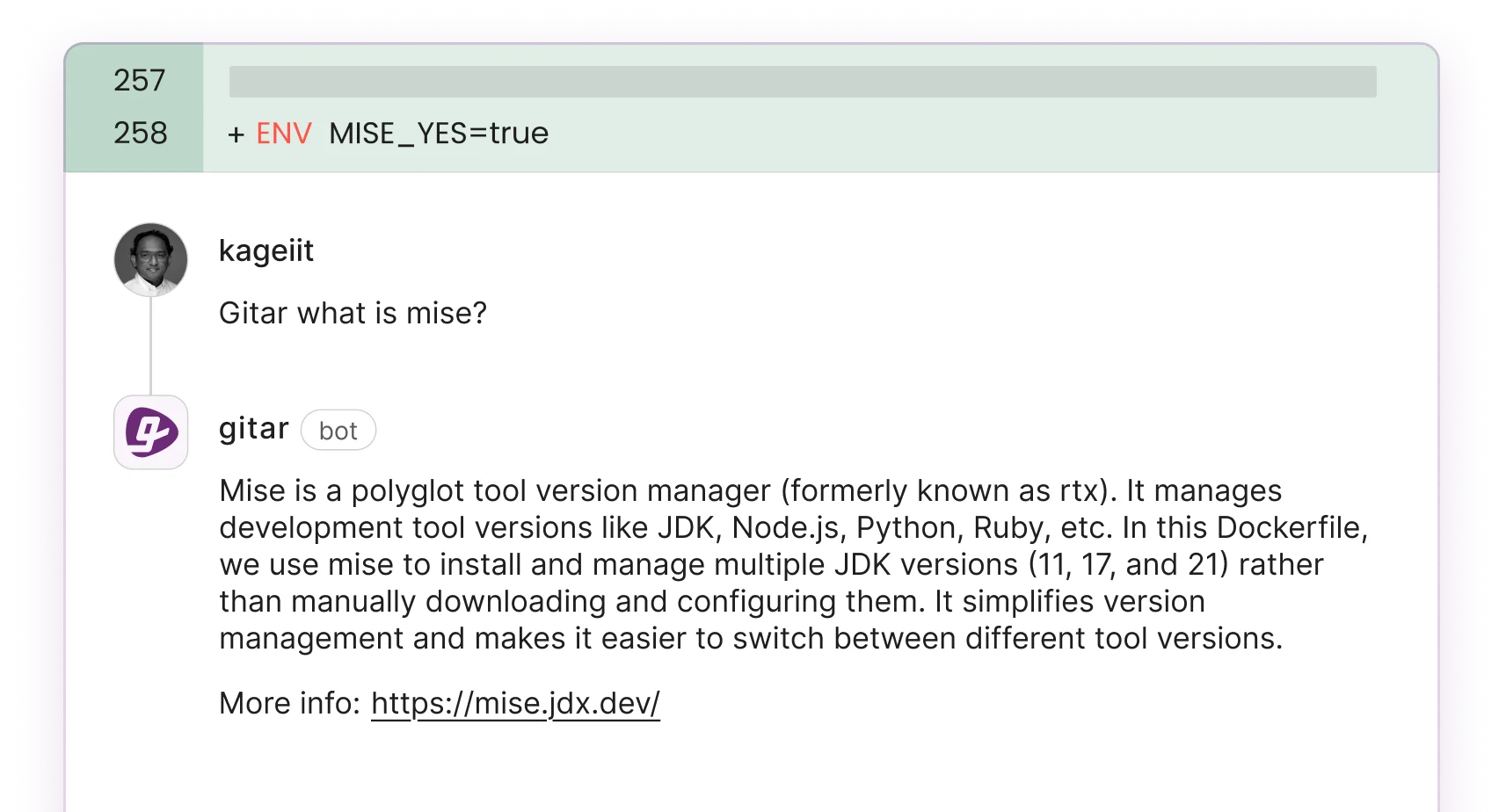
Free Coding AI Tools in 2026: From Suggestions to Action
The 2026 tooling landscape now favors autonomous action instead of pure suggestions. Traditional tools still recommend changes, while next-generation platforms like Gitar apply natural language workflows, validate fixes against CI, and commit only when builds pass. AI-authored code already makes up 26.9% of production code, so automated quality checks and fixing now play a central role in keeping development velocity high.
What Reddit Developers Want From Autofix Tools
Developer communities often complain that suggestion-only tools create extra work instead of removing it. Forum threads highlight a clear need for tools that apply fixes, validate them in CI, and give teams confidence in automated changes. Gitar meets these expectations with its healing engine and avoids the notification overload that many suggestion-based tools create.
Frequently Asked Questions
How should my team pick a free AI code fixing tool?
Teams should first decide whether they want suggestions or implemented fixes. If developers spend hours applying AI recommendations, tools like Gitar that provide autonomous fixing with CI validation deliver more value. You should also match the tool to your environment, since GitHub-heavy teams need deep repository integration while multi-platform teams require broad CI support. Free trials make it easy to compare real productivity gains before paying.
Which tool has the strongest CI integration for automated fixing?
Gitar offers the broadest CI coverage, with support for GitHub Actions, GitLab CI, CircleCI, and Buildkite, plus automatic failure analysis and fix commits. Unlike suggestion-only tools, Gitar validates each fix in your CI environment before committing, so new failures do not slip in. Its healing engine removes the manual implementation step that slows other AI review tools.
How do free AI coding tools fit into GitHub workflows?
Each tool integrates at a different depth. GitHub Copilot provides inline autocomplete and chat, but still requires manual application of suggestions. Gitar goes further with automatic pull request analysis, CI failure resolution, and commit generation inside GitHub workflows. It also tracks context across pull request iterations and uses a single dashboard comment instead of noisy notification streams.
What ROI can teams expect from automated code fixing?
Return on investment depends more on automation depth than on suggestion quality. Teams using Gitar report about $750,000 saved in annual productivity for a 20-developer team. Suggestion-only tools often deliver smaller gains because developers still perform the actual fixing.
Should our team move from paid AI tools to free options?
Free tools can deliver better value when they automate more of the workflow. Gitar’s 14-day Team Plan trial includes capabilities that many competitors charge $15 to $30 per developer each month for, and it also implements fixes instead of just suggesting them. Teams should focus on automation depth and proven ROI, since tools that remove manual work usually justify their cost more than expensive suggestion engines that add tasks.
Conclusion: Why Autofix Beats Suggestions in 2026
The move toward autonomous code fixing in 2026 marks a clear break from suggestion-only AI tools. Traditional assistants often increase workload because developers still need to apply and validate every change, while platforms like Gitar remove that bottleneck with validated automatic fixes and deep CI integration.
Install Gitar now, automatically fix broken builds, and ship higher quality software faster with a risk-free 14-day Team Plan trial.