
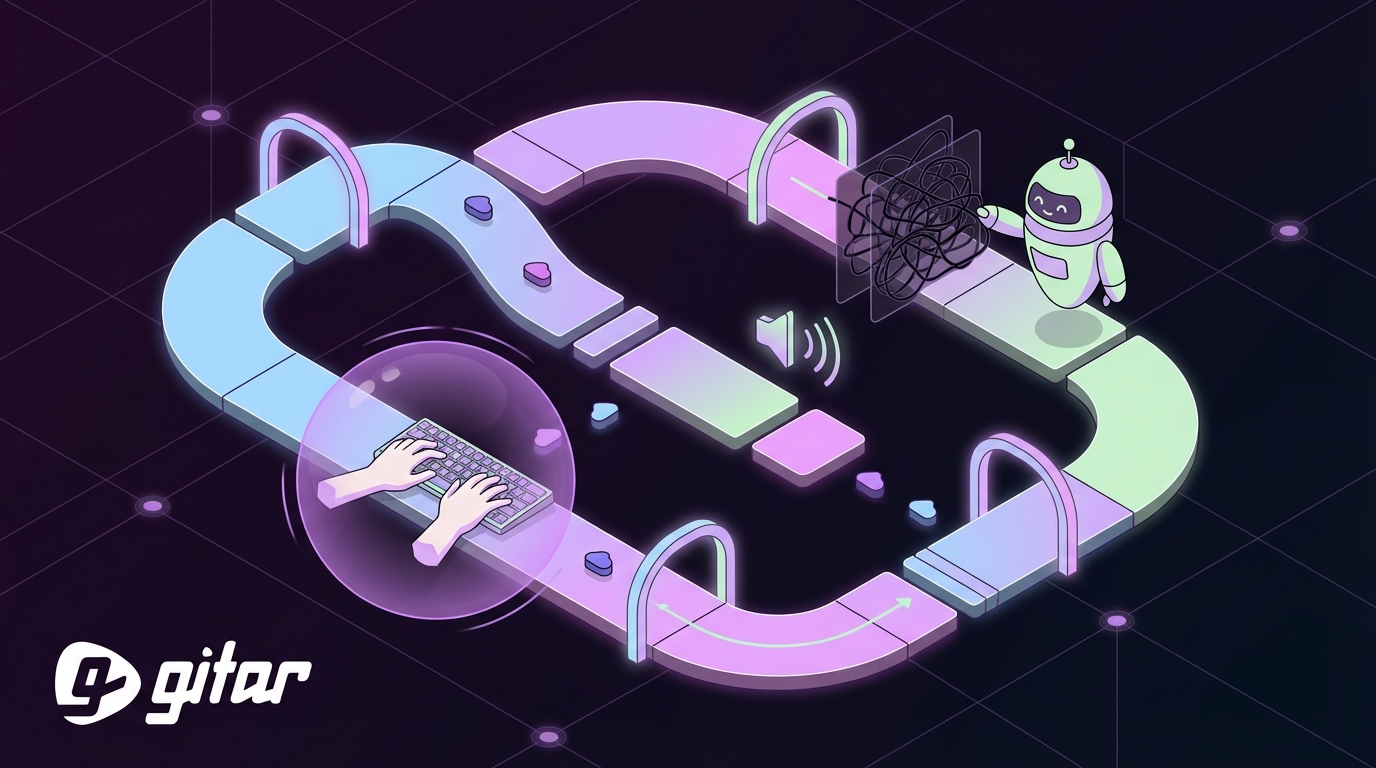
Key Takeaways
- AI coding tools speed up code generation but introduce flow-breaking interruptions from CI failures and PR reviews during long sessions.
- Plan 3-hour uninterrupted blocks with checklists, Do Not Disturb, and code breadcrumbs so you can re-enter work without friction.
- Follow ultradian 90-minute cycles instead of Pomodoro, pair them with ambient music, and use 2-minute triggers to sustain deep focus.
- Automate distraction shields, including AI tools that fix CI issues and apply review feedback without forcing context switches.
- Track flow metrics and refine your setup with Gitar’s free AI code review to remove workflow bottlenecks and reclaim productivity.
Flow State Basics for Long Coding Sessions
Flow state depends on deep immersion, clear goals, immediate feedback, and a balance between challenge and skill in creative work like programming. During flow, the prefrontal cortex enters transient hypofrontality, which reduces self-monitoring and supports the effortless concentration that makes complex coding feel intuitive.
Long coding sessions benefit strongly from flow because they demand sustained problem-solving, pattern recognition, and architecture decisions. However, flow usually needs 10-20 minutes of uninterrupted focus to start, and interruptions reset this clock. In the AI era, where 66% of developers spend more time debugging than expected, protecting flow becomes critical for productivity during extended sessions.
Core Tactics to Protect Flow While You Code
Use these practical tactics to keep flow during long coding sessions:
- Schedule 3-hour uninterrupted blocks and prepare your environment in advance
- Create code breadcrumbs so you can re-enter complex work quickly after breaks
- Build distraction shields with Do Not Disturb and AI automation
- Work in 90-minute ultradian cycles instead of 25-minute Pomodoro intervals
- Use ambient music and binaural beats to support stable focus
- Rely on 2-minute flow triggers for fast re-immersion after interruptions
- Apply fatigue management strategies once you reach hour four and beyond
1. Plan 3-Hour Deep Work Blocks for Coding
Long, focused coding blocks work best when you prepare your space and your mind. Protecting flow with Do Not Disturb periods and quiet spaces significantly improves long-session performance.
Pre-session checklist:
- Clear your physical workspace of visual clutter and distractions
- Close nonessential browser tabs and background applications
- Set your phone to airplane mode or Do Not Disturb
- Prepare water, snacks, and a comfortable room temperature
- Define specific coding objectives for this session
- Review breadcrumbs and context from your previous session
This setup reduces decision fatigue during the session and gives your brain a clear signal that it is time for deep work.
2. Leave Code Breadcrumbs for Easy Re-Entry
Using a notepad to capture intrusive thoughts cuts down on “attentional residue,” or mental clutter from competing concerns. You can mirror this idea in your codebase by leaving simple, explicit breadcrumbs.
Breadcrumb template:
- // TODO: Next – implement user authentication validation
- // CONTEXT: This function handles payment processing edge cases
- // STUCK: Need to research async/await pattern for database calls
- // PROGRESS: 3/5 test cases passing, debugging timeout issue
These comments act as anchors that help you restart complex thinking without paying the usual 15-23 minute re-entry cost that comes with task switching.
3. Build Distraction Shields with Do Not Disturb and AI
Modern dev workflows create constant pings that fragment attention and break flow. Snoozing notifications and using Do Not Disturb help you refocus on a single task, yet manual CI fixes still interrupt deep work.
Essential distraction shields:
- Turn on Do Not Disturb across your laptop, phone, and collaboration tools
- Use website blockers for social media, news, and other time sinks
- Set your Slack or Teams status to “Deep Work – Do Not Disturb”
- Automate CI failure resolution with tools like Gitar
- Batch email and message checks into a few fixed windows per day
You can control notifications, but you cannot control when CI fails or when reviewers leave comments. AI automation fills this gap and keeps your flow intact.
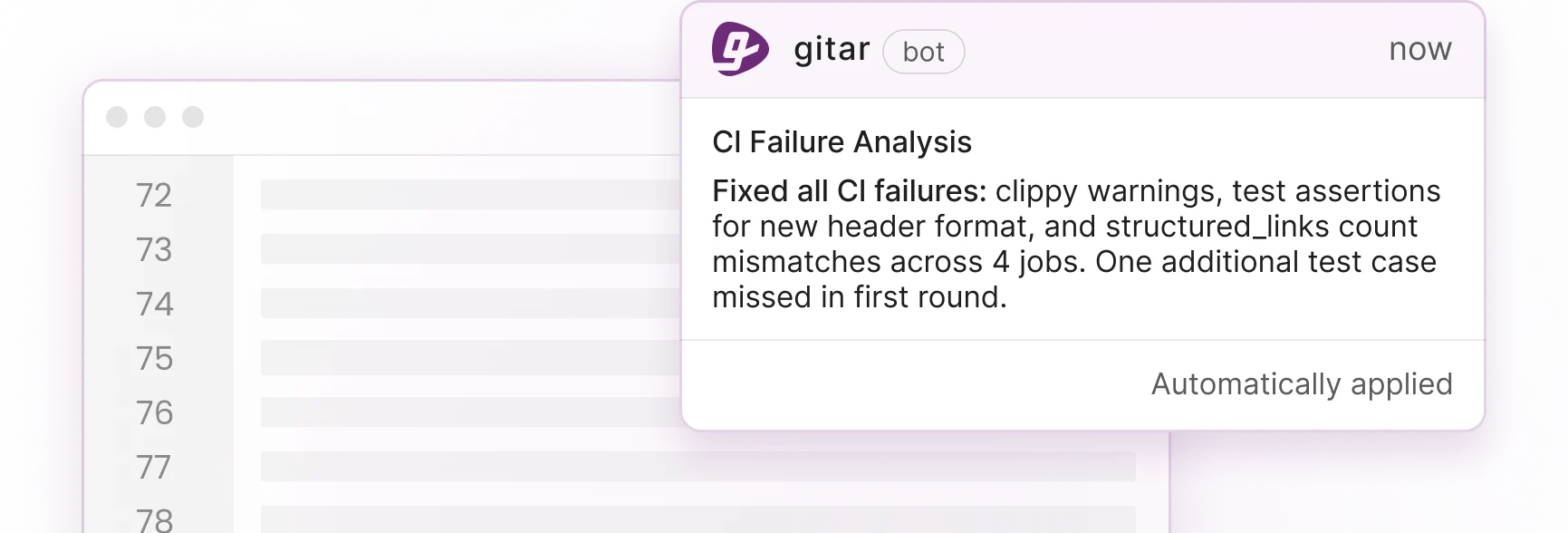
The Ultimate Flow Multiplier: Gitar’s Free AI Code Review
Traditional code review workflows interrupt flow at every failure and every comment. CI failures force you to stop coding, read logs, patch issues, push commits, and wait for reruns. Review feedback pulls you out of current work so you can address comments, then rebuild context afterward.
Gitar removes these flow-killers with targeted automation:
| Capability | Traditional Workflow | Gitar Automation | Flow Impact |
|---|---|---|---|
| CI Failure | Stop coding, debug, fix, push | Auto-analyzes and fixes (14-day free trial) | Zero interruption |
| Review Feedback | Read comments, implement, test | Implements changes automatically (14-day free trial) | Continuous focus |
| Notifications | Multiple pings per issue | Single updating comment | Minimal distraction |
Unlike CodeRabbit or Greptile, which charge $15-30 per developer for suggestions, Gitar’s code review stays completely free with unlimited repositories. The AI does more than flag issues, because it fixes problems, validates them against CI, and commits working solutions when you enable autofix during the 14-day free trial.
Install Gitar now to auto-fix broken builds, ship higher quality software faster, and protect your flow during critical coding sessions.
4. Use 90-Minute Ultradian Cycles Instead of Pomodoro
Flow in coding works as a trainable skill, with strategies for entering, protecting, and extending deep focus. The classic 25-minute Pomodoro pattern often clashes with long coding sessions because it interrupts just as deep focus begins.
| Technique | Work Period | Break Period | Best For |
|---|---|---|---|
| Pomodoro | 25 minutes | 5 minutes | Administrative tasks |
| Ultradian Cycles | 90 minutes | 20 minutes | Deep coding work |
Ultradian rhythms match natural attention spans and give enough time for complex problem-solving. The flow cycle moves through Struggle, Flow, Recovery, and Repeat phases, and honoring recovery with real breaks prevents burnout.
90-minute session template:
- Minutes 1-15: Warm-up and reload context
- Minutes 15-75: Deep flow-state coding
- Minutes 75-90: Wrap up and write breadcrumbs
- 20-minute break: Move your body and reset mentally
5. Use Ambient Audio to Support Focus
Brainwave entrainment with alpha (8-12 Hz) and low beta (12-15 Hz) frequencies helps stabilize neural activity for flow. The right soundscape can noticeably extend your attention span during long sessions.
Effective audio strategies:
- Binaural beats in the 8-12 Hz range to support alpha waves
- Brown or pink noise for steady background masking
- Instrumental music without lyrics to avoid language processing
- Nature sounds such as rain or ocean waves for gentle ambience
- Brain.fm or Focus@Will for research-backed focus tracks
Alpha-range binaural beats generated in real time help you enter flow patterns, especially during the first 10-20 minutes while you establish focus.
6. Create 2-Minute Flow Triggers for Fast Re-Entry
Interruptions still appear, even with strong boundaries. After an interruption, a 2-3 minute full break followed by a short priming ritual can recover 60-70% of your productivity.
Quick re-entry protocol:
- Take three deep breaths to calm your nervous system
- Review your last breadcrumb comment to restore context
- Say your immediate next action out loud
- Set a 90-minute timer to define your next focus block
- Start with a simple, familiar task to rebuild momentum
Three deep breaths activate the parasympathetic nervous system and create a clear psychological transition that separates the interruption from your coding work.
7. Fight Fatigue During Hour Four and Beyond
Very long coding sessions demand active fatigue management to keep your thinking sharp. Physical strain and mental exhaustion build up even when you feel “in the zone,” so you need small, regular resets.
Hour 4+ maintenance strategies:
- Use micro-movements every 30 minutes, such as shoulder rolls and hand stretches
- Follow a hydration rule of about 8 oz of water per hour, with electrolytes for 6+ hour days
- Protect your eyes with the 20-20-20 rule: every 20 minutes, look 20 feet away for 20 seconds
- Reset posture with standing desk intervals or simple adjustments
- Watch for diminishing returns and schedule strategic breaks when quality drops
These small habits prevent discomfort and fatigue from breaking flow during your most productive hours.
8. Remove AI-Era Coding Bottlenecks with Gitar
AI-assisted coding speeds up output but also introduces new flow-breaking bottlenecks. Teams with strong AI adoption cut median PR cycle times by 24%, yet they also face more review volume and CI complexity.
Gitar targets the specific interruptions that come with AI-accelerated development:
| AI-Era Problem | Manual Solution | Gitar Automation | Time Saved |
|---|---|---|---|
| CI lint failures | Stop, fix, push, wait | Auto-fix and commit (14-day free trial) | 15-30 minutes |
| Test failures | Debug, implement, verify | Analyze and resolve (14-day free trial) | 30-60 minutes |
| Review feedback | Context switch, implement | Automatic implementation (14-day free trial) | 20-45 minutes |
Teams often save more than one hour per developer per day by avoiding these context switches. One engineering lead shared that Gitar’s “unrelated PR failure detection” saves “significant time” by separating flaky infrastructure from real code bugs, which traditional tools rarely distinguish.
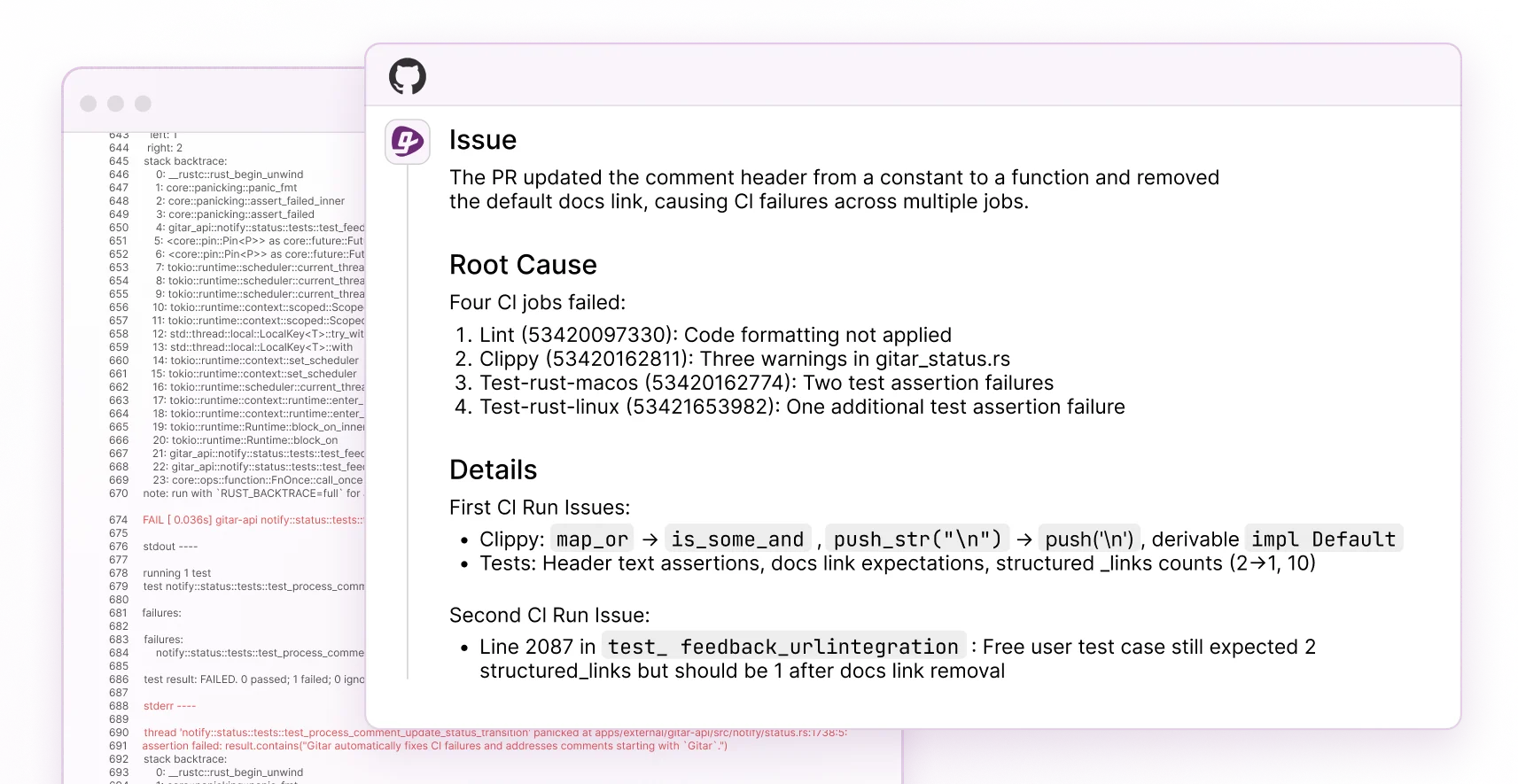
Install Gitar now to auto-fix broken builds and keep your flow intact during your highest-value coding windows.
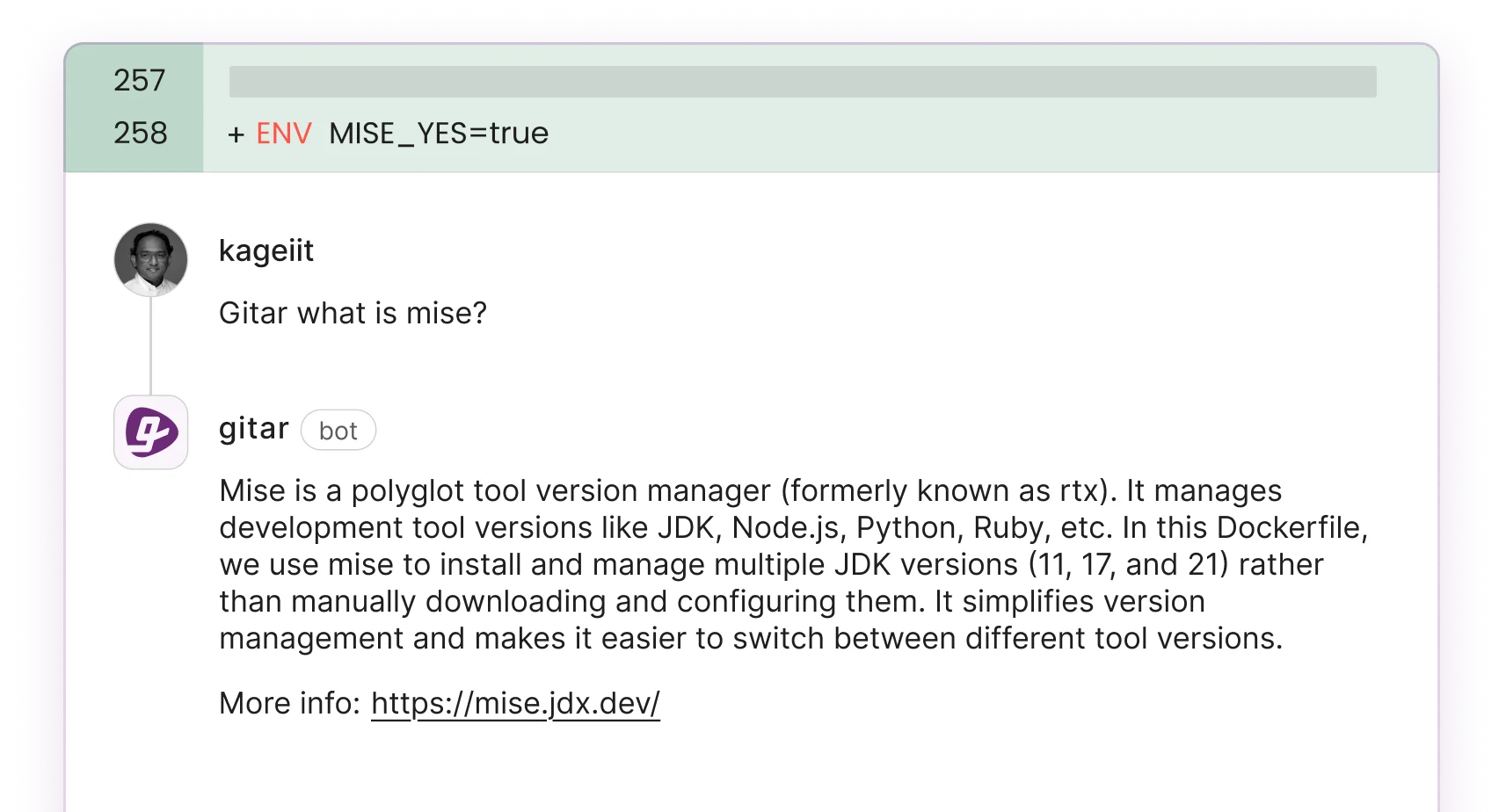
9. Measure and Refine Your Personal Flow System
Improving flow over time depends on tracking your patterns and adjusting your setup. Shifting to simpler goals when overwhelmed, or raising difficulty when bored, helps sustain flow over long periods.
Flow tracking checklist:
- Time from session start to first major interruption
- Number of context switches in each 3-hour block
- Self-rated flow quality on a 1-10 scale after each session
- Types of interruptions and how often they occur
- Recovery time after breaks or interruptions
- Output during flow versus non-flow periods
Use these data points to discover your ideal session length, your most disruptive triggers, and the conditions that support your best work. Then adjust your environment, tools, and rituals to match your personal flow profile.
Frequently Asked Questions
How do I get into flow state when programming?
Flow during programming starts with clear goals, fast feedback, and a good match between difficulty and skill. Define specific outcomes for your session, silence distractions with Do Not Disturb, and pick tasks that feel challenging but manageable. Spend the first 10-20 minutes reloading context and planning your approach. Support this with ambient music, comfortable lighting, and a stable temperature to make entry into flow smoother.
How can I stay in a coding flow state consistently?
Consistent flow comes from repeatable preparation and protection habits. Block 3-hour windows that match your natural energy peaks, usually up to two or three sessions per day. Use ultradian cycles of 90 minutes on and 20 minutes off instead of short intervals that cut deep focus. Automate common disruptions such as CI failures and PR reviews with tools like Gitar, and build pre-session rituals that tell your brain it is time to focus. Track your sessions so you can refine timing and environment over time.
Does AI hurt coding flow, and how can I prevent that?
AI tools can create a productivity paradox where you write code faster but face more interruptions from PR volume, CI failures, and review cycles. You can fix this by choosing AI automation that shields your focus instead of fragmenting it. Use AI tools that handle routine interruptions, such as fixing CI issues or applying review feedback, while you keep control over design and architecture decisions. Prioritize tools that reduce context switching instead of adding more alerts and manual steps.
Should developers use ultradian cycles or Pomodoro?
Ultradian cycles of 90-minute work blocks usually serve complex coding better than 25-minute Pomodoro intervals. They align with natural attention spans and give enough time for deep problem-solving. Pomodoro still helps with admin tasks or when you feel resistance to starting, but it often interrupts just as flow develops. Ultradian rhythms provide about 60-75 minutes of sustained focus after a short warm-up, which fits the demands of debugging, architecture, and creative problem-solving.
What are effective 2-minute flow triggers for developers?
Short flow triggers help you return to focus quickly after a break or interruption. Reliable options include three deep breaths to calm your system, reviewing your last breadcrumb to reload context, and saying your next action out loud to clarify intent. Start again with a simple, familiar task to regain momentum. You can also use physical triggers such as a specific keyboard shortcut, opening your main editor layout, or starting your focus playlist to signal that it is time for deep work.
Conclusion: Protect Flow and Upgrade Long Coding Sessions
The AI coding shift changed how developers work, speeding up code creation while multiplying interruptions and context switches. The nine strategies in this guide give you a practical system for protecting flow during long sessions, from environment setup and ultradian timing to automated CI and review handling.
Protecting flow in 2026 requires both deliberate habits and smart automation. You can control your workspace, notifications, and work rhythm, but you need AI tools like Gitar to absorb the constant CI failures, PR reviews, and workflow noise that would otherwise break your focus.
Reclaim your flow state and upgrade your coding output. Install Gitar now to auto-fix broken builds, ship higher quality software faster, and keep the uninterrupted focus that great software demands.