
Key Takeaways
- Faster deployment cycles reduce wasted developer time, lower burnout risk, and keep teams focused on shipping product instead of chasing CI failures.
- Traditional CI/CD and manual fixes struggle with modern complexity, leaving teams stuck in slow feedback loops and repeated build failures.
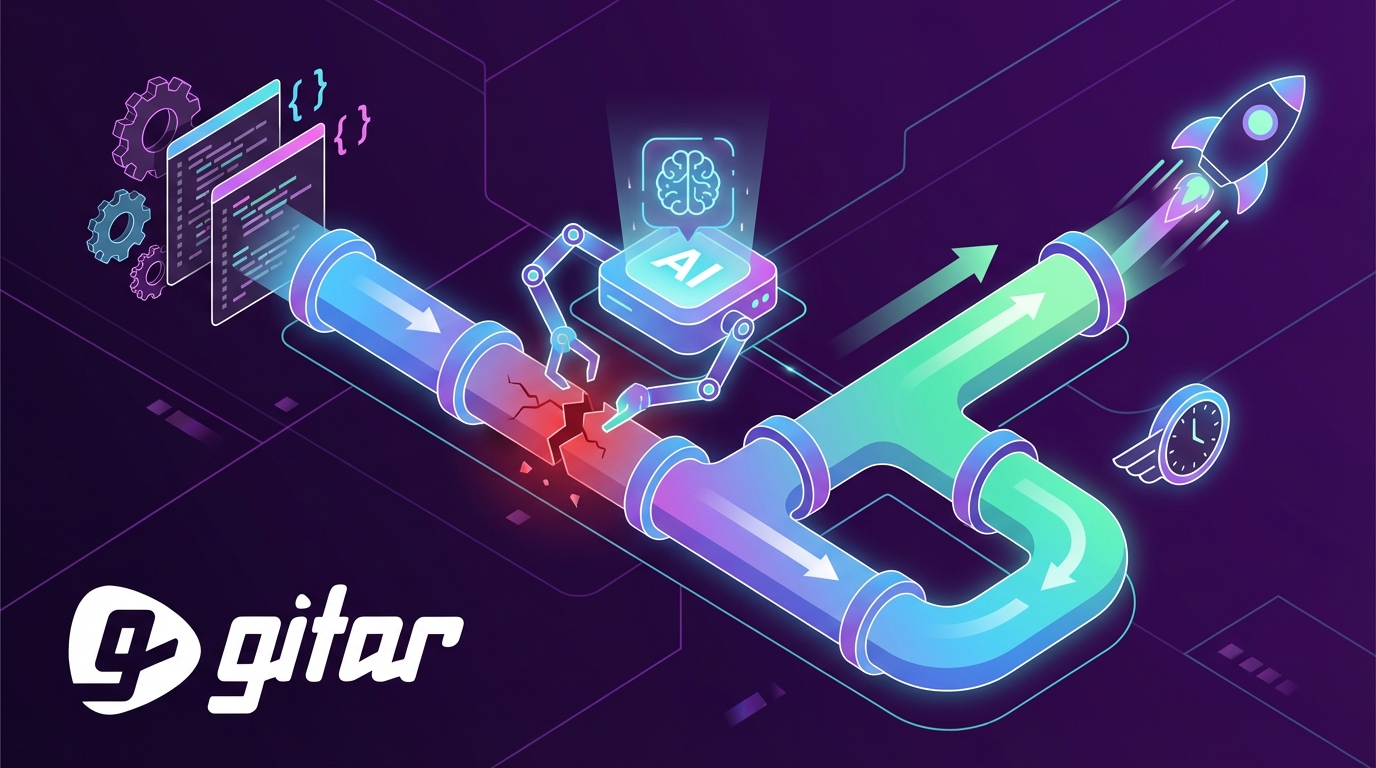
- Autonomous AI agents can analyze logs, propose code changes, and validate fixes in the background, creating self-healing CI pipelines.
- Engineering leaders gain measurable productivity, lower operational costs, and shorter time-to-merge by automating routine CI and review work.
- Gitar provides autonomous CI healing and code review fixes so teams can move to faster, more reliable deployment cycles.
Why Faster Deployment is a Strategic Imperative for Engineering Teams
The Cost of Slow Deployments and Developer Burnout
Developer time lost to CI failures and review loops has become a major cost center. Developers can spend up to 30% of their time dealing with broken pipelines and rework instead of building features. For a 20-developer team, that time can exceed 5,000 hours per year, which can approach $1M in productivity loss.
Slow deployments create constant context switching that interrupts flow state and erodes morale. Those delays ripple outward, pushing back releases and giving competitors more time to ship. CI/CD pipeline failures now represent a primary cause of delayed projects for many teams, stretching latency between first commit and merge.
The Shift from Manual CI/CD to Intelligent Automation
Modern engineering organizations need CI/CD systems that keep up with distributed teams, microservices, and complex dependency graphs. Manual log-diving and ad hoc scripts no longer scale. Teams are moving to AI agents that can handle repetitive pipeline and code-review tasks so developers can stay focused on deeper work.
Autonomous systems change CI/CD from a reactive process to a proactive one. Instead of waiting for developers to notice and fix failures, these systems can identify, resolve, and validate issues before they slow down the team.
Understanding Current CI/CD Bottlenecks: Why Traditional Approaches Fall Short
The Modern Deployment Landscape: Beyond Basic CI/CD
Current CI/CD pipelines must manage not only builds and tests but also merge queues, branch protection rules, and multi-repo dependencies. Many teams now wrestle with merge-queue bottlenecks and main-branch stability issues that did not exist in simpler environments.
Tool sprawl, long pipeline runtimes, and limited visibility into failures increase the time developers spend waiting for feedback. At the same time, environment drift and intricate dependency chains create failures that require careful, manual intervention.
The Limitations of Manual Fixes and AI Suggestion Engines
Most teams still rely on two types of solutions: manual fixes and AI suggestion tools. Manual fixes demand constant developer attention, from scanning logs to writing patches and re-running pipelines. Suggestion engines can surface potential changes, but often still require developers to implement, validate, and iterate on the fix.
Some AI code review tools, such as CodeRabbit, provide helpful comments and sometimes apply changes. Teams still need to oversee these suggestions, coordinate approvals, and manage re-runs, which keeps context switching high and slows down delivery.
Introducing Gitar: The Autonomous AI for Self-Healing CI/CD
How Gitar Improves Your CI/CD Pipelines
Gitar is an autonomous AI agent that fixes failing CI pipelines and addresses code review feedback. The system reduces the daily hours that developers spend pushing changes past CI and review checks. Instead of only suggesting edits, Gitar operates as a CI healing engine that detects, analyzes, fixes, and validates CI failures.
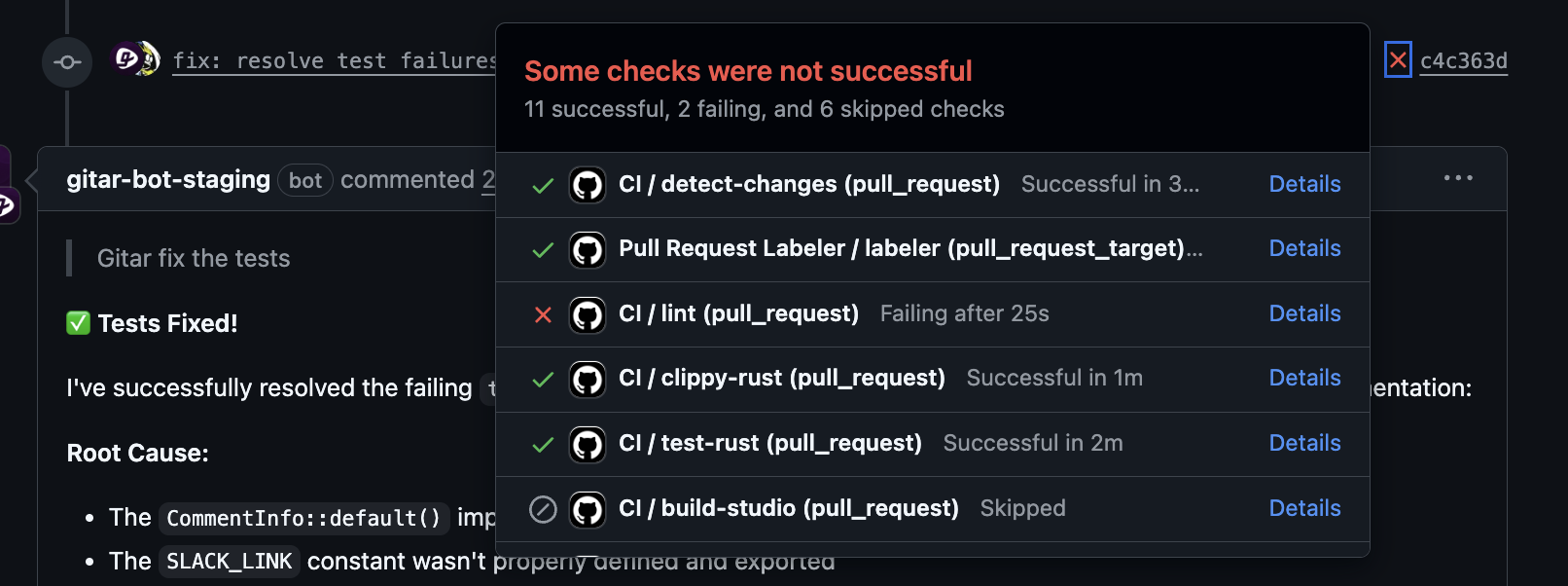
When a pull or merge request triggers a CI failure from linting, test failures, or build issues, Gitar analyzes the logs, determines an appropriate code change, applies the update to the branch, and re-runs the workflow to confirm the fix. This behavior creates a self-healing CI experience where many failures resolve in the background.
Key Features That Enable Self-Healing CI
End-to-End Autonomous Fixing: Gitar goes beyond suggestions and can apply, validate, and commit fixes for CI failures and code review feedback. The system handles issues such as lint violations, test failures, and build errors and aims to restore green builds with minimal developer involvement.
Full Environment Replication: Gitar replicates complex CI environments, including specific JDK versions, multiple SDKs, and third-party tools such as SonarQube and Snyk. This replication helps ensure that fixes account for the same constraints present in your production pipelines.
Support for Distributed Teams: Gitar reduces time zone friction by working on code review comments while team members are offline. A reviewer can leave feedback at the end of the day, and Gitar can apply fixes before the original author returns.
Configurable Trust Model: Teams can start in conservative suggestion mode, where Gitar proposes changes for human approval. As trust grows, they can enable more aggressive auto-commit behavior, with rollback options in place for safety.
Cross-Platform Coverage: Gitar integrates with major CI platforms, including GitHub Actions, GitLab CI, CircleCI, and Buildkite. This flexibility allows teams to standardize on one autonomous agent across different stacks.
The First-Time Experience with Autonomous CI
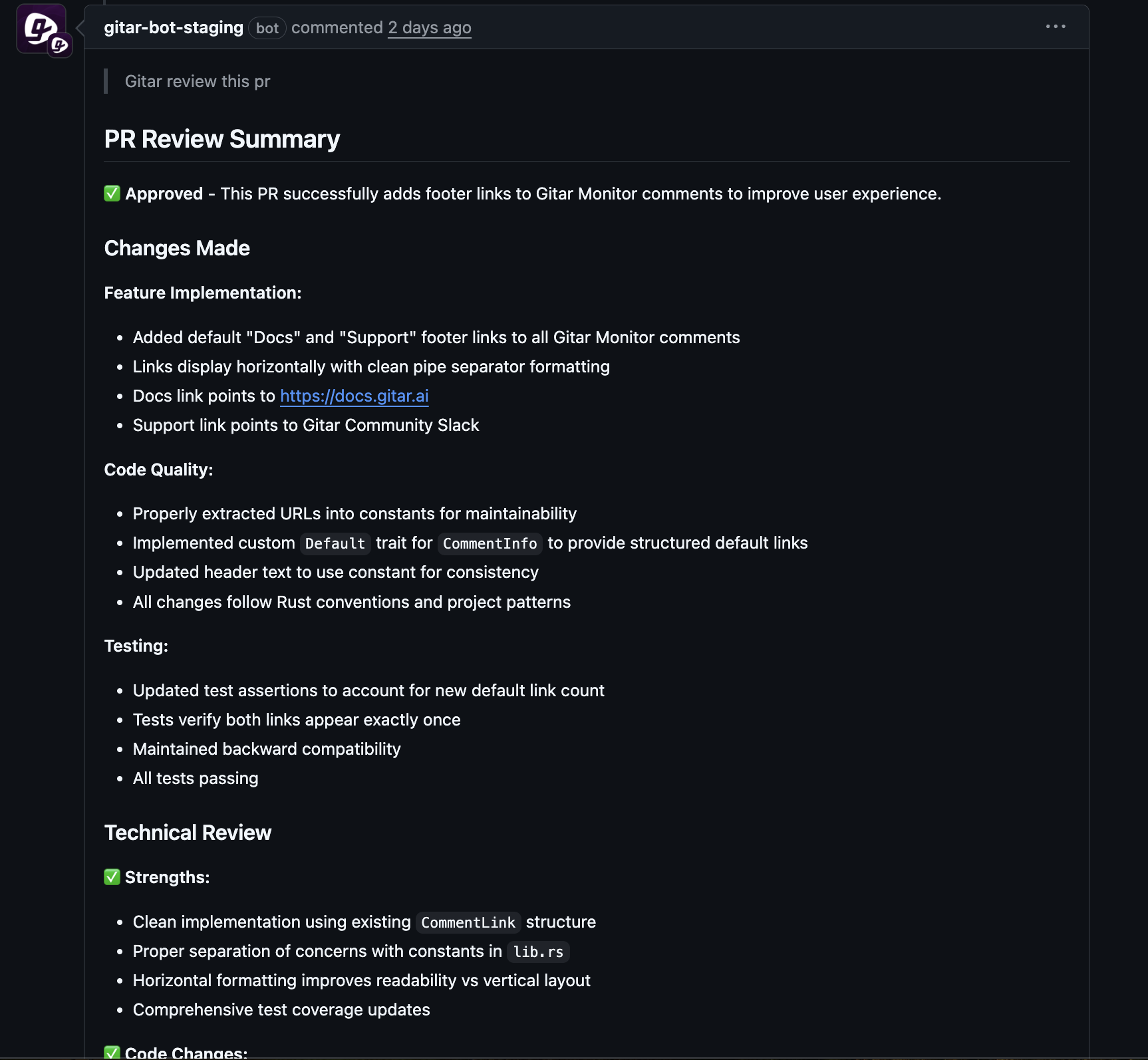
Many teams notice the impact the first time a lint error or flaky test fails CI and then resolve without a developer stepping in. Gitar analyzes the failure, updates the code, and commits with clear messaging, allowing developers to stay in flow and move on once the build passes.
Strategic Advantages for Engineering Leaders: Why Autonomous CI Is Valuable
Improving Developer Productivity and Reducing Context Switching
Autonomous CI helps developers protect deep work time. Reducing context switching and frequent pipeline interruptions keeps attention on feature design, architecture, and customer problems rather than building triage.
Teams start to view CI as a partner rather than a gatekeeper. When failures resolve quickly, developers can merge with more confidence and fewer delays, which supports better morale and consistent progress.
Reducing Operational Costs and Accelerating Time-to-Market
The financial impact of autonomous CI can be substantial. For a 20-developer team, Gitar can save thousands of hours per year by cutting time spent on CI failures and review cycles. Even at partial effectiveness, those savings can translate into hundreds of thousands of dollars in recovered productivity.
Shorter feedback loops also improve time-to-market. Features move from branch to production faster, allowing organizations to respond more quickly to customer needs and market changes.
Autonomous CI vs. Alternative Solutions
|
Feature |
Gitar (Autonomous AI) |
AI Suggestion Engines |
Manual Fixes |
|
Resolution Method |
Autonomously fixes and validates |
Suggests fixes that still need manual work |
Manual diagnosis and coding |
|
CI Pipeline Impact |
Aims to keep building green |
Requires manual re-runs |
Often triggers repeated failed runs |
|
Developer Focus |
Feature and system development |
Frequent context switching for fixes |
Ongoing firefighting and triage |
|
Time-to-Merge |
Reduced significantly |
Moderately reduced |
Can extend to hours or days |

Implementing Autonomous CI: A Framework for Success
Assessing Your Organization’s Readiness for AI Agents in CI/CD
Effective adoption starts with a clear view of your infrastructure, workflow maturity, and team culture. Teams that already use AI code review tools often adapt quickly because they are familiar with AI assistance yet still feel the impact of unresolved CI failures.
Most organizations roll out autonomous CI in stages. They begin with low-risk repositories and suggestion mode, refine policies based on results, then extend autonomous commits to higher-value pipelines once guardrails and rollback procedures are in place.
Avoiding Common Pitfalls When Accelerating Deployment Cycles
Overemphasis on tools without aligning workflows and people often derails automation efforts. Successful teams pair autonomous CI with clear ownership, review guidelines, and transparent communication about how AI agents behave in each repository.
Many organizations also underestimate the importance of security integration. Security checks need to live directly in the CI/CD pipeline so that automation does not bypass required controls or compliance steps.
Frequently Asked Questions (FAQ) about Autonomous CI
How does Gitar’s autonomous AI differ from existing AI code review tools?
Most AI review tools highlight issues and suggest changes that developers then need to apply and validate. Gitar acts as a healing engine that applies fixes, runs your full CI workflow, and ensures that the build returns to a green state, which reduces manual intervention.
We have a highly complex and customized CI/CD environment. Can Gitar integrate effectively?
Gitar is designed to run in complex environments. The system mirrors your dependencies, SDK versions, and tools such as SonarQube or Snyk so that autonomous fixes respect the same constraints and checks that your team already uses.
How does Gitar address organizational trust in automated code changes?
Gitar provides adjustable modes that let teams control how aggressively it commits changes. Many teams begin with suggestion-only mode, review the quality of fixes, then gradually enable auto-commit for selected repositories while keeping rollback options available.
What ROI can teams expect from implementing Gitar for faster deployment cycles?
Teams that lose up to $1M annually in productivity to CI failures and review delays can recover a significant share of that time. Gitar can help save thousands of hours per year, which often equates to hundreds of thousands of dollars in value and faster delivery.
How does autonomous CI handle security and compliance requirements?
Gitar works alongside your existing security scanners and policies. The agent runs fixes through your full pipeline, including security steps, and can require human approval for sensitive repositories so that compliance standards remain intact.
Conclusion: Moving to Faster, Self-Healing Deployment Cycles with Gitar
Traditional CI/CD and manual fixes no longer match the speed and complexity of modern software delivery. Autonomous CI gives teams a way to keep pipelines healthy, reduce interruptions, and move features to production more quickly.
Gitar shifts routine CI maintenance work from developers to an autonomous agent that fixes many failures on its own. This change helps organizations improve deployment velocity while protecting developer focus and morale.