Key Takeaways
- Slow, manual CI debugging and context switching create major delays in code integration and time-to-merge for modern teams.
- Evaluation criteria such as autonomy, environment awareness, and impact on developer flow help distinguish surface-level tools from deeper solutions.
- Traditional manual workflows and suggestion-only AI reviewers often shift effort around instead of removing CI and review bottlenecks.
- Autonomous CI-healing agents that apply and validate fixes in real CI environments reduce rework, review cycles, and time zone friction.
- Teams that want autonomous CI fixing and review support can install Gitar at https://gitar.ai/fix to speed up integration.
The Integration Gauntlet: Why Faster Code Integration Is a Critical Challenge
Inefficient code integration consumes time, attention, and budget across engineering organizations. Common version control bottlenecks include merge conflicts, lost work, branch complexity, and large file handling, which slow delivery and disrupt focus.
The daily CI pipeline path often becomes a gauntlet of lint errors, flaky or failing tests, dependency issues, and integration problems. Each failure interrupts deep work, forces log-diving, and adds more commits and reruns. Context switching multiplies when developers juggle several pull requests in parallel.
Distributed teams feel this impact even more. A failed build in one time zone can sit idle for hours before review, feedback, and fixes occur. Parallel work and rapid feedback loops help reduce context switching, yet many tools still rely on manual intervention at each failure.
The cost adds up quickly. A team of 20 developers losing only one hour per day to CI and code review issues can see annual productivity losses above seven figures, without counting delayed launches or lower morale.
Setting the Bar: Key Evaluation Criteria for Faster Code Integration Tools
Clear evaluation criteria help teams compare tools that promise faster integration and identify which ones actually reduce work.
- Autonomy vs. suggestion: Determine whether the tool only points out issues or also applies and validates fixes in code and CI.
- Environmental context: Confirm whether it understands and reproduces your real CI setup, including SDKs, dependencies, and third-party checks.
- Integration breadth: Review support for your version control and CI platforms to avoid new lock-in and migration projects.
- Impact on developer flow: Assess whether it removes context switching or simply relocates it to a later step in the process.
- Scalability and reliability: Ensure it can operate across many repositories, teams, and concurrent workflows without breaking state.
- Trust and control: Look for adjustable automation modes so teams can start with suggestions and move toward more autonomy over time.
- Distributed team support: Evaluate how well the tool shortens feedback loops across time zones and reduces idle PR time.
Solution Showdown: Comparing Tools for Faster Code Integration
Code integration tools differ in how much work they offload from developers and how deeply they integrate with CI pipelines.
Traditional Manual Workflows (The Status Quo)
Description: Developers interpret CI logs, diagnose issues, write fixes, and push new commits by hand every time a pipeline fails.
Evaluation: This approach offers full manual control but carries a high context-switching cost, limited scalability, and frequent delays. Merge conflicts, branching overhead, and version control issues further slow progress, especially for distributed teams that depend on asynchronous reviews.
AI Code Reviewers (e.g., CodeRabbit, Linear, Ellipsis)
Description: These tools add summaries, style suggestions, and potential bug alerts on pull requests, usually through comments or inline annotations.
Evaluation: They improve review quality but still depend on developers to edit code and re-run CI. These assistants help identify issues but do not directly shorten the integration cycle. The context-switching tax remains because each suggestion requires manual implementation and validation.
On-Demand AI Fixers (e.g., Claude Code / Anthropic GitHub Action)
Description: Developers call these tools on specific failures or files. Workflows often trigger via comments or events and run inside existing CI minutes.
Evaluation: These tools reduce some debugging effort but still require prompts, guidance, and manual validation. Most focus on GitHub and support a limited range of CI platforms. They help developers work faster rather than removing the work entirely.
IDE-Based Coding Assistants (e.g., GitHub Copilot)
Description: IDE assistants suggest code completions and snippets before commit, improving local coding speed and reducing boilerplate.
Evaluation: These assistants operate in the pre-commit phase, not in the CI environment. They do not manage post-commit failures, code review changes, or remote pipeline issues. As code creation speeds up, unresolved CI and review bottlenecks become more visible.
Gitar: The Autonomous CI Healing Engine
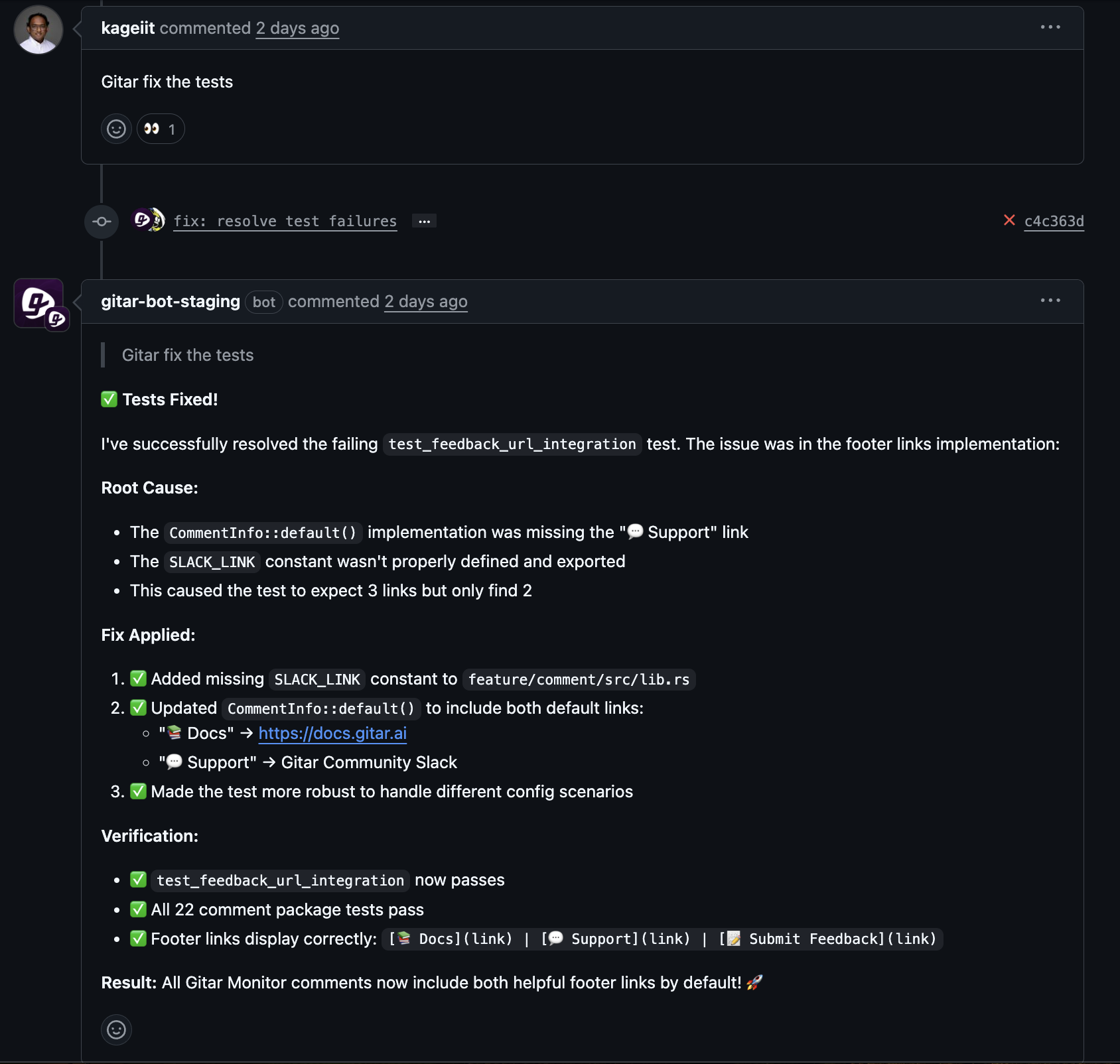
Description: Gitar is an autonomous agent that fixes failing CI pipelines and responds to code review feedback by editing code, committing changes, and re-running checks until builds pass or clear explanations are available.
Evaluation: Gitar focuses on autonomous fixes with full CI context, works across major git hosting and CI platforms, and reduces repeated context switching. It supports enterprise-scale setups and offers adjustable automation so teams can control how and when it commits changes.
Comparison Table: Tools for Faster Code Integration
|
Feature |
Traditional Manual |
AI Code Reviewers |
On-Demand AI Fixers |
Gitar |
|
Autonomy level |
None |
Suggestion-based |
Manual invocation |
Autonomous fixes |
|
Fix validation |
Manual |
None |
Manual |
CI-validated |
|
Context switching |
High |
Moderate |
High |
Reduced |
|
Environment context |
Local developer |
Limited |
Limited |
Full CI environment |
Teams that want to offload CI failure handling can install Gitar and let it propose or apply fixes directly in pull requests.
How Gitar Improves Everyday Code Integration Workflows
Gitar pairs autonomous behavior with practical controls so teams can shorten integration cycles without losing oversight.
- End-to-end fixing: Gitar edits code, commits changes, and re-runs CI so developers see updated pull requests that already passed checks or include clear failure explanations.
- Full environment awareness: Gitar works within enterprise CI workflows, including specific JDKs, multiple SDKs, and tools such as SonarQube or Snyk, so fixes align with real checks.
- Cross-platform support: Gitar connects with GitHub, GitLab, GitHub Actions, CircleCI, BuildKite, and other common pipelines, allowing teams to keep existing infrastructure.
- Configurable trust model: Teams can start with suggestions, move to auto-applied fixes behind approval, and then enable fully autonomous commits, with rollback options available.
- Support for distributed teams: Reviewers can leave comments that Gitar uses to update the codebase while the author is offline, which reduces time zone delays and idle PR time.

Frequently Asked Questions (FAQ) About Faster Code Integration Tools
Our team already uses AI code reviewers like CodeRabbit. Why add Gitar?
AI reviewers highlight potential problems but do not guarantee working fixes or apply them. Gitar focuses on healing rather than only reviewing. It edits code, commits changes, and validates them in CI so developers spend less time translating suggestions into working patches.
How does Gitar handle complex CI setups with many dependencies and tools?
Gitar operates inside the same CI workflows your team already uses. It takes into account language versions, dependency graphs, and external scanners before proposing or applying changes, which helps ensure that fixes pass the exact checks your organization relies on.
How does this compare to building our own integration with models like Claude or GPT?
Custom integrations require prompt design, state management, security controls, and CI orchestration. Gitar provides an end-to-end product that already connects to GitHub, GitLab, and major CI systems, so teams can adopt autonomous fixing without building or maintaining their own orchestration layer.
Conclusion: Accelerate Time-to-Merge With Autonomous CI Fixing
CI failures, long review loops, and frequent context switches slow down software delivery and increase costs. Many tools improve visibility or suggestions but still rely on manual work at each failure. Recent DevOps trends highlight AI-driven automation as a key path to more reliable and efficient workflows.
Gitar focuses on autonomous CI healing and review-aware fixes so teams can reduce time spent on routine debugging and regain time for higher-value work. Teams that want to evaluate this approach can install Gitar and observe its impact on CI stability, review throughput, and overall time-to-merge.