
CI build failures and code review delays often disrupt developer focus, slowing down productivity and project timelines. This article explores how autonomous CI fixes, powered by Gitar, offer a practical solution. Gitar, an AI agent, automates the resolution of these issues, helping developers stay focused and enabling teams to deliver software faster with consistent quality.
Why Manual CI Fixes Disrupt Developer Workflow
Manual resolution of CI failures and code review feedback creates significant obstacles for developers, costing time and focus. Let’s break down the specific challenges and their impact on productivity.
Context Switching Drains Time and Energy
Developers often face a frustrating cycle with CI failures. You submit a pull request, only to see it fail due to a small issue like a missing dependency or a lint error. Fixing it means stopping your current work, digging through logs, applying a change, and waiting for the pipeline to rerun.
The real cost goes beyond just minutes spent. Context switching can turn a quick fix into an hour of lost productivity as you struggle to refocus. Studies estimate up to 30% of developer time is lost to these interruptions, which can cost a 20-person team over $1 million annually in wasted effort.
Install Gitar now to automate fixes and keep your team focused
CI/CD Bottlenecks Slow Down Releases
CI/CD pipelines are crucial for code quality, but they become a hurdle when failures require manual fixes. Each delay pushes back release schedules, affecting time-to-market goals that matter to business leaders.
These slowdowns show up as delayed features, rushed fixes that risk quality, and challenges scaling with larger teams or codebases. When builds fail, they block not only new code but also urgent fixes, potentially harming customer trust and business outcomes.
Flaky Tests and Confusing Logs Waste Effort
Flaky tests, which pass locally but fail in CI, are a major frustration. They make developers question the reliability of the testing setup and waste time determining if the issue is real or just environmental.
Similarly, unclear error logs add to the problem, forcing developers to sift through dense output for clues. This not only delays fixes but also risks hiding serious issues, potentially leading to bugs in production.
Code Reviews Drag On for Distributed Teams
Distributed teams face extra challenges with code reviews due to time zone differences. A developer in one region might wait days for feedback from a teammate halfway across the world, turning quick changes into prolonged cycles.
Each round of feedback requires revisiting old work, making updates, and waiting again for approval. This process slows down project timelines and can impact team morale.
How Gitar Solves CI Failures with Autonomous Fixes
Gitar introduces an automated approach to CI fixes, shifting away from manual effort. This AI agent handles routine issues, letting developers focus on meaningful work.
Meet Gitar: Your AI Partner for CI Resolution
Gitar acts as an independent AI agent that identifies and resolves CI failures and code review issues without constant input. Unlike tools that just point out problems, Gitar analyzes failures, applies fixes, and updates pull requests on its own.

The key benefit is independence. Developers can submit their code and trust Gitar to handle common issues, minimizing interruptions and keeping workflows smooth.
Gitar’s Practical Benefits for CI/CD Workflows
Gitar offers hands-on solutions that go beyond suggestions. Here’s how it supports your team:
- Complete Fix Process: Gitar applies fixes and validates them across your full CI pipeline, ensuring pull requests pass all checks before completion.
- Accurate Environment Setup: It mirrors complex setups, including specific software versions and third-party tools like SonarQube, so fixes match your real conditions.
- Smart Code Review Handling: Gitar interprets reviewer comments and implements changes directly, speeding up the feedback loop.
- Customizable Automation Levels: Teams can choose how much autonomy Gitar has, from suggesting fixes for approval to fully independent commits with rollback options.
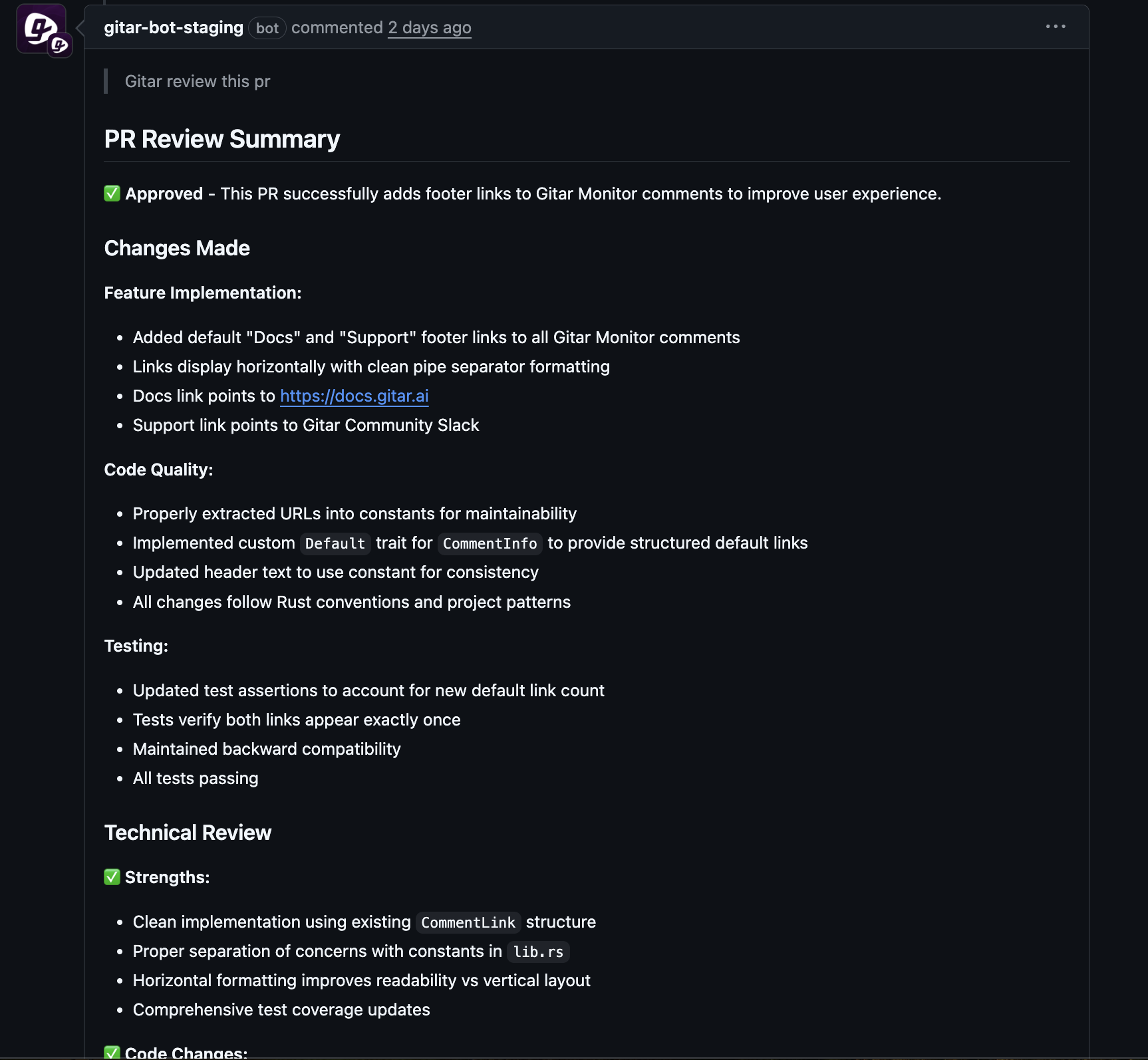
See how Gitar can improve your workflow with a demo
Clear Steps Gitar Takes to Resolve Failures Fast
Gitar establishes a reliable, automated process for handling CI failures and feedback, ensuring issues are addressed quickly and consistently.
Automating Problem Detection and Fixes
Manually fixing CI issues involves several steps, from spotting the failure to testing a solution. Gitar handles this entire process automatically. When a check fails, whether it’s a linting rule or a test, Gitar reviews the logs, identifies the cause, applies a fix, and commits it to the pull request branch.
It tackles common issues like:
- Linting and Formatting Errors: Adjusts code style to meet standards.
- Simple Test Failures: Updates failing tests or related code.
- Build Issues: Corrects dependencies or scripts causing failures.
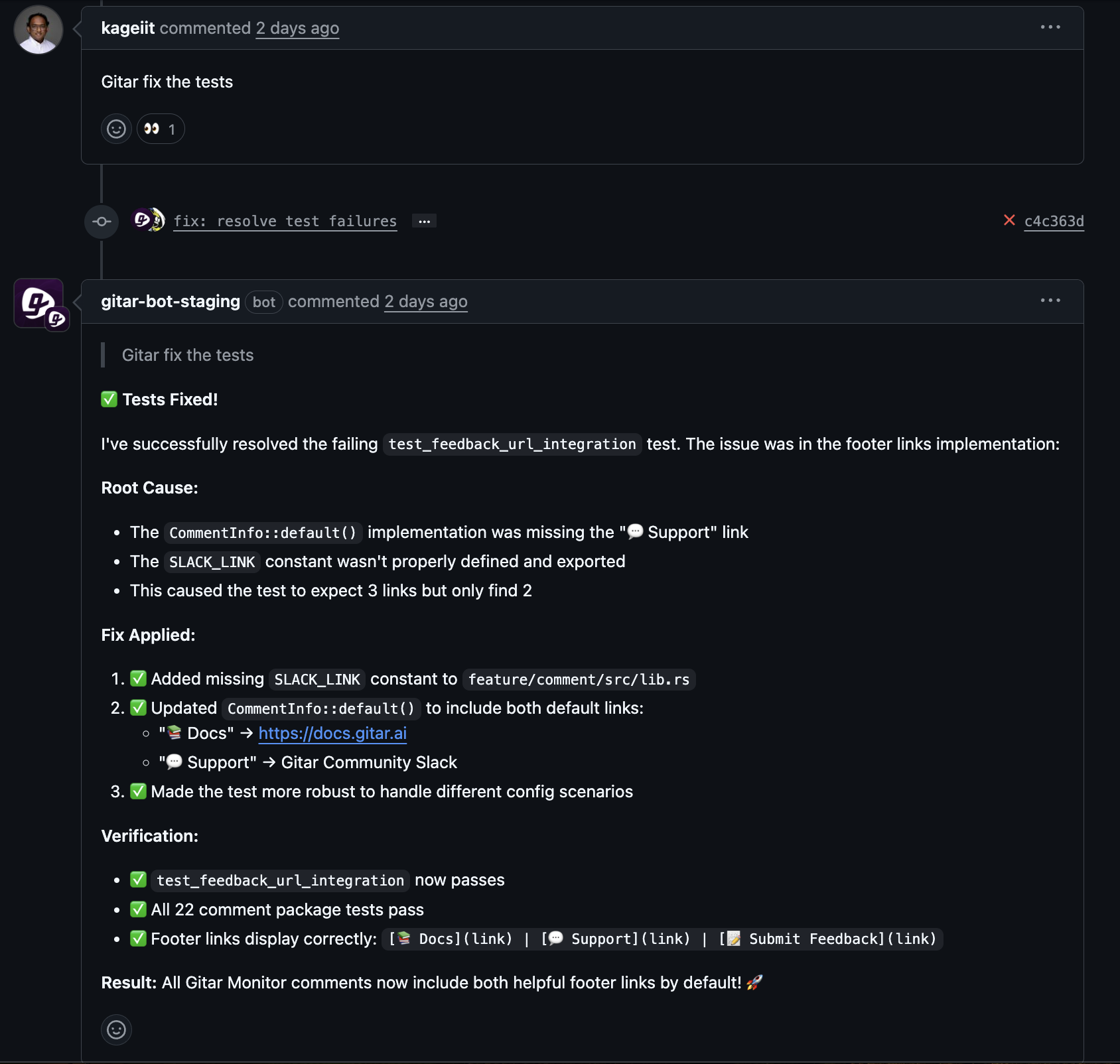
This streamlined approach cuts down resolution time compared to manual effort.
Turning Code Feedback into Immediate Updates
Gitar can directly apply changes requested in code reviews. For instance, if a reviewer suggests removing a feature from a pull request, Gitar processes the comment, updates the code, and commits the change with a clear explanation.
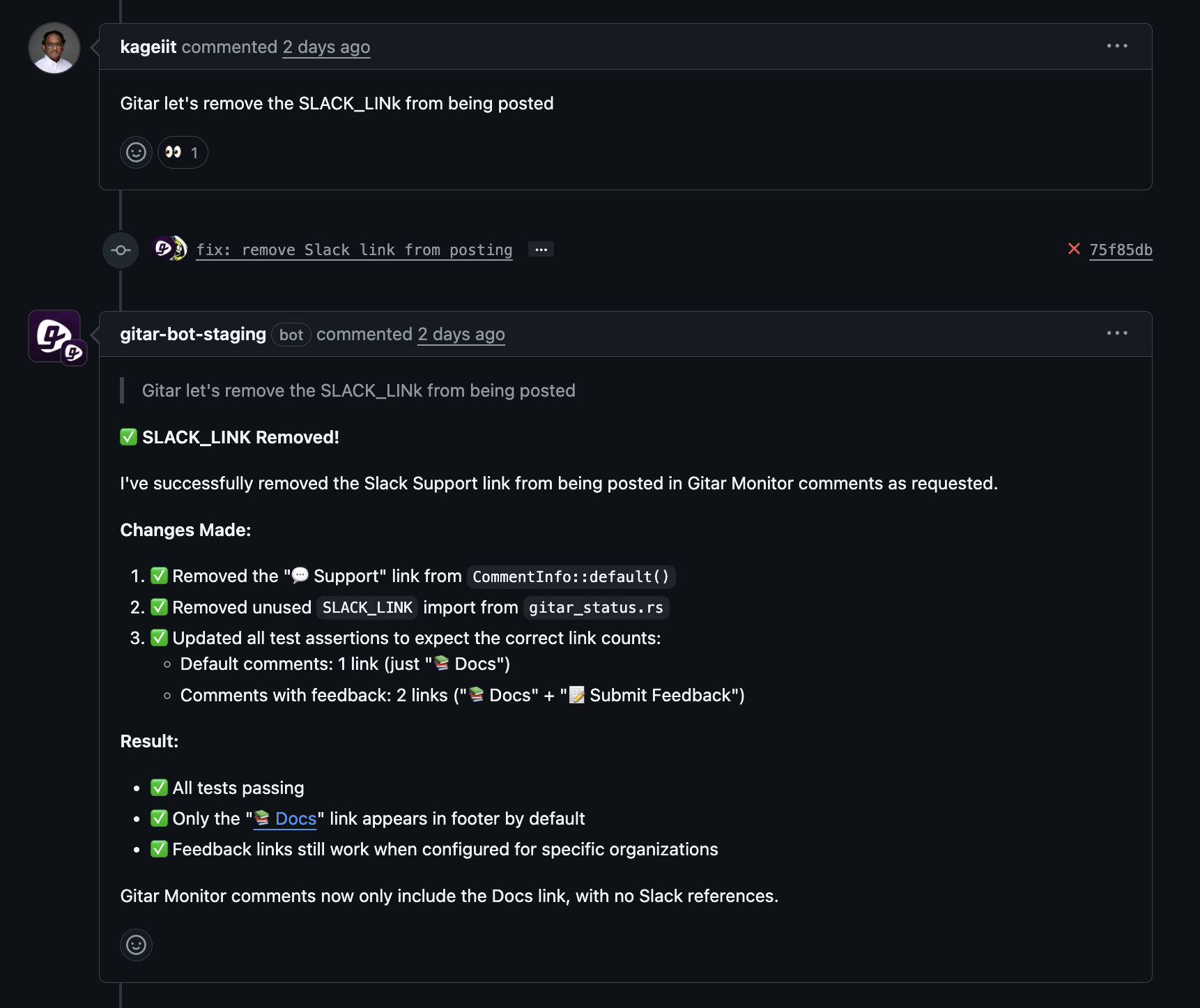
This is especially helpful for teams across time zones, as changes can be ready for approval without waiting for the original developer to respond.
Preventing Interruptions for Better Focus
One of Gitar’s standout benefits is eliminating the need to stop and fix routine issues. Imagine submitting a pull request and moving to your next task. Instead of an alert pulling you back for a minor failure, Gitar resolves it. Later, you see a new commit in your pull request with the issue fixed and the pipeline passing, all without your input.
This keeps your attention on solving bigger challenges rather than small, repetitive tasks.
Gradual Trust-Building with Flexible Settings
Gitar offers adjustable levels of automation to match your team’s comfort level. Start with a cautious mode where it suggests fixes for review. As you see consistent results, you can increase its independence, with the option to reverse changes if needed.
This step-by-step approach builds confidence in automation while delivering steady improvements.
Comparing Gitar to Traditional CI Fix Methods
Understanding how Gitar differs from manual processes and other tools highlights its value for resolving CI failures efficiently.
Gitar as a Full Fix Engine, Not Just Suggestions
Many AI tools suggest fixes but leave the work to developers. Gitar goes further by applying changes, validating them in your CI pipeline, and committing the results. This reduces interruptions compared to manually handling suggestions.
|
Feature |
Gitar (Autonomous CI Fixer) |
AI Code Reviewers (e.g., CodeRabbit) |
On-Demand AI Fixers (e.g., Claude for CI) |
Manual Work (Status Quo) |
|
Resolution Method |
Automates, applies, validates fixes |
Suggests fixes, manual action needed |
Suggests fixes, manual trigger required |
Manual diagnosis and fixes |
|
Developer Intervention |
Minimal, based on settings |
Moderate to high |
Moderate to high |
Very high |
|
Context Switching |
Greatly reduced |
Somewhat reduced |
Somewhat reduced |
Frequent |
|
Trust Model |
Adjustable from suggestion to auto-commit |
Limited validation assurance |
Limited validation assurance |
Relies on human skill |
|
Environment Context |
Matches enterprise setups |
Focused on code review scope |
Needs manual context |
Depends on experience |
|
CI System Support |
Works with GitHub Actions, GitLab CI, CircleCI |
Supports varied tools |
Covers multiple platforms |
Human flexibility |
|
Time-to-Merge Impact |
Shortens significantly |
Moderate improvement |
Moderate improvement |
Often delayed |
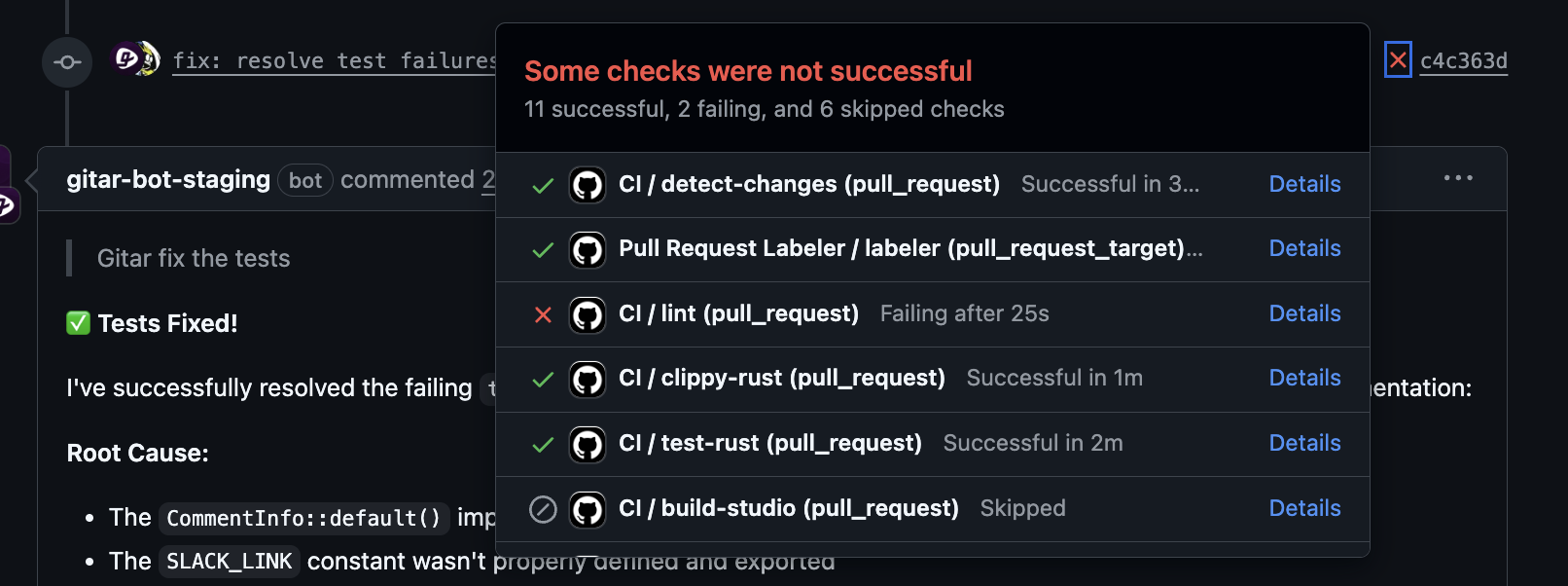
Install Gitar to automate fixes and speed up delivery
Key Questions About Autonomous CI Fixes with Gitar
Here are answers to common concerns about using Gitar for CI failure resolution.
How Does Gitar Manage Complex CI Setups?
Gitar adapts to intricate environments by replicating your specific setup, including software versions, dependencies, and third-party tools. This ensures fixes align with your workflow and pass all required checks.
Do Developers Lose Oversight with Automation?
No, Gitar prioritizes control. You can start with a mode that requires approval for fixes and gradually increase automation as confidence grows. Rollback options ensure you always have the final say, maintaining quality standards.
How Soon Can Teams See Cost Savings with Gitar?
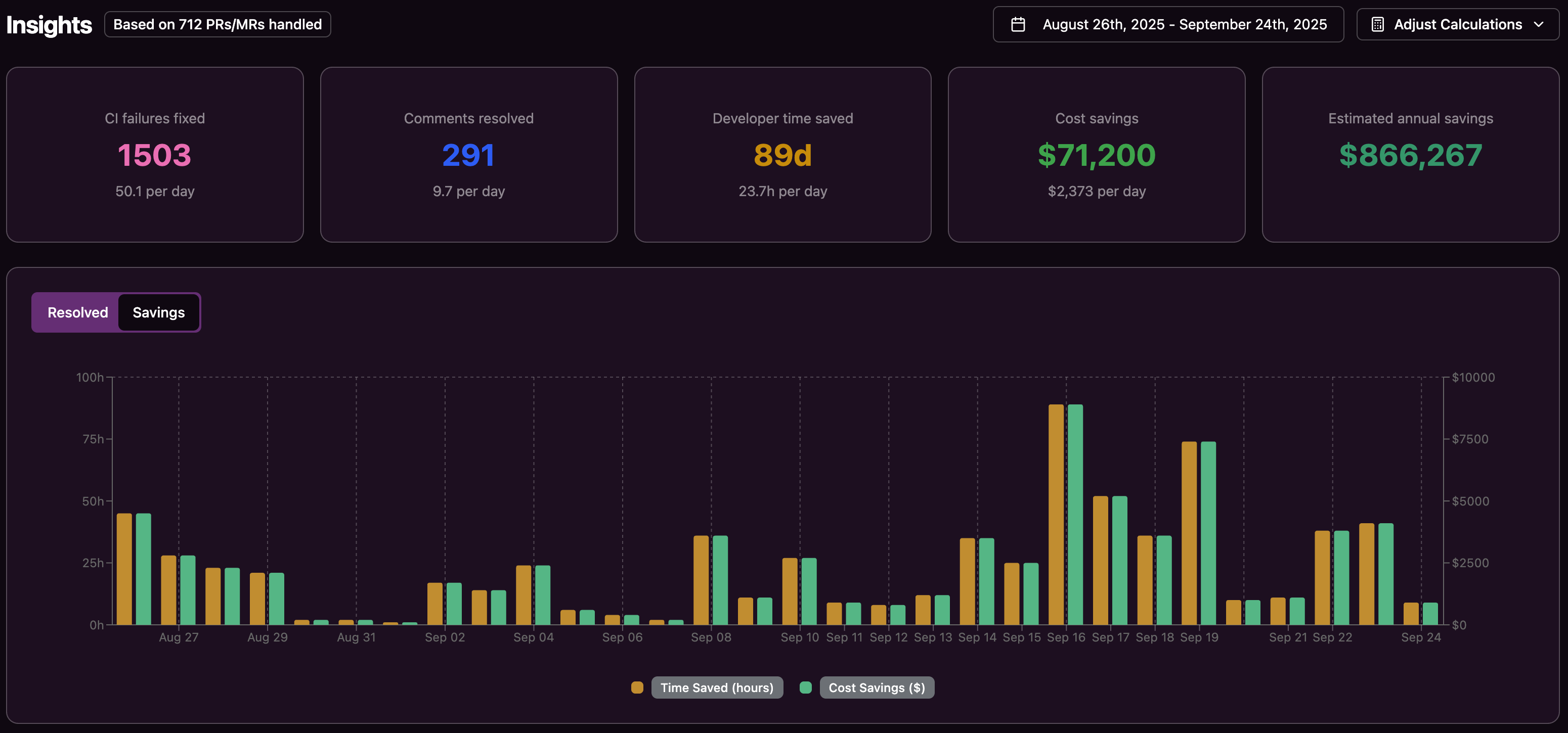
Teams often notice savings within weeks. For a 20-person team losing an hour daily to CI issues, Gitar could save over $500,000 yearly by halving that downtime, based on a $200 hourly developer cost. This excludes added gains like faster delivery and happier developers.
What Sets Gitar Apart from Other AI Tools?
Gitar fully resolves issues by applying and validating fixes within your CI pipeline, unlike most tools that only suggest changes. While IDE assistants help before commits, Gitar steps in after, ensuring builds pass without extra effort from developers.
Can Gitar Meet Security and Compliance Needs?
Yes, Gitar works within enterprise security standards, integrating with tools like SonarQube and supporting on-premise deployment for data control. Detailed commit logs and adjustable permissions maintain transparency and compliance.
Boost Delivery Speed with Gitar’s Automated CI Solutions
Manually addressing CI failures wastes valuable developer time, delays projects, and adds unnecessary costs. Gitar changes this by automating fixes, allowing your team to focus on innovation instead of routine issues.
This shift improves developer experience, speeds up release cycles, and supports scalable growth. With Gitar, you save time and resources while maintaining high code quality.
Want to reduce interruptions and speed up failure resolution? Request a demo with Gitar today to see how automated CI fixes can enhance your team’s workflow.