
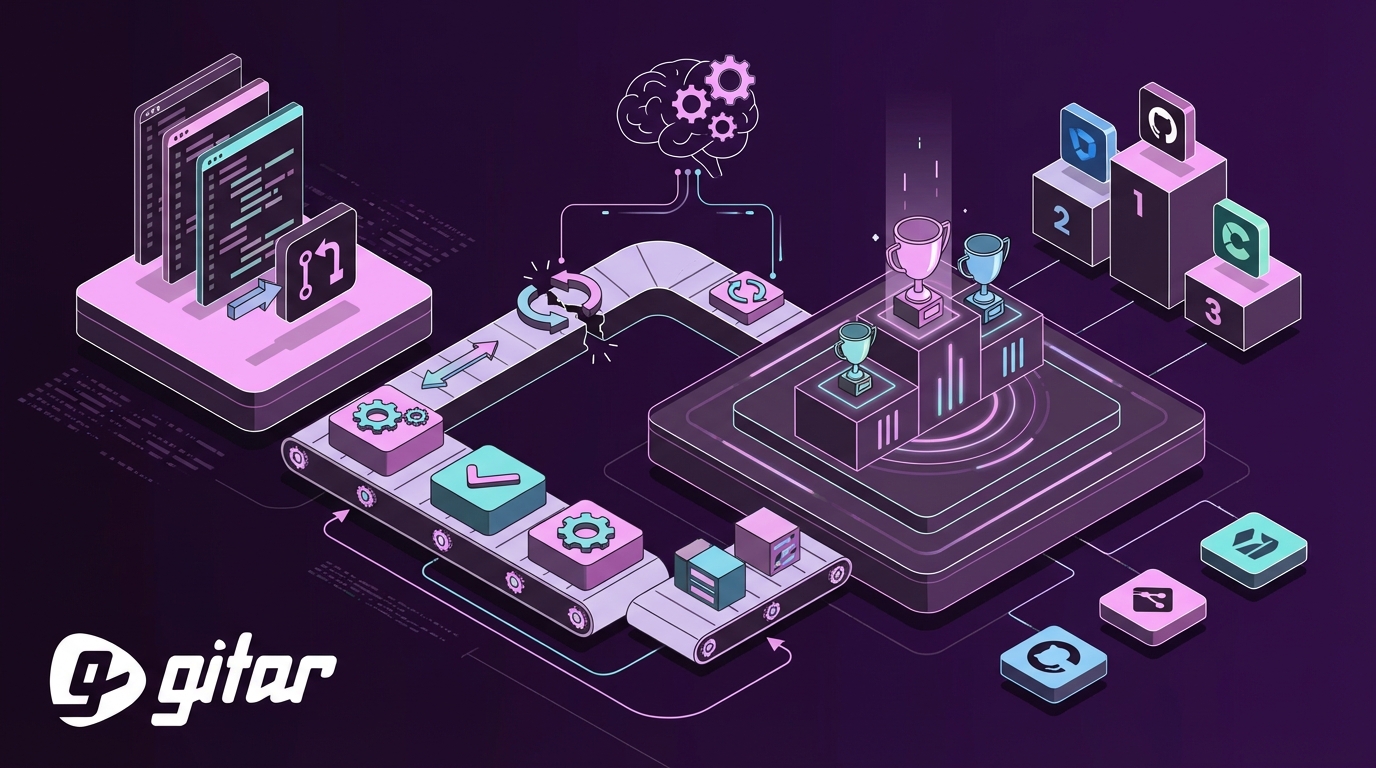
Key Takeaways
- Pull request workflows now represent a major bottleneck and cost center for enterprise software teams in 2026.
- Enterprise CI/CD platforms need automated validation, rapid feedback, scalable infrastructure, and strong integrations to support high pull request volume.
- Tools like GitHub Actions, GitLab CI/CD, CircleCI, Jenkins, and Azure DevOps each offer distinct advantages for different environments, compliance needs, and team preferences.
- AI-driven self-healing CI reduces manual work by diagnosing and fixing many CI failures and review-driven changes directly on pull requests.
- Gitar adds autonomous fixes on top of existing CI/CD platforms, and teams can install Gitar to reduce pull request toil and improve release throughput.
The Strategic Imperative: Why Optimized Pull Request Workflows Drive Competitive Advantage
Delayed time-to-market, developer burnout, and increased operational costs now directly affect competitive position for software-driven organizations. For a 20‑developer team, cumulative productivity loss from CI failures and code review delays can reach hundreds of thousands of dollars per year in wasted engineering capacity.
Efficient pull request workflows act as a differentiator for agile engineering teams. Traditional CI/CD platforms detect issues and orchestrate jobs, yet they still rely on developers to troubleshoot failures and implement review feedback. This manual gap expands as teams and pull request volume grow.
Self-healing CI addresses that gap. Autonomous systems analyze failures, generate validated fixes, and apply changes without human intervention. CI moves from a passive reporting layer to an active system that helps close pull requests faster while preserving developer focus.
Understanding the Landscape: Core Capabilities for Enterprise Pull Request Automation
Enterprise CI/CD platforms must go beyond simple builds. Effective pull request automation depends on a consistent set of capabilities.
Automated Validation
Modern platforms run linting, unit and integration tests, security scans, dependency checks, and build verification on every pull request. Security integration has become mandatory for enterprise environments, so vulnerability scanning and policy enforcement now sit directly in pull request pipelines.
Rapid Feedback Loops
Fast feedback helps developers stay in flow and reduces idle time. Platforms like CircleCI emphasize caching and parallelism to shorten pipeline duration, while others use intelligent test selection and incremental builds to avoid redundant work.
Deployment Strategies
Enterprise platforms must support canary releases, blue‑green deployments, and multi‑region rollouts. Tools like Spinnaker specialize in multi‑cloud continuous delivery with automated verification, which is important when pull requests flow into complex release processes.
Scalability and Performance
High‑volume teams need CI/CD that scales with large repositories and many concurrent pull requests. Efficient resource use, smart job scheduling, and elastic infrastructure help maintain predictable feedback times as organizations grow.
Integration Ecosystem
Enterprise pipelines rely on source control, artifact registries, observability tools, and collaboration platforms. Modern DevOps practices span SCM, CI/CD, infrastructure as code, observability, and collaboration, so integration breadth and depth strongly influence platform selection.
Autonomous Capabilities
Resolution-focused automation represents the newest layer. Platforms that only report failures still require developers to drop their current work and debug. Autonomous systems extend CI/CD from detection to remediation, reducing manual work inside each pull request.
In-Depth Platform Analysis: Ranking Enterprise CI/CD Automation Platforms for Pull Requests
This section focuses on pull‑request‑centric features such as feedback speed, automation coverage, integration, and autonomy.
Platform 1: GitHub Actions
GitHub Actions provides native CI/CD for GitHub repositories with workflow automation and a large marketplace of reusable actions. Teams define workflows in YAML, trigger jobs on pull request events, and extend pipelines with marketplace actions that cover common integrations and deployment targets.
This platform fits GitHub‑centric organizations that want tight integration and quick adoption. Teams with complex, multi‑VCS environments or strict self‑hosting requirements may need additional tooling.
Platform 2: GitLab CI/CD
GitLab functions as an all‑in‑one DevOps platform with advanced CI/CD, security, and compliance tools. Auto DevOps can generate pipelines automatically, and merge requests, CI jobs, security scans, and monitoring live in one interface.
This unified model simplifies governance and traceability around pull requests. Teams that prefer a best‑of‑breed approach or rely on other source control systems may face higher migration effort.
Platform 3: CircleCI
CircleCI operates as a CI/CD platform with a strong focus on speed and powerful caching. The cloud‑native design supports extensive parallelism and flexible execution environments, which helps teams iterate quickly on pull requests.
Usage-based pricing and reduced low‑level control compared with self‑hosted tools are common considerations for large enterprises or highly regulated workloads.
Platform 4: Jenkins
Jenkins serves as a widely adopted open‑source automation server with a broad plugin ecosystem. It supports highly customized pull request workflows and can integrate with many ecosystems.
This flexibility comes with operational overhead. Larger Jenkins deployments often require dedicated ownership for maintenance, scaling, and plugin lifecycle management.
Platform 5: Azure DevOps Pipelines
Azure DevOps provides CI/CD that aligns closely with Azure infrastructure and Microsoft tooling. Teams can define pipelines visually or in YAML and combine them with Azure Boards, Repos, and Artifacts.
This option works especially well for Microsoft‑centric organizations. Multi‑cloud teams and those concerned about vendor lock‑in may evaluate neutral options in parallel.
Other Notable Mentions
Bitbucket Pipelines offers native pipelines for Bitbucket repositories with simple configuration. Harness uses machine learning for deployment verification and anomaly detection, reflecting broader AI adoption in delivery workflows. Spinnaker focuses on complex multi‑cloud deployment strategies, and TeamCity provides strong build management for large enterprise codebases.
Elevating Pull Request Automation: The Power of AI-Driven Self-Healing CI
Traditional CI/CD tools orchestrate builds and tests, then alert developers when something breaks. This creates a recurring interruption pattern, where engineers switch context, inspect logs, and implement fixes before returning to planned work.
Self-healing CI introduces a healing engine on top of that orchestration. The system interprets failure logs, proposes or applies fixes, and updates pull requests automatically. Suggestion engines only highlight issues, while healing engines focus on resolution and help teams close pull requests with less manual effort.
Install Gitar to add autonomous healing on top of your existing CI/CD stack and reduce the time developers spend on repetitive CI fixes.
Introducing Gitar: Autonomous CI Fixes for Enterprise Pull Requests
Gitar adds an autonomous resolution layer to existing CI/CD platforms. The system analyzes CI failures and code review comments, generates candidate fixes, validates them in an environment that mirrors production, and applies approved updates directly to pull requests.

Key capabilities include:
- Full CI environment replication that respects enterprise SDK versions, dependencies, and tools such as SonarQube and Snyk, so fixes run in a realistic context.
- Autonomous fix generation for lint errors, failing tests, and build issues, with changes applied as commits or suggestions based on team settings.
- Intelligent code review assistance that reads reviewer comments and implements requested edits on the pull request.
- A configurable trust model that lets teams start in suggestion‑only mode and progress to fully autonomous commits with rollback controls.
- Cross‑platform CI support for tools such as GitHub Actions, GitLab CI, CircleCI, Buildkite, and other enterprise systems.
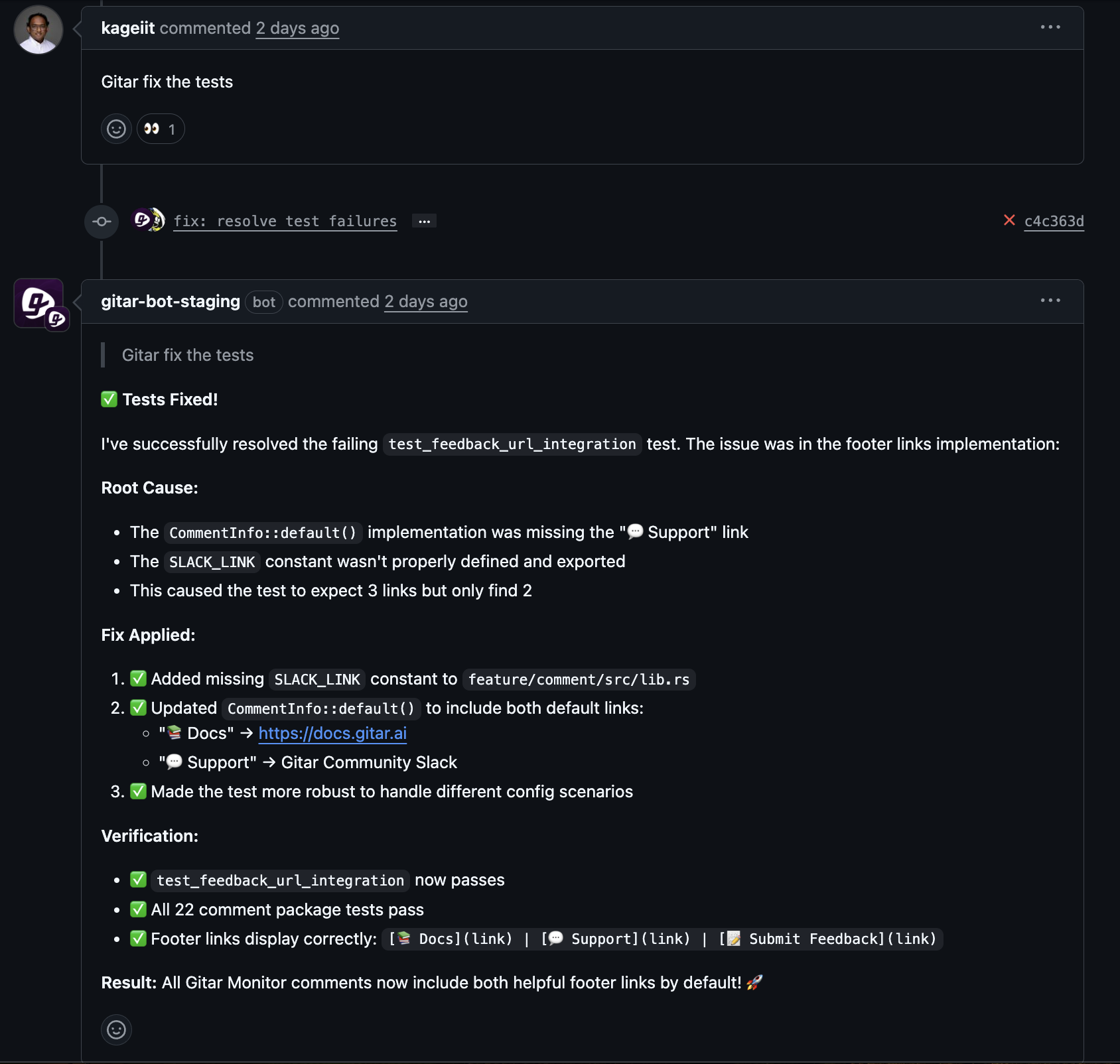
Table: Traditional CI/CD vs. Gitar Autonomous CI
|
Feature |
Traditional Enterprise CI/CD |
Gitar Autonomous CI |
|
Pull request validation |
Runs tests and checks |
Runs tests and checks, then fixes many issues automatically |
|
Issue resolution |
Relies on manual developer work |
Provides automated, validated code fixes |
|
Code review feedback |
Implemented manually by developers |
Applies AI‑generated changes that match reviewer comments |
|
Developer flow |
Interrupted by failing builds |
Protected, since many failures are fixed in the background |
|
Time to merge |
Limited by how quickly developers can debug |
Reduced because common failures are resolved automatically |
|
Engineering cost |
Higher due to repetitive CI toil |
Lower for routine fixes, allowing engineers to focus on feature work |
Strategic Considerations for Enterprise Adoption
Successful enterprise CI/CD programs balance tooling choices with integration, security, scalability, and measurement.
Integration planning should include source control, artifact registries, observability platforms, ticketing systems, and chat tools. The goal is a pull request experience where validation, feedback, and remediation are accessible in one place.
Security needs to be part of the pipeline, not an afterthought. Secret management, dependency scanning, and policy checks protect builds, and compliance frameworks such as SOC 2 and ISO 27001 require strong audit trails and governance embedded in CI/CD workflows.
Scalability planning should consider current and future pull request volume, repository growth, and team expansion. Platforms and autonomous tools like Gitar should handle higher parallelism and more complex validation without degrading feedback times.
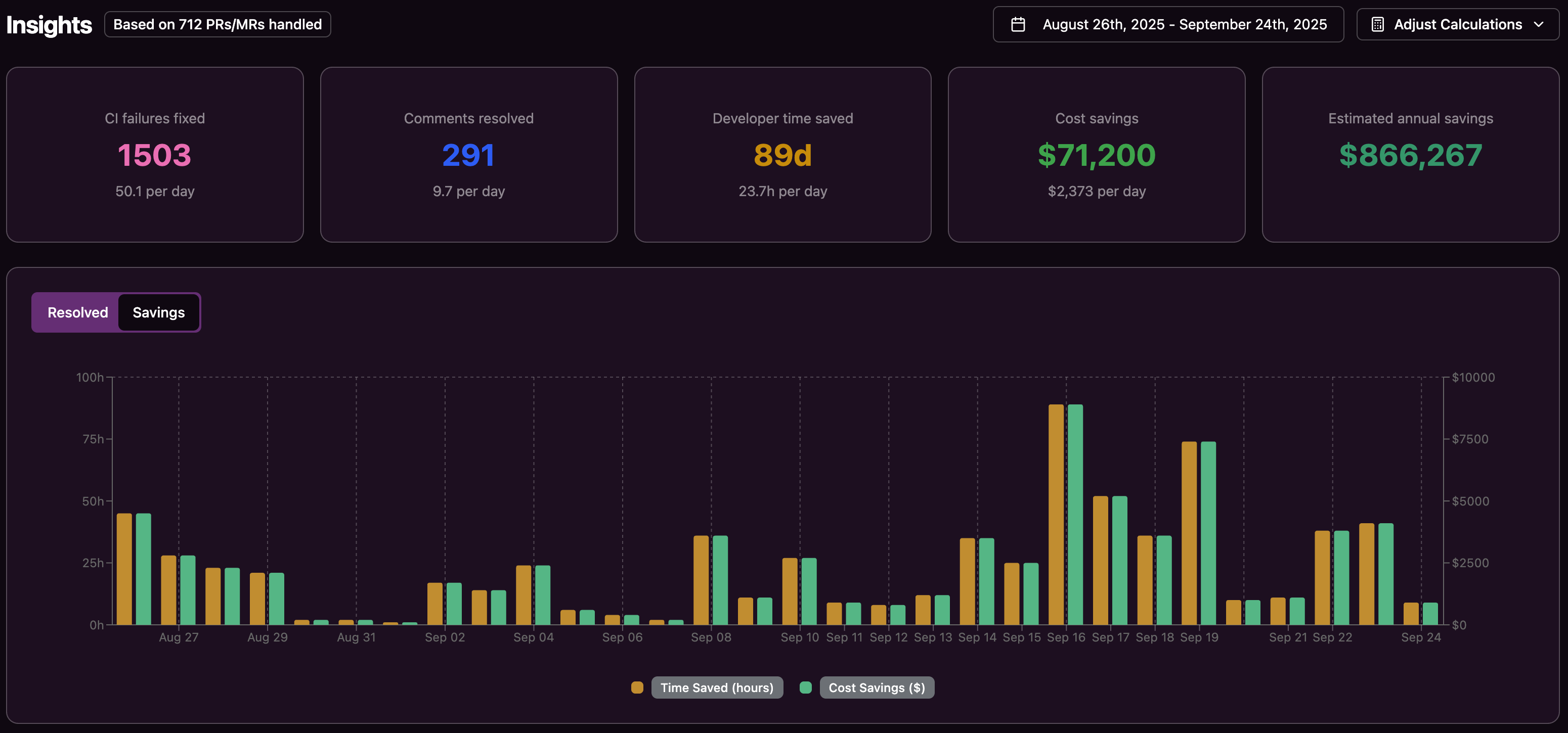
Measuring return on investment should extend beyond deployment frequency. Useful indicators include time to resolve CI failures, average time from pull request open to merge, number of manual review cycles, and developer satisfaction. Autonomous CI can contribute by shrinking resolution times and lowering context switching.
Frequently Asked Questions (FAQ)
What is the primary difference between a CI healing engine like Gitar and traditional AI review tools?
Traditional AI review tools highlight issues and suggest fixes, but developers still apply and validate the changes manually. A CI healing engine such as Gitar not only identifies issues, it also generates, tests, and applies fixes directly on pull requests. This approach reduces manual debugging work and lets developers focus on higher‑value tasks.
How does an autonomous CI platform address time zone issues for distributed teams during code review?
Distributed teams often wait a full workday for review comments and another cycle for requested changes. When reviewers leave comments, Gitar can interpret the feedback, implement the requested changes, and update the pull request while the original author is offline. Developers then start their next workday with many requested edits already applied.
Can autonomous CI engines handle unique and complex enterprise CI/CD setups, including specific SDK versions and third-party tools?
Gitar is designed to mirror enterprise environments closely, including SDK versions, dependency graphs, and tools such as SonarQube and Snyk. This context awareness helps ensure that generated fixes behave correctly in the same conditions as the production CI system.
What level of trust and control do engineering teams have when implementing autonomous CI fixes?
Teams control how Gitar proposes and applies changes through a configurable trust model. Many organizations begin with suggestion mode, where the system opens pull request suggestions for human review. As confidence grows, teams can move to automatic commits for selected categories of fixes, while retaining audit logs and rollback options.
Conclusion: Autonomous Workflows as the Next Step in Enterprise Pull Request Automation
Optimized pull request workflows now sit at the center of competitive software delivery. GitHub Actions, GitLab CI/CD, CircleCI, Jenkins, Azure DevOps, and similar platforms provide the orchestration foundation that enterprises need for repeatable, observable pipelines.
Manual debugging and implementation of review feedback still consume considerable time, especially at scale. Autonomous systems such as Gitar help close this gap by turning common CI failures and review-driven edits into automated tasks that run alongside existing pipelines.