
Key Takeaways
- Manual CI troubleshooting and code review cycles consume significant developer time and disrupt deep work.
- Pipeline inefficiencies, context switching, and distributed teams slow delivery and increase engineering costs.
- Autonomous AI agents now diagnose issues, generate fixes, and validate changes directly in CI/CD pipelines.
- Gitar provides environment-aware, automated CI fixes and code review support across common CI platforms with configurable trust levels.
- Teams can reduce time spent on CI failures and review rework, lower costs, and keep developers focused by adopting Gitar, available here.
The Problem: Manual CI & Code Review Are Hurting Engineering Team Efficiency
The High Cost of Developer Context Switching and Flow Disruption
Modern development workflows often trap engineers in a loop of failed builds, flaky tests, and small fixes that require repeated context switches. A single broken pipeline forces a developer back into logs, local environments, and re-runs that interrupt focus.
Developers can waste up to 30% of their time dealing with issues related to CI and code review. That loss reflects more than minutes in a pipeline queue. The mental overhead of dropping a feature task, fixing a CI error, and then rebuilding context can turn a quick fix into an hour of lost productivity.
Poorly designed pipelines increase this impact. When logs are hard to interpret and ownership is unclear, teams spend additional time routing issues instead of shipping features. Frequent interruptions erode focus and reduce the quality of engineering output.
Slower Delivery and Higher Business Costs
Slow CI/CD pipelines reduce delivery speed, team morale, and business momentum by eroding organizational velocity. Slower time to market can delay revenue, weaken customer satisfaction, and give competitors room to move faster.
Pipeline inefficiency creates four main costs: delivery friction, security risk, financial waste, and strategic drag. These costs compound as more code enters the system. While AI-assisted coding tools increase code volume, review and integration capacity do not always keep pace, so bottlenecks shift from writing code to validating and merging it.
Distributed Teams and the Waiting Game
Distributed teams feel these bottlenecks more acutely. A pull request opened in San Francisco and reviewed in Bangalore can require several cycles of comments and updates. Each cycle may span workdays instead of hours because of time zone gaps.
Traditional AI review tools help reviewers leave better comments but still rely on humans to apply and validate changes. When CI and CD processes are fragmented across teams, even straightforward fixes can stall in coordination loops.
Install Gitar to automatically fix broken builds and ship higher quality software faster.
The Solution: Autonomous AI Agents for Higher Engineering Team Efficiency
What Autonomous AI Agents Do in Software Development
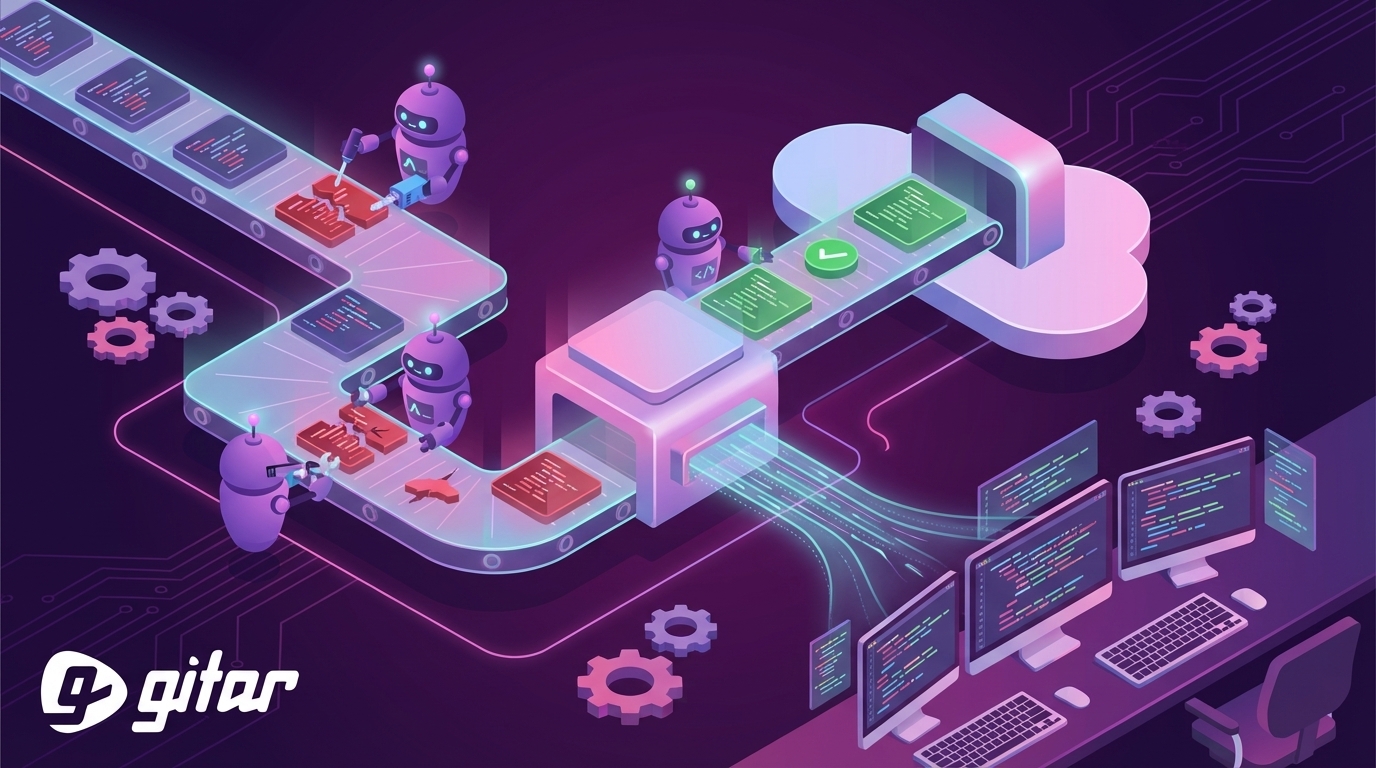
Autonomous AI agents extend beyond suggestion tools by taking action on behalf of the team. These agents identify CI and review issues, diagnose likely root causes, generate code changes, and validate results inside the pipeline.
Instead of acting as recommendation engines that require manual follow-through, they operate as healing engines. They surface issues, apply fixes, and confirm that pipelines are green before developers return to the work.
Self-Healing CI/CD Pipelines in 2026
Effective 2026 CI/CD strategies emphasize quality at speed through faster release cycles, earlier bug detection, and reduced risk. Self-healing capabilities align directly with that goal.
In 2025, CI/CD best practices highlighted how predictive analytics powered by AI can forecast pipeline failures or bottlenecks and enable proactive remediation before issues impact delivery. Autonomous agents extend this approach by combining prediction with automated repair.
In a self-healing setup, the system detects failures, proposes and applies fixes, runs the full CI workflow, and only then surfaces results. Developers stay focused on feature work while the pipeline maintains itself where possible.
Using Gitar To Automate CI Fixes and Code Review
Gitar is an autonomous AI agent built to reduce time spent on CI failures and review-driven rework. It focuses on the parts of the workflow that most disrupt flow: failed pipelines, repetitive fixes, and mechanical code review updates.
Core Capabilities That Improve Engineering Team Efficiency
End-to-end autonomous fixing. Gitar applies fixes directly, validates them against the full CI workflow, and ensures all jobs pass before presenting updated pull requests. It handles common failures such as linting and formatting issues, test failures, and build errors.
Full environment replication. Gitar emulates complex enterprise environments, including specific JDK versions, multiple SDKs, and third-party tools such as SonarQube and Snyk. That context helps ensure fixes are accurate and production-ready.
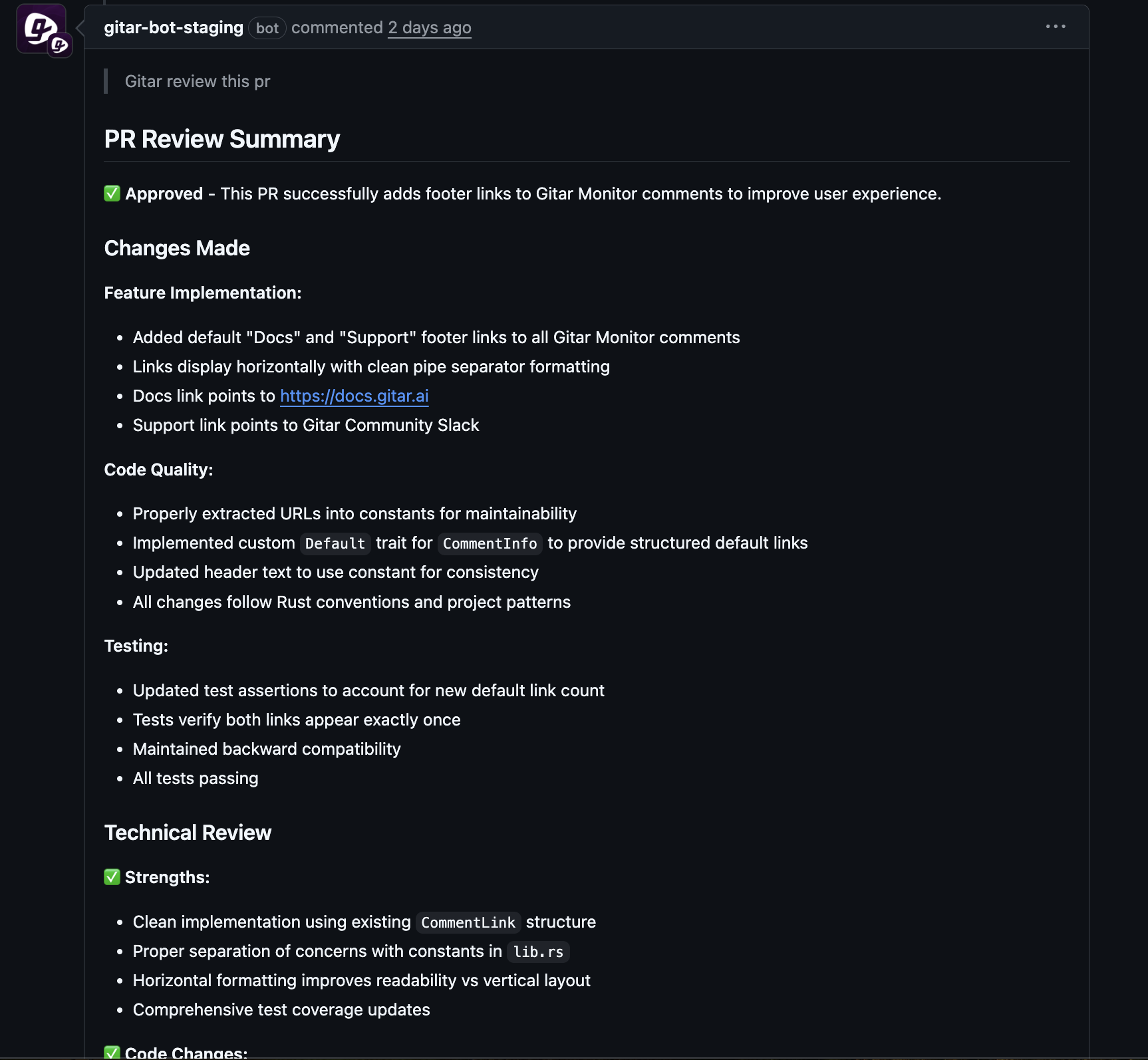
Intelligent code review assistant. Gitar supports reviewers by generating initial reviews and implementing feedback. Reviewers can tag Gitar on a pull request or comment on specific lines, and Gitar applies the requested changes and updates the code.
Configurable trust model. Teams can start in a conservative mode, where Gitar proposes changes for review, and later move to auto-commit modes with rollback controls once they are comfortable.
Cross-platform compatibility. Gitar integrates with GitHub Actions, GitLab CI, CircleCI, BuildKite, and other CI systems, so teams can adopt it without reworking existing pipelines.
Improve engineering team efficiency with Gitar’s autonomous AI tools by requesting a demo.
Mastering Flow: How Gitar Reduces Context Switching
Automatic CI Fixes in Everyday Work
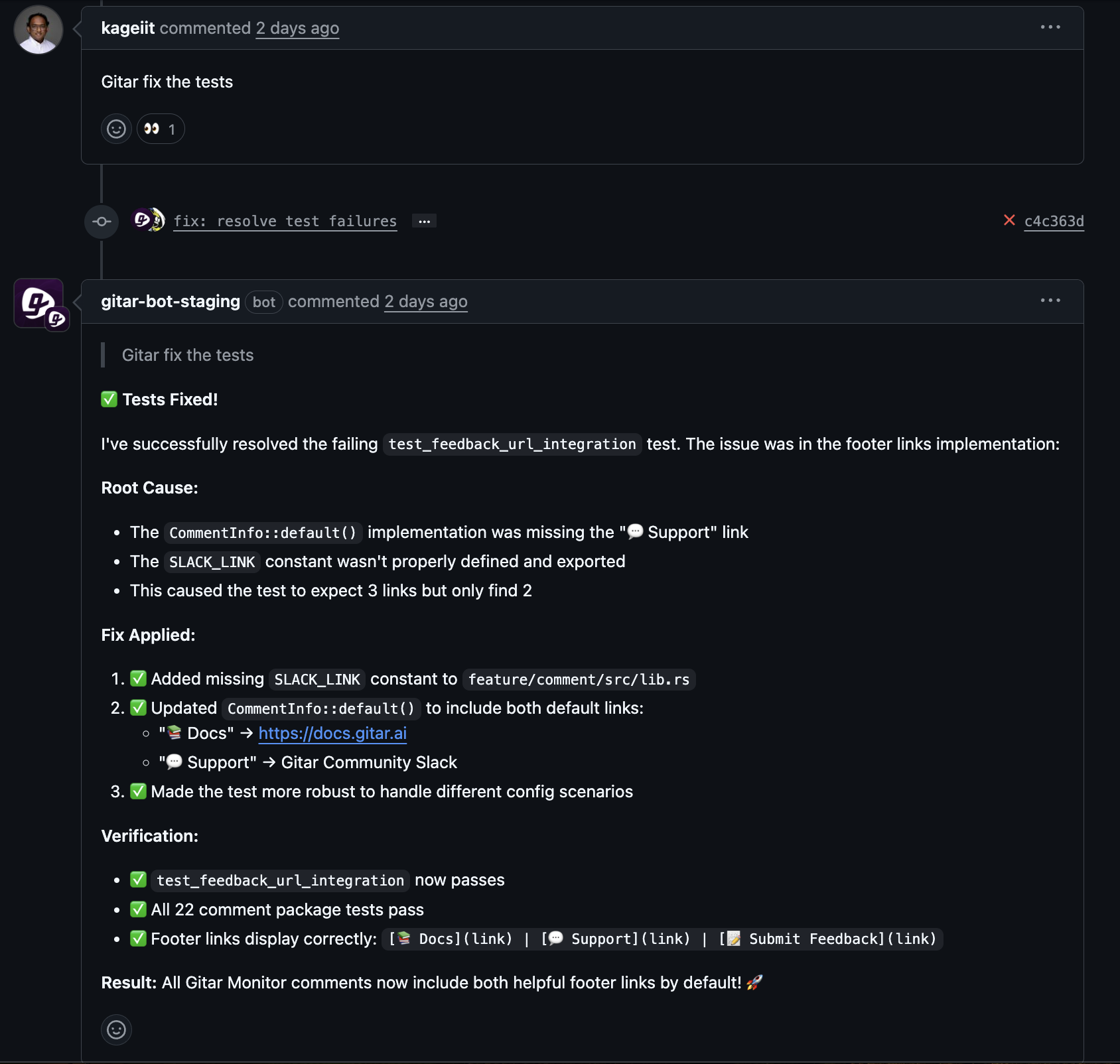
Developers who push a pull request and move on to their next task no longer need to monitor pipelines closely. When Gitar detects a CI failure such as a lint error or a small test fix, it creates a new commit with an explanation of the change and re-runs the pipeline.
This workflow turns a manual troubleshooting cycle into an automated background process. Developers can focus on feature work while Gitar handles routine CI issues.
Gitar and Manual Debugging Compared
|
Feature |
Gitar (Autonomous AI Agent) |
Manual Debugging (Traditional) |
|
Issue detection |
Automatic and proactive in CI |
Manual log monitoring |
|
Diagnosis |
AI-based root cause analysis |
Manual log review and deduction |
|
Fix generation |
Automatic code changes |
Manual coding and problem-solving |
|
Validation |
Full CI pipeline rerun for green builds |
Manual reruns, sometimes multiple cycles |
|
Developer flow |
Maintained with minimal context switches |
Interrupted by frequent context switches |
|
Productivity impact |
Higher effective engineering capacity |
Lower capacity due to CI overhead |
Accelerating Delivery and Reducing Costs With Automated Code Review
Eliminating Code Review Bottlenecks
Short feedback loops and faster time to merge are key drivers of competitive delivery performance. Gitar supports this by implementing code review feedback automatically.
Reviewers can leave comments for Gitar to address. Gitar applies the requested changes, updates the pull request, and re-runs CI so that authors and reviewers focus on higher-level feedback instead of mechanical edits.
Supporting Distributed Engineering Teams
Distributed teams benefit from this automation across time zones. A reviewer in India can request changes at the end of their day, and Gitar can implement and validate those updates before a US-based author comes online. Review cycles that once spanned several days compress into a single iteration.
This capability reduces coordination delays that arise when CI, CD, and product teams operate on different schedules.
Quantifiable ROI From CI and Review Automation
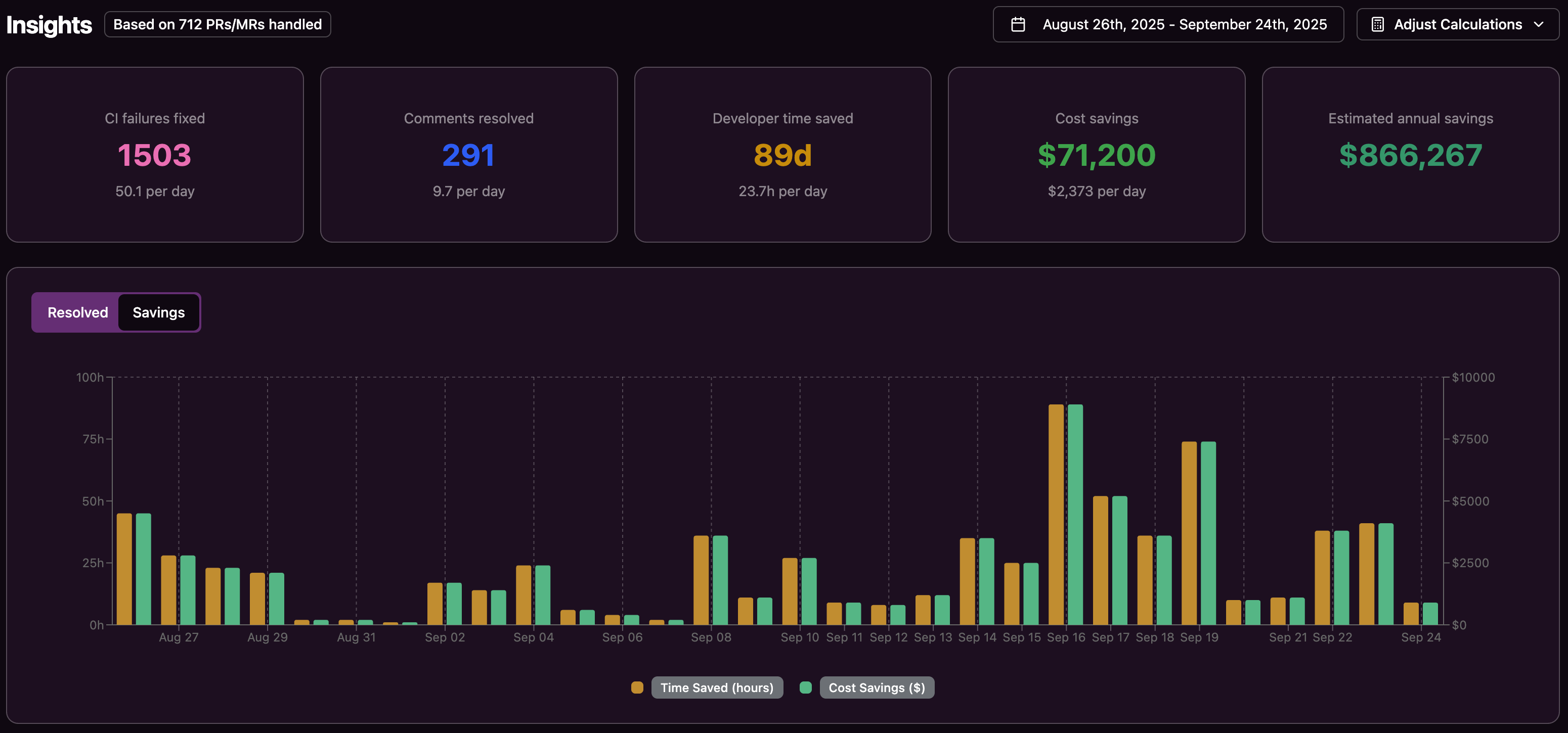
Consider a 20-developer team that spends 1 hour per day on CI or review-related issues. Over a year, that effort equals roughly 5,000 hours. At an average loaded cost of $200 per hour, the annual impact approaches $1 million.
If Gitar removes even half of that time by automating fixes and reducing failed runs, teams could save about $500,000 per year while improving developer satisfaction and delivery speed.
Install Gitar to reduce CI-related costs and increase developer capacity.
Beyond Suggestions: How Gitar Differs From Other Engineering Team Efficiency AI Tools
Healing Engine Instead of Suggestion Engine
Many AI tools focus on suggesting fixes or leaving review comments that still require manual work. Gitar focuses on applying and validating changes so that pipelines end in green builds whenever possible.
This approach is useful when teams struggle to identify failure causes quickly or when ownership for fixes is fragmented across services and teams.
End-to-end Solution Instead of DIY Toolkits
Some large language model integrations function as toolkits that require significant engineering time for integration, prompt design, and context management. Gitar ships as an end-to-end system that connects to repositories and CI platforms and manages the full flow from detection to resolution.
Context-aware, Cross-platform Operation
On-demand AI fixers that run on a single job or IDE assistants that focus on pre-commit workflows often lack full CI context. Gitar operates in the post-commit phase, understands the CI environment, and supports multiple CI systems, so it can reason about failures in the same context CI uses for validation.
Frequently Asked Questions (FAQ) About Engineering Team Efficiency AI Tools
Q: Our team already uses AI reviewers like CodeRabbit. How is Gitar different for engineering team efficiency?
A: AI reviewers typically focus on feedback. Gitar extends that model by applying fixes, re-running CI, and presenting green builds when possible, which reduces manual steps between feedback and merge.
Q: We are concerned about trusting automated fixes. How does Gitar address this?
A: Teams can start with suggestion-only modes where Gitar opens changes as separate commits or pull requests for review. Once confidence grows, they can enable auto-commit with clear audit trails and rollback options.
Q: Our CI setup is complex with unique dependencies. Can Gitar handle it?
A: Gitar is designed to mirror real CI environments, including language versions, build tools, and security scanners, so fixes are validated against the same conditions that production builds use.
Q: How does Gitar help onboard new engineers?
A: New hires can contribute without fully mastering the CI stack on day one. Gitar handles many environment-specific issues, which shortens the time from first pull request to successful merge.
Q: What happens if Gitar introduces a regression?
A: Every change Gitar makes is documented with explanations, and teams can roll back quickly. Trust modes and approvals let teams choose the right balance of automation and manual oversight.
Conclusion: Improving Engineering Team Efficiency With Autonomous AI Agents
CI failures and code review bottlenecks no longer need to be persistent friction points. Autonomous AI agents now provide practical ways to diagnose issues, apply fixes, and validate changes without constant human intervention.
Gitar focuses on the most disruptive parts of the development lifecycle, including broken pipelines and repetitive review updates. By reducing context switching, shortening feedback loops, and lowering the cost of CI-related work, Gitar helps teams ship reliable software more efficiently.